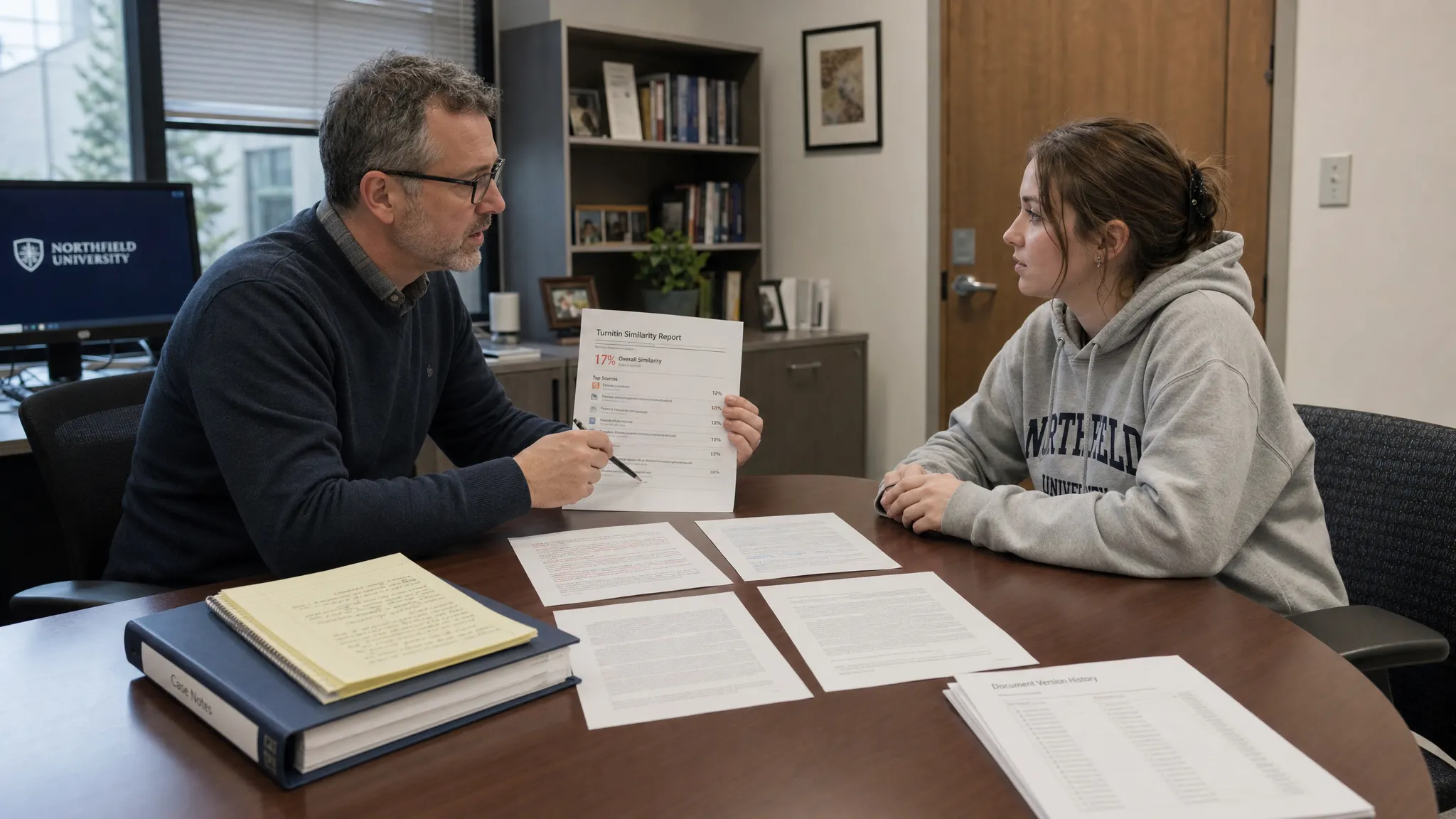
If a professor says, “The AI detector says you used ChatGPT,” it can feel like the case is already over. It is not.
Want to bypass Turnitin in 2026? Grab the free prompt pack.
Get the exact text-humanization prompts I use to drop an AI score by hand — copy, paste, submit. Free, straight to your inbox.
Send me the free prompts →In most academic settings, an AI detector report can be used as a reason to ask questions, open a review, or request more evidence. But it should not be treated as standalone proof that a student cheated. The key issue is not whether a professor is allowed to look at an AI content detector. The key issue is whether the professor, department, or academic integrity office can fairly prove unauthorized AI use under the rules that apply to your class and school.
This article is not legal advice. It is a practical guide to how university rules, Turnitin guidance, AI detection limits, and fair academic process usually work in 2026.
Short answer: AI detectors are evidence, not proof by themselves
A professor can usually use an AI detection report as a signal. That means it may justify a conversation, a request for drafts, or a referral to an academic integrity process if the school’s policy allows it.
But a detector score alone is weak proof because it does not show who wrote the text, what tools were used, whether AI use was allowed, or whether the student had a normal human drafting process. AI detectors make probabilistic classifications based on writing patterns. They do not observe the writing process.
So the better answer is:
A professor may be allowed to use AI detector results as supporting evidence, but responsible policies generally require human review, policy analysis, and corroborating evidence before punishment.
That distinction matters. A Turnitin AI score, GPTZero result, or Copyleaks report may be part of the file. It should not be the whole case.
What the rules usually say
There is no single U.S. rule that applies to every college, professor, and assignment. The controlling rules are usually a mix of the syllabus, the student handbook, the academic integrity code, department guidance, and the school’s technology policy.
Here is the practical breakdown.
| Rule source | What it usually controls | What it means for AI detector proof |
|---|---|---|
| Assignment instructions | Whether AI tools are allowed, banned, or allowed with disclosure | If AI use was permitted, a detector score does not automatically show misconduct |
| Syllabus AI policy | What counts as unauthorized assistance | The professor must connect the detector result to a specific violated rule |
| Academic integrity code | Evidence standards, hearings, appeals, and sanctions | A formal penalty usually requires more than suspicion |
| Vendor guidance | How tools like Turnitin should be interpreted | Detector results are typically framed as review aids, not automatic verdicts |
| Fair process rules | Notice, evidence, and the chance to respond | Students should be able to see and answer the evidence against them |
| Privacy and data policies | Access to documents, logs, and accounts | Detectors do not automatically access Google Docs history or ChatGPT logs |
The most important point is simple: schools punish rule violations, not detector percentages. If the policy bans “unauthorized generative AI use,” the professor still has to show that the work more likely violated that rule. A high AI score may raise suspicion, but it does not explain what happened.
For a deeper breakdown of report language, see our guide to AI detection reports and what the scores really mean.
Why AI detector scores are shaky as standalone proof
AI detection tools can be useful in some workflows, especially as a screening tool. The problem starts when a score is treated like a lab result or a plagiarism match. AI detection is not that precise.
AI detectors predict patterns, not authorship
AI detectors analyze text features such as predictability, sentence structure, uniformity, and statistical similarity to known AI-generated writing. They do not know whether you typed the essay, whether you used Grammarly, whether you wrote multiple drafts, or whether you received tutoring.
That is why a detector report is better understood as a risk signal. It says, “This text resembles patterns associated with AI-generated content.” It does not say, “This student used AI on Tuesday at 9:42 p.m.”
Turnitin’s public AI writing resources present the tool as part of an educator review workflow, not as a replacement for instructor judgment. You can review Turnitin’s own AI writing materials on its AI writing detection page.
False positives and bias are documented concerns
Independent research has repeatedly warned that AI detectors can misclassify human writing. A widely cited Stanford HAI article found that AI detectors showed bias against non-native English writing, with essays by English learners being flagged at much higher rates than essays by native English writers. Stanford summarized the issue in AI Detectors Biased Against Non-Native English Writers.
A 2023 study by Weber-Wulff and coauthors in the International Journal for Educational Integrity tested multiple AI detection tools and concluded that detection results were not reliable enough for high-stakes use without caution. The study is available here: Testing of detection tools for AI-generated text.
OpenAI also shut down its own AI classifier because of accuracy problems, noting that it was no longer available due to a low rate of accuracy. You can still see the notice on OpenAI’s original AI classifier announcement.
These concerns do not mean every AI detector result is wrong. They mean the result needs context, especially when the consequences include a failing grade, academic misconduct record, suspension, or loss of scholarship.
Detectors often disagree with each other
One tool may say “human,” another may say “AI,” and Turnitin may flag a section that free public detectors ignore. This happens because each detector uses different training data, thresholds, preprocessing, and scoring rules.
That disagreement is one reason a professor should be careful about saying, “The detector proves it.” If the same text can receive conflicting results from different systems, the score is not direct proof of authorship.
If you are dealing with conflicting reports, read AI Detector Says Human, Turnitin Says AI: What to Do Next.
AI detection is not the same as plagiarism detection
A plagiarism checker compares your text against sources, publications, websites, and student paper databases. If it finds a match, the report can often point to the source text. Even then, context matters because quotes, references, templates, and common phrases can inflate similarity.
An AI content detector is different. It usually does not point to a source you copied from. It estimates whether the prose resembles AI-generated content. That makes it inherently less direct than a source match in a plagiarism report.
For the difference between these two scores, see Turnitin AI % vs Similarity %: What’s Actually Different?.
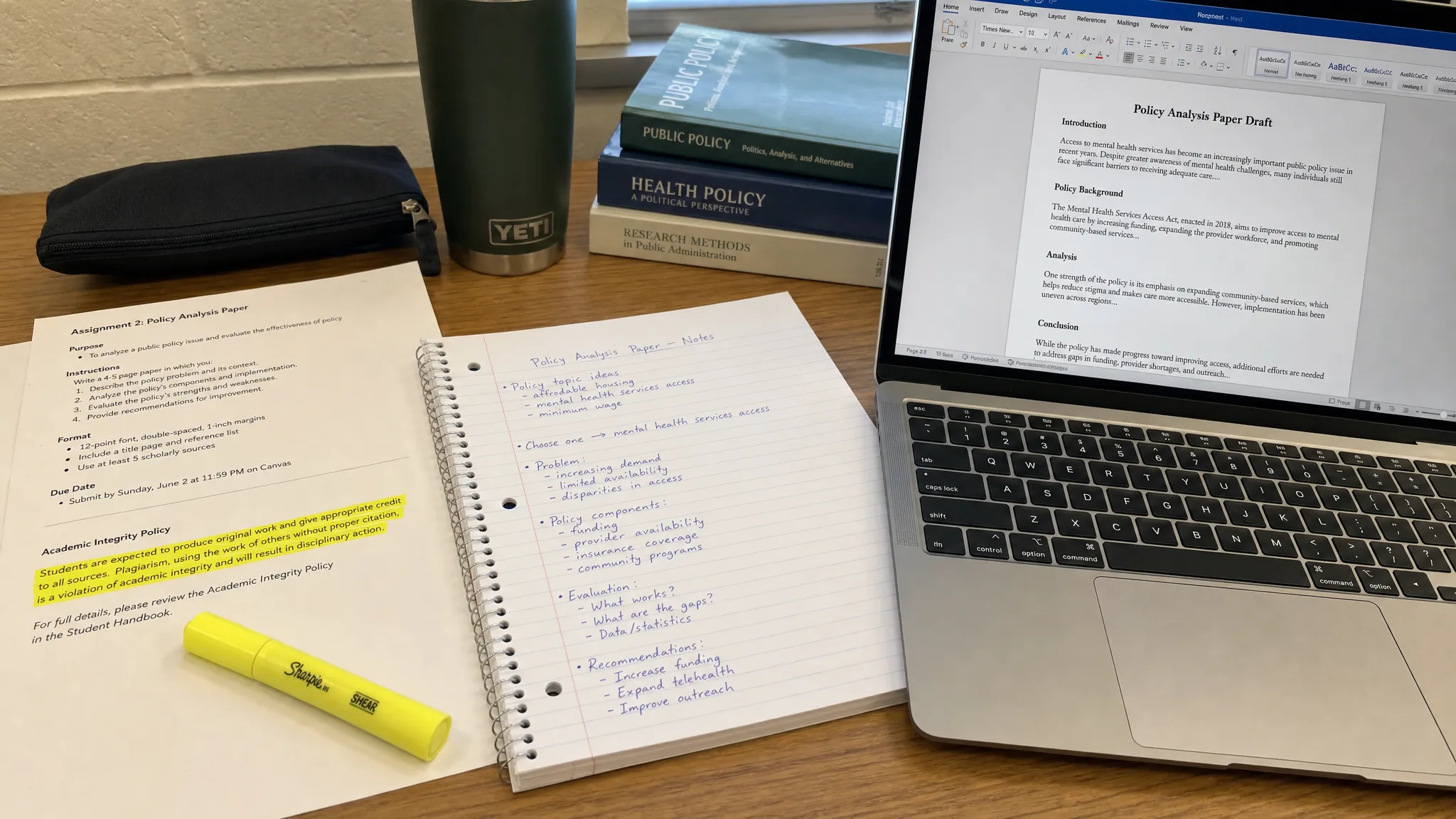
What professors can legitimately do with AI detector results
A professor is not automatically acting unfairly by checking a suspicious submission with an AI detection tool, assuming the school permits that tool. The problem is overclaiming what the result proves.
A fair use of AI detection usually looks like this:
- The professor treats the result as a prompt for review, not a final verdict.
- The student is told what concern exists and which policy may have been violated.
- The student can see or understand the evidence, including highlighted passages if available.
- The professor considers drafts, notes, version history, research materials, and explanations.
- Any formal sanction follows the school’s academic integrity process.
A weak or risky use looks different.
| Risky practice | Why it is a problem | Better approach |
|---|---|---|
| Failing a student based only on an AI percentage | The score is probabilistic and may be wrong | Use the score as one factor and review authorship evidence |
| Refusing to explain the evidence | The student cannot respond meaningfully | Share the report details allowed by school policy |
| Treating polished writing as proof of AI | Strong writers, ESL students, and edited drafts can look “AI-like” | Ask for process evidence and an explanation of choices |
| Ignoring the syllabus | AI may be allowed for brainstorming, editing, or translation | Identify the exact rule allegedly violated |
| Demanding private account access without policy support | Chat logs and personal accounts raise privacy concerns | Offer alternative verification, such as drafts or oral defense |
Many schools now recognize this distinction. Vanderbilt University, for example, publicly explained why it disabled Turnitin’s AI detection tool in 2023, citing concerns about false positives, student access, and the risk of misuse. You can read Vanderbilt’s explanation here: Vanderbilt University is disabling Turnitin’s AI detector.
What evidence actually matters in an AI-use allegation
If an AI detector result is only one signal, what counts as stronger evidence? In most academic disputes, the strongest evidence shows the writing process, not just the final text.
| Evidence type | How strong is it? | Why it matters |
|---|---|---|
| Google Docs or Word version history | Strong supporting evidence | Shows drafting over time, revisions, and development |
| Outlines, notes, source annotations, and reading logs | Strong supporting evidence | Shows the ideas came from your research process |
| Earlier drafts with rougher writing | Strong supporting evidence | Human writing usually evolves through messy stages |
| Oral explanation or live defense | Strong supporting evidence | Shows whether you understand your argument and sources |
| AI detector score | Weak to moderate supporting evidence | Suggests risk, but does not prove authorship |
| Writing style comparison | Weak supporting evidence | Style can change by assignment, stress, editing, and topic |
| ChatGPT logs voluntarily provided | Potentially strong but sensitive | Can clarify use, but may include private or unrelated material |
| Admission of prohibited AI use | Strong evidence | Directly addresses the rule violation |
Version history is not magic proof, but it is often more persuasive than a detector score because it shows process. Our guide Is Google Docs or Word Version History Enough as Proof? explains what makes version history more or less convincing.
Also remember that AI detectors cannot independently read your Google Docs history or ChatGPT conversations. Those are separate systems. For privacy and access details, see Can AI Detectors Read Google Docs History or ChatGPT Logs?.
If a professor says the detector is proof, what should you say?
Stay calm and move the conversation from accusation to process. You do not need to attack the professor or the tool. You need to ask for the rule, the evidence, and the chance to respond.
Here is a professional template you can adapt:
Professor [Name], I understand the concern about the AI detection result, and I take the academic integrity policy seriously. Could you please share the specific policy or assignment rule that is being applied, the detector report or highlighted passages you are relying on, and the next step in the review process? I would like the opportunity to provide my drafts, notes, source work, and version history so the authorship process can be reviewed alongside the detector result.
This wording does three things. It shows respect, asks for the actual rule, and offers evidence. It also avoids the biggest mistake students make, which is arguing only that “AI detectors are unreliable.” That may be true in general, but your goal is to prove your work process in this specific case.
If you were just accused and need a time-sensitive plan, use our guide: Accused of AI Use: What to Do in the Next 24 Hours.
Scenario guide: how the rules apply in common cases
The syllabus bans all AI use
If the syllabus clearly bans AI-generated content, the professor still needs evidence that you used AI. A detector score may support suspicion, but drafts, notes, and your ability to explain the work remain important.
If you did use AI despite a clear ban, focus on honesty and mitigation. Lying or trying to reconstruct fake process evidence can make the outcome worse.
The syllabus allows AI for brainstorming only
This is one of the most common gray areas. If you used AI for brainstorming, outlining, grammar feedback, or idea generation, the question becomes whether the final submitted text crossed the line into AI-authored work.
Your best evidence is an AI-use log, prompts if you kept them, your own drafts, and a clear explanation of which parts you wrote yourself.
The policy is vague or silent
A vague policy does not automatically mean “anything goes.” Many academic integrity codes still prohibit unauthorized assistance, misrepresentation, or submitting work that is not your own.
But vague rules make detector-only punishment harder to justify. If the school did not clearly explain what AI use was prohibited, a fair review should consider ambiguity, student notice, and whether the professor gave assignment-specific guidance.
The detector flagged an ESL student or highly polished writer
This is exactly where caution is needed. Research has shown that non-native English writing can be misclassified at higher rates. Polished, formulaic, or highly structured academic prose can also look machine-like.
If this applies, build a process-based defense. Include drafts, translation or grammar tool disclosures if relevant, source notes, and an explanation of your normal writing style. You may also want to reference research on AI detection bias against ESL students.
You used Grammarly, QuillBot, or a text humanizer
Editing tools complicate the picture. Grammar checkers, paraphrasers, and text humanizer tools can smooth out sentence rhythm and make writing look more uniform. That does not automatically prove cheating, but it can raise questions if your school limits automated rewriting.
Do not try to “fix” a flagged submission by secretly running it through another tool after the accusation. Preserve the original file and build a transparent timeline. If you used an allowed tool, explain what it changed and provide earlier drafts if possible.
For instructors: the safer standard is “totality of evidence”
If you are an instructor, the most defensible question is not, “Can I prove AI use with this detector?” It is, “Do I have enough reliable evidence, under our policy, to conclude that unauthorized assistance occurred?”
A fair AI review process should include:
- A clear assignment-level AI policy before submission.
- A detector report treated as a lead, not a verdict.
- A conversation with the student before serious sanctions.
- Review of drafts, notes, sources, and version history.
- Documentation of why the final decision follows the academic integrity code.
This approach protects students from false positives and protects instructors from making decisions that are difficult to defend later. It also encourages better learning conversations. Sometimes the issue is not misconduct. It may be overediting, weak source integration, formulaic writing, or confusion about what “AI assistance” means.
Bottom line
Professors can often use AI detectors as part of an academic integrity review. They should not use them as automatic proof.
A detector report is strongest when it is paired with other evidence, such as unexplained authorship gaps, inconsistent understanding of the paper, missing drafts, suspicious document history, or an admission of prohibited AI use. It is weakest when it stands alone against a student who has drafts, notes, version history, and a credible explanation of the writing process.
If you are a student, your best defense is not panic and not detector-shopping. It is documentation. Keep your drafts, preserve your notes, understand your course policy, and be ready to explain how your work developed.
Frequently Asked Questions
Can a professor fail me based only on a Turnitin AI score? They may try, but a detector-only penalty is vulnerable under many academic integrity processes because AI scores are probabilistic. Ask for the specific policy, the report details, and the opportunity to submit drafts, notes, and version history.
Is an AI detector report considered proof of cheating? It is better understood as evidence or a signal, not proof by itself. Proof usually requires connecting the result to a specific rule violation and considering other evidence.
Does a 0% AI score prove I did not use AI? No. AI detectors can produce false negatives as well as false positives. A low score may reduce suspicion, but it does not prove the writing process.
Can professors use GPTZero, Copyleaks, or free AI detectors instead of Turnitin? That depends on school policy. Even if a professor is allowed to use outside tools, the same caution applies: the result should not be treated as a final verdict without human review and corroborating evidence.
Can I be forced to show my ChatGPT logs? Policies vary. A school may ask for relevant evidence, but personal account logs can raise privacy issues. If you are uncomfortable, ask what policy requires it and offer alternatives such as drafts, version history, research notes, or an oral explanation.
Should I run my accused essay through a humanizer before responding? No. After an accusation, changing the document can damage your credibility and make the timeline harder to explain. Preserve the submitted version and focus on evidence of authorship.
What should I collect if I am accused of AI use? Save the submitted file, Google Docs or Word version history, outlines, notes, source annotations, earlier drafts, assignment instructions, emails, and any allowed AI-use disclosures. Put them in a simple folder and prepare a one-page timeline.
Need help understanding an AI detection report?
Detection Drama publishes free guides and tools for reading AI detection reports, understanding Turnitin flags, and improving AI-assisted writing without losing facts or authorship evidence. Start with the Detection Drama resource hub before you respond to a detector score, especially if a grade or misconduct record is on the line.
