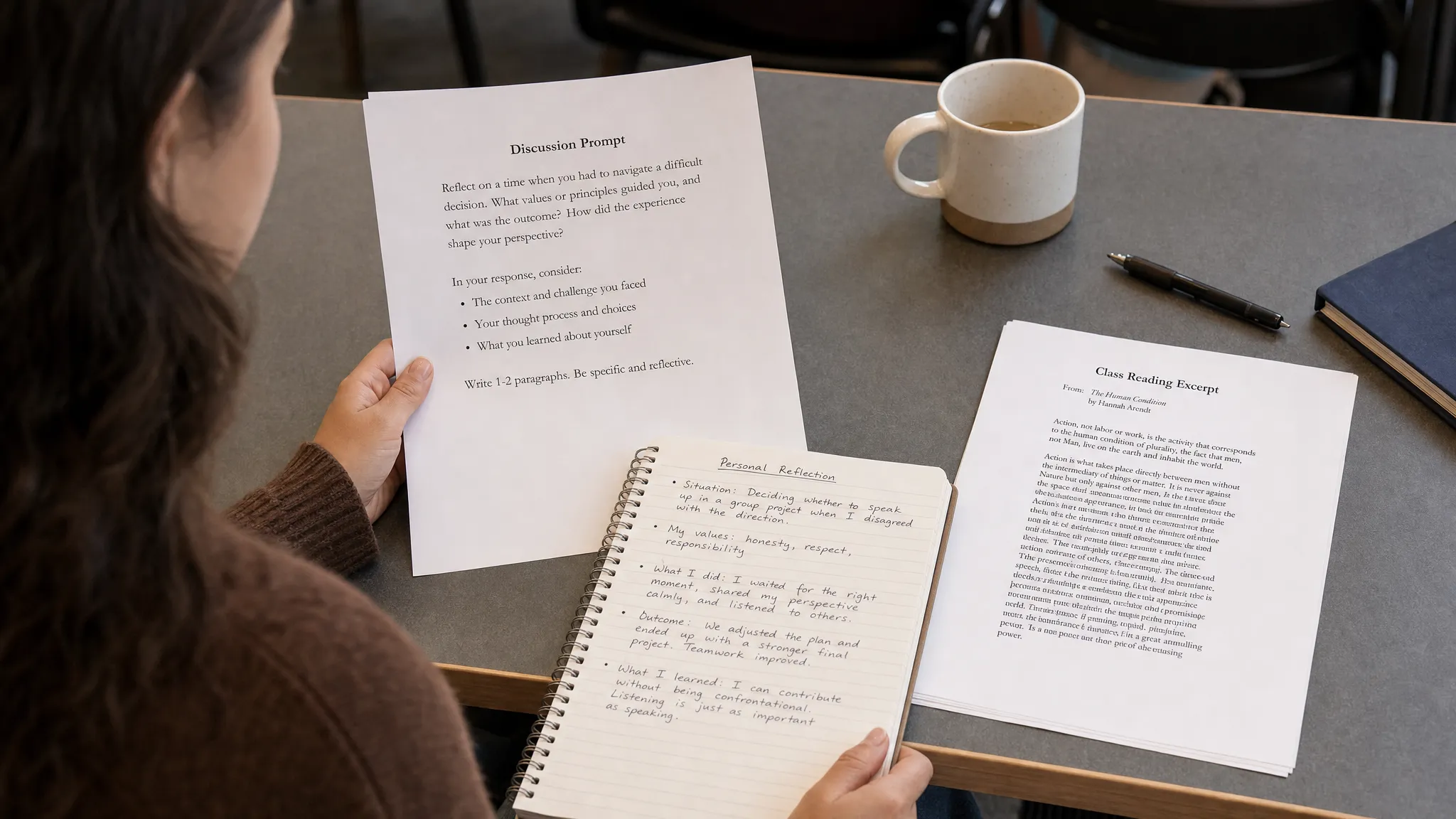
Yes, AI humanizers can work on discussion posts and reflections, but they are less predictable than they are on longer essays or blog drafts. Short, personal assignments leave less text for a tool to reshape, and they give instructors more reasons to judge the writing by voice, specificity, and course engagement instead of detector scores alone.
Want to bypass Turnitin in 2026? Grab the free prompt pack.
Get the exact text-humanization prompts I use to drop an AI score by hand — copy, paste, submit. Free, straight to your inbox.
Send me the free prompts →The practical answer is this: a text humanizer can reduce obvious AI-generated phrasing, smooth awkward sentences, and make a draft sound less templated. It cannot create real participation, real reflection, or a believable learning process for you. For discussion boards and reflective journals, the strongest signal is not just lower AI detection. It is whether the post sounds like a person responding to a specific class moment.
That distinction matters because these assignments are often short, informal, and tied to your personal experience. A 1,500-word essay gives a humanizer room to vary structure and rhythm. A 180-word discussion reply does not. If the original draft is generic, a humanizer may simply produce a different kind of generic.
Why discussion posts and reflections are harder to humanize
Discussion posts and reflections look simple, but they are actually difficult for AI writing tools because they rely on context. The prompt may ask for your reaction to a reading, a connection to a lecture, a reply to a classmate, or a personal takeaway from an activity. Generic AI writing often misses those small anchors.
AI detectors also behave differently on short text. With fewer words, there is less statistical evidence to evaluate. That can make results unstable, especially when the post uses common academic phrases like “this reading highlights,” “it is important to consider,” or “in conclusion.” As we explain in our guide on why short essays get flagged by AI detectors more often, short assignments are easier for detectors and human readers to misread because they have fewer distinctive authorship signals.
Research has also shown that AI detection tools are imperfect. A Stanford HAI summary of research on AI detectors reported concerns about non-native English writing being misclassified, and a study in the International Journal for Educational Integrity found that detector performance varied across tools and conditions. That does not mean every flag is wrong, but it does mean detector results should not be treated as proof by themselves.
For discussion posts and reflections, the bigger issue is usually not the detector. It is whether the post has a human footprint.
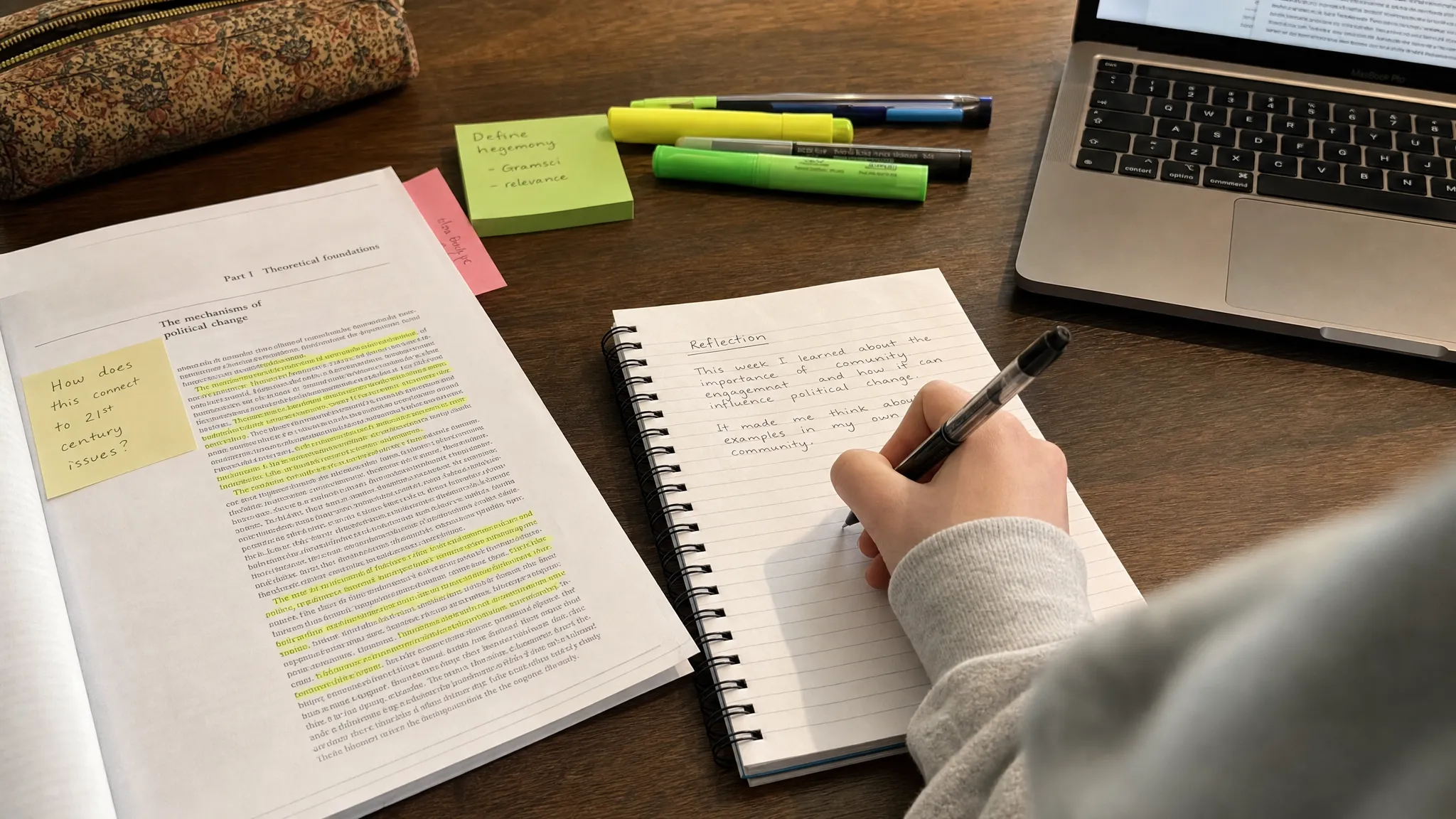
Where AI humanizers help, and where they fail
A humanizer is most useful when the draft already contains your ideas, but the wording feels too polished, stiff, or repetitive. It is least useful when the draft has no personal detail, no course-specific reference, and no clear connection to the prompt.
| Situation | Can a humanizer help? | What still needs manual editing |
|---|---|---|
| A post sounds too formal for a discussion board | Yes | Add your normal phrasing and a specific class reference |
| A reflection uses generic phrases like “this was very impactful” | Sometimes | Replace vague reactions with a concrete moment or example |
| A reply to a classmate does not mention what they said | No | Respond to their actual point, not just the topic |
| A short post is under 150 words | Limited | Add substance before rewriting, not just style changes |
| A post includes quotes or citations | Carefully | Protect source names, page numbers, and required citation format |
| A fully AI-generated reflection has no real experience behind it | Not reliably | Rebuild it around your actual thinking and process |
The most common mistake is treating a humanizer like a one-click fix. On longer content, a rewrite tool can sometimes hide obvious machine patterns. On short reflective writing, the tool may make the post sound even stranger: too casual, too emotional, or full of “human” quirks that do not match your normal style.
If you want a deeper explanation of the mechanics, see our guide on how AI humanizers work and why detectors still flag text. The key takeaway is simple: humanizers change patterns, but they do not guarantee authenticity.
What makes a discussion post sound human
A good discussion post is not just grammatically correct. It shows that you read, watched, listened, or participated in something specific.
Most AI-sounding discussion posts have the same shape. They open with a broad agreement, summarize the topic in safe language, add a general opinion, and close with a polished final sentence. That structure is easy to recognize because it feels like a template.
A stronger post usually includes four things:
- A direct answer to the prompt instead of a broad introduction
- One specific reference to the reading, lecture, lab, case, or class activity
- A small piece of reasoning that explains why your view changed or stayed the same
- A natural sentence or two that sounds like your normal class voice
For example, a generic AI-style post might say:
The reading demonstrates the importance of communication in group settings. I found it interesting because communication is essential for collaboration and success.
A more grounded version would sound like:
The part that stuck with me was the section on unclear roles in group projects. I have usually blamed group problems on people not doing their work, but this made me think the first meeting matters more than I realized. If nobody defines what “done” means, everyone can think they contributed while still leaving gaps.
The second version is not “messier” for the sake of it. It is more specific. It shows a real thought process.
What makes a reflection sound human
Reflections are even harder to fake because the assignment often asks for metacognition, meaning your thinking about your own thinking. A humanizer can improve sentence rhythm, but it cannot know what surprised you, confused you, annoyed you, or made you reconsider something.
The best reflections usually include a before-and-after movement. You do not need a dramatic life lesson. You just need a clear shift.
Here are common reflection patterns that sound AI-generated and how to fix them:
| Weak reflection pattern | Why it sounds AI-like | Better move |
|---|---|---|
| “This experience taught me a lot.” | Too vague to verify | Name one thing you learned and where it happened |
| “I will apply this in the future.” | Generic closing line | Explain one specific future situation |
| “It was challenging but rewarding.” | Overused phrase | Describe the actual challenge |
| “I gained a deeper understanding.” | Abstract and inflated | Show what you misunderstood before |
| “Overall, this was very meaningful.” | Emotional but unsupported | Add the detail that made it meaningful |
A reflection does not need to be perfectly polished. In fact, over-polishing can be a problem. If your normal writing is direct and casual, but the reflection suddenly sounds like a scholarship essay, an instructor may notice even if a detector does not.
This is why voice preservation matters. Our guide on how to rewrite AI text without losing your original voice explains how to keep your normal rhythm instead of replacing it with generic “humanized” prose.
Do humanizers help with Turnitin on discussion posts?
Sometimes, but you should not assume they will.
Turnitin’s AI writing indicator is designed for academic prose, and official Turnitin materials describe AI detection as an indicator rather than a complete authorship judgment. In practice, whether a discussion post is checked depends on how the assignment is submitted, how the LMS is configured, the text length, and the instructor’s workflow.
Even when a humanizer lowers an AI score in one detector, another detector may disagree. Turnitin, GPTZero, Copyleaks, and other tools use different models, thresholds, and preprocessing methods. That is why a post can look fine in one AI content detector and still raise concerns somewhere else.
For short posts, the better goal is not “make the score disappear.” The better goal is to make the writing defensible:
- It answers the exact prompt
- It refers to real course material
- It includes your own reasoning
- It matches your normal voice
- It has drafting evidence if someone asks questions
If you are worried about a Turnitin issue specifically, read what Turnitin’s AI highlighting actually means before you overreact to a number or highlight.
A safer workflow for humanizing short posts
For discussion posts and reflections, the safest workflow is light editing, not aggressive rewriting. The shorter the assignment, the more every sentence matters.
- Start with your own notes: Before using any AI writing tool, jot down the reading, class moment, example, or personal reaction you actually want to include. This gives the post an authentic base.
- Draft plainly first: Write a rough version in your own words, even if it is messy. A rough personal draft is usually better than a polished generic draft.
- Use a humanizer only for wording: If your policy allows it, use a text humanizer to smooth stiffness, reduce repetitive structure, or make the tone more natural. Do not use it to invent ideas.
- Compare the output to your original meaning: Humanizers can change emphasis, soften claims, or add wording that sounds unlike you. Cut anything that you would not say in class.
- Add one specific anchor manually: Mention a page, concept, lecture example, class discussion, peer comment, or personal observation. This is the part tools usually cannot supply well.
- Read it out loud: If it sounds like a motivational blog post instead of a student response, revise it again.
- Save evidence of your process: Keep the prompt, notes, draft, and final version. For academic work, process evidence is often more persuasive than detector screenshots.
This workflow is especially important if you use grammar tools, paraphrasers, or AI writing assistants. If a question comes up later, you want to show how the final post developed. Our guide on how to build an authorship packet before you submit gives a more complete evidence checklist.
When you should not use an AI humanizer
There are times when a humanizer creates more risk than it removes.
Avoid using one if the assignment policy bans AI assistance entirely, if the post is supposed to be a personal journal entry, or if the tool starts adding details that did not happen. Also be careful with very short posts. If the assignment is only 100 to 150 words, a humanizer may change half the post just to make it sound different.
You should also avoid heavy rewriting when citations, quotations, or technical terms matter. A humanizer that changes “social learning theory” into “community-based knowledge development” may sound smoother, but it can damage accuracy. If your post references a reading, protect author names, terminology, page numbers, and required citation format.
For citation-heavy writing, see our guide on whether you can humanize AI text and keep citations intact.
Quick checklist before submitting a discussion post or reflection
Before you submit, ask yourself these questions:
- Would this sound believable if I read it out loud in class?
- Does it mention something specific from the course or prompt?
- Is there at least one sentence that only I would likely write?
- Did I remove generic phrases that could fit any class?
- Did I preserve citations, quotes, and key terms?
- Do I have notes or drafts showing how I got to the final version?
If the answer is no to most of these, running the text through another humanizer is probably not the fix. The post needs more substance, not more rewriting.
So, do AI humanizers work on discussion posts and reflections?
They can work as editing aids, but they are not reliable as standalone AI detection bypass tools for short personal assignments.
For discussion posts, humanizers can make a draft less robotic, but you still need direct engagement with the prompt and your classmates. For reflections, they can improve flow, but you still need a real moment, a real reaction, and a real shift in thinking. In both formats, the best protection is not just a lower detector score. It is writing that you can explain, defend, and recognize as your own.
If you use an AI humanizer, use it lightly. Keep your meaning. Add specific context yourself. Save your drafts. And never assume that a “human” result in one detector means the post is risk-free everywhere.
Frequently Asked Questions
Can Turnitin detect humanized discussion posts? It can still flag text after humanization, especially if the post remains generic, overly polished, or structurally similar to AI-generated writing. Humanizers may reduce obvious patterns, but they do not guarantee a safe Turnitin result.
Are reflections easier to humanize than essays? Not always. Reflections are shorter and more personal, so weak details stand out. A tool can adjust tone, but it cannot replace your actual experience, confusion, reaction, or learning process.
Is it safe to use a text humanizer on a 200-word discussion post? It depends on your course policy and how much the tool changes. For a 200-word post, use only light rewriting and manually check every sentence. Small changes can alter tone or meaning quickly.
Why does my post still sound AI-written after humanizing it? The source draft may be too generic. If the post has no course reference, personal observation, or specific reasoning, a humanizer will only rephrase vague content. Add substance before changing style.
Should I run my post through multiple AI detectors before submitting? You can use detectors as rough signals, but do not treat them as final proof. Different detectors often disagree. A stronger approach is to check voice, specificity, citations, and authorship evidence.
Need a quick short-post preflight?
If your policy allows AI-assisted editing, you can use Detection Drama to review and humanize short AI-assisted text without email friction. Use the free humanizer and AI authenticity analysis as a first pass, then do the final human edit yourself.
For short assignments, do not stop at the tool output. Add the class-specific detail, restore your natural voice, and keep proof of your writing process. That is what makes a discussion post or reflection sound genuinely authored.
