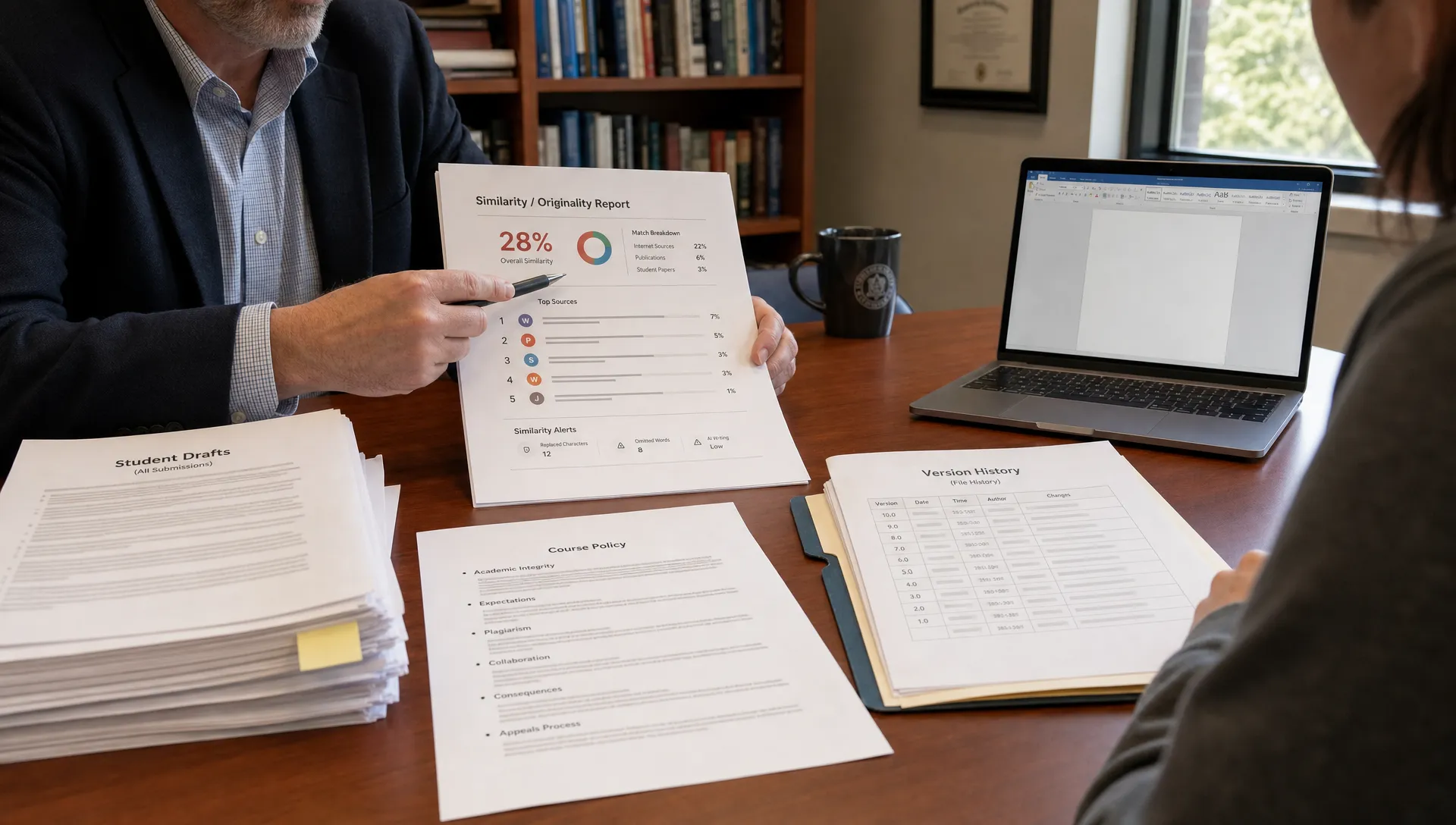
AI detector reports can feel more definitive than they really are. A percentage, a red highlight, and a label like “likely AI” can create the impression that a teacher is looking at direct evidence of misconduct. In reality, an AI detector for teachers usually shows a prediction, not proof.
That distinction matters. In 2026, schools and colleges are still trying to balance academic integrity with fair treatment of students, especially as AI writing tools, paraphrasers, grammar assistants, and human editors all blur the line between “generated” and “assisted.” A report can be useful as an investigative signal, but it is easy to misunderstand what the data actually means.
This guide breaks down what teachers usually see inside AI detection reports, what those scores do and do not show, and how educators can interpret them without overreaching.
Want to bypass Turnitin in 2026? Grab the free prompt pack.
Get the exact text-humanization prompts I use to drop an AI score by hand — copy, paste, submit. Free, straight to your inbox.
Send me the free prompts →The short answer: AI detector reports show probability, not authorship
Most AI detection reports answer a narrow question: does this text resemble patterns the model associates with AI-generated writing?
They do not directly answer the more important classroom questions:
- Did the student write this assignment?
- Did the student use AI in a way the policy forbids?
- Did the student disclose permitted AI assistance?
- Was the flagged section edited, translated, paraphrased, or revised by a human?
- Is the detector wrong?
A plagiarism checker compares submitted text against databases, websites, publications, and other student papers to find matching or similar language. An AI content detector works differently. It estimates whether the writing style, structure, predictability, and statistical patterns resemble machine-generated text.
That means an AI report is best treated as a screening tool. It may justify a closer look, a conversation, or a request for process evidence. It should not be treated as a complete misconduct case by itself.
What an AI detector report usually contains
Different platforms use different labels, but most reports share the same basic parts. Some are designed for classroom use, such as Turnitin’s AI writing indicator. Others are general-purpose AI detection tools used by teachers, editors, or institutions.
| Report element | What it usually means | Common misunderstanding |
|---|---|---|
| Overall AI score | The detector’s estimate that some portion of the text resembles AI-generated writing | “This is the percentage of the paper written by AI” |
| Highlighted passages | Sections the model considers more AI-like than the rest | “Every highlighted sentence is definitely AI-written” |
| Confidence label | A category such as low, medium, high, likely, or unlikely | “High confidence means there is no chance of error” |
| Qualifying text rules | Parts of the document the detector includes or excludes | “The tool analyzed every word equally” |
| Similarity score, if included | Overlap with known sources, usually from a separate plagiarism system | “AI detection and plagiarism detection are the same thing” |
| Report notes or warnings | Tool-specific limitations, thresholds, or unsupported content types | “The fine print does not matter” |
The most important point is that the overall score is a model output. It is not a forensic measurement. It is not equivalent to browser history, Google Docs version history, draft files, or a student admission.
What teachers may see in Turnitin-style reports
Turnitin is the best-known example because many schools already use it for similarity checking. When an institution enables AI writing detection, an instructor may see an AI writing indicator connected to the submission report.
Turnitin’s own guidance describes the AI score as an indicator of the amount of qualifying text the system predicts was generated by AI. The company has also emphasized that results should be considered alongside other information, not used as the only basis for an academic misconduct decision. You can review Turnitin’s product guidance through its AI writing detection support materials.
In practical terms, a teacher may see:
- An AI writing percentage or indicator
- Highlighted portions of the student’s paper
- A report view showing which passages triggered the model
- Tool-specific warnings when the submission is too short or not suitable for analysis
- Sometimes, a separate similarity report from the plagiarism checker
Students often misunderstand this part. There is not necessarily a hidden “real” percentage that teachers can always view beyond the report interface. Access depends on the institution, product settings, and report type. For a student-focused explanation, Detection Drama has a separate guide on what teachers can see in a Turnitin AI percentage.
The key phrase is “qualifying text.” AI detectors may exclude quoted material, bibliographies, very short text, non-prose sections, or unsupported formats. So a 40% AI indicator usually does not mean “40% of every word in the uploaded file is AI.” It means the system found AI-like patterns in a portion of the text it decided was eligible for analysis.
Why an AI score is not the same as a plagiarism score
Teachers are used to plagiarism reports, so it is tempting to read AI reports the same way. That can cause problems.
A plagiarism report can point to a matching source. If a paragraph matches an online article, the report can show the overlap. A teacher can inspect quotation marks, citations, paraphrasing, and source use.
An AI detector usually cannot point to an original source because there may not be one. Instead, it evaluates statistical properties of the writing. Common signals may include predictability, sentence uniformity, generic phrasing, low variation in style, and patterns associated with large language model output.
That is useful, but it is also fragile. A careful human writer can sound predictable. A non-native English writer may use simpler constructions. A student following a rigid rubric may produce formulaic prose. A heavily edited AI draft may no longer look machine-generated. A humanized or paraphrased AI draft may evade detection.
This is why AI detection should be read as a lead, not a verdict.
What AI detector reports do not show
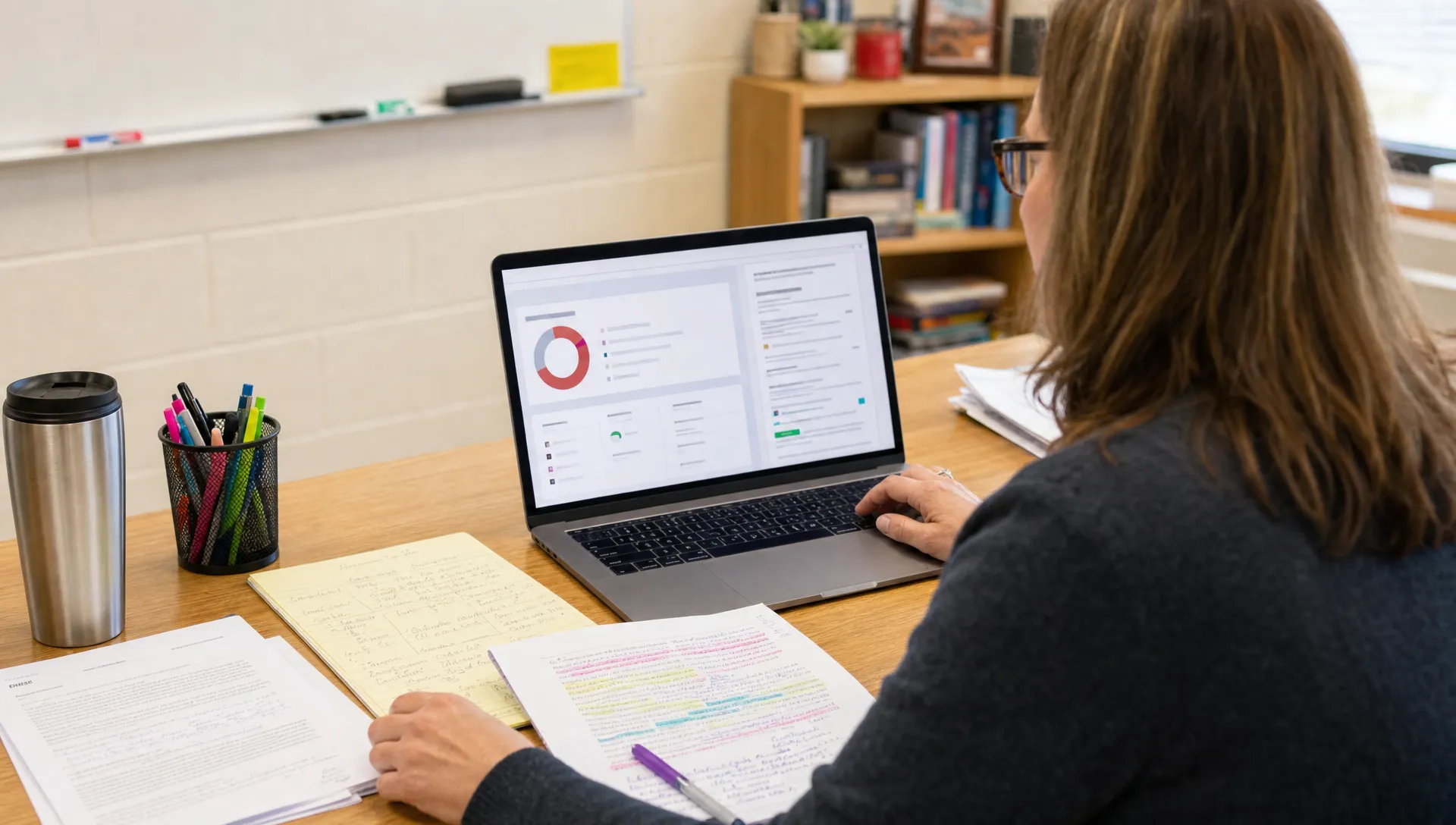
A report can show that a detector found AI-like patterns. It cannot show the full writing process. That gap is where many disputes begin.
| Question | Can the report answer it? | Better evidence to consider |
|---|---|---|
| Did the student use ChatGPT or another AI tool? | Not directly | Draft history, student explanation, writing conference, assignment process records |
| Did the student violate the course policy? | Not by itself | The actual policy, allowed tools, disclosure rules, assignment instructions |
| Which exact tool was used? | Usually no | Student admission, device logs where lawfully available, platform records |
| Was grammar software used? | Usually no | Student disclosure, document edits, tool policy |
| Was the student’s writing translated? | Usually no | Student explanation, language background, draft comparison |
| Is the highlighted sentence definitely AI-written? | No | Contextual review and comparison with other writing samples |
This matters because many schools now allow some AI assistance while banning other uses. For example, a policy might allow brainstorming, spell-checking, or grammar suggestions but prohibit generating full paragraphs. An AI detector report usually cannot distinguish those categories reliably.
It also cannot read intent. A student who misunderstood citation rules, used an AI grammar assistant, or revised a generated outline into original prose may trigger a report that looks similar to a student who copied an entire AI-written essay.
Why false positives happen
False positives occur when a detector labels human writing as AI-generated. They are not rare enough to ignore, especially in high-stakes settings.
Research has found that AI detectors can perform unevenly across student populations. A widely cited 2023 study in Patterns reported that several detectors were more likely to misclassify non-native English writing as AI-generated, raising fairness concerns for multilingual students. The study is available through Cell Press00130-7).
OpenAI also discontinued its own AI classifier after noting its low accuracy, which is an important reminder that even leading AI companies have struggled with reliable detection. OpenAI’s archived note on the classifier explains that it was no longer available due to its low rate of accuracy.
False positives are more likely when writing is short, generic, highly structured, or constrained by a template. A five-paragraph essay written to satisfy a rubric may look statistically ordinary. A lab report or business memo may use standardized phrasing. A student trying to write “more academically” may flatten their voice and accidentally resemble AI output.
For a deeper look at tool-by-tool reliability, Detection Drama tracks AI detection false positive rates and the factors that can make reports less dependable.
Why false negatives also matter
Teachers should also understand the opposite problem. A false negative happens when AI-generated text passes as human.
This is increasingly common because students can edit AI output, use paraphrasing tools, translate text through multiple systems, or combine AI-generated sections with their own writing. Some tools marketed as text humanizers are specifically designed to reduce AI detector scores.
That does not mean every low score proves innocence. It means the detector is not a complete enforcement system. A student could misuse AI and receive a low AI score, while another student could write honestly and receive a high score.
In other words, both high and low scores have limits. The report should guide attention, not replace judgment.
How teachers can read reports more fairly
A responsible review starts with slowing down. The teacher’s goal is not to “catch” a student based on a number. The goal is to determine whether there is enough evidence to start a fair academic integrity process.
Before acting on a report, teachers should ask:
- Is the assignment long enough and suitable for AI detection?
- Does the report identify specific passages, or only a broad score?
- Are the highlighted passages formulaic because of the prompt, rubric, or genre?
- Does the student have drafts, notes, outlines, or version history?
- Does the student’s explanation match the development of the work?
- Does the course policy clearly define allowed and prohibited AI use?
Many institutions now recommend using AI reports only as one piece of evidence. Vanderbilt University, for example, publicly explained why it disabled Turnitin’s AI detector in 2023, citing concerns about false positives, transparency, and the impact of accusations on students. Its guidance on AI detection remains a useful example of institutional caution.
A fair process often includes a conversation. Ask the student how they approached the assignment, what sources they used, what changed between drafts, and how they would explain their argument. Students who wrote the work can usually discuss choices, revisions, and sources in detail. Students who relied too heavily on AI may struggle to explain the substance, but even that should be evaluated carefully and consistently.
A practical checklist for teachers
The table below gives a simple way to interpret the most common report signals without treating them as automatic proof.
| If the report shows… | Do not assume… | Consider doing this instead |
|---|---|---|
| A high AI percentage | The student definitely cheated | Review drafts, compare writing samples, and follow the school’s integrity process |
| Highlighted introduction or conclusion | The whole paper is AI-written | Check whether the section is generic because of the assignment format |
| AI-like phrasing in source summaries | The student fabricated the work | Compare notes, citations, and source understanding |
| A low AI percentage | No AI was used | Look at process evidence if other concerns exist |
| A mismatch with prior writing | AI is the only explanation | Consider tutoring, editing, translation, stress, or topic familiarity |
| A detector warning or unsupported text notice | The score is still reliable | Treat the report as weak or unusable for that submission |
This approach protects teachers too. If a case becomes disputed, the strongest position is not “the detector said so.” It is “the detector raised a concern, and we reviewed additional evidence through a consistent process.”
Detection Drama covers this issue in more detail in its guide to whether professors can use AI detectors as proof, which explains why detector output is usually better understood as supporting evidence rather than standalone proof.
What students should know about teacher AI reports
Students should not assume that an AI detector report is invisible, harmless, or always accurate. If a school uses these tools, instructors may see scores and highlighted passages that students never see unless the teacher shares them.
The best protection is process evidence. Keep outlines, notes, drafts, source annotations, and version history. If AI assistance is allowed, disclose it exactly as the course policy requires. If a tool was used only for grammar, brainstorming, translation, or formatting, document that use.
Students should also avoid panicking over a number. A report is not the same as a misconduct finding. If questioned, stay calm, ask what the report shows, request a chance to explain the writing process, and provide drafts or notes where possible.
For teachers, this is another reason to design assignments around process. Draft checkpoints, in-class writing, oral defenses, annotated bibliographies, and reflection notes can provide much better evidence of learning than an AI detector alone.
Frequently Asked Questions
What does an AI detector for teachers actually show? It usually shows a predicted AI score, highlighted passages, and sometimes confidence labels or warnings. It shows whether text resembles AI-generated writing patterns, not definitive proof of who wrote it.
Can a teacher prove AI use with only a detector report? A detector report alone is usually weak evidence. Schools should consider drafts, version history, student explanations, writing samples, and the course AI policy before making a misconduct decision.
Is a Turnitin AI percentage the same as a plagiarism percentage? No. A plagiarism percentage measures similarity to known sources. An AI percentage estimates how much qualifying text the system predicts may be AI-generated.
Can AI detectors falsely accuse students? Yes. False positives can happen, especially with formulaic writing, short assignments, non-native English writing, rigid templates, or heavily edited work.
Can students see the same AI report teachers see? Not always. Access depends on the platform, school settings, and instructor choices. Some students only see similarity information, while teachers may have access to AI indicators.
Should teachers stop using AI detectors completely? Not necessarily. They can be useful as a signal, but they should be used cautiously, transparently, and with additional evidence rather than as an automatic penalty tool.
Keep the report in perspective
AI detector reports look technical, but they are not neutral truth machines. They show probabilities, patterns, exclusions, and warnings. They do not show intent, authorship, or policy violation by themselves.
For teachers, the safest approach is to use reports as one clue within a broader review. For students, the safest approach is to preserve evidence of the writing process and understand what these tools can and cannot claim.
Detection Drama publishes practical guides on AI detection, Turnitin reports, false positives, and academic integrity disputes so readers can understand the technology behind the score before treating it as proof.
Want to bypass Turnitin in 2026? Grab the free prompt pack.
Get the exact text-humanization prompts I use to drop an AI score by hand — copy, paste, submit. Free, straight to your inbox.
Send me the free prompts →