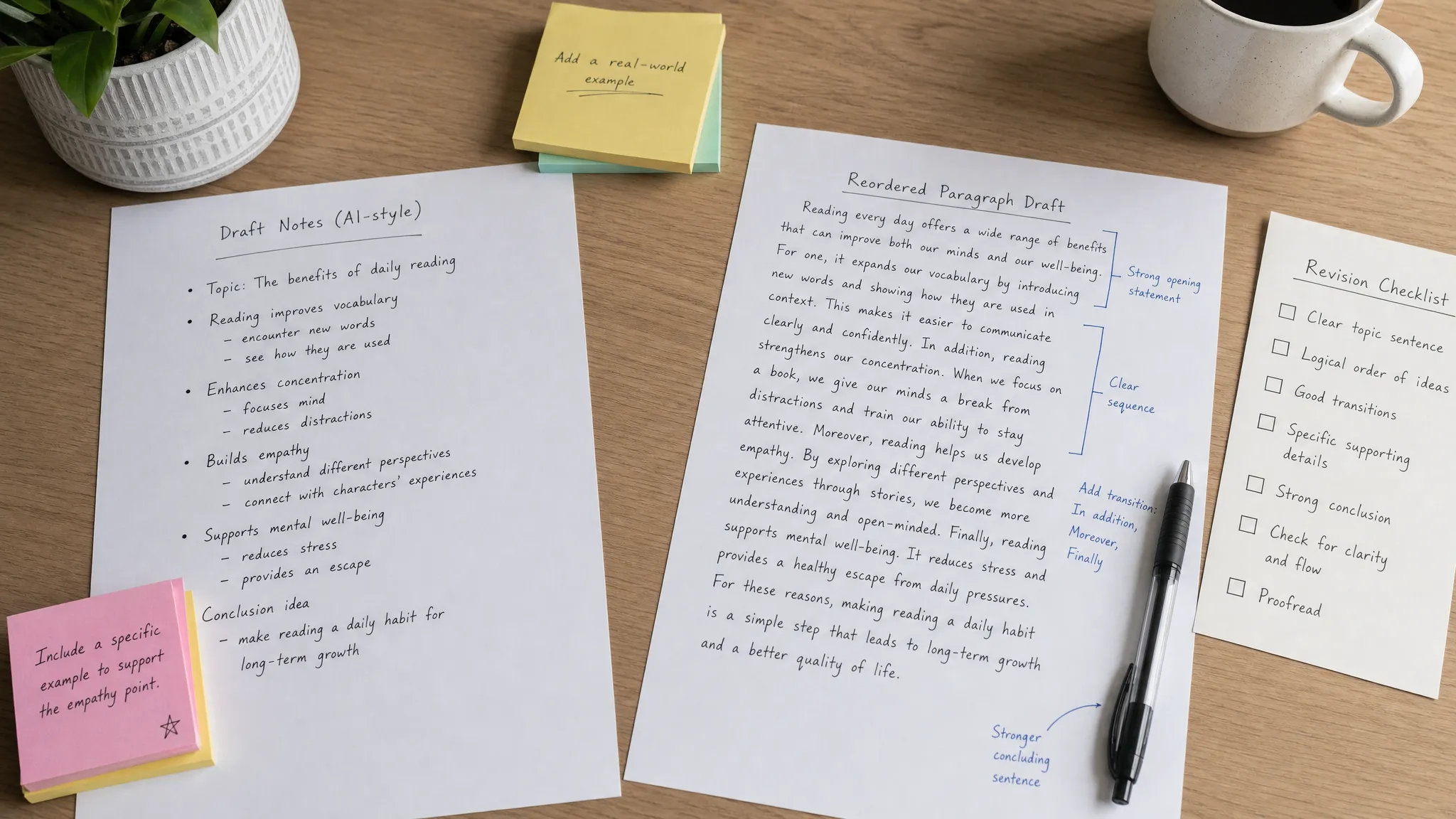
AI bullet points are useful when you are planning, summarizing, or getting unstuck. The problem starts when those bullets are pasted into a draft and lightly stitched together. The result often sounds stiff: every sentence has the same weight, the logic feels too neat, and the paragraph reads like a list wearing a disguise.
To rewrite AI bullet points into natural paragraphs, you need more than a synonym swap. You need to decide what the paragraph is trying to do, combine related ideas, add reasoning, and restore the kind of rhythm people use when they actually explain something.
This guide walks through a practical editing process you can use for essays, emails, blog posts, discussion replies, reports, and short professional drafts.
Want to bypass Turnitin in 2026? Grab the free prompt pack.
Get the exact text-humanization prompts I use to drop an AI score by hand — copy, paste, submit. Free, straight to your inbox.
Send me the free prompts →Why AI bullet points sound unnatural as paragraphs
AI-generated bullet points tend to be clean, balanced, and complete. That makes them convenient, but it also makes them easy to recognize. Each bullet often starts with the same grammatical pattern, uses broad phrasing, and avoids the messy specificity that makes human writing persuasive.
For example, an AI list might say:
- Improves productivity
- Saves time on repetitive tasks
- Enhances collaboration
- Supports better decision-making
Those points are not wrong, but they are too abstract. If you turn them into a paragraph by simply adding connecting words, you get something like this:
This improves productivity, saves time on repetitive tasks, enhances collaboration, and supports better decision-making.
That sentence is grammatical, but it is not a real paragraph. It does not explain who benefits, why the benefits matter, or how the ideas relate to each other. It also keeps the generic AI texture intact.
Human readers notice these patterns even when they are not using an AI content detector. If you want a deeper breakdown of the signals readers pick up on, Detection Drama has a useful guide on what makes writing sound AI generated to real human readers.
The key is to stop treating bullet points as sentences waiting to be expanded. Treat them as notes. Your job is to turn notes into a thought.
Start with the paragraph's main job
Before rewriting, ask what the paragraph is supposed to accomplish. A paragraph usually has one main job, even when it contains several details. It might explain a cause, compare two options, defend a claim, summarize a process, or show why something matters.
Ask three quick questions:
- What is the main idea I want the reader to understand?
- Which bullet points actually support that idea?
- What context is missing because the bullets are too compressed?
Once you answer those questions, write a plain one-sentence purpose for the paragraph. This sentence does not have to appear in the final draft. It is a guide for your rewrite.
For example, if your bullets are about remote work, your paragraph purpose might be:
The paragraph should explain that remote work saves time, but only when teams set clear communication habits.
That purpose is already more human than a list of benefits. It has a condition, a point of view, and a reason for the paragraph to exist.
Group bullet points by meaning, not by order
AI lists often organize ideas by surface similarity, not by the logic a reader needs. When rewriting bullet points into paragraphs, the original order is optional. You should move points around if a different sequence creates a better flow.
A simple structure is context first, then main claim, then support, then implication. This works because readers usually need to know what situation you are talking about before they can care about the claim.
Consider these AI bullet points:
- Reduces meeting fatigue
- Allows employees to focus deeply
- Requires managers to set expectations
- Can improve work-life balance
- Helps teams avoid unnecessary check-ins
A weak rewrite would stack them in the same order. A stronger rewrite would group them by logic. Meeting fatigue and unnecessary check-ins belong together. Focus and work-life balance are outcomes. Manager expectations are the condition that makes the benefits possible.
A natural paragraph could become:
Remote work can reduce meeting fatigue, but it does not happen automatically. Teams usually benefit when managers set clear expectations about when to use meetings, messages, or shared documents. With fewer unnecessary check-ins, employees have more room for deep work, and that extra control over the day can also improve work-life balance.
Notice what changed. The paragraph does not include every bullet as a separate sentence. It combines ideas, adds a condition, and creates movement.
Choose the right paragraph shape
Not every set of bullet points should become the same type of paragraph. Sometimes you need a compact summary. Other times you need an explanation with examples. University writing centers often emphasize unity and development in paragraphs, and the UNC Writing Center's guide to paragraphs is a helpful reminder that a paragraph should develop one controlling idea rather than collect loosely related sentences.
Use this table to decide how to reshape your bullet points:
| Bullet point pattern | Best paragraph shape | What to add |
|---|---|---|
| List of benefits | Claim plus explanation | Who benefits, why it matters, and one concrete example |
| List of steps | Process paragraph | Time order, transitions, and warnings about mistakes |
| List of pros and cons | Comparison paragraph | A clear judgment or tradeoff |
| List of features | Use-case paragraph | The situation where each feature matters |
| List of research notes | Evidence paragraph | Source context, interpretation, and connection to your point |
| List of objections | Response paragraph | The concern, your answer, and a limitation if needed |
This step prevents the most common AI rewrite problem: paragraphs that are grammatically smooth but logically empty.
Turn fragments into relationships
Bullet points usually state ideas side by side. Paragraphs show relationships between ideas. That means your rewrite should make the logic visible.
Instead of asking, How do I make this bullet longer?, ask:
- Does this idea cause another idea?
- Does it contrast with another point?
- Is it an example of a broader claim?
- Is it a condition that changes the outcome?
- Is it less important than the other points?
Here is a simple example.
AI bullet points:
- Students use AI writing tools for brainstorming
- Some rely too much on generated drafts
- Instructors want original thinking
- Clear guidelines reduce confusion
Flat rewrite:
Students use AI writing tools for brainstorming. Some rely too much on generated drafts. Instructors want original thinking. Clear guidelines reduce confusion.
Natural rewrite:
AI writing tools can be useful during brainstorming, especially when students are trying to find possible angles for a topic. The problem begins when a generated draft replaces the student's own thinking instead of supporting it. Clear course guidelines help reduce that confusion because they show where AI can assist and where the student needs to make the argument independently.
The natural version adds cause and contrast. It also explains the tension instead of just naming the parts.
Add human texture without padding
Many people try to humanize AI text by adding casual phrases or unnecessary adjectives. That usually makes the writing worse. Natural paragraphs do not need filler. They need texture.
Texture comes from specifics, judgment, and lived context. You can add it by naming the audience, narrowing the situation, or including a realistic example.
Compare these two versions:
Generic: Time management is important because it helps people complete tasks efficiently and reduce stress.
More natural: Time management matters most when several small deadlines are competing for attention. A student who has a quiz, a discussion post, and a work shift on the same day does not just need motivation. They need a realistic plan for what gets done first.
The second version sounds more human because it chooses a specific scenario. It does not try to sound impressive. It tries to be useful.
When working from AI bullet points, look for one place where a concrete detail would clarify the paragraph. You do not need to add an example after every sentence. One well-placed detail is often enough.
Keep your original voice in the rewrite
A natural paragraph should still sound like it came from you. If the AI bullet points are based on your notes, preserve your phrasing where it matters. If you would normally write short, direct sentences, do not turn the paragraph into polished corporate prose. If your assignment or workplace expects a formal tone, do not add slang just to seem human.
A good way to protect your voice is to highlight three things before editing: your main opinion, any terms you must keep, and any sentence that already sounds like you. Then rewrite around those anchors.
For a fuller workflow, see Detection Drama's guide on rewriting AI text without losing your original voice. The same principle applies here: you are not just changing the surface of the text. You are restoring intention.
A practical before-and-after rewrite
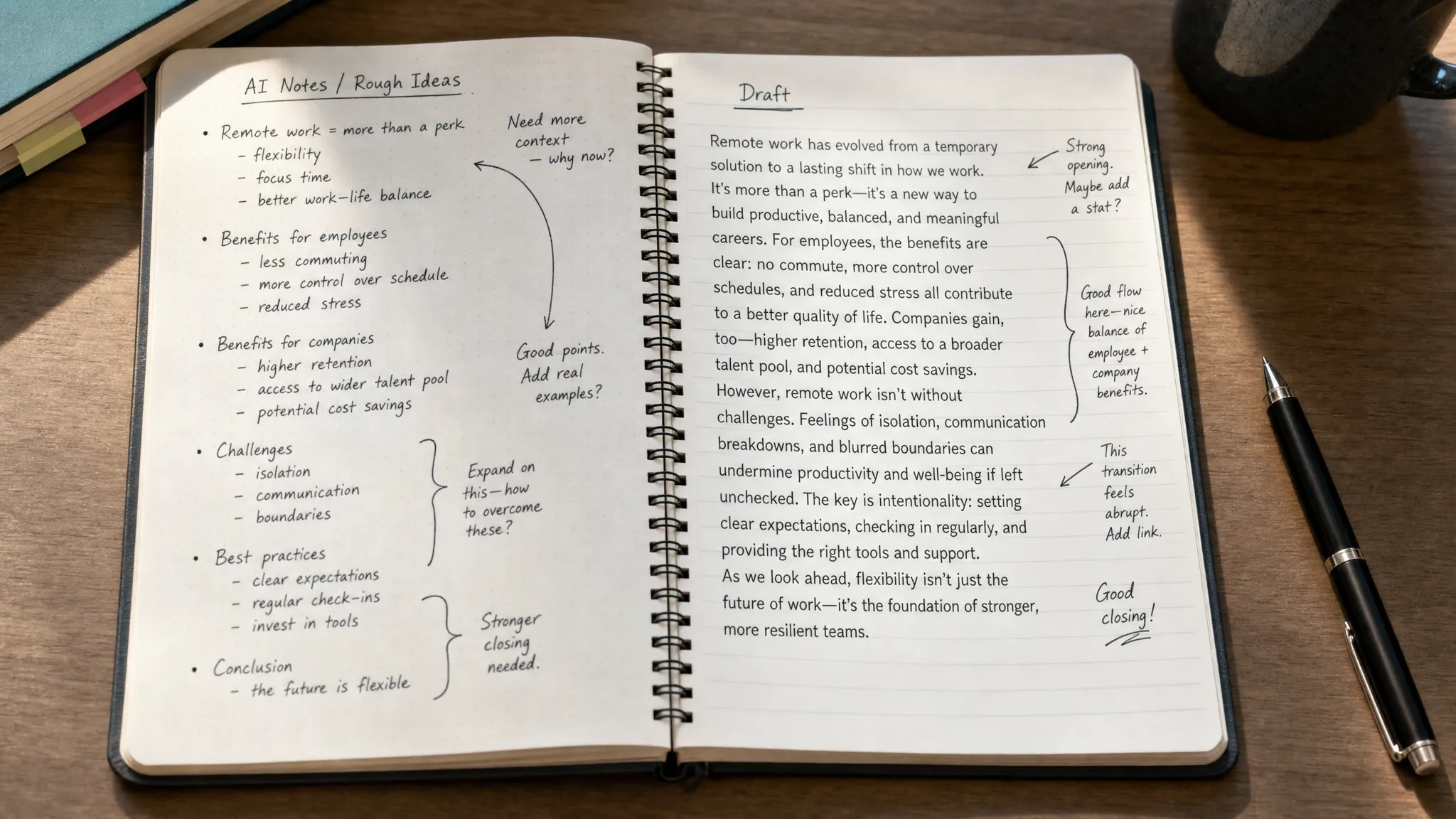
Let's take a realistic set of AI bullet points and turn them into a paragraph step by step.
AI bullet points:
- Social media affects attention span
- Short videos encourage quick switching
- Students may struggle with long readings
- Notifications interrupt concentration
- Setting boundaries can improve focus
Weak paragraph:
Social media affects attention span because short videos encourage quick switching. Students may struggle with long readings because notifications interrupt concentration. Setting boundaries can improve focus.
This is not terrible, but it still feels mechanical. The sentence pattern repeats, and the ideas are too compressed.
Better paragraph:
Social media can make sustained attention harder, not because every platform is harmful, but because many apps reward quick switching. After watching a stream of short videos, a long reading assignment can feel unusually slow, even when the material is not difficult. Notifications make the problem worse by pulling attention away before the reader has settled into the task. For students, simple boundaries such as silencing alerts or setting a fixed reading window can make focus feel less like willpower and more like a routine.
This version works better because it adds nuance. It avoids the exaggerated claim that all social media is bad. It explains the mechanism, gives a student-centered context, and ends with a practical implication.
How to rewrite bullet points for different formats
The right paragraph style depends on where the text will appear. A college discussion post, a business email, and a blog article should not sound identical.
For an academic paragraph, lead with the claim and make the reasoning clear. Avoid over-casual phrasing, and keep citations attached to the ideas they support. If you are working in APA or MLA, be especially careful not to separate a source from the sentence it belongs to.
For a professional email, start with the reader's situation. People do not want a paragraph that lists everything you know. They want the decision, update, or request to be easy to understand.
For a blog post, focus on flow. Use a stronger opening sentence, vary sentence length, and add examples that help the reader picture the idea. If you need a fast revision routine after converting bullets into prose, Detection Drama's 10-minute process for making AI writing sound more natural pairs well with the method in this article.
For a personal statement or reflective paragraph, do not over-polish. A slightly uneven but honest sentence often sounds more credible than a perfect sentence with no personal detail.
Common mistakes to avoid
The biggest mistake is treating every bullet point as equally important. In a real paragraph, some ideas lead and others support. If you give every point the same amount of space, the paragraph will still feel like a list.
Another mistake is relying on transition words without adding real logic. Words like furthermore, moreover, and additionally can make AI-generated content sound even more artificial when every sentence uses them the same way. Use transitions only when they describe the actual relationship between ideas.
Watch out for these habits:
- Keeping the bullet order even when the logic would work better in a different sequence
- Turning each bullet into one sentence and calling it a paragraph
- Adding vague phrases like in today's world or it is important to note
- Replacing normal words with formal synonyms you would not usually use
- Removing all opinion, uncertainty, or context in an attempt to sound polished
A clean plagiarism checker result also does not mean the writing sounds natural. Plagiarism tools and AI detection tools look for different signals, and neither can replace a careful human read-through.
Quick editing checklist
After you rewrite AI bullet points into a paragraph, read the paragraph once for meaning and once for sound. The first pass checks whether the argument makes sense. The second pass checks whether it feels natural.
Use this checklist before you finalize the paragraph:
- The paragraph has one clear main idea.
- Related bullet points are combined instead of stacked.
- At least one sentence explains why or how something happens.
- The paragraph includes context, a condition, or a concrete example.
- Sentence lengths vary naturally.
- Transition words are specific, not decorative.
- The final sentence adds value instead of repeating the first sentence.
- The wording still sounds like something you would actually write.
If the paragraph passes those checks, it is usually much stronger than a direct bullet-to-sentence conversion.
When a text humanizer can help
A text humanizer can be useful when you already understand your point but the draft still sounds too rigid. It can help smooth repetitive sentence patterns, reduce generic phrasing, and give you a cleaner version to edit by hand.
That said, a humanizer should not replace your judgment. If the tool changes your meaning, removes necessary citations, or makes the paragraph sound unlike you, revise it. The best results usually come from combining tool-assisted rewriting with a final human pass.
Detection Drama provides a free humanizer tool, AI authenticity analysis, and instant access without requiring an email. You can use Detection Drama to get a starting rewrite, then apply the paragraph-level checks above to make sure the final version is clear, accurate, and genuinely yours.
For school or professional work, always follow the rules that apply to your situation. Do not use rewriting tools to misrepresent prohibited AI use. Use them to improve clarity, preserve your own ideas, and make rough AI-assisted notes readable.
Frequently Asked Questions
How do I turn AI bullet points into a paragraph without sounding robotic? Start by identifying the main idea, then group related bullets into a logical sequence. Add context, reasoning, and one specific example instead of turning each bullet into a separate sentence.
Should every bullet point appear in the final paragraph? No. Some bullet points may repeat the same idea or be less important than others. A natural paragraph often combines, reorders, or removes bullets so the main point is easier to follow.
Can I use a text humanizer after rewriting bullet points myself? Yes, but use it as an editing aid, not a final authority. Review the output for accuracy, voice, citations, and meaning before submitting or publishing it.
Why do rewritten bullet points still get flagged by an AI content detector? They may still contain predictable structure, generic wording, or repetitive rhythm. AI detection is also imperfect, so focus on making the writing clear, specific, and voice-driven rather than chasing one score.
What is the fastest way to improve a bullet-point rewrite? Add a sentence that explains the relationship between two ideas. Cause, contrast, condition, and consequence make paragraphs feel more human because they show actual thinking.
Make your bullet-point draft sound like a real paragraph
AI bullet points are a starting point, not a finished draft. The fastest way to improve them is to stop expanding them mechanically and start rebuilding the thought behind them.
If you want help smoothing a rough rewrite, try the free tools at Detection Drama. Use the output as a draft, then add your own context, examples, and final judgment so the paragraph reads like something a person actually meant to say.
Want to bypass Turnitin in 2026? Grab the free prompt pack.
Get the exact text-humanization prompts I use to drop an AI score by hand — copy, paste, submit. Free, straight to your inbox.
Send me the free prompts →