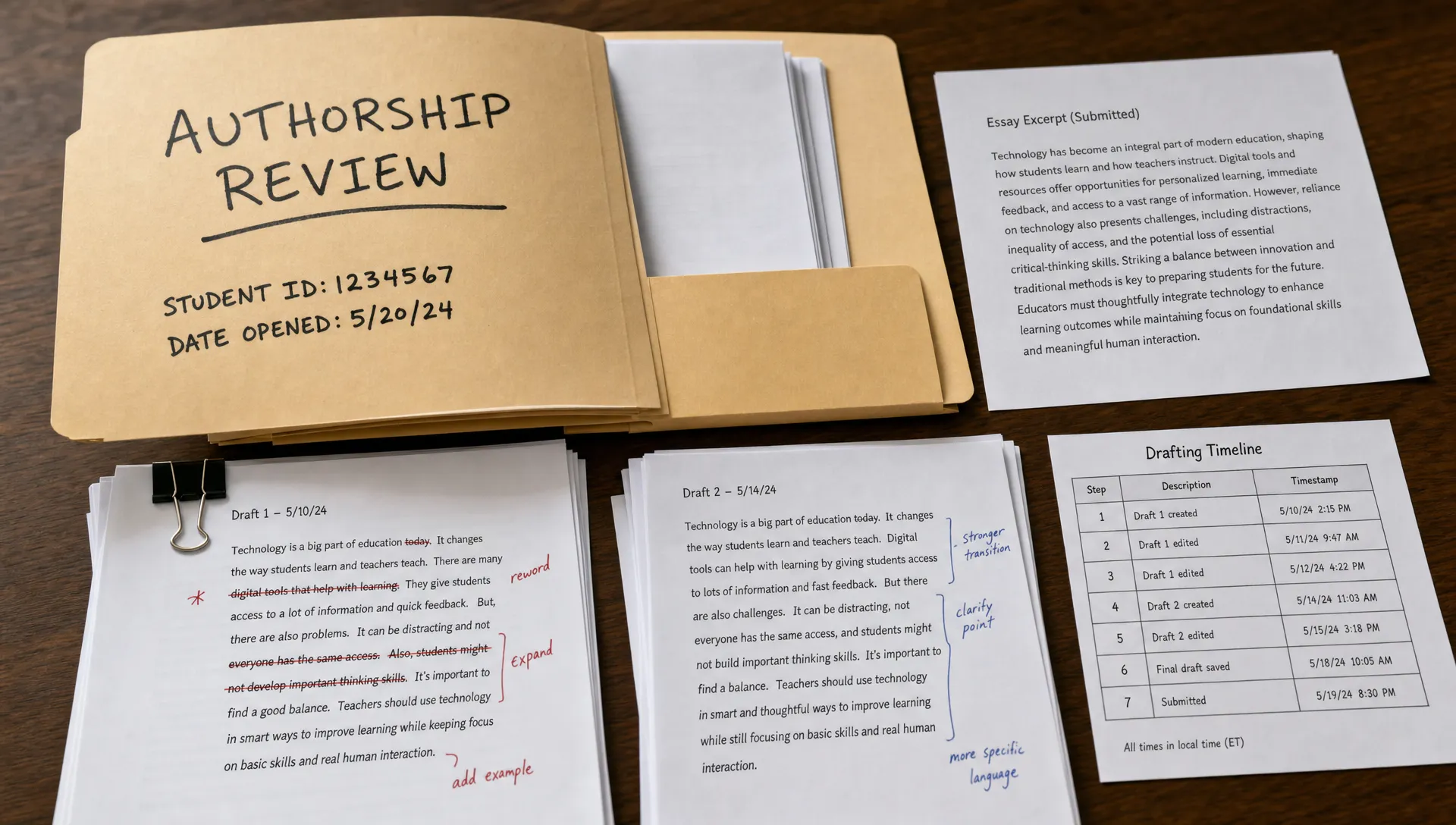
Yes. Turnitin can flag a paper you wrote in Google Docs, but not because Google Docs makes your writing suspicious.
In a normal submission, Turnitin is not judging whether you typed the paper in Google Docs, Microsoft Word, Pages, or a learning management system text box. It is analyzing the submitted text. If the text matches other sources, the Similarity Report may highlight it. If your school has Turnitin’s AI writing feature enabled, the system may also estimate whether parts of the paper look like AI-generated content.
The only tool that bypassed Pangram and Turnitin in 2026.
Most humanizers clear one detector and get caught by the other. StealthWriter is the one that gets past both — run Ghost 5.2 Pro at level 7–8, section by section, and re-check before you submit.
Try StealthWriter →That distinction matters. A Turnitin flag is not the same thing as proof that you used ChatGPT, copied from a source, or cheated. It is a signal that an instructor may review. Google Docs can help you defend your work because it can preserve drafts, edits, comments, and timestamps, but it does not automatically prevent an AI detection or plagiarism checker flag.
The only tool that bypassed Pangram and Turnitin in 2026.
Most humanizers clear one detector and get caught by the other. StealthWriter is the one that gets past both — run Ghost 5.2 Pro at level 7–8, section by section, and re-check before you submit.
Try StealthWriter →The only tool that bypassed Pangram and Turnitin in 2026.
Most humanizers clear one detector and get caught by the other. StealthWriter is the one that gets past both — run Ghost 5.2 Pro at level 7–8, section by section, and re-check before you submit.
Try StealthWriter →The only tool that bypassed Pangram and Turnitin in 2026.
Most humanizers clear one detector and get caught by the other. StealthWriter is the one that gets past both — run Ghost 5.2 Pro at level 7–8, section by section, and re-check before you submit.
Try StealthWriter →The only tool that bypassed Pangram and Turnitin in 2026.
Most humanizers clear one detector and get caught by the other. StealthWriter is the one that gets past both — run Ghost 5.2 Pro at level 7–8, section by section, and re-check before you submit.
Try StealthWriter →The only tool that bypassed Pangram and Turnitin in 2026.
Most humanizers clear one detector and get caught by the other. StealthWriter is the one that gets past both — run Ghost 5.2 Pro at level 7–8, section by section, and re-check before you submit.
Try StealthWriter →The only tool that bypassed Pangram and Turnitin in 2026.
Most humanizers clear one detector and get caught by the other. StealthWriter is the one that gets past both — run Ghost 5.2 Pro at level 7–8, section by section, and re-check before you submit.
Try StealthWriter →The only tool that bypassed Pangram and Turnitin in 2026.
Most humanizers clear one detector and get caught by the other. StealthWriter is the one that gets past both — run Ghost 5.2 Pro at level 7–8, section by section, and re-check before you submit.
Try StealthWriter →The only tool that bypassed Pangram and Turnitin in 2026.
Most humanizers clear one detector and get caught by the other. StealthWriter is the one that gets past both — run Ghost 5.2 Pro at level 7–8, section by section, and re-check before you submit.
Try StealthWriter →The only tool that bypassed Pangram and Turnitin in 2026.
Most humanizers clear one detector and get caught by the other. StealthWriter is the one that gets past both — run Ghost 5.2 Pro at level 7–8, section by section, and re-check before you submit.
Try StealthWriter →The only tool that bypassed Pangram and Turnitin in 2026.
Most humanizers clear one detector and get caught by the other. StealthWriter is the one that gets past both — run Ghost 5.2 Pro at level 7–8, section by section, and re-check before you submit.
Try StealthWriter →First, which Turnitin flag are we talking about?
Students often say “Turnitin flagged my paper” as if there is only one kind of result. There are at least two common issues that get mixed together:
| Turnitin result | What it generally means | What it does not prove by itself |
|---|---|---|
| Similarity Report | Parts of your text match, or closely resemble, existing sources in Turnitin’s databases, websites, publications, or student papers | That you intentionally plagiarized |
| AI writing indicator | Turnitin’s model estimates that some writing patterns resemble AI-generated text | That you personally used AI or violated policy |
| Instructor concern after review | A teacher believes the submission does not match your usual writing, process, or assignment requirements | That the detector was correct |
Turnitin’s public materials describe AI writing detection as a feature that analyzes submitted writing for patterns associated with AI writing tools. It is not a mind reader, and it cannot know your intent. You can review Turnitin’s own overview of its AI writing detection for the broad explanation of how the company frames the feature.
So if you wrote your essay in Google Docs and it got flagged, the most likely explanation is simple: the finished text triggered a detector or similarity match after submission. Google Docs itself was not the cause.
What Turnitin usually sees from a Google Docs paper
For a standard submission, Turnitin receives the final document or text you submit. That may be a .docx, PDF, copied text, or a file exported from Google Docs. In that normal workflow, Turnitin is not automatically watching every keystroke you type in your private document.
What it usually evaluates is the finished paper: the title, body paragraphs, citations, quoted material, and sometimes the bibliography depending on settings. Your instructor may also separately look at other evidence, such as drafts, revision history, writing conferences, class notes, or previous assignments.
Here is the practical breakdown:
| Question | Short answer | Why it matters |
|---|---|---|
| Can Turnitin flag a Google Docs paper? | Yes | The file origin does not protect the final text from AI detection or similarity checks |
| Does typing in Google Docs prove the paper is human-written? | No | It creates a writing trail, but the trail must be reviewed in context |
| Can Turnitin normally see your private version history? | No, not from a basic uploaded file | Version history is separate unless you share access or your school uses connected tools |
| Can a teacher ask to see your Google Docs history? | Yes, depending on school policy | This can become part of an authorship review |
| Can a clean Google Docs history still look suspicious? | Sometimes | Large pasted blocks, missing notes, or a one-session draft may raise questions, but they are not proof |
If your class uses Google Classroom, Turnitin Draft Coach, or school-managed integrations, the situation can be more complicated. Some tools are designed to work closer to the drafting process, and institutional settings matter. For more on that distinction, Detection Drama has a separate breakdown of how Turnitin inside Google Classroom changes what teachers may review.
Can Turnitin read your Google Docs version history?
Usually, no. An AI content detector does not automatically open your private Google Docs history, read every version, or access your ChatGPT account. If you upload a final file to Turnitin, the detector analyzes that submitted file.
However, there are important exceptions and side channels:
- You might share the Google Doc with your instructor.
- Your instructor might ask you to show version history during an authorship review.
- Your school may use Google Workspace or Google Classroom tools that create additional process records.
- You may submit through an integration that handles files differently from a simple upload.
- A teacher may compare the paper with your prior writing, outlines, notes, or in-class work.
The key point is that “Turnitin flagged it” and “my teacher reviewed my Google Docs process” are two different things. Turnitin’s detector typically evaluates text. A teacher or institution may separately review process evidence.
If you are trying to understand this privacy line, read the detailed guide on whether AI detectors can read Google Docs history or ChatGPT logs. The short version is that detectors do not magically access private histories, but people with permission can review documents you share.
Why an original Google Docs paper can still look AI-like
This is the part that feels unfair: a paper can be genuinely yours and still receive an AI detection flag.
AI detectors are pattern classifiers. They look at statistical and linguistic features in the final text. Turnitin does not publish every detail of its model, and no responsible reviewer should treat the score as a perfect lie detector. But in general, writing can look “AI-like” when it is highly polished, predictable, generic, or unusually uniform.
Original student writing may trigger concern when it has features such as:
- Very even sentence length across many paragraphs.
- Generic topic sentences that do not show a personal reasoning path.
- Repetitive transitions like “Furthermore,” “Moreover,” and “In conclusion.”
- Broad claims with limited engagement with specific class materials.
- Perfectly balanced paragraphs that follow the same structure every time.
- Heavy rewriting by grammar, translation, or paraphrasing tools.
- A voice that differs sharply from previous work without an obvious reason.
None of these features proves AI use. Strong academic writers sometimes sound polished. Multilingual students may use simpler, more predictable structures. Students under pressure may follow formulaic essay templates. Grammarly, translation tools, tutoring feedback, and repeated revision can also make prose smoother and less idiosyncratic.
That is why the best response is not panic. The best response is evidence.
Does Google Docs version history prove you wrote it?
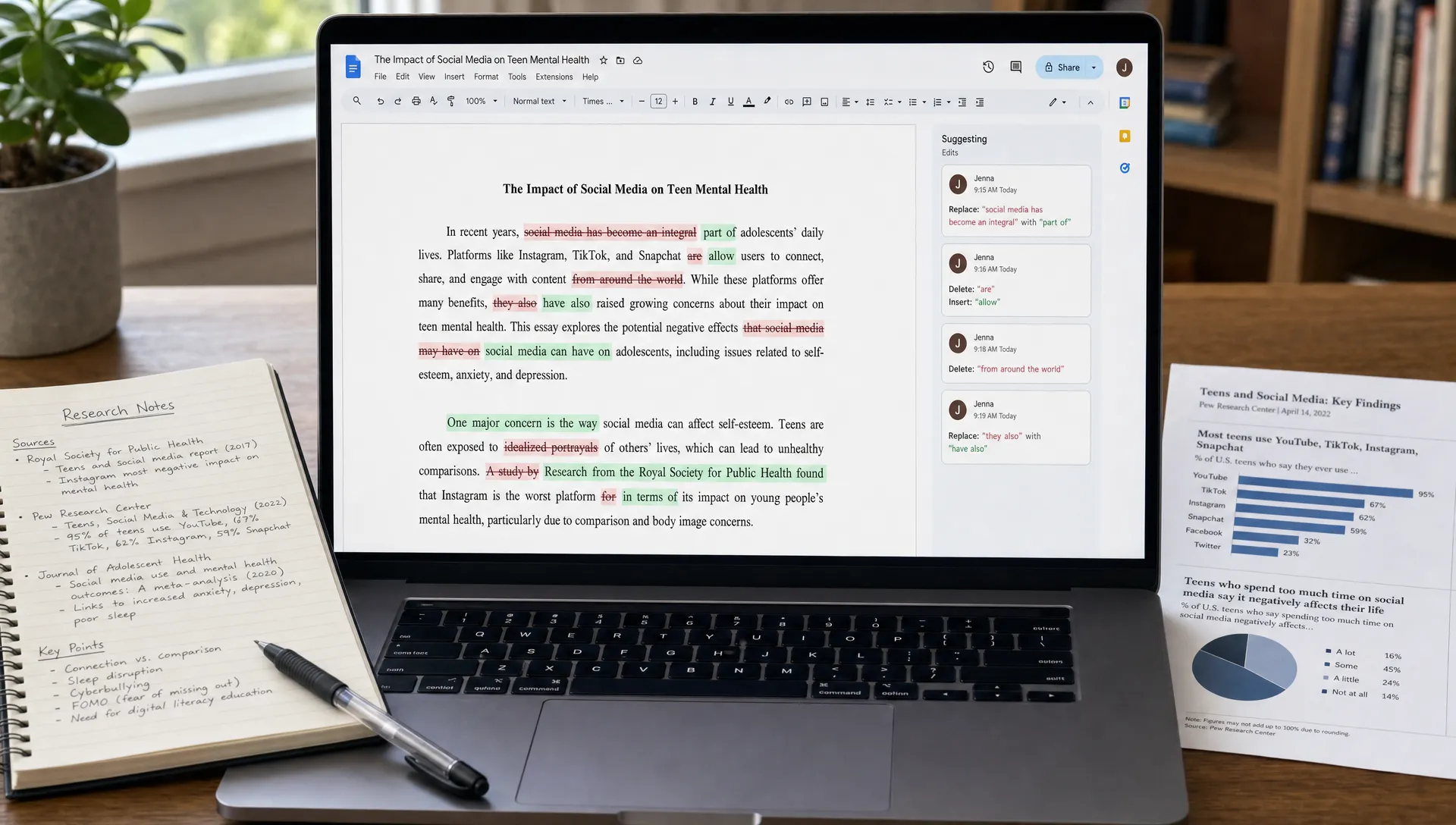
Google Docs version history can be strong evidence, but it is not always enough by itself.
Google explains that version history lets users view earlier versions of a file and see edits over time in Docs, Sheets, and Slides. You can find the official instructions in Google’s help page on viewing changes and version history.
For authorship disputes, a good version history can show a realistic writing process. For example, it may show that you started with a rough outline, added source notes, drafted paragraphs gradually, changed your thesis, inserted citations, revised wording, and corrected mistakes over several sessions. That kind of progression is much more persuasive than a single finished document.
But version history has limits. If you drafted offline and pasted the essay into Google Docs at the end, the history may show one large paste even though the work was yours. If you made a new copy of a document, some historical context may be lost. If you wrote quickly in one sitting, the history may be short. If you used a school template, shared device, or browser crash recovery, the timeline may look strange.
In other words, Google Docs history is evidence, not a courtroom verdict. Detection Drama covers this nuance in more depth in its guide on whether Google Docs or Word version history is enough as proof.
What to preserve if your Google Docs paper is flagged
If your paper gets questioned, do not start deleting drafts, renaming files, rewriting the whole essay, or creating fresh copies. Those actions can accidentally weaken your evidence.
Preserve the original document first. Keep the Google Doc intact, including comments, suggestions, timestamps, and version history. If you need to make changes for a resubmission, make a separate copy and clearly label it, but keep the original untouched.
Then gather supporting materials that show how the paper developed. Helpful evidence may include your outline, research notes, annotated sources, bibliography drafts, screenshots of library searches, assignment planning notes, earlier paragraphs, teacher feedback, tutor comments, and in-class writing samples. The goal is not to overwhelm your instructor. The goal is to show a coherent path from assignment prompt to final paper.
A simple authorship packet might include:
| Evidence | Why it helps |
|---|---|
| Google Docs version history | Shows when and how the document changed |
| Outline or planning notes | Shows your structure before the final prose existed |
| Annotated sources | Shows engagement with research, not just finished claims |
| Draft paragraphs | Shows development of ideas and wording |
| Comments or suggestion mode edits | Shows revision decisions and outside feedback |
| In-class writing samples | Gives a comparison point for your natural voice |
| Citation notes | Helps explain similarity matches caused by quoted or paraphrased material |
If you used any AI writing tools in a way your course allows, be honest and preserve that record too. Some classes allow brainstorming, outlining, grammar help, or citation assistance. Others ban all AI use. Your defense is much stronger when it matches the actual course policy.
What to do if Turnitin flags a paper you wrote in Google Docs
If you are facing an accusation or a nervous email from an instructor, respond calmly and methodically.
- Ask what was flagged: Find out whether the issue is Turnitin similarity, Turnitin AI detection, citation formatting, a style mismatch, or a combination of concerns.
- Request the relevant report or summary: If your school allows students to view the report, look at the exact passages highlighted instead of guessing.
- Save the original Google Doc: Do not delete comments, accept all suggestions, overwrite drafts, or create a new “clean” version as your only copy.
- Prepare a short process explanation: Write a factual timeline of when you researched, outlined, drafted, revised, and proofread the paper.
- Share version history if appropriate: Offer to walk the instructor through the version history rather than sending random screenshots with no context.
- Connect evidence to the flagged sections: If Turnitin highlighted one paragraph, show the notes, source, or earlier draft that led to that paragraph.
- Ask for human review under school policy: A detector result should be reviewed with context, especially when you can show drafts and process evidence.
The tone of your response matters. Avoid saying, “Turnitin is wrong, so this is unfair,” even if you feel that way. A better approach is: “I wrote this paper myself, and I can show my drafting process. Could we review the flagged sections alongside my Google Docs history and research notes?”
That framing moves the discussion away from panic and toward evidence.
How to reduce the risk next time
You cannot guarantee that an AI content detector will never flag your writing. But you can reduce the chance of a messy dispute by making your writing process visible from the beginning.
Start major assignments in the same document where you plan to finish them. Add your outline, messy notes, source quotes, and early thesis attempts before the final draft. Use comments to mark why you chose certain evidence. Keep suggestion mode edits when they show meaningful revision. Avoid pasting a fully finished essay into a blank Google Doc unless you also preserve where that essay was drafted.
Most importantly, make your paper specific. AI-like writing often feels generic because it summarizes the obvious. Human academic writing becomes more defensible when it shows real choices: why one source matters more than another, how a class concept changed your interpretation, where your argument narrowed, and what tradeoffs you made while revising.
If you use grammar tools, paraphrasers, translators, or a text humanizer, understand your school’s rules first. A tool that polishes every sentence can blur your natural voice, especially if it replaces your wording with generic academic phrasing. Use support tools to clarify your own writing, not to replace your authorship.
Frequently Asked Questions
Can Turnitin tell that I wrote my essay in Google Docs? Not in the sense students usually mean. Turnitin generally analyzes the submitted document, not the private drafting environment. Your instructor may separately review your Google Docs history if you share it or if your school uses connected tools.
Can Turnitin flag something that is 100% human-written? Yes. AI detection is probabilistic, not perfect. A flag means the text matched patterns the system associates with AI-generated content. It does not automatically prove misconduct.
Does Google Docs version history clear me automatically? No. It can be strong supporting evidence, especially if it shows gradual drafting and revision, but it still needs to be interpreted by a human reviewer.
What if I pasted my own essay into Google Docs at the end? Explain where the earlier drafting happened and provide that evidence if you have it. A large paste can look suspicious, but it is not proof of AI use.
Can my teacher demand to see my Google Docs history? That depends on your institution’s academic integrity policy, privacy rules, and assignment requirements. If asked, you can request a clear explanation of what evidence is needed and how it will be reviewed.
Should I run my paper through multiple AI detectors before submitting? Be careful. Different detectors often disagree, and uploading work to third-party sites can create privacy or originality concerns. If you do a pre-check, understand the tool’s data policy and do not treat the score as a final truth.
Need a clearer way to understand AI detection?
A Google Docs draft can help you prove process, but it will not automatically stop a Turnitin AI flag. If you want to understand why certain writing sounds detector-like, explore the guides and resources at Detection Drama. Use them responsibly, follow your school’s AI policy, and keep evidence that shows your work is genuinely yours.
