Pangram vs Turnitin is not a close race on accuracy: in the only independent head-to-head, Pangram flagged 39 of 40 fully AI papers and Turnitin flagged none. But Turnitin is the score your instructor sees, and Pangram cannot predict it.
Runs Detection Drama and covers AI detectors and humanizers. I ran no detector checks for this piece. It is based on a peer-reviewed 2026 study, both companies’ own documentation, one published paired dataset, news reports and reader posts on Reddit, all read on 20 and 21 November 2026. Reddit comments are people’s claims, not verified facts. Neither company paid for this article.
Want to bypass Turnitin in 2026? Grab the free prompt pack.
Get the exact text-humanization prompts I use to drop an AI score by hand — copy, paste, submit. Free, straight to your inbox.
Send me the free prompts →Last updated: 21 November 2026
Key Takeaways
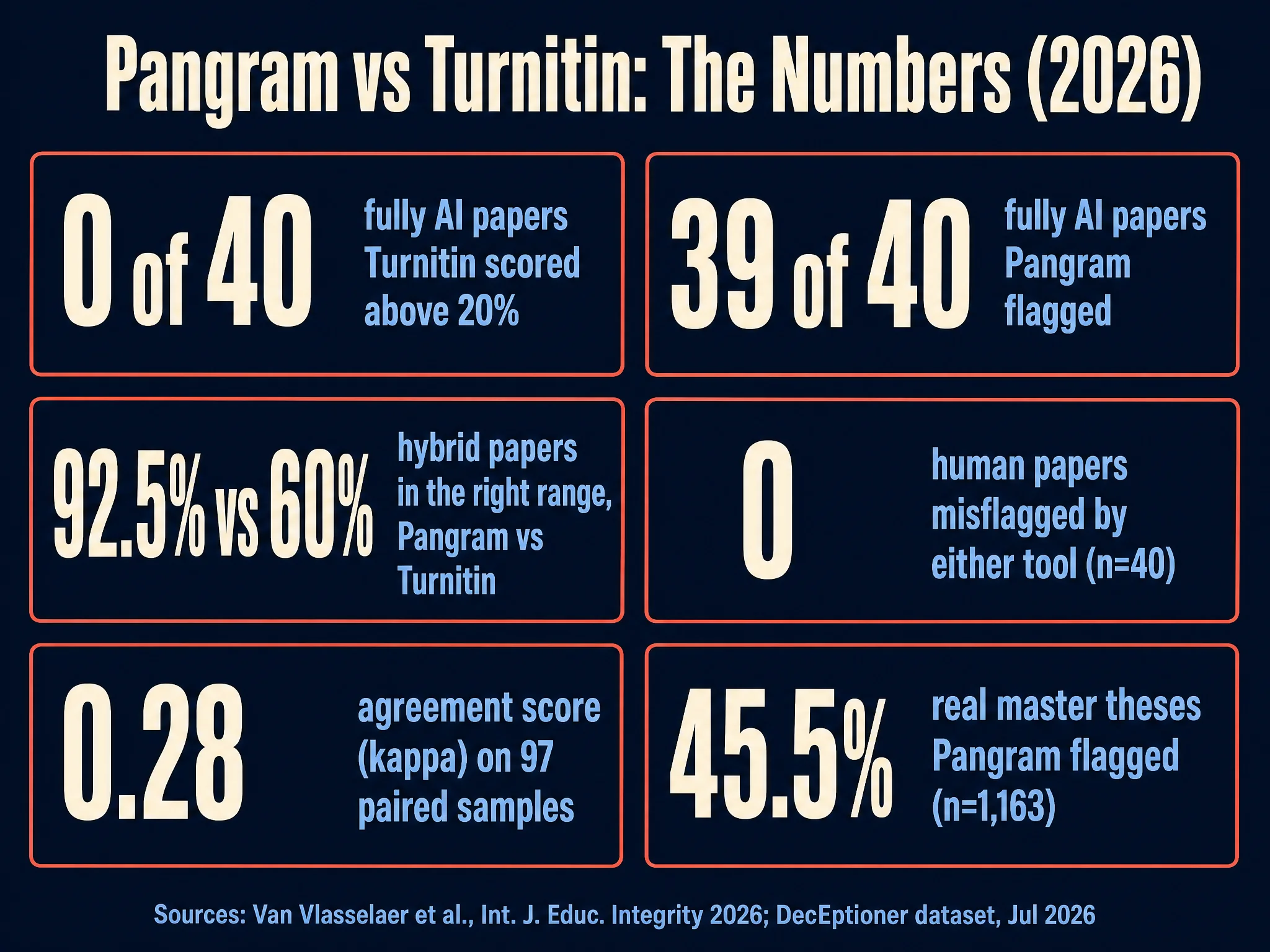
- In a 2026 peer-reviewed test of 160 papers, Turnitin put all 40 fully AI papers in its 0 to 20% band, while Pangram flagged 39 of them (Van Vlasselaer et al., Int. J. Educational Integrity).
- Neither tool misflagged any of the 40 human papers in that study, so the gap is about missed AI, not false accusations.
- On papers that mixed human and AI text, Pangram landed in the right range 92.5% of the time and Turnitin 60%.
- A Pangram pre-check does not predict Turnitin: in a published set of 97 paired results the two agreed only weakly (Cohen’s kappa 0.28), and the most common split was Turnitin 0% with Pangram 100% (DecEptioner dataset).
- The false positive numbers each company quotes about the other are not independent: Pangram puts Turnitin at about 1 in 200, Turnitin claims under 1% for documents above 20% AI.
- Anyone can run Pangram on a free tier or from $20 a month. Turnitin sells no individual license, so the only real Turnitin score is the one your school runs.
Is Pangram or Turnitin more accurate?
Pangram is more accurate on the only independent comparison that tested both on the same papers. Researchers at Vrije Universiteit Brussel ran 160 academic papers with known authorship through Pangram, Turnitin, GPTZero and Copyleaks and published the results in June 2026 (Van Vlasselaer, Van Droogenbroeck and Spruyt).
The papers came in four groups of 40: fully human, fully AI-written (ChatGPT Deep Research and GPT-4o), hybrid papers with AI passages inserted into human text, and AI passages “humanised” with a prompt. Here is how the two tools did.
| Paper type (40 each) | Pangram | Turnitin |
|---|---|---|
| Fully human | 100% correct (0 misflagged) | 100% correct (0 misflagged) |
| Fully AI | 65% strict, 97.5% inclusive (39 flagged, 1 uncertain) | 0% (all 40 scored 0 to 20%) |
| Hybrid (human + AI passages) | 92.5% strict | 60% |
| Humanised AI passages | 92.5% strict | 50% |
| Average error on fully AI papers | -14.3 points | -99.6 points |
“Strict” means the score fell in the exact expected band, “inclusive” means it was at least partly right. The authors’ own summary is blunt: of the four tools, only one produced satisfactory results, and that was Pangram.
Two limits matter before you treat this as settled. The sample is 40 papers per group, not thousands. And Turnitin has shipped several model updates since 2025, including AI bypasser detection on 27 August 2025 and recall updates in October 2025 and February 2026, so today’s Turnitin may score the same papers higher. We cover that change in Turnitin now detects AI humanizers.
What are Pangram and Turnitin, and who can use each?
Pangram is a standalone AI text detector from Pangram Labs that anyone can use. Its pricing page lists an Individual plan at $20 a month for up to 300,000 words, a Professional plan at $65 a month, and a limited free tier. Our Pangram review covers the product in detail.
Turnitin is the plagiarism and AI writing platform that schools license. It does not sell individual licenses, so a student only sees an AI score if the instructor shares it. Sites that sell “Turnitin reports” are resellers or unrelated tools, as we explain in can you use Turnitin for personal use.
How do Pangram and Turnitin compare side by side?
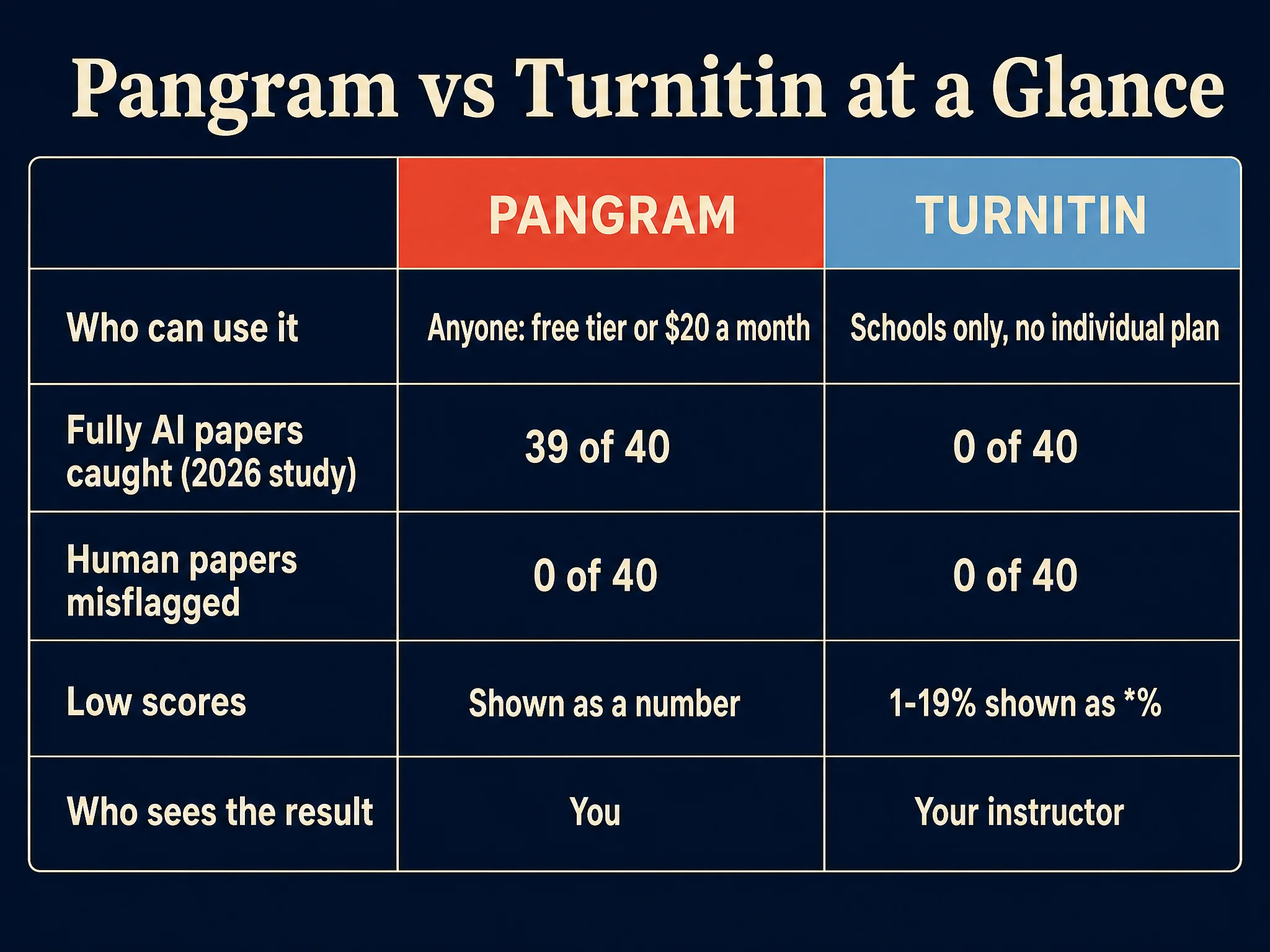
They differ most on access, on how low scores are shown, and on who sees the result. The table pulls the documented differences together.
| Pangram | Turnitin | |
|---|---|---|
| Who can run it | Anyone, free tier or paid plan | Only institutions with a license |
| Price | $20/month Individual, $65/month Professional | Quoted to schools, not public |
| Scores from 1 to 19% | Shown as a number | Shown as an asterisk (*%) with no number or highlights |
| Minimum length | Short texts accepted | 300 words; up to 30,000 words of qualifying text |
| AI bypasser / humanizer detection | Trained on AI-edited text | Added 27 August 2025 |
| Who sees the result | You | Your instructor |
| Fully AI papers caught (2026 study) | 39 of 40 | 0 of 40 |
The asterisk is the detail that trips most students up. Turnitin says it hides scores from 1 to 19% because false positives are more common in that range (Turnitin Guides). Pangram shows the number. So “Pangram 12%, Turnitin *%” is often the same reading displayed two ways. Our explainer on what the Turnitin asterisk means goes deeper.
Does passing Pangram mean you will pass Turnitin?
No, and the reason is not what most students assume. People on Reddit use Pangram as a “preliminary detector” before Turnitin, as one r/BypassAiDetect poster put it while admitting they were “not sure how bad turnitin is” (thread, October 2026). The data says the two tools rarely give the same number.
A humanizer vendor, DecEptioner, published 100 texts that had both a Pangram and a Turnitin result, 97 of them comparable (July 2026). The two agreed on the exact score in 49 of 97 cases and on a broad high or low call in 56. Cohen’s kappa, a standard agreement measure, was 0.28, which is weak. Treat this as indicative: the vendor sells a humanizer and did not say where the texts came from.
The direction of the disagreement is the useful part. The single most common pairing was Turnitin 0% with Pangram 100%, in 34 samples. Pangram also tended to give extreme scores: only 0, 68 and 100 appeared in its column. That matches the Brussels study, where Turnitin under-scored AI text and Pangram did not.
Whose false positive numbers should you believe?
Believe the independent numbers first, then each company’s claims about itself, and the companies’ claims about each other last. The table shows why the sources disagree.
| Claim | Who says it | Independent? |
|---|---|---|
| Pangram false positive rate about 1 in 10,000; Turnitin about 1 in 200 | Pangram | No, vendor comparing itself to a rival |
| On 300+ word ESL essays: Pangram 0.02%, Turnitin 1.4%; native English: 0.00% vs 1.3% | Pangram, 25,021 texts | No, but it re-ran the datasets Turnitin used in its own public evaluation |
| Turnitin document false positive rate under 1% for documents with over 20% AI writing | Turnitin, May 2023 | No, vendor claim about itself |
| 0 of 40 human papers misflagged by either tool | Van Vlasselaer et al. | Yes, but a small sample |
The honest summary: on human writing, both tools look careful in independent testing, and Pangram’s own larger tests suggest it is more careful still. Turnitin’s sub-1% claim only covers documents scored above 20%, which is why it hides lower scores behind the asterisk. For every published rate across tools, see our AI detector disagreement statistics.
Where does Pangram get it wrong?
Pangram’s errors in public reports mostly run toward missing AI or odd edge cases, not toward accusing humans. In November 2026 one r/LocalLLM user said they shuffled every word of a 1983 book passage into word salad and Pangram still called it 100% human (reader report). Another r/BypassAiDetect user said Originality.ai scored their rewrite 97% human while Pangram kept flagging it as AI paraphrased (reader report). Both are single unverified claims, but they show the tool is a classifier, not a judge.
What should you do when Pangram and Turnitin disagree?
Read the disagreement by its direction, then act on your writing process, not the score. Pick your two results below to see what the evidence suggests.
Pangram said one thing, Turnitin another
Pick one Pangram result and one Turnitin result.
Whatever the combination, the same three rules hold. Keep your drafts and version history, because process evidence settles disputes that scores cannot; our guide to what writing-process trackers prove shows which records count. Do not rewrite clear human sentences just to move a detector. And if you are already facing a question from an instructor, follow what to do in the first 24 hours. For the general case of one tool saying human and Turnitin saying AI, see AI detector says human, Turnitin says AI.
Why is Pangram showing up in courts, journals and newsrooms?
Because it is the detector outsiders trust most, which raises the stakes when it is wrong. In November 2026, 404 Media reported that Department of Justice lawyers were using Pangram results to argue that defense attorneys’ filings were AI-written, in a voter fraud case (404 Media, 17 November 2026). The story drew a 60-comment thread on r/law (thread).
Pangram also runs inside Substack’s AI label, which we covered in Substack’s AI detector, and the Brussels team ran it on 1,163 real master’s theses, where it flagged 529 (45.5%) for some AI use, mostly at low to moderate levels. Turnitin stays inside education. For a student, that split means Pangram is the tool you can check yourself, and Turnitin is the one with consequences.
Which one should you use?
Use Pangram if you want the most accurate public check of your own text, and use Turnitin’s result if your school shares it, because that is the one that counts. You will rarely get to choose Turnitin; your institution does.
Choose Pangram when you are a student, writer or editor checking your own work, when you want a number rather than an asterisk, or when you need to test text under 300 words. Its strictness is a feature for honest self-checks and a nuisance if you used AI for heavy editing.
Rely on Turnitin when your instructor has run it and shared the report, because that report is what any decision will be based on. Read it with the asterisk rule and the 2026 study in mind: a low Turnitin score is weaker evidence of human writing than a low Pangram score.
If you are weighing Pangram against other public detectors instead, see Pangram vs GPTZero and Pangram vs Originality.ai. If you are wondering whether a humanizer gets past it, our evidence review of humanizers against Pangram is the place to start.
Frequently asked questions
Is Pangram more accurate than Turnitin?
In the only independent head-to-head, yes. Pangram flagged 39 of 40 fully AI papers and Turnitin flagged none above 20%. On hybrid papers Pangram was right 92.5% of the time and Turnitin 60%. Neither misflagged any of the 40 human papers.
Does Pangram use the same model as Turnitin?
No. They are separate companies with separate models. Turnitin builds its detector in-house and licenses it to schools; Pangram sells its own detector to individuals and institutions.
If Pangram says my essay is human, will Turnitin say the same?
Probably, but not certainly. No public checker predicts Turnitin. In a published set of 97 paired results the two agreed only weakly, and most disagreements were Pangram scoring higher than Turnitin, not lower.
Why does Pangram say 100% when Turnitin shows an asterisk?
Turnitin hides any AI score from 1 to 19% behind an asterisk, and in the 2026 study it put fully AI papers in that band. Pangram tends to give extreme scores. A gap like this usually means Turnitin under-scored the text.
Can I run my paper through Turnitin myself?
Not legitimately. Turnitin does not sell individual licenses. Sites offering a “Turnitin report” are resellers or different detectors, and uploading to them can put your paper in a database you do not control.
How much does Pangram cost?
Pangram lists an Individual plan at $20 a month for up to 300,000 words and a Professional plan at $65 a month, plus a limited free tier. Check its pricing page before you pay, because plans change.
Can a Pangram or Turnitin score prove I used AI?
No. Both are statistical classifiers. The 2026 study authors say detection results should not be used as sole evidence in high-stakes decisions. Drafts, notes and version history are what prove how you wrote something.
How this article was put together: no detector checks were run for it. Figures come from the peer-reviewed Van Vlasselaer et al. study (160 papers, plus 1,163 theses checked by Pangram), Pangram’s and Turnitin’s own documentation and pricing pages, the DecEptioner paired dataset (97 comparable texts, vendor-published), and 404 Media’s reporting. Reddit posts are quoted as claims. Sources were read on 20 and 21 November 2026.
