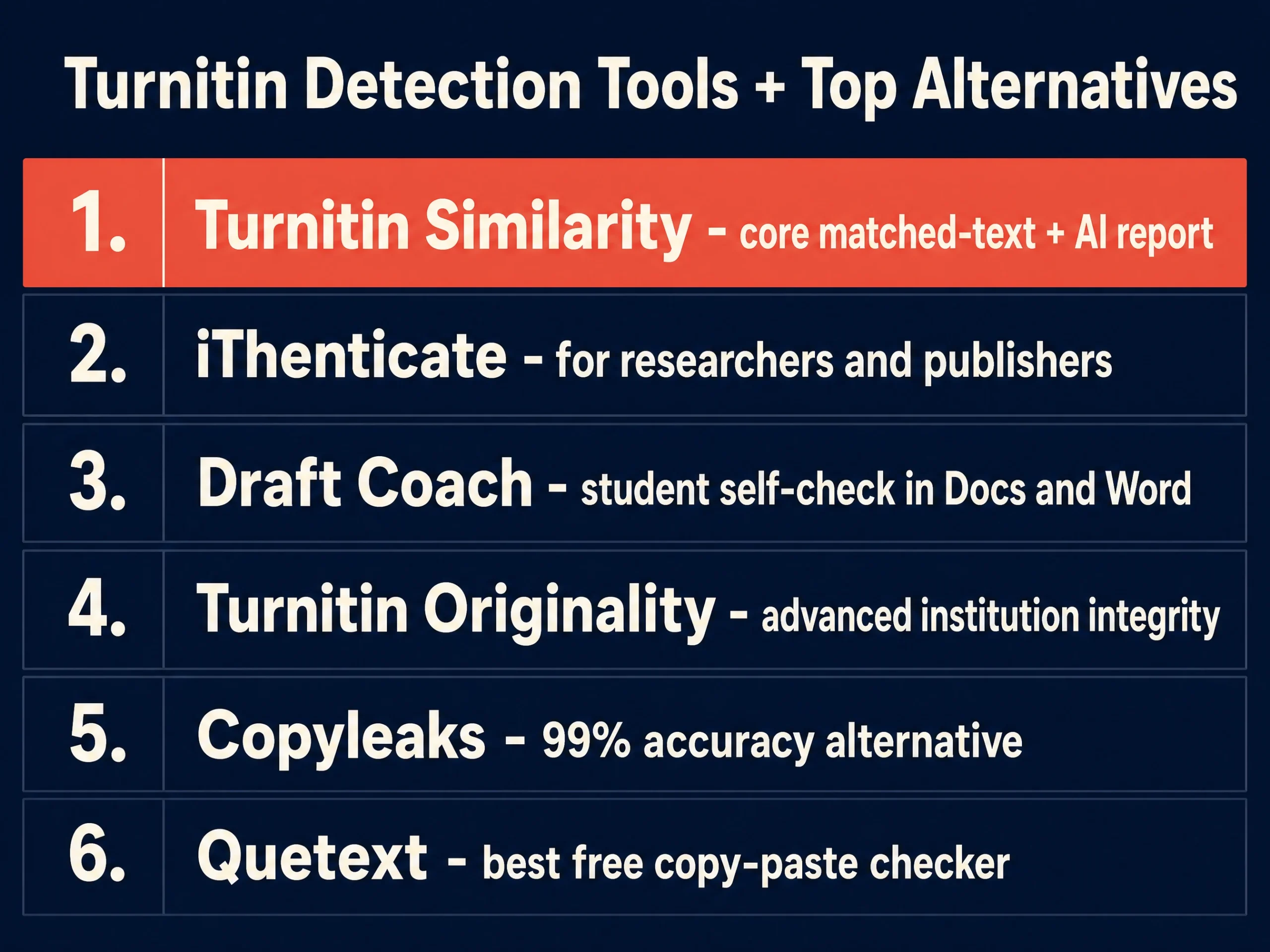
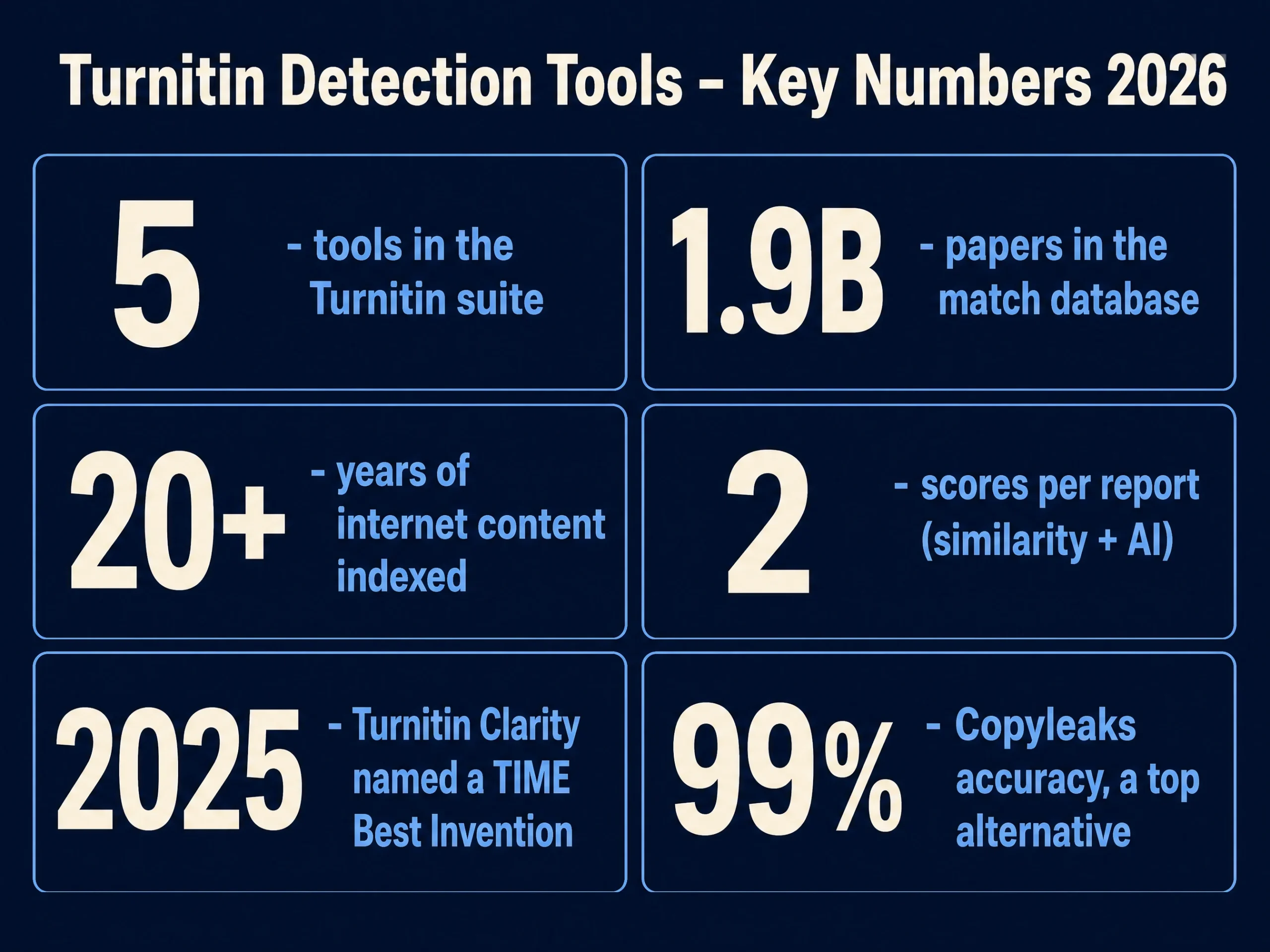
Turnitin’s plagiarism detection tools are a suite, not one product: Turnitin Similarity for classrooms, iThenticate for researchers, Draft Coach for student self-checks, and Turnitin Originality for advanced institutional integrity — all built on the same 1.9-billion-paper match database. The strongest independent alternatives are Copyleaks and Quetext.
Want to bypass Turnitin in 2026? Grab the free prompt pack.
Get the exact text-humanization prompts I use to drop an AI score by hand — copy, paste, submit. Free, straight to your inbox.
Send me the free prompts →Key Takeaways
- Turnitin sells four detection tools on one engine: Similarity, iThenticate, Draft Coach, and Originality (Turnitin).
- Every report can carry two scores — a Similarity (matched-text) score and a separate AI Writing score.
- iThenticate is the same detection engine aimed at researchers and journal publishers, not students.
- Draft Coach is the only Turnitin tool students can run themselves, inside Google Docs and Word.
- Turnitin Clarity was named one of TIME’s Best Inventions of 2025.
- The best non-Turnitin options are Copyleaks (reported 99% accuracy) and Quetext for a genuinely useful free tier (Red Paper test).
What makes a good plagiarism detection tool?
Three things separate an institutional-grade detector from a free web toy. First, database depth — matching against student papers and paywalled journals, not just the open web. Second, a separate, transparent AI-writing signal, since 2026 disputes are about machine text as much as copied text. Third, workflow fit: does it live where the work happens, inside Canvas, Google Docs, or a publisher’s submission system?
Turnitin wins on the first because of scale — a 1.9-billion-paper archive plus 70+ billion web pages. Where it is beatable is price and false-positive tolerance, which is exactly where alternatives compete. For the underlying distinction that trips people up, read Turnitin AI vs similarity.
How was this list chosen?
I grouped the tools by who actually uses them — students, instructors, researchers, institutions — then ranked within each group by database access and independent accuracy testing. Turnitin’s own products lead because they share the match database schools rely on; alternatives are included only where independent 2026 tests put their accuracy near institutional grade. For a fuller primer on the platform itself, see what Turnitin software is.
Which are the Turnitin plagiarism detection tools?
1. Turnitin Similarity — the core classroom tool
Similarity is the product most people mean when they say “Turnitin.” It compares a submission against the full match database and returns the Similarity score plus, since 2023, the AI Writing Indicator. It runs inside the LMS, so instructors see reports without students ever visiting a website. This is the tool your grade is measured against.
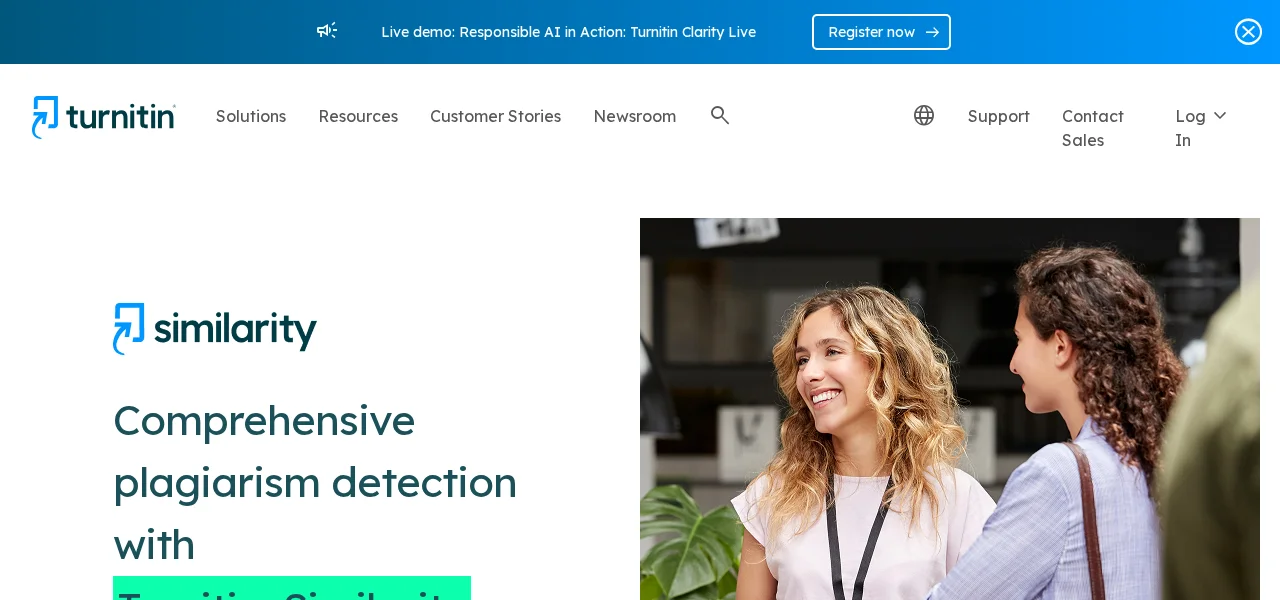
Screenshot: Turnitin Similarity (turnitin.com), captured July 2026.
2. iThenticate — for researchers and publishers
iThenticate is the same detection engine pointed at academic publishing. Journals and researchers use it for pre-publication similarity checks against scholarly databases, catching self-plagiarism and duplicate submissions before a manuscript goes out. If you are a graduate student writing for publication, this is the report an editor may run. We break it down in our iThenticate review.
3. Draft Coach — the student self-check
Draft Coach is the only Turnitin tool students operate themselves. It installs as a Google Docs or Microsoft Word add-on and lets you run your own similarity, citation, and grammar checks before submitting — but only if your institution licenses it. It is the legitimate answer to wanting a free Turnitin check before submitting.
4. Turnitin Originality — advanced institutional integrity
Originality bundles plagiarism and AI detection with deeper investigative signals for institutions that need more than a classroom report — think contract-cheating and paper-mill detection. It targets integrity offices rather than individual instructors, and sits alongside Feedback Studio, Turnitin’s grading layer.
5. Copyleaks — the strongest alternative
Outside the Turnitin ecosystem, Copyleaks is the most credible institutional alternative, with reported accuracy over 99% and low false positives, plus native integration with Canvas, Moodle, Blackboard, and Google Docs. It is the tool schools most often evaluate against Turnitin.
6. Quetext — the best free option
For a no-cost gut-check, Quetext’s DeepSearch free tier is the most useful for catching obvious copy-paste, and it added AI detection. It will not see Turnitin’s private student-paper database, so treat its number as an estimate, not a verdict (Quetext’s own tools guide; broader tested list at Paperpal). If you also use a paraphraser like QuillBot, see our QuillBot review and how the Turnitin asterisk reads on the report.
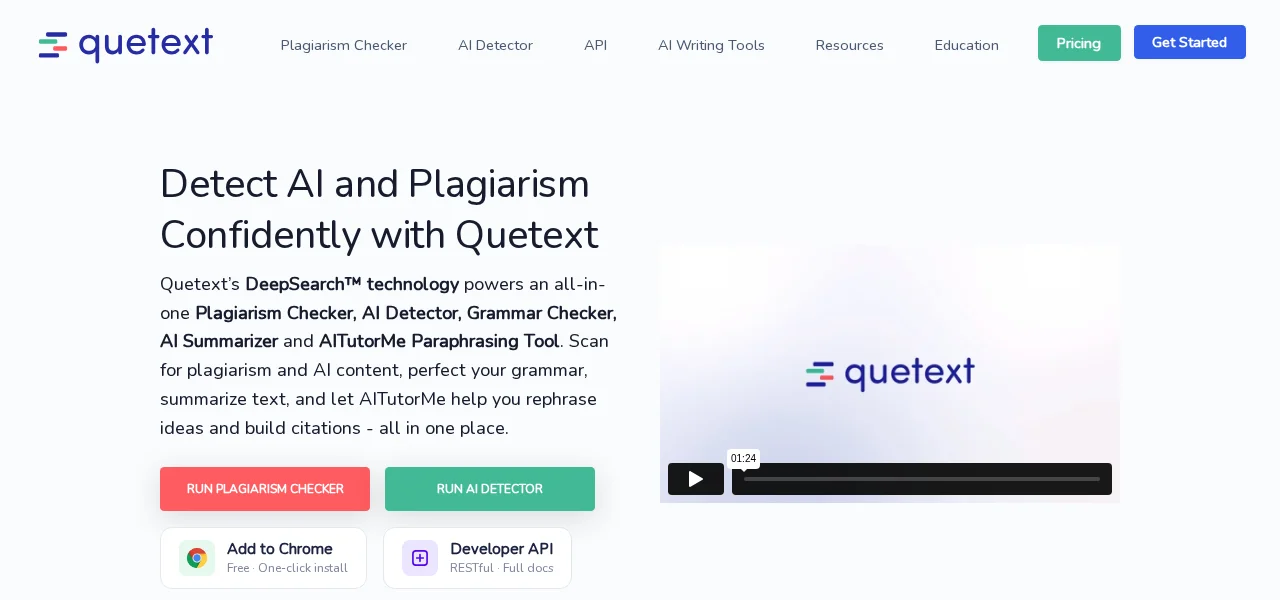
Screenshot: Quetext (quetext.com), captured July 2026.
How do the tools compare?
| Tool | Who it’s for | AI detection? | Self-serve? |
|---|---|---|---|
| Turnitin Similarity | Instructors | Yes | No (LMS only) |
| iThenticate | Researchers / publishers | Limited | Institution / publisher |
| Draft Coach | Students | Similarity + citations | Yes (if licensed) |
| Turnitin Originality | Integrity offices | Yes + investigative | No |
| Copyleaks | Schools / business | Yes (99% reported) | Yes |
| Quetext | Students / writers | Yes | Yes (free tier) |
Which plagiarism detection tool should you use?
Match the tool to your role. If you are a student, you cannot pick Turnitin Similarity — your school does — so use Draft Coach if it is available and Quetext as a rough pre-check. If you are an instructor or admin, the real decision is Turnitin versus Copyleaks, and it usually comes down to database needs, false-positive tolerance, and budget. If you are publishing research, iThenticate is the expected standard.
Whatever the tool, remember its output is a signal, not a verdict — a point worth keeping in mind given how many universities have restricted AI detectors and why correctly quoted text still gets flagged.
Get the free text-humanization prompts
Get the exact text-humanization prompts I use to drop an AI score by hand — copy, paste, submit. Free, straight to your inbox.
Free · No credit card · Straight to your inbox
Frequently asked questions
How many plagiarism detection tools does Turnitin have?
Four main ones: Turnitin Similarity (classrooms), iThenticate (researchers/publishers), Draft Coach (student self-checks), and Turnitin Originality (institutional integrity). All share the same match database.
What is the difference between Turnitin Similarity and iThenticate?
Same detection engine, different audiences. Similarity serves classrooms through the LMS; iThenticate serves researchers and journal publishers for pre-publication checks.
Can students use any Turnitin detection tool directly?
Only Draft Coach, and only if the institution licenses it. It runs in Google Docs and Word for pre-submission self-checks.
What is the best alternative to Turnitin?
Copyleaks is the strongest institutional alternative, with reported 99% accuracy and LMS integrations. Quetext is the best free option for catching copy-paste.
Do these tools detect AI writing too?
Turnitin Similarity, Originality, Copyleaks, and Quetext include AI detection. Draft Coach focuses on similarity and citations rather than AI scoring.
Are free plagiarism tools as accurate as Turnitin?
No. Free tools catch obvious copy-paste but cannot access Turnitin’s private student-paper database, so they miss matches Turnitin is built to find. Use them as an estimate only.
Methodology: Tool descriptions are sourced from Turnitin’s official product pages and 2026 independent tool tests (Red Paper’s 15-tool ranking, Paperpal’s tested alternatives). Screenshots of Turnitin Similarity and Quetext were captured directly in July 2026. Accuracy figures are the vendors’ or testers’ reported numbers, not our own lab results. No affiliate placement determined the ranking.