Turnitin is academic-integrity software that checks written work against a database of student papers, journals, and web pages, returning two separate scores: a Similarity score for matched text and an AI Writing score estimating machine-generated content. It is sold to institutions, not individuals.
Want to bypass Turnitin in 2026? Grab the free prompt pack.
Get the exact text-humanization prompts I use to drop an AI score by hand — copy, paste, submit. Free, straight to your inbox.
Send me the free prompts →Key Takeaways
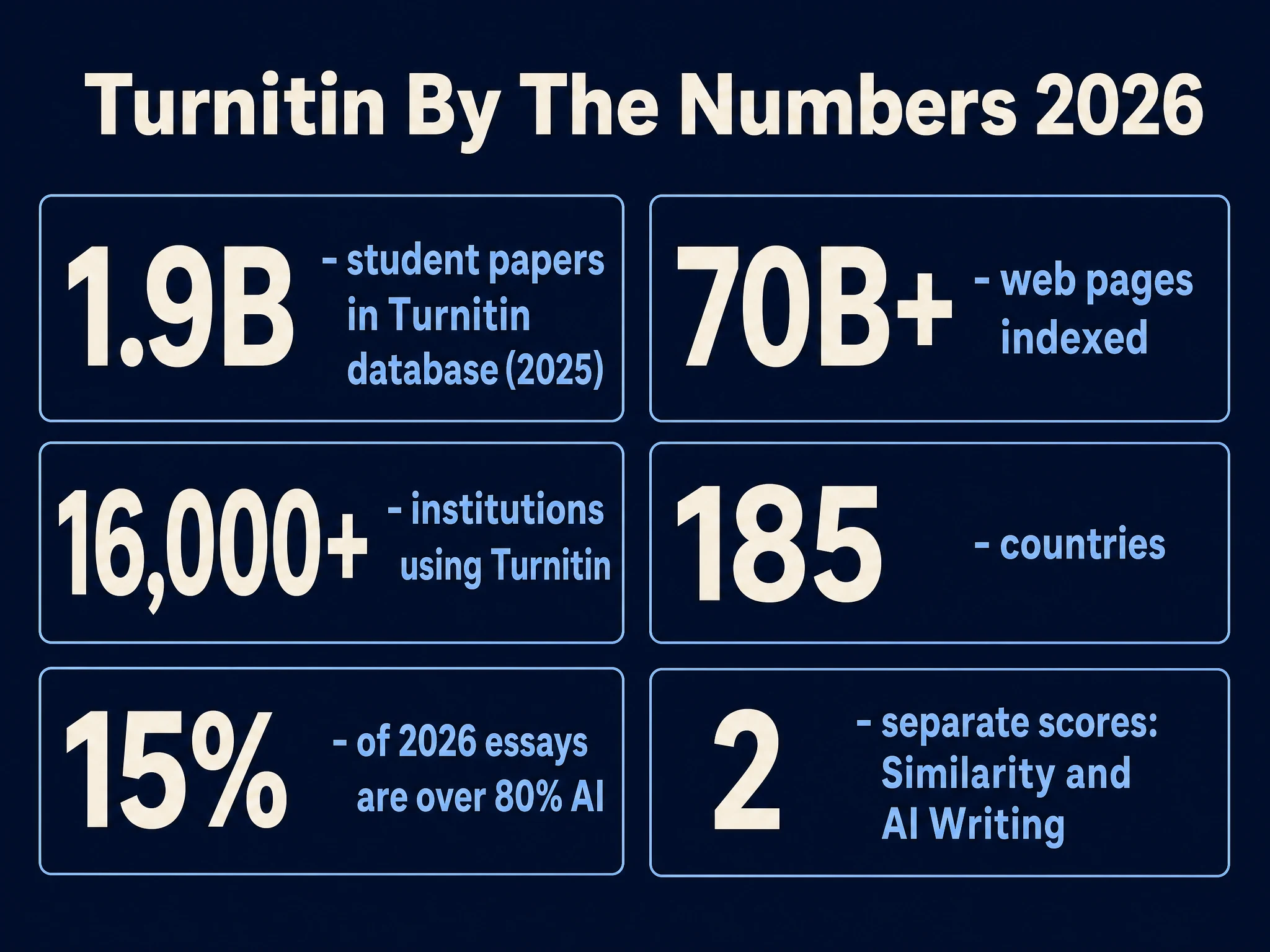
- Turnitin is used by 16,000+ institutions across 185 countries and checks work against a database of 1.9 billion student papers and 70+ billion web pages (Wikipedia, Turnitin).
- It returns two independent scores: the Similarity score (matched text) and the AI Writing score — they are calculated separately (Turnitin Guides).
- The AI detector reads perplexity and burstiness at the sentence level and covers GPT-3.5, GPT-4, GPT-4o, Claude, and Gemini output.
- Turnitin calls it a Similarity Report, not a plagiarism report — a high number is not proof of cheating, only of matched text.
- The product family includes Similarity, Feedback Studio, Draft Coach, and iThenticate for research and publishing.
- By early 2026, roughly 15% of essay submissions were over 80% AI, up from about 3% when the detector launched in 2023.
What is Turnitin software?
Turnitin is an academic-integrity platform that schools use to check submitted work for text matches and, since 2023, for AI-generated writing. A student uploads an essay through their course system, Turnitin compares it against a vast reference database, and the instructor receives a report highlighting matched passages and an AI-writing estimate. It has been the dominant tool in higher education for over two decades, running inside learning platforms like Canvas, Blackboard, and Moodle rather than as a website you visit.
The critical thing to understand is that Turnitin is business-to-business software. There is no consumer sign-up and no individual license — access comes through your institution. That is why students searching for a free Turnitin checker keep hitting paywalls and clone sites instead of the real product.
How does Turnitin software work?
When a paper is submitted, Turnitin tokenizes the text and compares it against its content databases: previously submitted student papers, a huge index of current and archived web pages, and licensed scholarly publications. Any overlapping strings are highlighted and rolled up into a single Similarity percentage that tells the instructor how much of the submission matches existing sources.
According to Turnitin’s own documentation, the AI Writing Indicator runs automatically alongside this check (Turnitin AI solutions). It scores each sentence for the probability that it was machine-generated, then reports the percentage of qualifying text the model believes is AI. That number is separate from the similarity score — a point we unpack in Turnitin AI vs similarity: what’s actually different.
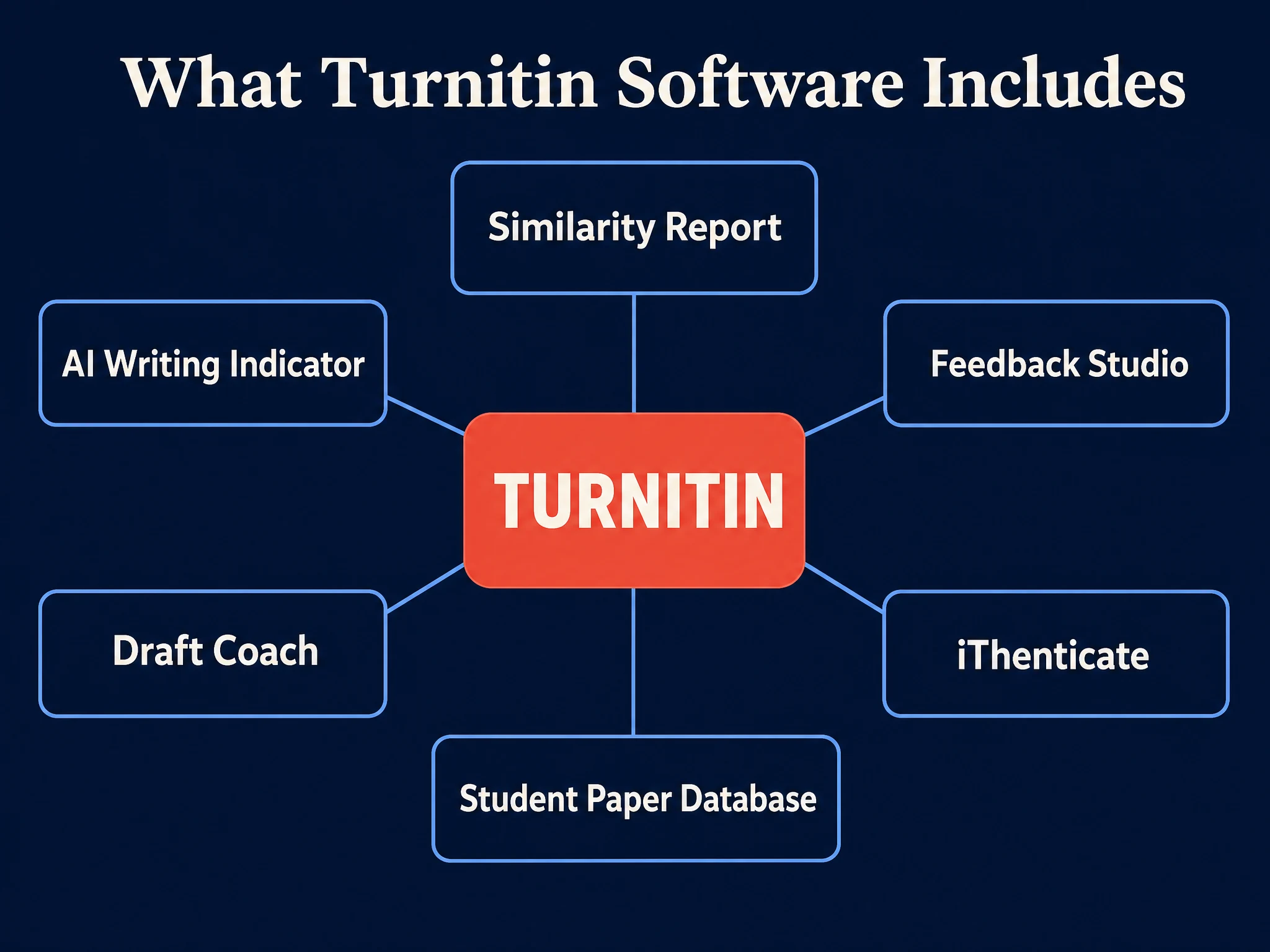
The core components bundled under the Turnitin name.
What are the two Turnitin scores?
Every enhanced Similarity Report can show two numbers, and confusing them causes most of the panic students feel.
The Similarity score
This is the percentage of your text that matches Turnitin’s database. Turnitin deliberately calls it a Similarity Report, not a plagiarism report, because matched text is not automatically misconduct — properly quoted and cited passages still register. Reading the color bands and symbols correctly matters; see what the Turnitin asterisk means and why quotes sometimes get marked as plagiarism.
The AI Writing score
This estimates how much of your writing was generated by a large language model. It relies on stylometric signals — perplexity (how predictable your word choices are) and burstiness (variation in sentence length) — and is trained on millions of human and AI texts. It is also the score most prone to false positives, which is why we track why Turnitin flags AI when other detectors don’t.
What products make up the Turnitin family?
| Product | Who it’s for | What it does |
|---|---|---|
| Turnitin Similarity | Instructors / institutions | Core matched-text + AI writing report |
| Feedback Studio | Instructors | Grading, inline comments, rubrics on top of Similarity |
| Draft Coach | Students (in Google Docs / Word) | Self-check similarity, citations, grammar before submitting |
| iThenticate | Researchers / publishers | Pre-publication similarity checking for journals |
iThenticate is the research-facing sibling most people don’t realize is the same company — we cover it in our iThenticate review.
Why does Turnitin software matter in 2026?
Because the stakes moved from copied text to machine-written text. Turnitin’s early-2026 data shows roughly 15% of essay submissions now score over 80% AI, versus about 3% at the 2023 launch. That surge is why the AI Writing score, not the classic similarity number, drives most academic-integrity disputes today.
It also matters because the tool is imperfect. A growing number of institutions have restricted or dropped AI detection over false-positive concerns, which we document in universities that banned AI detectors. Knowing what the software actually measures — and what it doesn’t — is the difference between a calm response to a flag and a panicked one.
What are common misconceptions about Turnitin?
The biggest is that a high similarity score equals plagiarism. It doesn’t; it means matched text, quotes and references included. The second is that Turnitin “stores and sells” your essay — it retains submissions in its comparison database for institutional matching, not resale. The third is that the AI score is a verdict. It is a probability estimate, and instructors are told to treat it as a prompt for conversation, not proof. If you have been flagged, start with how to lower your Turnitin AI score without humanizer tricks and what teachers actually see.
Get the free text-humanization prompts
Get the exact text-humanization prompts I use to drop an AI score by hand — copy, paste, submit. Free, straight to your inbox.
Free · No credit card · Straight to your inbox
Frequently asked questions
What does Turnitin software actually check?
Two things: text similarity against its database of student papers, web pages, and journals, and the probability that your writing was AI-generated. The two scores are calculated and reported separately.
Is Turnitin a plagiarism checker or an AI detector?
Both. It began as a similarity/plagiarism checker and added a separate AI Writing Indicator in 2023. A single submission can return both scores.
Can I buy Turnitin as an individual?
No. Turnitin is licensed to institutions, not individuals. Students access it through their school’s learning platform; there is no consumer subscription.
How big is Turnitin’s database?
Around 1.9 billion student papers as of 2025, plus 70+ billion web pages and licensed scholarly content, used across 16,000+ institutions in 185 countries.
Does a high Turnitin score mean I plagiarized?
Not necessarily. Turnitin calls it a Similarity Report because it counts all matched text, including correctly quoted and cited passages. Instructors interpret the context.
What is the difference between Turnitin and iThenticate?
Same company, different audience. Turnitin serves classrooms; iThenticate is built for researchers and publishers doing pre-publication similarity checks.
How accurate is Turnitin’s AI detection?
It is a probability estimate, not proof, and can produce false positives on human writing. That is why several institutions have limited its use and why instructors are told to treat it as a starting point for discussion.
Methodology: Figures are drawn from Turnitin’s official product and guide pages, its AI-writing solution documentation, and the Turnitin Wikipedia entry for database size (1.9B papers, 2025). AI-prevalence figures (15% over 80% AI in 2026 vs 3% in 2023) reflect Turnitin’s own release data as reported across 2026 coverage. No affiliate placement influenced the descriptions above.

Turnitin sits inside a crowded market. See the full list of AI detection tools universities use in 2026, including which schools switched detection off entirely.
