The Turnitin AI checker for teachers is a built-in AI Writing score that appears automatically inside the instructor’s Similarity Report when a student submits — but Turnitin itself says it must never be the sole basis for penalizing a student. It is a conversation starter, not proof.
Want to bypass Turnitin in 2026? Grab the free prompt pack.
Get the exact text-humanization prompts I use to drop an AI score by hand — copy, paste, submit. Free, straight to your inbox.
Send me the free prompts →Key Takeaways
- Teachers do not run a separate tool — the AI Writing score is built into the report inside Canvas, Moodle, and Blackboard (Turnitin Guides).
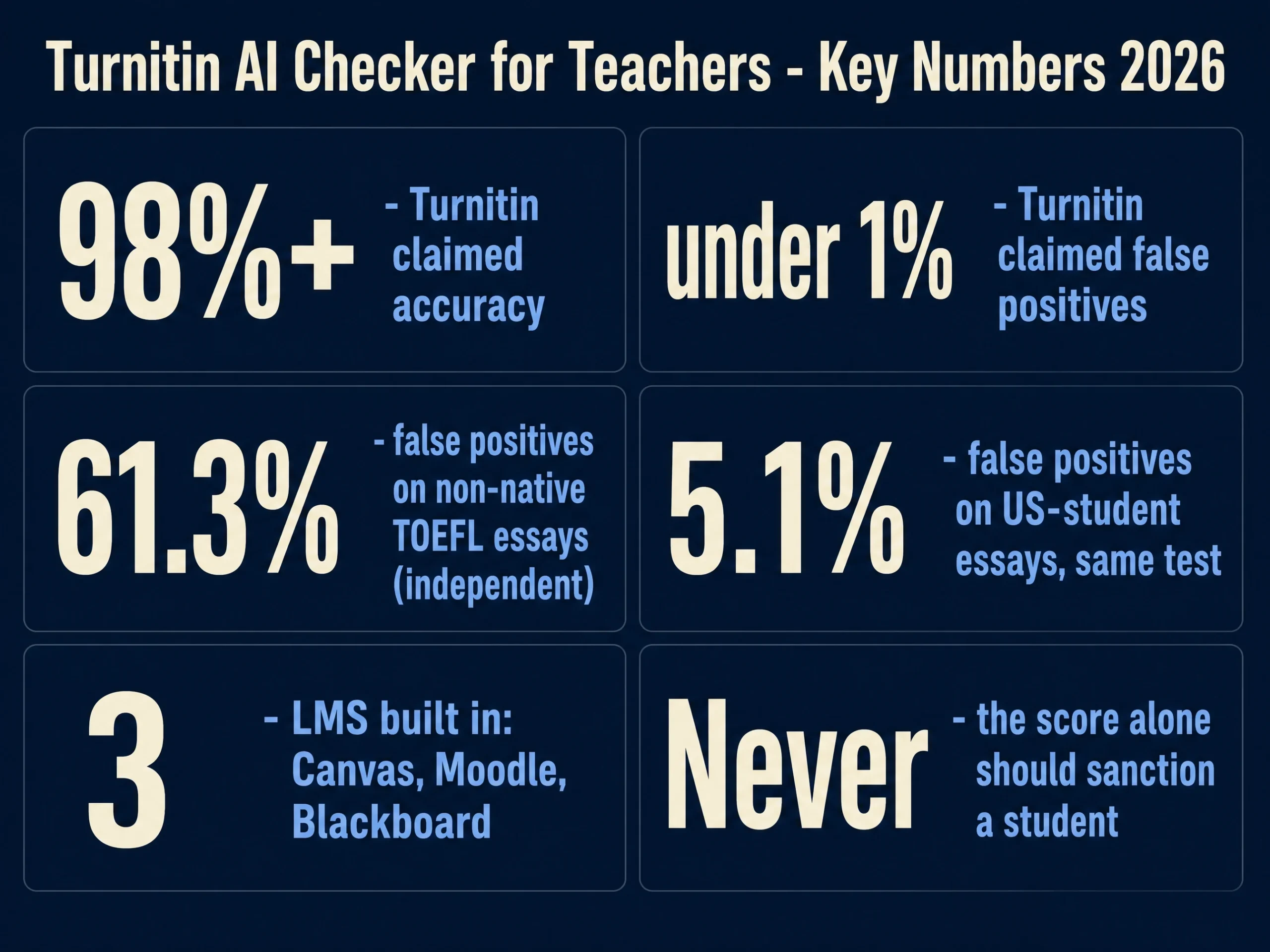
- Turnitin claims 98%+ accuracy and under 1% false positives, but that figure is disputed by independent research (Turnitin).
- One 2026 study found a 61.3% false-positive rate on TOEFL essays by non-native (Chinese) students versus 5.1% for US students in the same setup.
- Turnitin’s own guidance: the score should not be the sole basis for adverse action and requires human judgment.
- The AI score is separate from the Similarity score — a clean similarity result can still carry an AI flag.
- The strongest evidence in a dispute is process evidence: drafts, notes, and version history.
What is the Turnitin AI checker for teachers?
It is not a standalone product teachers open on its own. Turnitin’s AI writing detection is a model that runs automatically alongside the similarity check and surfaces an AI Writing score inside the same report the instructor already reviews for grading. When a student submits to a Turnitin-enabled assignment, the AI indicator processes the text and reports the percentage of qualifying writing the model believes was machine-generated.
For teachers, that means there is nothing extra to install or launch. The score is embedded in the Authorship/Similarity view, and it is entirely separate from the matched-text number — a distinction we unpack in Turnitin AI vs similarity and in the wider platform overview at what Turnitin software is.
How do teachers access the AI writing report?
The instructor has to enable Turnitin when creating the assignment; if it is on, the report generates automatically on submission. Inside the learning system, the teacher opens the submission and sees three things in one place: the similarity score, highlighted matched passages, and the AI Writing percentage with the flagged sentences shaded. Reports are exportable, which Turnitin positions as documentation for any integrity conversation.
There is no separate login and no student-visible AI score by default — students generally cannot see the AI percentage their teacher sees, which we cover in can teachers see your real Turnitin AI percentage.
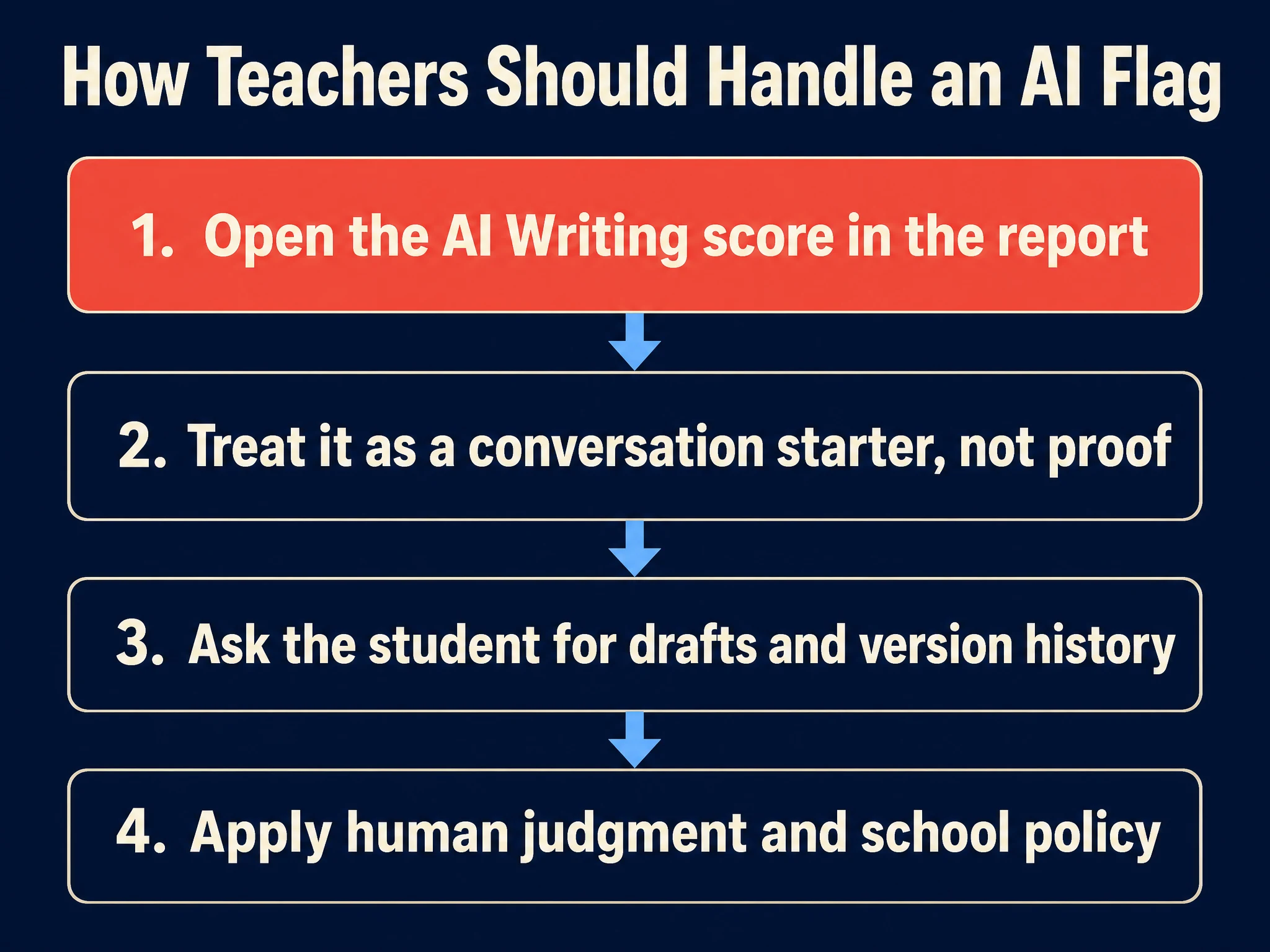
Turnitin’s own framing: the score opens a conversation, it does not close a case.
How accurate is Turnitin’s AI checker for teachers?
Turnitin advertises 98%+ accuracy with under 1% false positives. That headline number holds up poorly under independent scrutiny, especially for particular student populations. The most important caveat for any teacher is bias against non-native English writers: a 2026 follow-up reported a mean false-positive rate of 61.3% on TOEFL essays written by Chinese students, compared with 5.1% on US-student essays in the same test (Liang et al., detector-bias research). An independent classroom evaluation reached a similar cautionary conclusion (Temple University teaching center).
Technical prose and heavily edited drafts also trip the model. This is not a reason to ignore the score — it is a reason to treat it as one signal among several. We track the mechanism in why Turnitin flags AI when other detectors don’t and the equity problem in AI detection’s ESL bias.
How should a teacher respond to an AI flag?
Follow Turnitin’s own posture: the score starts a conversation, it does not end one. Open the AI Writing percentage and read the highlighted sentences rather than the headline number. Then ask the student for process evidence — drafts, outlines, and version history — before forming any conclusion. Finally, apply human judgment against your institution’s academic-integrity policy.
The reason process evidence matters so much is that it is exactly what a false-positive student can produce and a genuine cheater usually cannot. We cover what counts in is Google Docs version history enough as proof and what proof can clear a 35% AI flag.
| Do | Don’t |
|---|---|
| Read the highlighted sentences, not just the % | Treat the percentage as a verdict |
| Ask for drafts and version history | Accuse before hearing the student |
| Weigh ESL and technical-writing bias | Apply the score uniformly to all writers |
| Follow your school’s integrity policy | Act on the score alone |
Why does the AI checker matter for teachers in 2026?
Because the flag now drives more disputes than copied text, and because acting on it wrongly has real consequences for students. A growing number of institutions have restricted or disabled AI detection over exactly these fairness concerns, documented in universities that banned AI detectors. Teachers who understand the tool’s limits protect both integrity and the students most likely to be falsely flagged. It also helps to know the ordinary writing habits that trigger a flag so a clean essay isn’t misread.
Get the free text-humanization prompts
Get the exact text-humanization prompts I use to drop an AI score by hand — copy, paste, submit. Free, straight to your inbox.
Free · No credit card · Straight to your inbox
Frequently asked questions
Do teachers have to turn on Turnitin’s AI checker?
Yes. The instructor enables Turnitin when creating the assignment. If enabled, the AI Writing score generates automatically when the student submits — no separate tool to launch.
Can teachers see an AI score students can’t?
Generally yes. The AI Writing percentage appears in the instructor’s report and is not shown to students by default. Students see their similarity result but usually not the AI score.
Is Turnitin’s AI checker accurate enough to accuse a student?
No, not on its own. Turnitin itself says the score must not be the sole basis for adverse action. Independent tests show high false-positive rates for non-native English writers.
What false-positive rate should teachers worry about?
Turnitin claims under 1%, but a 2026 study found 61.3% false positives on TOEFL essays by non-native students versus 5.1% for US students. Treat flags on ESL writing with extra caution.
What evidence should a teacher request after a flag?
Process evidence: drafts, outlines, notes, and Google Docs or Word version history. It is the strongest way to distinguish a false positive from genuine misconduct.
Does a high similarity score mean a high AI score?
No. They are separate signals. A paper can have low similarity and still be flagged for AI writing, or vice versa.
Methodology: Report-access and interpretation guidance is drawn from Turnitin’s official AI Writing Report documentation and its false-positive guidance for educators. The 61.3% vs 5.1% false-positive figures come from 2026 independent research on non-native English writing (following the widely cited Stanford detector-bias work). We describe the tool’s limits without accessing any student data. No affiliate placement influenced this guidance.

Turnitin is rarely the only tool in play on a campus. For the wider picture of what AI detector colleges use alongside it, including which schools switched detection off entirely.
