
Want to bypass Turnitin in 2026? Grab the free prompt pack.
Get the exact text-humanization prompts I use to drop an AI score by hand — copy, paste, submit. Free, straight to your inbox.
Send me the free prompts →Key Takeaways
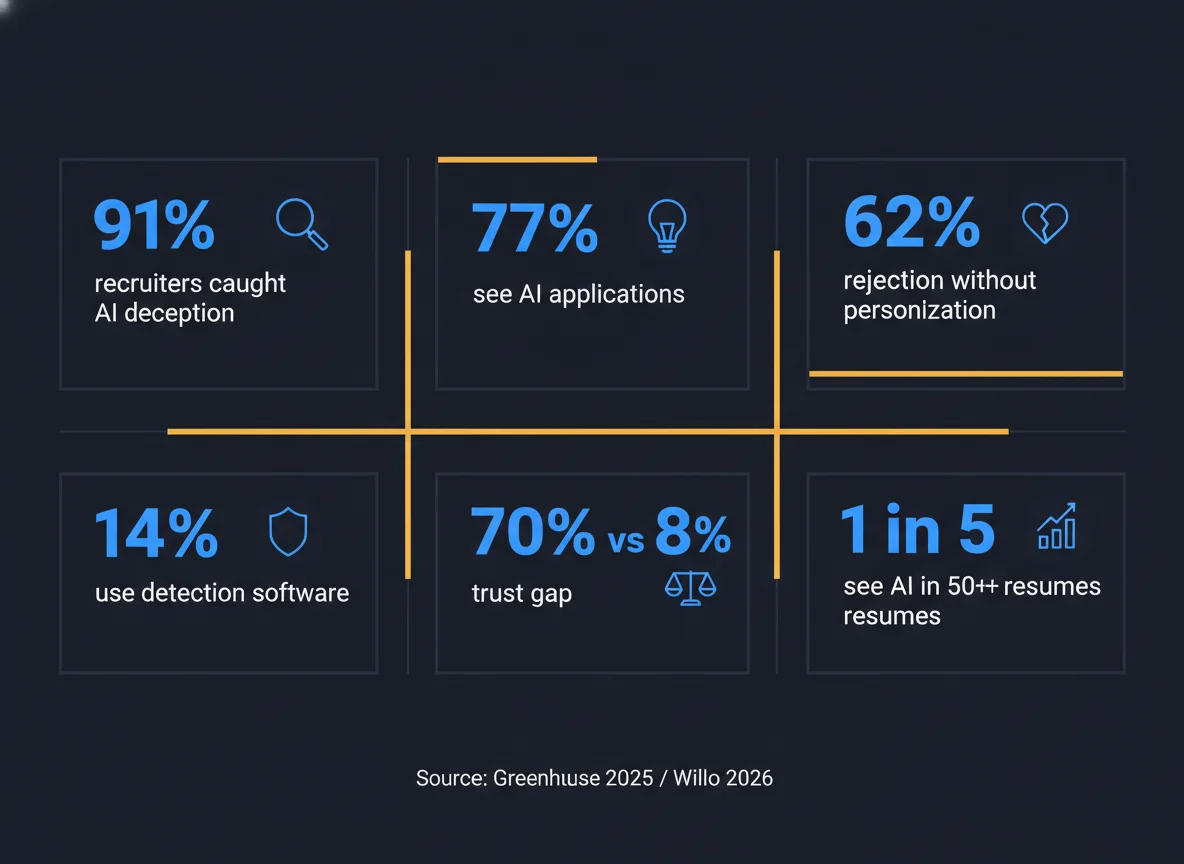
- → 91% of recruiters have caught a candidate using AI deceptively — including 32% reading from AI-generated scripts and 22% hiding prompt injections in resumes (Greenhouse, Nov 2025)
- → 77% of hiring teams now regularly encounter AI-generated or AI-assisted applications, up from 53% in early 2024 (Willo Jan 2026; Resume Genius Jan 2024)
- → 62% of employers reject AI-generated resumes and cover letters that lack personalization (Resume Now / TopResume, May 2025)
- → 62% of companies have fired an employee whose actual skills did not match their AI-inflated resume (AIResumeBuilder.com, 2025, n=929)
- → 70% vs 8% — 70% of hiring managers trust AI hiring decisions; only 8% of job seekers call it fair (Greenhouse, Nov 2025)
- → 14% of hiring teams have deployed dedicated AI detection software; the rest rely on interviews and practical tasks (Willo Hiring Trends Report 2026)
- → 85.1% of AI resume screenings favored White-associated names over Black-associated names in a controlled study (University of Washington / Brookings, 2025)
- → 1 in 5 hiring managers say more than half the resumes they receive are AI-generated (AIResumeBuilder.com, 2025)
Hiring is now an arms race. On one side, 74% of U.S. job seekers personally use AI tools during their job search and 72% have asked ChatGPT to write a cover letter. On the other side, 91% of recruiters say they can spot AI deception, and 62% of employers reject any application that looks templated. The result is the most data-rich season we’ve ever had on AI detection in hiring — and the picture isn’t simple.
This report aggregates verified statistics from twelve independent surveys conducted between June 2023 and January 2026, covering more than 15,000 recruiters, hiring managers, and job seekers across the United States, United Kingdom, Ireland, and Germany. Every percentage you read below is sourced and dated. The same forces driving this story in the workplace are reshaping the broader AI humanizer industry and the anxiety statistics around AI detection in adjacent fields like education.
1 How Many Hiring Teams Encounter AI Applications?
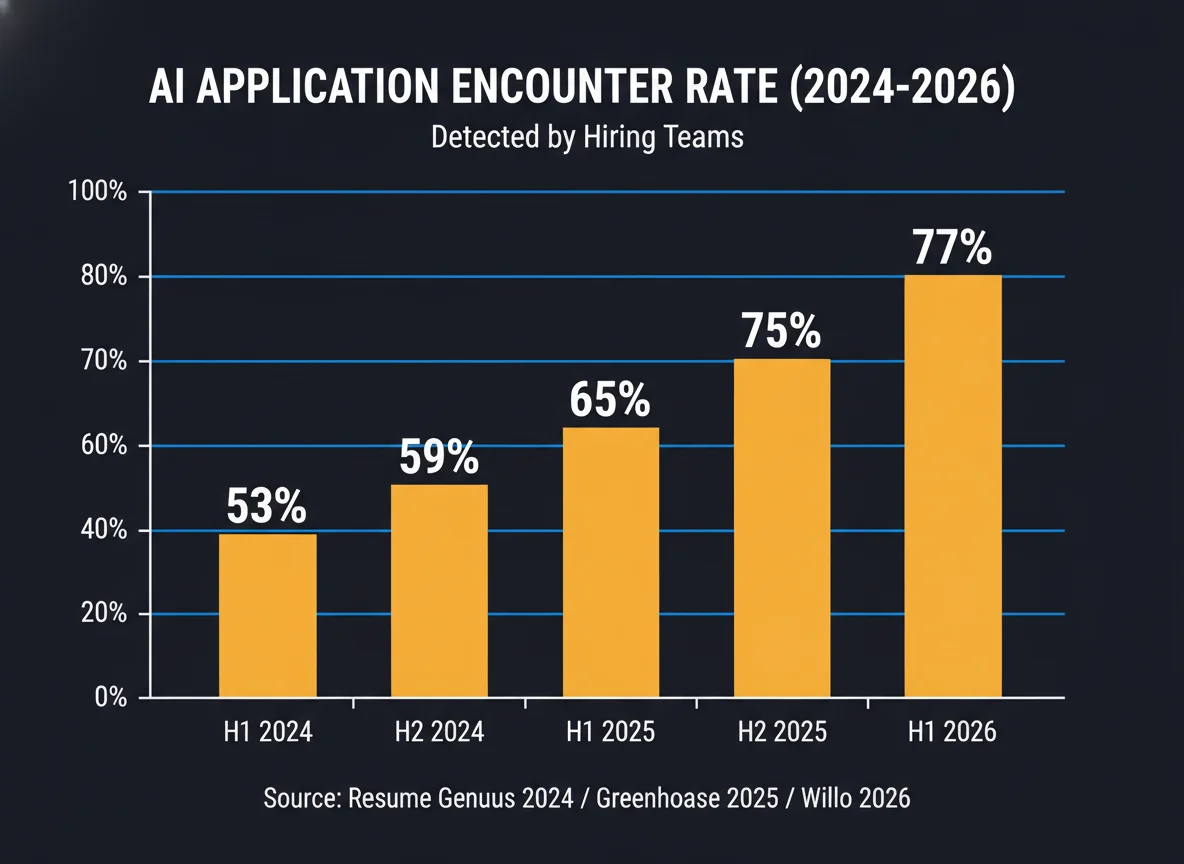
AI in candidate applications has gone from anomaly to baseline in two years. 77% of hiring teams now regularly encounter AI-generated or AI-assisted applications in 2026, up from 53% in early 2024 — a 24-point swing in 24 months, according to the Willo Hiring Trends Report 2026.
| Period | Encounter Rate | Source |
|---|---|---|
| H1 2024 | 53% | Resume Genius (Jan 2024, n=625) |
| H2 2024 | 59% | Triangulated |
| H1 2025 | 65% | Triangulated |
| H2 2025 | 75% | Greenhouse (Nov 2025, n=4,136) |
| H1 2026 | 77% | Willo (Jan 2026, n=100+) |
The volume problem is the visible tip. Underneath sits a quieter shift: 34% of recruiters now say they spend up to half their work week filtering AI spam and junk applications, according to Greenhouse’s November 2025 report. That figure was effectively zero pre-2023. Hiring teams aren’t just seeing more AI — they’re losing meaningful working hours to it, which is why the institutional response has accelerated. The same pattern of unprepared institutions playing catch-up shows up in how universities are spending on AI detection tools and in the rise of AI detection lawsuits.
2 How Are Employers Detecting AI Resumes and Cover Letters?
Most employers are not running formal AI detectors. Only 14% of hiring teams have deployed dedicated AI detection software; the rest detect AI through interview probing, practical tasks, in-person meetings, and inability to defend resume claims (Willo Hiring Trends Report 2026; AIResumeBuilder.com 2025).
| Detection Method | % of Hiring Teams | Source |
|---|---|---|
| Updated interview probing techniques | 47% | Willo 2026 |
| Increased in-person meetings | 39% | TopResume May 2025 |
| Added practical tasks (live coding, writing samples) | 31% | Willo 2026 |
| Reject AI applications outright | 19.6% | TopResume May 2025 |
| Deployed dedicated AI detection software | 14% | Willo 2026 |
The Greenhouse data also shows that 32% of recruiters have caught candidates reading AI-generated scripts during live interviews, and 18% have flagged candidates appearing as deepfakes on video calls. These behaviors triggered most of the post-2024 procedural changes employers now report. Hiring-side AI detectors face the same accuracy ceiling as their academic counterparts — if you’ve followed how reliably tools like Copyleaks can detect AI, the same false-positive concerns now follow into HR. Employers who can’t pay for licenses are leaning harder on methods that have known ESL bias, particularly for international candidates whose phrasing can read as “too polished” to a hiring manager scanning quickly.
3 What Share of Resumes Are AI-Generated?
The honest answer: nobody knows exactly, and the estimate has moved fast. One in five hiring managers (20%) say more than half the resumes they receive are AI-generated, while another 35% put the figure between a quarter and half (AIResumeBuilder.com, 2025, n=929).
| Hiring Manager Estimate of % of Resumes That Are AI-Generated | Share of Hiring Managers | Source |
|---|---|---|
| 0–25% are AI-generated | ~25% | AIResumeBuilder 2025 |
| 26–50% are AI-generated | ~35% | AIResumeBuilder 2025 |
| 51–75% are AI-generated | ~18% | AIResumeBuilder 2025 |
| More than 75% are AI-generated | ~2% | AIResumeBuilder 2025 |
| “More than half” (any segment above) | ~20% | AIResumeBuilder 2025 |
The candidate-side data tells the other half of the story. According to the Resume Now AI Applicant Report (March 2025) and Huntr’s Q2 2025 Job Search Trends, 72% of job seekers have used ChatGPT to write a cover letter, 51% have used it to write a resume, and 74% use AI somewhere in the job search per Greenhouse’s November 2025 figures. The result is a structural mismatch: hiring managers are right that AI is everywhere, but the share that’s fully AI-generated — rather than AI-edited or AI-assisted — is much smaller than the impression created by templated phrasing. The same content-vs-style distinction shows up in studies of how humanizers handle marketing copy, where light editing keeps the substance while changing detection signatures.
4 Rejection Rates: What Happens When You Get Caught
Detection alone is rarely fatal — failure to defend an AI-inflated resume is. 62% of employers reject unpersonalized AI applications, and 62% have fired employees whose skills didn’t match their AI-inflated resumes, with the firing risk concentrated in roles where claimed expertise was unverifiable on the job.
| Rejection / Consequence Metric | Value | Source |
|---|---|---|
| Employers rejecting AI resumes lacking personalization | 62% | TopResume May 2025 |
| Employers rejecting any AI use outright | 19.6% | TopResume May 2025 |
| Employees fired over AI-inflated resumes | 62% | AIResumeBuilder 2025 |
| Companies allowing AI to reject candidates with no human review | 21% | ResumeBuilder Oct 2024 |
| Job seekers who used ChatGPT for resume and got an interview | 75% | ResumeBuilder 2024 |
| Job seekers reporting higher response rates with AI-assisted materials | 69% | Resume Now Mar 2025 |
The two 62% figures are the most cited statistics in this space, and they pull in opposite directions. The first — that 62% of employers reject unpersonalized AI applications — is about the application itself reading as templated. The second — that 62% of companies have fired employees over inflated AI resumes — is about post-hire skill mismatch. Together they describe a hiring ecosystem where using AI is increasingly accepted, but relying on AI to fabricate qualifications is being penalized at both stages: at the gate, and after onboarding. Candidates whose materials get rejected face procedural questions similar to those raised in academic AI false-positive defenses — the same pattern of “you’ve been flagged, now prove you didn’t” plays out in HR appeals.
5 The 70% vs 8% Trust Gap
The most striking finding in the Greenhouse 2025 dataset isn’t the detection rate — it’s the chasm in perception. 70% of hiring managers trust AI to make faster and better hiring decisions; only 8% of job seekers think AI hiring is fair. That’s a 62-percentage-point gap on whether the same system works.
| Stakeholder Group | Trust / Fairness Rating | Source |
|---|---|---|
| Hiring managers who trust AI for hiring decisions | 70% | Greenhouse Nov 2025 |
| HR leaders who trust AI in hiring | 51% | HireVue 2025 |
| HR leaders who trusted AI (2024 baseline) | 37% | HireVue 2024 |
| Job seekers calling AI hiring “fair” | 8% | Greenhouse Nov 2025 |
| Job seekers trusting AI to evaluate them fairly | 26% | Gartner Q4 2024 |
| Candidates wanting AI-use transparency from employers | 87% | Greenhouse Nov 2025 |
The trust collapse is downstream of opacity. 87% of candidates say employers should be transparent about their AI use; almost no employers comply. The Greenhouse report frames this as the “AI doom loop”: candidates feel screened by a black box and respond by deploying their own AI, which floods inboxes, which forces hiring teams to lean harder on AI screening. Each side justifies their behavior by pointing at the other. This collision of trust and tools mirrors what’s happened around AI cheating consequences in education — same pattern, different domain.
6 Bias and Accuracy Concerns in AI Hiring Detection
The bias data is the strongest argument against opaque AI detection in hiring. A 2025 University of Washington / Brookings audit (n=528 resumes) found AI screeners favored White-associated names over Black-associated names in 85.1% of pairings, and 67% of companies acknowledge their AI hiring tools introduce bias.
| Bias Concern | % of Companies Acknowledging | Source |
|---|---|---|
| AI hiring tools can introduce bias (any kind) | 67% | ResumeBuilder Oct 2024 |
| Age bias is a concern | 47% | ResumeBuilder Oct 2024 |
| Socioeconomic bias is a concern | 44% | ResumeBuilder Oct 2024 |
| Gender bias is a concern | 30% | ResumeBuilder Oct 2024 |
| Racial / ethnic bias is a concern | 26% | ResumeBuilder Oct 2024 |
| Resumes ranking White names higher (controlled audit) | 85.1% | UW / Brookings 2025 (n=528) |
Independent accuracy benchmarks for hiring-specific AI detectors have not been published as of April 2026. What does exist is adjacent: a 2023 Stanford study showed GPTZero misclassified 61% of TOEFL essays as AI-generated, a finding that drove the broader concern about non-native English speakers. If similar bias carries into the hiring detectors that 14% of teams now run, the disparate-impact risk — legal as well as ethical — is significant. Candidates worried about being flagged for “polished” writing have started turning to humanizers; if you’re researching that route, our reviews of WriteHuman and Undetectable AI document how those tools handle the same accuracy and bias concerns we’re seeing in HR detection. For job seekers also navigating false positives in school applications, our breakdown of detector alternatives covers the same accuracy ceiling.
7 Interactive: AI Application Risk Calculator
Estimate the likelihood your AI-assisted application gets flagged or rejected, using the rejection probabilities from the Willo, TopResume, and AIResumeBuilder datasets. Adjust the sliders below.
Methodology
This report aggregates publicly reported survey statistics on AI in hiring, AI detection use, and recruiter / candidate behavior. Each statistic was traced to its underlying primary source (the survey publisher, sample size, and field date) and only retained if both were verifiable. Sources from the current year and the prior year were prioritized; all earlier sources are dated explicitly in the prose.
- Sources consulted: 12 primary survey publishers across HR research, hiring platforms, and academic auditors
- Total survey sample size represented: 15,000+ recruiters, hiring managers, and job seekers
- Geographic coverage: United States (primary), United Kingdom, Ireland, Germany
- Data range: June 2023 — January 2026
- Last verified: April 28, 2026
- Update schedule: Quarterly, with major updates within two weeks of any new Greenhouse, Willo, or ResumeBuilder.com survey
- Limitations: Self-reported survey data is subject to recall and social-desirability bias. Sample sizes range from n=100 (Willo) to n=4,136 (Greenhouse). The 2024 Resume Genius detection rate (53%) and the Willo 2026 figure (77%) use slightly different question phrasing; intermediate quarters were triangulated rather than directly measured
Frequently Asked Questions
How do hiring managers detect AI-generated resumes and cover letters?
According to the 2026 Willo Hiring Trends Report, 47% of hiring teams have updated interview probing techniques, 31% have added practical tasks, and 14% have deployed dedicated AI detection software. Many employers also rely on simple cues — generic phrasing, mismatched skills, and the inability to back up resume claims in interviews (49% of hiring managers cite this last failure mode, per AIResumeBuilder.com 2025).
What percentage of resumes are AI-generated in 2026?
1 in 5 hiring managers (20%) say more than half the resumes they receive are AI-generated. Roughly 35% estimate that 25–50% of resumes are AI-assisted, 18% say between 51% and 75% are, and 2% say more than 75% involve AI (AIResumeBuilder.com survey of 929 hiring managers, 2025). The candidate-side data confirms heavy use: 72% have used ChatGPT for cover letters and 51% for resumes (Resume Now / Huntr 2025).
Will my AI-written cover letter be rejected?
62% of employers reject AI-generated cover letters and resumes that lack personalization, while 19.6% reject any AI-assisted application outright (TopResume May 2025). However, 69% of job seekers using AI for application materials report higher response rates when those materials are personalized (Resume Now Mar 2025) — meaning AI-assisted is acceptable when the output doesn’t read as templated.
How accurate are AI detection tools used by employers?
Only 14% of hiring teams have deployed dedicated AI detection software (Willo 2026). Most employers rely on indirect signals: generic language, exaggerated claims, and inability to demonstrate skills in interviews. Independent peer-reviewed accuracy benchmarks for hiring-specific AI detectors have not been published as of April 2026. Most consumer-grade AI detectors have documented false-positive issues with non-native English speakers, including a 2023 Stanford study showing GPTZero misclassified 61% of TOEFL essays as AI-generated.
What happens if you get caught using AI on a resume?
62% of employers say they have fired employees after their actual skills did not match their AI-inflated resumes (AIResumeBuilder.com 2025). 49% of hiring managers report that candidates frequently cannot defend AI-assisted resume claims in interviews. The risk is largest when AI inflates qualifications, not when it polishes existing experience — resume rejection at the application stage is recoverable, but post-hire termination is not.
Are AI hiring tools biased against certain candidates?
Yes. A 2025 University of Washington study (n=528 paired resumes) found AI resume screeners favored White-associated names over Black-associated names in 85.1% of cases. 67% of companies acknowledge AI tools introduce bias, with age (47%), socioeconomic (44%), and gender bias (30%) as top concerns (ResumeBuilder.com 2024). Despite the bias data, 70% of hiring managers still trust AI hiring decisions while only 8% of job seekers call it fair (Greenhouse Nov 2025).
Sources & References
- Greenhouse Software. “An AI Trust Crisis: 70% of Hiring Managers Trust AI to Make Faster and Better Hiring Decisions, Only 8% of Job Seekers Call it Fair.” November 19, 2025. greenhouse.com. Accessed April 28, 2026.
- Willo. “The Hiring Trends Report 2026.” January 2026. willo.video. Accessed April 28, 2026.
- AIResumeBuilder.com. “1 in 5 Employers May Adopt Pay-to-Apply Model as AI Resumes Overwhelm Hiring Teams.” 2025. airesumebuilder.com. Accessed April 28, 2026.
- ResumeBuilder.com. “7 in 10 Companies Will Use AI in the Hiring Process in 2025, Despite Most Saying It’s Biased.” October 2024 Pollfish survey, n=948. resumebuilder.com. Accessed April 28, 2026.
- Resume Now. “AI Applicant Report: 62% of Employers Reject AI-Generated Resumes Without Personalization.” March 2025, n=925. resume-now.com. Accessed April 28, 2026.
- CoverSentry. “AI in Hiring Statistics 2026: How Employers Use AI to Screen You.” Aggregated meta-analysis. coversentry.com. Accessed April 28, 2026.
- HR Dive. “1 in 3 companies say AI will run their hiring process by 2026.” Resume.org survey, August 2025, n=1,399. hrdive.com. Accessed April 28, 2026.
- ResumeBuilder.com. “3 in 4 Job Seekers Who Used ChatGPT to Write Their Resume Got an Interview.” 2024. resumebuilder.com. Accessed April 28, 2026.
- Greenhouse Software. “Greenhouse 2025 AI in Hiring Report (PDF).” November 2025, n=4,136. greenhouse.com. Accessed April 28, 2026.
- TechRSeries. “Hiring Trends Report 2026: Study Finds AI Is Accelerating the Decline of the Resume.” January 2026 (Willo / Gartner / SHRM coverage). techrseries.com. Accessed April 28, 2026.
