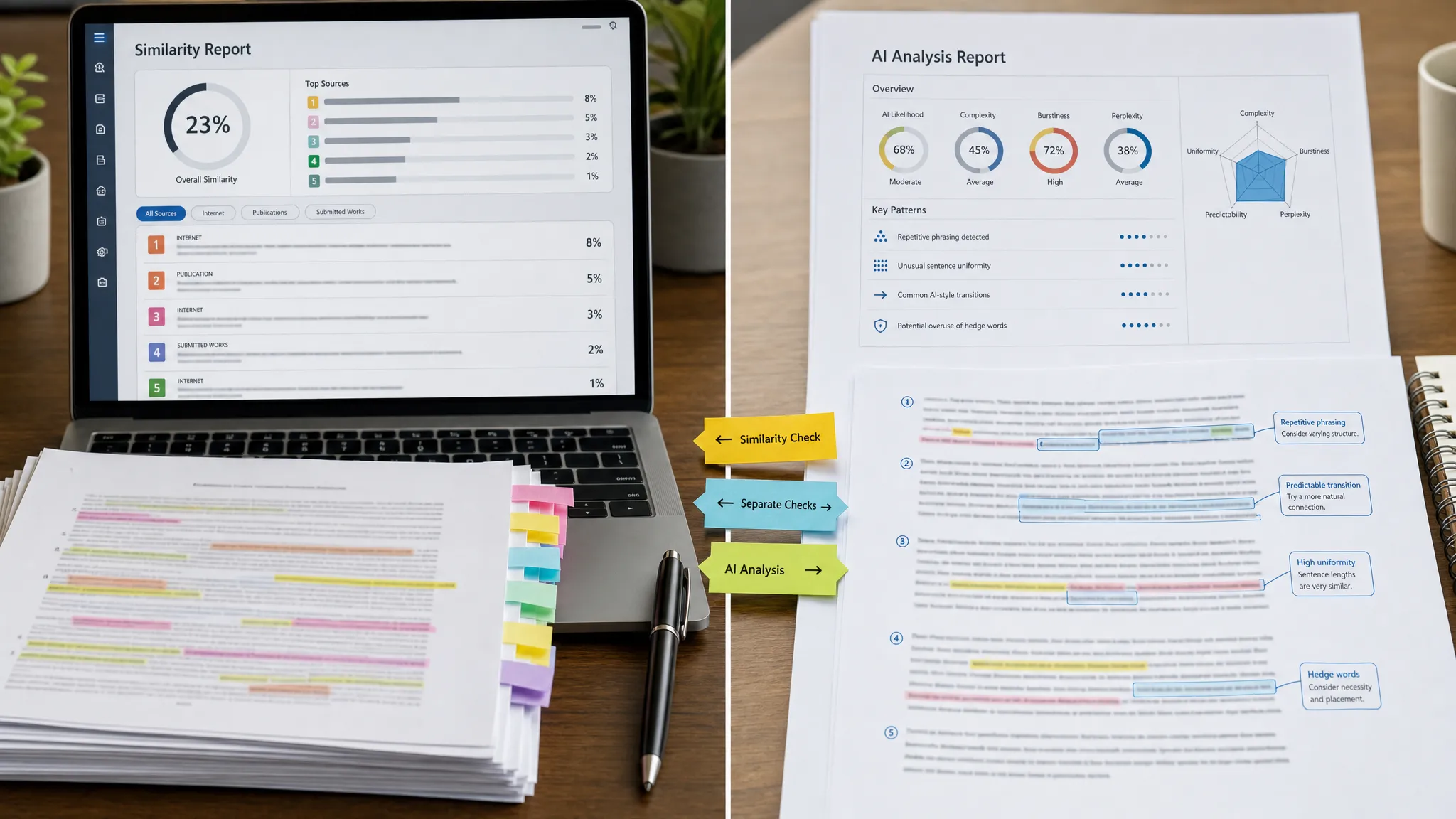
AI detectors and plagiarism checkers often appear in the same dashboard, especially in tools used by schools, publishers, and content teams. That makes it easy to assume they measure the same thing. They do not.
Want to bypass Turnitin in 2026? Grab the free prompt pack.
Get the exact text-humanization prompts I use to drop an AI score by hand — copy, paste, submit. Free, straight to your inbox.
Send me the free prompts →An AI detector tries to estimate whether text was likely generated or heavily shaped by AI writing tools. A plagiarism checker compares text against known sources to find matching or closely similar wording. One is about authorship signals. The other is about source overlap.
That difference matters. A paper can have a low plagiarism score and still receive a high AI score. A blog post can have a high similarity score because of quotes, citations, boilerplate, or product names while still being written by a person. Neither result automatically proves misconduct, cheating, or originality. The reports need context.
The short version: AI detector vs plagiarism checker
If you only remember one thing, remember this: plagiarism checkers look outward at sources, while AI detectors look inward at writing patterns.
| Tool | Main question it asks | What it analyzes | Typical output | What it cannot prove |
|---|---|---|---|---|
| AI detector | Does this text resemble AI-generated writing? | Linguistic patterns, predictability, structure, style, and model-like signals | AI score, confidence label, highlighted passages | Who wrote the text or whether AI use violated a policy |
| Plagiarism checker | Does this text match existing sources? | Text overlap against web pages, student papers, journals, books, and databases | Similarity percentage, matched sources, highlighted overlaps | Whether overlap is unethical or properly cited |
That is why the reports often disagree. They are not two versions of the same test. They are measuring different risks.
What an AI detector actually does
An AI content detector is usually a machine-learning classifier. It is trained to compare examples of human-written and AI-generated content, then estimate which category a new text resembles more closely.
Modern detectors may look at many signals, including sentence predictability, word choice patterns, paragraph rhythm, repetition, generic phrasing, transition density, and how evenly polished the writing feels. Older public explanations often focused on ideas like perplexity and burstiness, but commercial systems now tend to use broader model-based classification.
The important part is that an AI detector is not reading your mind, opening your ChatGPT account, or checking whether you personally typed each sentence. It is evaluating the submitted text.
That is why AI detection can be useful as a screening tool but risky as a final verdict. Even OpenAI discontinued its own AI classifier in 2023 because of accuracy limitations, noting that the tool had a low rate of accuracy. Research has also raised concerns about false positives, especially for non-native English writers. Stanford HAI summarized findings showing that some detectors were biased against non-native English writing patterns, which is one reason many schools now treat detector results cautiously.
AI detection reports often include:
- An overall AI percentage or likelihood label
- Highlighted sentences or sections that look AI-like
- Confidence language such as low, medium, or high
- Sometimes a breakdown by paragraph or sentence
Those outputs are signals for review. They are not proof that a specific person used a specific tool.
For a deeper breakdown of report language, see Detection Drama’s guide to what AI detection scores really mean.
What a plagiarism checker actually does
A plagiarism checker, sometimes called a similarity checker, compares submitted text against a database of existing text. That database may include public web pages, academic journals, books, institutional paper repositories, previously submitted student papers, and publisher databases.
A plagiarism checker does not usually care whether a sentence sounds human or AI-written. It cares whether the wording overlaps with something already available to the system.
Tools like Turnitin Similarity, iThenticate, Copyleaks, Grammarly’s plagiarism checker, and QuillBot’s plagiarism checker can identify exact matches and near matches. Turnitin describes its Similarity product as a way to compare student work against a large collection of internet, academic, and student paper sources. In publishing, iThenticate is commonly used to screen manuscripts for text overlap before peer review or publication.
Plagiarism checker reports often include:
- A similarity percentage
- A list of matching sources
- Highlighted matching phrases or passages
- Filters for quotes, bibliographies, small matches, or excluded sources
A high similarity score is not automatically plagiarism. Properly quoted text, bibliography entries, legal language, assignment prompts, common definitions, and standard methodology descriptions can all raise similarity. A human reviewer still needs to decide whether the overlap is acceptable, cited, excessive, or suspicious.
Why AI scores and similarity scores can conflict
Because the tools measure different things, the same document can produce very different results. These four combinations are common.
| Result pattern | What it may mean | What to check next |
|---|---|---|
| High similarity, low AI | The text overlaps with sources but does not look strongly AI-generated | Quotes, citations, bibliography, copied phrases, paraphrase quality |
| Low similarity, high AI | The text appears original but has AI-like writing patterns | Draft history, writing process, generic phrasing, over-polished edits |
| High similarity, high AI | The text both overlaps with sources and resembles AI-style writing | Source use, AI policy, citation accuracy, whether copied text was rewritten |
| Low similarity, low AI | The text does not strongly trigger either system | Still verify citations, facts, and assignment requirements |
The most confusing situation is usually low similarity but high AI. Students and writers often assume that if a plagiarism checker says the work is original, they are safe. But originality of wording and authorship style are different questions.
The reverse can also happen. A human-written academic paper may get a high similarity score because it includes a long reference list, standard lab methods, or properly quoted source material. That does not make it AI-generated.
Key differences in plain English
1. Plagiarism checkers compare text to sources
A plagiarism checker asks: where else does this wording appear?
If it finds a match, it points to the source. That gives reviewers something concrete to inspect. They can open the source, compare passages, and decide whether the overlap is quoted, cited, paraphrased, or copied.
This makes plagiarism reports easier to verify than AI reports. A matched source either exists in the report or it does not. The interpretation can still be subjective, but the evidence is visible.
2. AI detectors compare text to learned patterns
An AI detector asks: does this writing resemble the statistical patterns of AI-generated text?
That evidence is less direct. A highlighted paragraph may look AI-like because it is generic, polished, repetitive, or unusually uniform. But a human writer can also produce those traits, especially in formulaic academic assignments, ESL writing, corporate copy, or heavily edited drafts.
This is why AI detector results need more caution. They are pattern judgments, not source matches.
3. Plagiarism can be fixed with source discipline
If a similarity report is high for the wrong reasons, the fix is usually source-related. You can add missing citations, use quotation marks, paraphrase more genuinely, remove copied structure, or adjust bibliography filters when appropriate.
The goal is not to hide overlap. The goal is to make source use transparent.
4. AI flags are usually addressed with process evidence
If an AI detector flags a text, rewriting alone may not solve the real problem. The stronger response is to show how the work was made.
Useful evidence can include outlines, notes, version history, drafts, source annotations, feedback, and a short explanation of your writing process. Detection Drama calls this an authorship packet, and it is often more persuasive than arguing about a percentage. If you are worried about a false flag, start with the Turnitin AI false positive checklist.
Can plagiarism checkers detect AI writing?
Not by default. A traditional plagiarism checker is not designed to detect AI writing. It detects source overlap.
However, some platforms now combine plagiarism checking and AI detection in one interface. Turnitin, Copyleaks, QuillBot, Originality.ai, and other tools may offer both types of analysis. That does not mean the two scores are generated the same way.
A combined report can show both similarity and AI writing indicators, but you should still read them separately:
| Report element | Best interpretation |
|---|---|
| Similarity percentage | Amount of text matching known sources |
| Matched source list | Where overlapping text may have come from |
| AI percentage or label | Estimated likelihood of AI-like writing patterns |
| AI highlights | Sections the model considers more suspicious |
| Citation and quote matches | Items that may be legitimate if formatted correctly |
If your platform shows both scores, do not average them together. A 10% similarity score and a 60% AI score do not combine into a 35% integrity problem. They are separate signals.
Can AI detectors detect plagiarism?
Usually, no. An AI detector is not a source-matching system. It may flag a copied passage if that passage also looks AI-like, but it will not reliably tell you where the text came from.
This matters for editors and instructors. If the concern is source misuse, use a plagiarism checker. If the concern is undisclosed AI assistance, an AI detector may provide a lead, but it should be paired with process evidence and policy review.
Which tool should you use first?
For most writers, students, and editors, the plagiarism checker should come first. Source accuracy is easier to verify and easier to fix. After that, an AI detector can be used as a secondary review tool if your institution, client, or publisher cares about AI disclosure.
A practical pre-submission workflow looks like this:
- Run a plagiarism or similarity check to find source overlap.
- Fix citation issues, quotation formatting, and weak paraphrases.
- Review the text manually for generic, overly polished, or unsupported claims.
- Use an AI detector only as a risk signal, not as a final truth test.
- Save drafts, notes, and version history before submitting.
If you are using AI writing tools at any stage, check the relevant policy first. Some courses allow AI for brainstorming but not drafting. Some publishers allow AI-assisted editing but require disclosure. Some workplaces care mainly about factual accuracy and brand voice. The same text can be acceptable in one setting and risky in another.
How to lower plagiarism risk ethically
Reducing plagiarism risk is not about tricking a plagiarism checker. It is about using sources correctly.
Start by separating your own claims from source claims. If a sentence depends on a source, cite it. If the wording is distinctive, quote it. If you paraphrase, change more than the words. Change the structure, explain the idea in your own reasoning, and connect it to your argument.
Be especially careful with AI-generated summaries of sources. AI tools can blur the line between paraphrase and invention. They may also produce claims that sound sourced but do not actually appear in the cited article. Before submission, match each citation to the exact claim it supports.
For academic writing, do not run reference lists, direct quotes, DOIs, or legal-style language through aggressive rewriting tools. Those elements need precision more than stylistic variation.
How to reduce AI detector misunderstandings ethically
Reducing AI detector risk should not mean making your writing worse or hiding misconduct. The better approach is to make authorship clearer.
Human writing usually contains context, judgment, uneven emphasis, and specific reasoning. AI-like writing often feels smooth but generic. To make a draft more clearly yours, add assignment-specific examples, explain why evidence matters, include your real decision process, and vary sentence rhythm naturally.
If you use a text humanizer, treat it as an editing aid, not a magic shield. Humanizers can alter meaning, flatten your voice, break citations, or introduce awkward phrasing. Always compare the rewritten version against the original and verify facts before using it.
A good rule: if you cannot explain a paragraph out loud, it is not ready.
For educators and editors: use the right evidence for the right question
The fairest review process separates similarity concerns from AI-authorship concerns.
If the issue is plagiarism, inspect the matched sources. Ask whether the overlap is quoted, cited, common language, or copied without credit. If the issue is AI use, ask whether the final text conflicts with the writer’s process, prior work, draft history, or stated tool use.
AI detector results should be treated as triage. They can point to passages worth reviewing, but they should not replace human judgment. This is especially important for short submissions, ESL writers, highly formulaic assignments, and heavily edited work.
For students, the best defense is not a perfect detector score. It is a clear creation trail. For instructors, the best process is not one percentage threshold. It is consistent policy, transparent review, and corroborating evidence.
FAQ
Is an AI detector the same as a plagiarism checker? No. An AI detector estimates whether writing resembles AI-generated text. A plagiarism checker compares the text against existing sources to find overlap.
Does a high plagiarism score mean I plagiarized? Not automatically. Quotes, bibliographies, templates, common phrases, and properly cited material can raise similarity. A human reviewer has to inspect the matches.
Does a high AI score prove I used ChatGPT? No. A high AI score is a risk signal, not proof of tool use. False positives can happen, especially with short, polished, formulaic, or non-native English writing.
Can Turnitin show both AI detection and plagiarism results? Yes, depending on the institution’s settings and products. Turnitin’s Similarity score and AI writing indicator are separate signals and should be interpreted separately.
What if my plagiarism checker says 0% but an AI detector flags my paper? That means the text may not match known sources but still resembles AI-like writing patterns. Preserve drafts, notes, version history, and source work so you can show your process.
Which matters more, AI score or similarity score? It depends on the policy and the concern. Similarity is more directly tied to source overlap. AI score is more about authorship signals and usually needs more supporting evidence.
Final takeaway
The AI detector vs plagiarism checker debate comes down to evidence type. Plagiarism checkers find text overlap. AI detectors estimate writing-pattern risk. Both can be helpful, and both can be misread.
If you are reviewing your own work, use each tool for its actual purpose. Fix source problems with better citation and paraphrasing. Address AI-detector concerns with clearer reasoning, more specific writing, and proof of authorship.
If you want a faster way to inspect AI-like passages before submitting or publishing, try Detection Drama’s free tools at detectiondrama.com. You can analyze writing, humanize AI text when appropriate, and review detection-style feedback without an email signup. Just remember: the safest final draft is not only lower-risk on a detector. It is accurate, sourced, explainable, and genuinely yours.
