
Want to bypass Turnitin in 2026? Grab the free prompt pack.
Get the exact text-humanization prompts I use to drop an AI score by hand — copy, paste, submit. Free, straight to your inbox.
Send me the free prompts →Key Takeaways
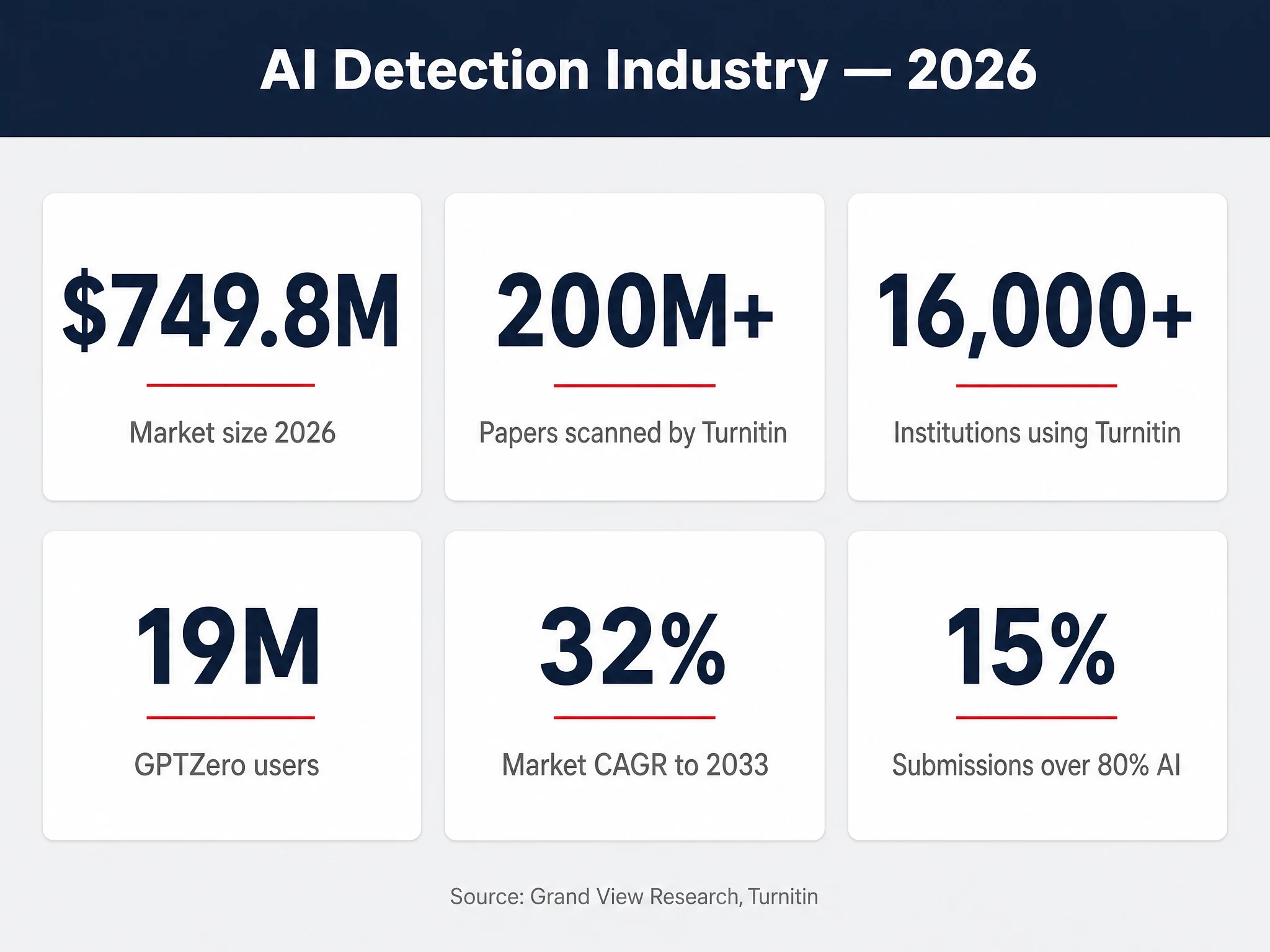
- → The AI detector market is valued at about $749.8M in 2026, projected to reach $5.2B by 2033 at a 32% CAGR (Grand View Research)
- → Turnitin has scanned more than 200 million papers for AI since April 2023 (Turnitin)
- → Turnitin’s AI indicator is deployed across 16,000+ institutions in 185 countries (Turnitin)
- → GPTZero reached 19 million users and ~$30M ARR before its June 2026 acquisition by Grammarly’s parent, Superhuman (TechCrunch)
- → Since October 2025, 15% of Turnitin submissions score over 80% AI — a fivefold jump from 2023 (Turnitin)
- → Detectors falsely flag non-native English writing at rates up to 61.3% (Stanford, Patterns)
- → At least 16 universities have switched Turnitin’s AI detection off over reliability and fairness concerns (EdTech Innovation Hub)
The AI detection industry sits at a strange crossroads in 2026: revenue is climbing fast while confidence in the product is falling. Detectors are being bought, merged and embedded into mainstream writing tools at the same time that dozens of universities are quietly switching them off. This page collects every published number worth citing — market size, scan volume, user counts, accuracy rates and institutional adoption — so you can see the whole board at once. For readers who want the counterpart data on the tools built to beat these systems, our AI humanizer usage statistics for 2026 cover the other side of the arms race.
Want to bypass Turnitin in 2026? Grab the free prompt pack.
Get the exact text-humanization prompts I use to drop an AI score by hand — copy, paste, submit. Free, straight to your inbox.
Send me the free prompts →1 How big is the AI detection market?
The global AI detector market is valued at roughly $749.8 million in 2026 and is projected to reach about $5.2 billion by 2033, growing at a 32% compound annual growth rate.
| Metric | Value | Source |
|---|---|---|
| Market size (2026) | $749.8M | Grand View Research |
| Projected market size (2033) | $5.23B | Grand View Research |
| Compound annual growth rate | 32.0% | Grand View Research |
| Alternative 2026 valuation | $0.98B | MarketsandMarkets |
| Estimates vary by methodology; both firms agree on a ~30%+ growth trajectory. | ||
Two research houses put slightly different price tags on the market — Grand View Research anchors it near $750 million while MarketsandMarkets values it closer to $980 million — but both agree on the shape of the curve: roughly a third of compounding growth per year, driven by generative-AI adoption in education and publishing. That demand is exactly why the category keeps attracting acquisitions, and why the debate over whether the tools actually work has become a question of whether Turnitin detects AI or just guesses at patterns.
2 How much content is being scanned?
Turnitin alone has run more than 200 million papers through its AI writing indicator since April 2023, and the share of heavily AI-written submissions has climbed fivefold since launch.
| Metric | Value | Source |
|---|---|---|
| Papers scanned since April 2023 | 200M+ | Turnitin |
| Papers with ≥20% AI writing (Mar 2024) | 22M (~11%) | Turnitin |
| Papers with ≥80% AI writing (Mar 2024) | 6M (~3%) | Turnitin |
| Submissions >80% AI (since Oct 2025) | 15% | Turnitin |
| Source: Turnitin AI writing statistics, 2024–2026. | ||
3 Who leads — users, revenue and reach
Turnitin dominates the institutional market with 16,000+ deployments, while GPTZero leads the consumer side with 19 million users — a base large enough to trigger a June 2026 acquisition by Grammarly’s parent company.
| Company / metric | Value | Source |
|---|---|---|
| Turnitin institutions | 16,000+ | Turnitin |
| Turnitin country reach | 185 | Turnitin |
| GPTZero registered users | 19M | TechCrunch |
| GPTZero annual recurring revenue | ~$30M | TechCrunch |
| Superhuman (Grammarly) daily writing users | 40M | Superhuman |
| Source: Turnitin, TechCrunch, Superhuman, 2026. | ||
The single biggest structural shift of 2026 is consolidation. GPTZero — 19 million users, roughly $30 million in ARR — was acquired in June 2026 by Superhuman, the company Grammarly rebranded to after buying the email app. That folds a leading detector into a writing stack touching 40 million people a day, which changes the game for anyone relying on a humanizer: detection is moving from a one-off scan you clear before submitting into the editor itself. It also reframes an old question — whether Turnitin or GPTZero is the tougher detector — now that GPTZero has a giant distribution engine behind it.
4 How accurate are the detectors?
On raw AI text the leading detectors score in the low-to-mid 90s, but accuracy collapses on paraphrased and humanized text — where every major detector has been shown to miss the large majority of cases.
| Detector | Raw AI accuracy | Source |
|---|---|---|
| Turnitin | 96% | Independent testing |
| Originality.ai | 94% | Independent testing |
| GPTZero | 92% | Independent testing |
| Raw, unmodified AI text. Accuracy drops sharply once text is paraphrased or humanized. | ||
The headline accuracy numbers only hold for unedited machine text. Once content is paraphrased, detection falls to the 70s; once it is run through an advanced humanizer, Turnitin catches as little as 11% of it. That gap is the entire reason the humanizer market exists, and it explains how AI humanizers work — and why detectors still flag text when the rewriting is done badly.
5 The false-positive problem in numbers
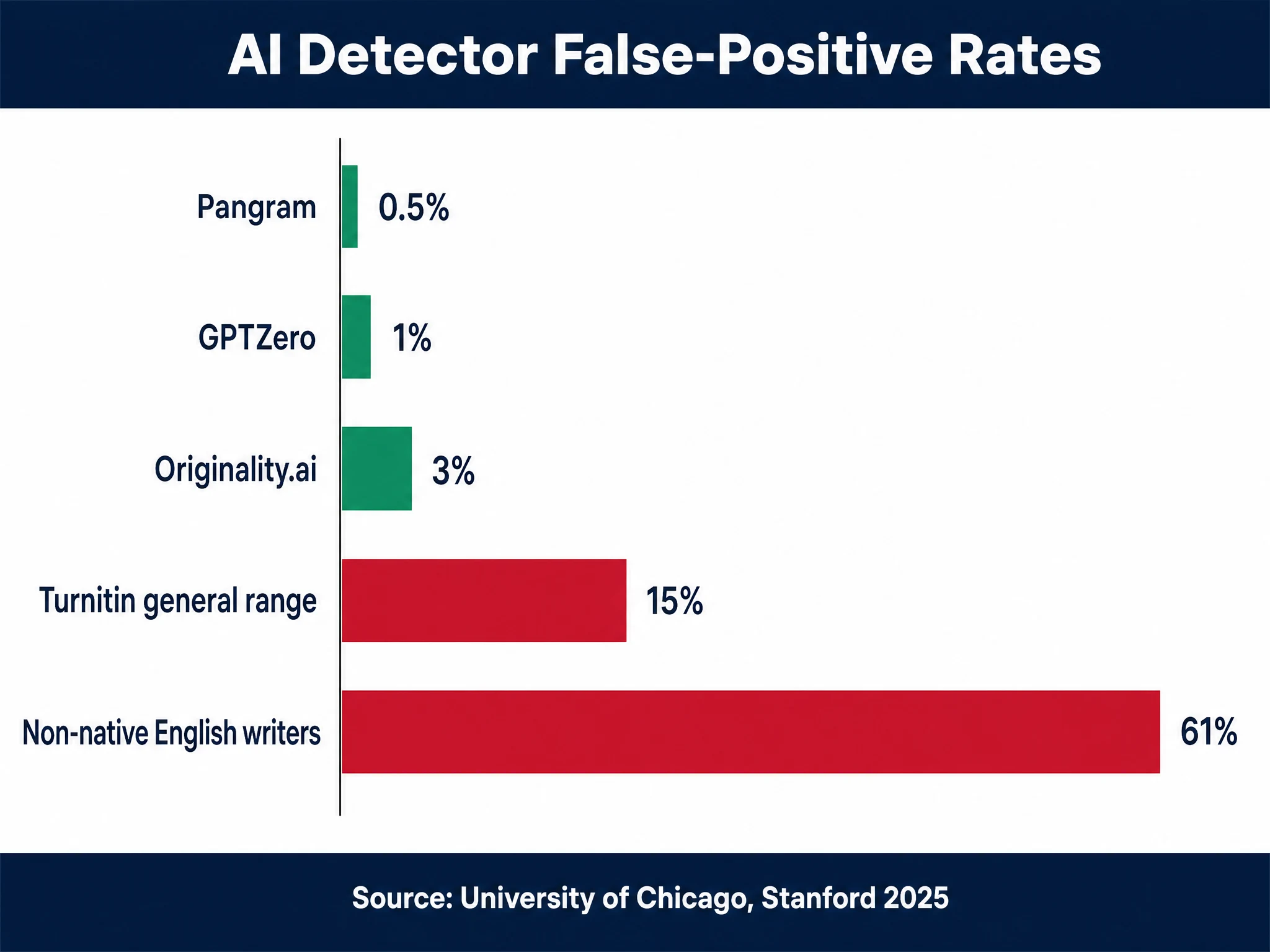
False-positive rates range from under 1% for the best detectors to 61% for non-native English writers — the single most damaging statistic in the entire category.
| Population / detector | False-positive rate | Source |
|---|---|---|
| Pangram (independent test) | <0.5% | University of Chicago |
| GPTZero (medium–long text) | ~1% | University of Chicago |
| Originality.ai (medium–long text) | ≤1% | University of Chicago |
| General detector range | 4–15% | Multiple, 2026 |
| Authentic student writing (192-text set) | 43–83% | 2026 study |
| Non-native English (TOEFL essays) | 61.3% | Stanford, Patterns |
| Source: University of Chicago (Jabarian & Imas, 2025); Stanford (Patterns, 2023, no superseding study as of 2026). | ||
6 Institutional adoption is reversing
At least 16 universities have disabled Turnitin’s AI detection, and Australia’s Curtin University switched it off entirely from 1 January 2026 — the clearest sign that adoption is now moving backward at the top of the market.
| Institution / metric | Value | Source |
|---|---|---|
| Universities that disabled AI detection | 16+ | EdTech Innovation Hub |
| Named US institutions | UCLA, UCSD, Vanderbilt, Yale, JHU, Northwestern | Multiple |
| Curtin University (Australia) | Disabled Jan 1, 2026 | EdTech Innovation Hub |
| ESL flag rate vs native (internal testing) | ~3× higher | Multiple |
| Source: EdTech Innovation Hub, Curtin University, 2026. | ||
The reversal is telling because these are not fringe schools — they include the most selective universities in the US, plus a major Australian institution that turned detection off system-wide. Their stated reasons echo the false-positive data above: unreliable scores, roughly triple the flag rate for non-native speakers, and a decision to prioritize teaching over surveillance. For the running list, see our tracker of universities walking away from Turnitin AI detection in 2026.
Methodology
This page compiles publicly reported figures on the AI text-detection industry. Where two sources report the same metric, the more recent figure is used and older data is dated in-line. Market-size estimates differ by firm and methodology and are presented side by side rather than averaged.
- Sources consulted: 9 across market research, vendor disclosures, academic studies and tech press
- Data range: 2023–2026 (freshest figures lead each section)
- Last verified: July 19, 2026
- Update schedule: Quarterly, or on any major acquisition or accuracy study
Frequently Asked Questions
How big is the AI detection market in 2026?
The AI detector market is valued at roughly $749.8 million in 2026 and is projected to reach about $5.2 billion by 2033, a 32% compound annual growth rate (Grand View Research). A second estimate from MarketsandMarkets puts the 2026 figure closer to $980 million.
How many papers has Turnitin scanned for AI?
Turnitin has reviewed more than 200 million papers since its AI writing indicator launched in April 2023. As of March 2024, about 11% contained at least 20% AI writing and about 3% contained at least 80%. Since October 2025, 15% of submissions score over 80% AI.
Which AI detector has the lowest false-positive rate?
In independent University of Chicago testing, Pangram was the only detector to stay under a 0.5% false-positive cap. GPTZero and Originality.ai both held rates at or below 1% on medium-to-long passages. General detectors range from 4% to 15%.
Why do detectors flag non-native English writers?
Perplexity-based detectors read the simpler, more predictable sentence structures common in non-native writing as machine-like. A Stanford study found a 61.3% false-positive rate on TOEFL essays versus 5.1% for US students — the fairness gap most universities cite when disabling detection.
How many universities have disabled AI detection?
At least 16 universities — including UCLA, UC San Diego, Vanderbilt, Yale, Johns Hopkins and Northwestern — have disabled Turnitin’s AI detection. Curtin University in Australia switched it off system-wide from 1 January 2026, citing reliability and equity concerns.
Can detectors catch humanized AI text?
Largely no. Turnitin’s detection rate falls from about 97% on raw AI text to roughly 52% on standard humanizer output and as low as 11% on advanced humanizers. This gap is why the humanizer market continues to grow alongside detection.
Sources & References
- Grand View Research. “AI Detector Market Size, Share & Trends Report, 2026–2033.” grandviewresearch.com. Accessed July 19, 2026.
- MarketsandMarkets. “AI Detector Market Report.” marketsandmarkets.com. Accessed July 19, 2026.
- Turnitin. “AI writing statistics” and one-year anniversary release. guides.turnitin.com. Accessed July 19, 2026.
- TechCrunch. “Superhuman acquires AI detection startup GPTZero.” techcrunch.com. Accessed July 19, 2026.
- Superhuman. “Superhuman to acquire GPTZero.” blog.superhuman.com. Accessed July 19, 2026.
- University of Chicago (Jabarian & Imas). “Artificial Writing and Automated Detection,” BFI WP 2025-116. bfi.uchicago.edu. Accessed July 19, 2026.
- EdTech Innovation Hub. “Curtin University to disable Turnitin AI detection tool in 2026.” edtechinnovationhub.com. Accessed July 19, 2026.
- Chicago Booth Review. “Do AI Detectors Work Well Enough to Trust?” chicagobooth.edu. Accessed July 19, 2026.
- EdTechImpact. “Pangram AI Detection Reviews 2026.” edtechimpact.com. Accessed July 19, 2026.
