Nearly two-thirds of UK undergraduates say assessment at their institution has changed significantly in response to AI. The change is not better detection — it is the return of the handwritten, invigilated exam.
Want to bypass Turnitin in 2026? Grab the free prompt pack.
Get the exact text-humanization prompts I use to drop an AI score by hand — copy, paste, submit. Free, straight to your inbox.
Send me the free prompts →Source: HEPI/Kortext Student Generative AI Survey 2026 (n = 1,054)
- 65% of UK undergraduates report assessment has changed significantly because of AI. (HEPI 2026)
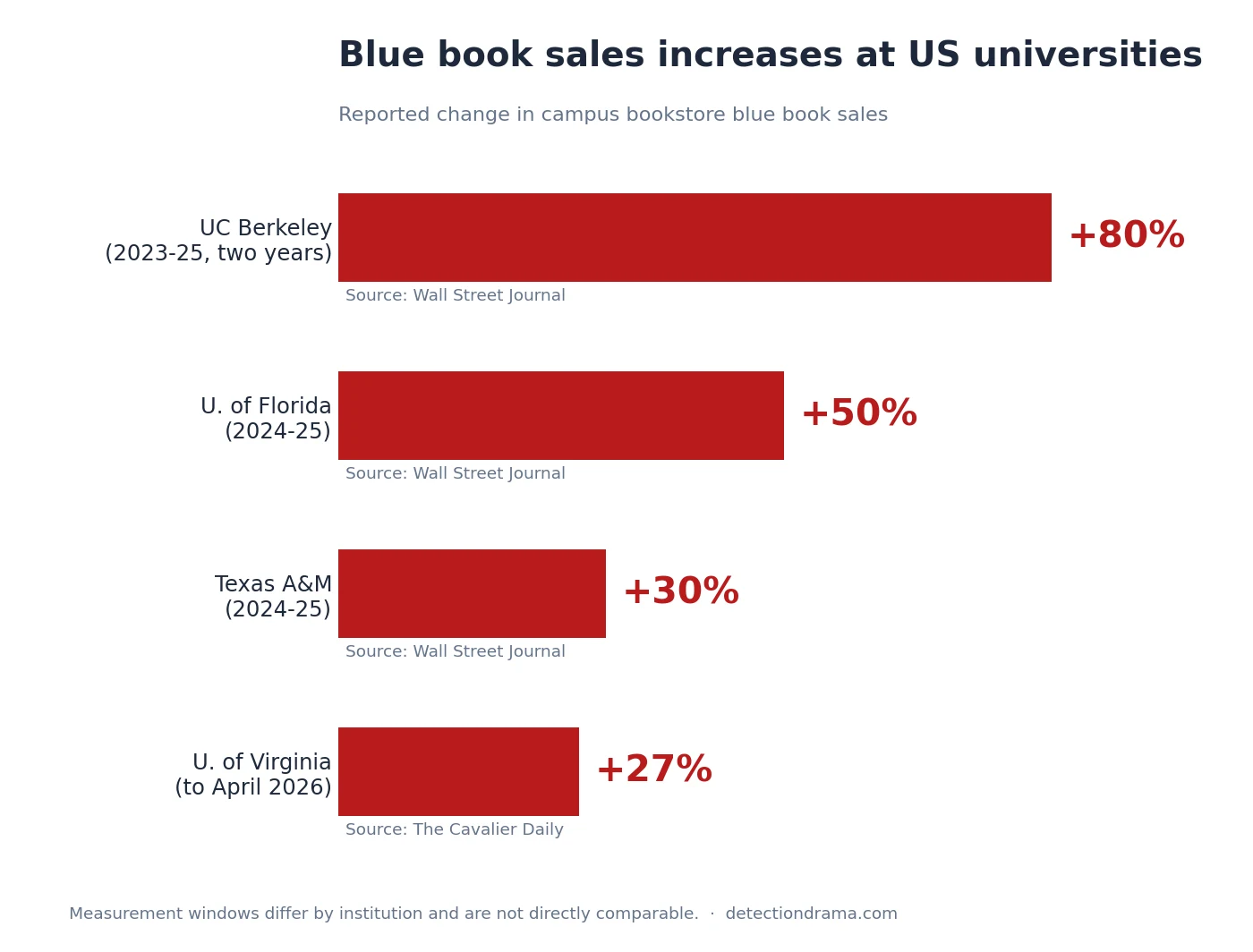
- Blue book sales more than doubled nationally between 2022 and 2024, and rose 80% at UC Berkeley’s Cal Student Store across 2023-24 and 2024-25. (Circana via The Economist; Wall Street Journal, May 2025)
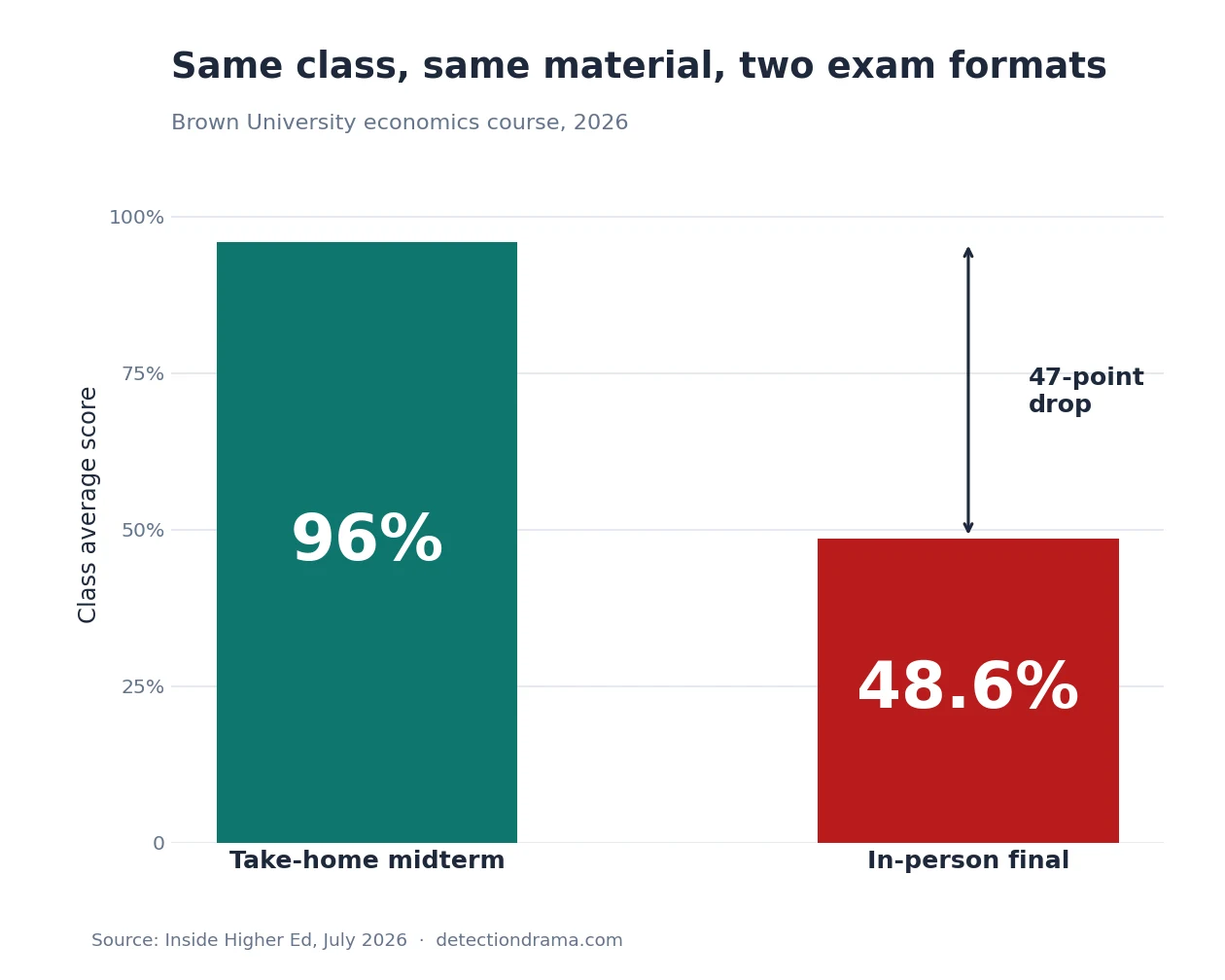
- At Brown University, a take-home midterm averaged 96%; the in-person final in the same course averaged 48.6%, against a historical final range of 65-80%. (Inside Higher Ed, July 2026)
- Only 12% of students admit putting AI-generated text directly into assessed work — but that is up from 3% in 2024. (HEPI 2026)
- 66% of US high-school and college instructors said they were rethinking their assignments because of AI — a small September 2023 survey (n=228) that has been widely recycled since. (Intelligent.com, 2023)
- The University of Bath moves to invigilated “closed” assessments from 2026-27; Cardiff is considering the same. (Times Higher Education, June 2026)
- The reversal is already leaking: the College Board banned smart glasses from the SAT in March 2026. (Inside Higher Ed)
1What triggered the reversal
Institutions did not abandon AI detection because they found something better. They abandoned it because the detectors did not hold up, and the cheapest remaining control was to put students in a room with paper. That story is documented most cleanly at Brown University, where an economics professor ran the same cohort through both formats in the same semester.
| Metric | Value | Source |
|---|---|---|
| Take-home midterm class average | 96% | Inside Higher Ed, Jul 2026 |
| In-person final class average | 48.6% | Inside Higher Ed, Jul 2026 |
| Students who dropped rather than sit the in-person final | 18 | Inside Higher Ed, Jul 2026 |
| US instructors rethinking assignments because of AI | 66% | Intelligent.com, Sep 2023 (n=228) |
| Historical average, same course’s final exams | 65-80% | Inside Higher Ed, Jul 2026 |
A 47-point collapse between two assessments of the same cohort on the same material is the number that moved administrators, because it needs no detector to interpret. It is worth stating the caveat the coverage usually drops: 86 students enrolled, 18 withdrew rather than sit the in-person final, and a further nine did not turn up, so the 48.6% reflects the roughly 59 who did. That is a self-selected remainder, and if anything the students most reliant on the take-home format are the ones missing from it. The comparison still holds — the course’s finals had never previously averaged below 65% — but it is not a clean like-for-like. It is also the reason the argument shifted from accuracy to architecture — a shift that had already begun as Turnitin started losing universities over its AI detection product, and accelerated once a growing list of institutions banned AI detectors outright.
2Blue book sales, institution by institution
Blue book sales are the only hard, independently reported proxy for how far the reversal has gone, because campus bookstores count units. These are every figure published to date.
| Institution | Increase | Period / Source |
|---|---|---|
| United States, national retail sales | More than doubled | 2022 to 2024 · Circana, via The Economist (Nov 2025) |
| Cal Student Store (UC Berkeley) | +80% | Across 2023-24 and 2024-25 · Wall Street Journal (May 23, 2025) |
| University of Florida | Nearly +50% | 2024-25 academic year · Wall Street Journal (May 23, 2025) |
| Texas A&M University | More than +30% | 2024-25 academic year · Wall Street Journal (May 23, 2025) |
| University of Virginia | +27% | April 2024-25 to April 2025-26 · The Cavalier Daily |
| Roaring Spring Paper Products (manufacturer) | Rising since 2020-21 | Company statement · Wall Street Journal (May 23, 2025) |
The comparability caveat matters more than it looks. The Berkeley figure covers two academic years while Texas A&M’s covers one, and two of the three WSJ numbers are bounds rather than point estimates, so this table describes direction rather than a ranking. The national Circana figure is the one to lead with if you only quote one: it is the broadest measurement available, and doubling between 2022 and 2024 places the inflection alongside ChatGPT’s arrival rather than alongside any institutional policy.
3Which universities have formally reverted
Sales figures show individual instructors changing tactics. Policy changes show institutions doing it deliberately, and those are rarer and more consequential.
| Institution | Change | Effective / Source |
|---|---|---|
| University of Bath | Open/closed split | 2026-27 · Times Higher Education, Jun 2026 |
| Cardiff University | Under consideration | Announced Jun 2026 · Times Higher Education |
| College Board (SAT) | Smart glasses banned | March 2026 · Inside Higher Ed |
Bath’s model is the one worth watching, because it does not simply reinstate exams — it formally sorts every assessment into “open” (AI permitted) or “closed” (time-limited, invigilated, in-person). That is a structural answer rather than a defensive one, and it sidesteps the accusation problem entirely: in a closed assessment there is nothing to detect, and in an open one there is nothing to accuse. For students, that distinction matters far more than any detector threshold, because the documented false positive rates across the major detectors stop being load-bearing the moment the venue changes.
The pattern also explains why AI detection policies at large US universities have grown so inconsistent. Institutions are transitioning at different speeds, and a policy written for a detector-first world reads very differently once half the assessments are invigilated.
4How widespread is the shift?
The best sector-wide measurement comes from the UK, where HEPI has surveyed undergraduates annually and can therefore show movement rather than a snapshot.
| Metric | Value | Source |
|---|---|---|
| Students saying assessment changed significantly due to AI | 65% | HEPI/Kortext 2026 |
| Students using AI in at least one way | 95% | HEPI/Kortext 2026 |
| Students using generative AI for assessed work | 94% | HEPI/Kortext 2026 |
| Students putting AI-generated text directly into assessed work (2026) | 12% | HEPI/Kortext 2026 |
| Same metric, 2025 | 8% | HEPI/Kortext 2025 |
| Same metric, 2024 | 3% | HEPI/Kortext 2024 |
| Survey base | 1,054 | UK full-time undergraduates |
The 95% and the 12% are the two numbers that get misquoted in opposite directions. Near-universal AI use does not mean near-universal cheating — most of that 95% is research, summarising and editing. The figure that actually describes submitted AI text is 12%, and it quadrupled in two years. Institutions are redesigning assessment around the 12% while the number of students who actually get caught remains a small fraction of it.
5Cost calculator: what a blue book policy costs a course
The reversal has a per-course price that rarely appears in the coverage: booklets, plus the invigilation and hand-grading hours that a digital submission did not require. Adjust the inputs for your own course.
Blue book exam cost estimator
For a mid-sized lecture course the booklets are trivial and the grading hours are not. That asymmetry is why the reversal is concentrated in departments that already ran large in-person exams, and why what universities currently spend on AI detection tools is not a like-for-like saving: dropping a licence does not recover the labour that replaces it.
6Does it actually work?
Partly, and for less time than institutions expect. Moving assessment into a supervised room removes the LLM-at-home problem and replaces it with a hardware problem.
| Development | Detail | Source |
|---|---|---|
| College Board bans smart glasses from SAT | March 2026 | Inside Higher Ed, Feb 2026 |
| Ban includes prescription models | Yes | Inside Higher Ed, Feb 2026 |
| Smart glasses rental market, China | $6-12/day | Rest of the World, via PetaPixel, Apr 2026 |
| AI glasses banned from China’s college entrance and civil service exams | Yes | Rest of the World, via PetaPixel, Apr 2026 |
| Digital cheating on non-exam course points (ASU syllabi audit) | 45% of points | Inside Higher Ed, Mar 2026 |
The College Board extending its ban to prescription frames is the detail that gives the game away — once the cheating device is indistinguishable from a medical necessity, invigilation becomes a screening problem rather than a supervision one. The evidence on in-person courses is narrower than it is often reported: Inside Higher Ed’s March 2026 audit of Arizona State syllabi found that 45% of available points sat in attendance and homework components that could be gamed digitally, which is a finding about course design rather than about proctored exams being beaten. Taken together the two point the same way, and it is the pattern already visible when AI cheating became effectively undetectable: each control holds until its workaround is cheap enough to rent.
7Who the reversal disadvantages
The equity objection is the strongest argument against the shift, and it is structurally identical to the objection against detectors — both fall hardest on the same students.
As Axios reported in March 2026, multilingual writers and students with disabilities who need accommodations are at a marked disadvantage in timed, handwritten conditions. That maps precisely onto the detector-era evidence: the same populations carried the cost when detectors showed measurable bias against ESL students and when neurodivergent writers were flagged at elevated rates. Swapping the mechanism did not change who absorbs the error.
There is a pedagogical objection too. Handwritten timed exams remove revision — drafting, feedback, rewriting — which is where most of the writing instruction actually happens. Critics have been blunt about the regression: Steven Krause of Eastern Michigan University, quoted by Axios, asked why institutions did not simply have students write with chisels. Instructors who want the integrity guarantee without discarding the revision process have generally moved toward documented process instead, which is where writing-process trackers and what they genuinely prove become relevant.
Worth noting for students caught in the transition: supervised writing is not automatically safe from a flag either. Work produced under supervision can still be flagged as AI, and if that happens the response differs from a standard accusation — the invigilation record is itself the evidence, which is a much stronger position than the one most students are in during the first 24 hours after an AI accusation.
8Methodology
Research date: August 11, 2026.
What is included: every publicly reported figure we could locate on blue book sales, institutional policy reversals, and sector-wide assessment change attributable to generative AI. Each number in this article carries a named publication and a date.
Freshness distribution: of the sources cited, eight were published in 2026 and two in 2025. One survey instrument (Intelligent.com, n=228) dates to September 2023 and is labelled as such everywhere it appears.
What is excluded and why: several widely circulated figures were dropped because no primary source could be reached — notably a claim that 53.6% of Australian tertiary submissions checked between October 2025 and April 2026 contained AI, and secondary reports that named specific Ivy League institutions as having reverted to handwritten exams. Aggregator sites restating the HEPI 65% figure as a “65% rise in vivas” were also excluded; that is a misreading of the survey.
Known limitations: blue book sales figures come from individual campus bookstores over differing measurement windows and are not directly comparable to one another. Two of the Wall Street Journal figures are bounds (“nearly 50%”, “more than 30%”) rather than exact values, and the WSJ article is paywalled — those three figures were confirmed through The Cavalier Daily’s restatement of them. The Brown University comparison is affected by attrition and is annotated accordingly in section 1. The HEPI survey covers UK full-time undergraduates only (n = 1,054) and should not be read as global. No central body publishes counts of institutions that have reverted to invigilated assessment, so section 3 is necessarily incomplete.
Update schedule: reviewed quarterly, or sooner when a new institutional figure is published.
9Frequently asked questions
Are universities really going back to blue books?
Yes, though unevenly. National blue book sales more than doubled between 2022 and 2024 (Circana, via The Economist). At institution level the Wall Street Journal reported an 80% rise at UC Berkeley’s Cal Student Store across 2023-24 and 2024-25, nearly 50% at the University of Florida and more than 30% at Texas A&M in 2024-25; the University of Virginia reported roughly 27% through April 2026. Most of that is individual instructors changing tactics rather than institution-wide mandates, which remain rare.
Why did universities switch from AI detectors to handwritten exams?
Because detection stopped being defensible. Institutions faced documented false positive rates and mounting disputes, and several banned AI detectors outright. An invigilated exam removes the need to prove authorship after the fact, which is why it became the preferred control despite costing more in staff hours.
What is the Brown University 96% to 48.6% statistic?
An economics professor at Brown gave a take-home midterm on which the class averaged 96%, then an in-person final that averaged 48.6% — a 47-point drop, against a historical final range of 65-80% for that course. Of the 86 enrolled, 18 withdrew rather than sit the in-person exam and nine did not appear, so the final average reflects roughly 59 students. Inside Higher Ed reported it in July 2026.
Do in-person exams actually stop AI cheating?
They stop the take-home LLM, but not indefinitely. The College Board banned smart glasses from the SAT in March 2026, including prescription models, and AI-enabled glasses rent for $6-12 a day in China despite already being barred from that country’s college entrance exams. Invigilation shifts the problem from detecting text to screening hardware.
How many students actually submit AI-written text?
12% of UK undergraduates admit putting AI-generated text directly into assessed work, up from 8% in 2025 and 3% in 2024. That is far below the 95% who use AI in some form — most use is research and editing rather than submission. See how many students actually get caught for the enforcement side.
Do handwritten exams disadvantage some students?
Yes. Axios reported in March 2026 that multilingual writers and students with disabilities who need accommodations are at a marked disadvantage in timed, handwritten conditions. This mirrors the detector era, when the same groups absorbed most of the errors — the pattern is documented in the data on detection-related student anxiety.
Which universities have formally changed their assessment policy?
The University of Bath moves to an “open” versus “closed” assessment split from 2026-27, where closed assessments are time-limited, invigilated and in-person. Cardiff University confirmed it is considering a similar approach. Both were reported by Times Higher Education in June 2026. No central register of such changes exists.
10Sources
- Higher Education Policy Institute. “Student Generative Artificial Intelligence Survey 2026.” hepi.ac.uk. Accessed August 11, 2026.
- Higher Education Policy Institute. “Report 199: Student Generative AI Survey 2026” (PDF). hepi.ac.uk. Accessed August 11, 2026.
- Wall Street Journal. “They Were Every Student’s Worst Nightmare. Now Blue Books Are Back.” Published May 23, 2025. wsj.com. Accessed August 11, 2026.
- The Cavalier Daily. “Blue books return in an effort to combat AI usage.” cavalierdaily.com. Accessed August 11, 2026.
- Inside Higher Ed. “Brown Professor Suspects Most of His Class Used AI to Cheat.” insidehighered.com. Accessed August 11, 2026.
- Times Higher Education. “Are universities returning to in-person exams to combat AI cheating?” timeshighereducation.com. Accessed August 11, 2026.
- Inside Higher Ed. “College Board Prohibits Wearing Smart Glasses During SAT.” insidehighered.com. Accessed August 11, 2026.
- Inside Higher Ed. “In-Person Classes Aren’t Safe From AI Cheating Boom.” insidehighered.com. Accessed August 11, 2026.
- PetaPixel. “Students Are Using Smart Glasses to Cheat on Their Exams” (reporting Rest of the World). Published April 1, 2026. petapixel.com. Accessed August 11, 2026.
- CNN. “AI glasses are aiding cheating in exams. Test-obsessed Asia is ground zero.” Published June 26, 2026. cnn.com. Accessed August 11, 2026.
- Education Week. “Teachers Turn to Pen and Paper Amid AI Cheating Fears, Survey Finds” (reporting the Intelligent.com survey, n=228). Published October 2023. edweek.org. Accessed August 11, 2026.
- The Economist. “AI is accelerating a tech backlash in American classrooms” (carrying Circana blue book sales data). Published November 20, 2025. economist.com. Accessed August 11, 2026.
- Axios. “Blue books make a comeback at colleges in the AI era.” axios.com. Accessed August 11, 2026.
Last updated: August 11, 2026. Figures reviewed quarterly.
