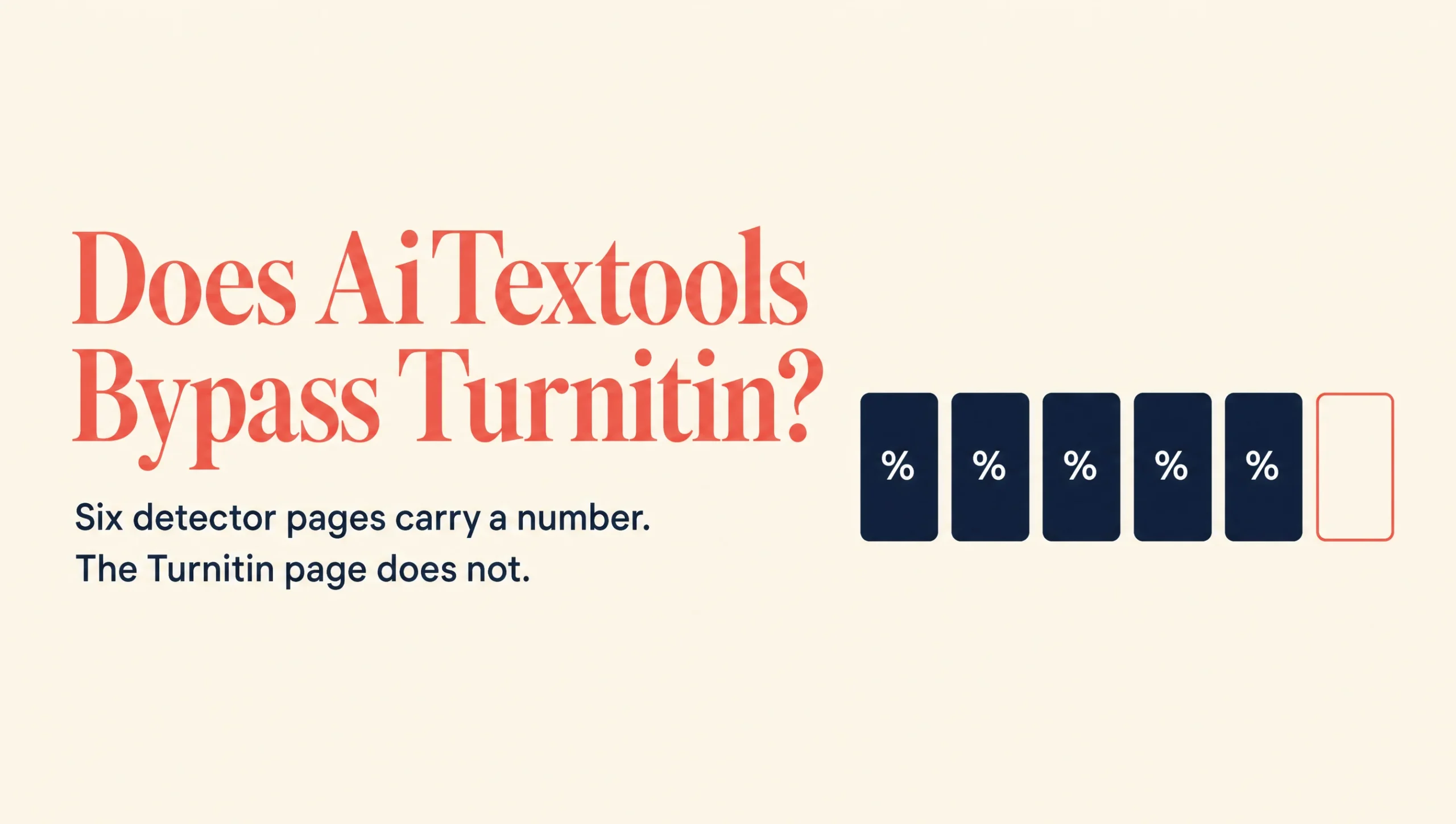
Does AiTextools bypass Turnitin? It publishes a result for six other detectors and none for this one — on a site that names Turnitin more than anything else.
Want to bypass Turnitin in 2026? Grab the free prompt pack.
Get the exact text-humanization prompts I use to drop an AI score by hand — copy, paste, submit. Free, straight to your inbox.
Send me the free prompts →Key Takeaways
- AiTextools publishes a before-and-after result on six detector pages. Its dedicated bypass-Turnitin page carries no result at all.
- Turnitin is the most-mentioned detector on the site — 1,357 times across 66 pages. It is the only one with a landing page and no number.
- Its contact page says the rewriter is “optimized to produce results that pass each of these” — naming five detectors. Turnitin is not among the five.
- Section 16 of its Terms: “We do not guarantee that rewritten text will pass any specific AI detection system.”
- The six results that do exist each use a different source text on a different topic, so none can be compared with any other.
- 29 of 32 blog posts are backdated in their machine-readable schema, one to January 2024 — two years before the domain was registered.
- There are no detector screenshots anywhere, and the site’s only non-logo image, its social preview, returns a 404.

Does AiTextools bypass Turnitin?
It has never said. And on a site this saturated with the word, that silence is the most informative thing available.
We crawled all 66 URLs in the sitemap and counted every detector name. Turnitin appears 1,357 times across 66 pages — more than GPTZero at 1,311, more than Originality at 766. It is the most-mentioned detector on the site.
It is also the only one whose dedicated page publishes no result.

Six detector pages carry a before-and-after pair. The page at /ai-humanizer/bypass-turnitin carries none. This page reports no first-party test; everything below was fetched on 31 August 2026.
What is AiTextools actually optimised against?
Its own contact page answers this, and the answer is not Turnitin.
Five detectors are named as optimisation targets. They are the same five — plus QuillBot — that get a published result. Turnitin is not among them.
That is a more honest framing than most of this market manages, and it should be credited as such. AiTextools is not claiming a Turnitin percentage it cannot support. It is claiming optimisation against a specific detector set, and Turnitin sits outside that set.

Section 16 of its Terms makes the same point contractually: “We do not guarantee that rewritten text will pass any specific AI detection system.” Section 14 adds that “rewritten text may still be detected by some AI detection tools in some cases.”
The gap here is narrower than elsewhere in this cluster. It is not a 99% promise against a flat disclaimer. It is a product tuned to a detector set assembled before Turnitin’s bypasser detection existed, sold on a site that mentions Turnitin 1,357 times anyway.
Why does the missing number line up with the access rules?
Look at which detectors got a published result.
| Detector | Result published? | Can a consumer query it directly? |
|---|---|---|
| ZeroGPT | Yes — 100% to 0% | Yes — public self-serve |
| Originality.ai | Yes — 99% to 2% | Yes — public self-serve |
| GPTZero | Yes — 98% to 2% | Yes — public self-serve |
| Copyleaks | Yes — 97% to 3% | Yes — public self-serve |
| QuillBot | Yes — 96% to 3% | Yes — public self-serve |
| Winston AI | Yes — 94% to 4% | Yes — public self-serve |
| Turnitin | No | No — institutions only |
Turnitin’s help centre states it “does not sell individual licenses or single-use subscriptions”, and that “AI writing detection reports are not visible to students”. Draft Coach, the only student-facing Turnitin product, has no AI detection at all.
The six detectors AiTextools published numbers for are all freely queryable. The one it did not is the one no vendor can lawfully reach. The pattern is consistent with a vendor that ran the tests it could run and declined to invent the one it could not — which, in this market, counts as restraint.
Readers can apply the test elsewhere too: Turnitin’s documentation says “no score or highlights are attributed for AI detection scores in the 1% to 19% range”, showing an asterisk instead. Any screenshot displaying a specific Turnitin AI figure like 3% or 12% is not a genuine current report.
datePublished from all 32 blog posts and compared them against the domain’s RDAP registration record. We requested every image asset directly and recorded its HTTP status. Turnitin’s claims are quoted from its capabilities FAQ, help centre and press releases, each dated. Academic figures are cited to the peer-reviewed source.How good are the six results that do exist?
Weak, and for a reason that has nothing to do with Turnitin. Each of the six pages uses a different source text on a different topic — business, SEO, climate change, project management, education, content marketing. Six different topics means six different difficulty levels, so the neat descending sequence from 100 down to 94 is not a comparison of anything.
There are also no screenshots anywhere on the site. The only non-logo image is the social preview, and that returns a 404.
And the dates do not hold. The domain was registered on 11 January 2026, yet 29 of 32 blog posts carry a JSON-LD datePublished predating it — one stamped 15 January 2024, almost two years early. The visible bylines show plausible 2026 dates; the schema that search engines consume does not. The affected pages include the detector rankings and a claimed Turnitin accuracy study.
What can be checked on Turnitin’s side?
Almost nothing. Turnitin shipped paraphrasing detection in July 2024 and dedicated bypasser detection in August 2025, and has published no accuracy figure for either since. It has never published an overall accuracy percentage at all. On 4 August 2026 it merged the AI-paraphrased highlight into AI-generated, so instructors can no longer see how much of a flag came from bypasser detection.
Independently, Hadra, Cambridge and Mesbah (February 2026, 192 texts) measured Turnitin at 0.61 overall accuracy and 0.51 recall, performing poorly on hybrid human-and-AI text. Weber-Wulff et al. (2023) put field-wide accuracy on machine-paraphrased text at 26%, with Turnitin the best of 14 tools tested.
What should you take from this?
AiTextools is optimised against a detector set that does not include Turnitin, says so on its contact page, and declines to publish a Turnitin figure it could not have obtained. Read plainly, the site is telling you the answer: it was not built for this detector.
What it should not be given credit for is the 1,357 mentions. A tool that names Turnitin more than any other detector while excluding it from its optimisation targets and its results is recruiting on a promise it has quietly scoped out of.
Turnitin’s own guidance says its model “may misidentify human-written, AI-generated, and AI-paraphrased text, so it should not be used as the sole basis for adverse actions against a student”, and four universities have disabled it — Vanderbilt, Waterloo, Curtin and Washington State.
If your real worry is being wrongly flagged on your own writing, keep your drafting history — it costs nothing and it survives a detector being wrong. It matters most for the writers detectors treat worst: ESL writers and AI detection and false positives for neurodivergent students. Check before you submit with the best pre-submission check and the Turnitin self-check, and strip the obvious tells by hand first via what to remove before using an AI humanizer.
For the product itself see our AiTextools review, and for the detector it never names at all, does AiTextools bypass Pangram. Other Turnitin cells: Clarity Bubble, WriteHuman, Ryne AI, UnAIMyText, AuraWrite, Text Polish and HueWrite.
Get the free text-humanization prompts
Get the exact text-humanization prompts I use to drop an AI score by hand — copy, paste, submit. Free, straight to your inbox.
Free · No credit card · Straight to your inbox
Frequently asked questions
Does AiTextools bypass Turnitin?
It has never claimed a result. The site publishes before-and-after figures on six detector pages — ZeroGPT, Originality, GPTZero, Copyleaks, QuillBot and Winston — and its dedicated bypass-Turnitin page publishes none. That is a striking omission on a site that names Turnitin 1,357 times.
Doesn’t the site say it is optimised for Turnitin?
No, and this is the detail most readers miss. Its contact page states: “The platform checks content against multiple detectors including GPTZero, Originality.ai, Copyleaks, ZeroGPT, and Winston AI. The text rewriter is optimized to produce results that pass each of these.” Five detectors are named as optimisation targets. Turnitin is not one of them, despite being the name that appears most across the site.
What do the Terms say?
Section 16: “We do not guarantee that rewritten text will pass any specific AI detection system.” Section 14 adds: “Rewritten text may still be detected by some AI detection tools in some cases. We make no guarantees about accuracy, reliability, or effectiveness of our tools.”
Are the six published results reliable?
Not as a set. Each uses a different source text on a different topic — business, SEO, climate change, project management, education and marketing. Six different topics means six different difficulty levels, so the descending sequence from 100 down to 94 does not compare anything to anything. None is accompanied by a screenshot, a date, a generating model or a repeat trial.
Why can nobody test Turnitin independently?
Turnitin states it “does not sell individual licenses or single-use subscriptions”, its AI writing report is instructor-facing and “not visible to students”, and Draft Coach — the only student-facing Turnitin product — has no AI detection. Notice that the six detectors AiTextools does publish results for all sell public self-serve access. Turnitin is the one that does not, and it is the one with no number.
What is the date problem?
The domain was registered on 11 January 2026, yet 29 of its 32 blog posts carry JSON-LD datePublished values predating that — the earliest 15 January 2024, nearly two years early. The visible bylines show plausible 2026 dates; the machine-readable schema that search engines consume does not. The affected pages include its detector rankings and a claimed Turnitin accuracy study.
What does it cost, and can I get a refund?
Free, Lite at $9.99, Pro at $12.99 and Exclusive at $19.99 a month, with humanizer input capped between 30 and 300 words per request. The refund terms contradict themselves on the same page: the clause is headed “24-Hour Refund Window” while the summary above it describes a “3-day refund policy” in the same sentence as “within 24 hours.”
Who operates it?
No legal entity, jurisdiction, registration number, VAT number, address or named person appears on any of the 66 pages — only a support email, behind a Cloudflare-redacted registration.
