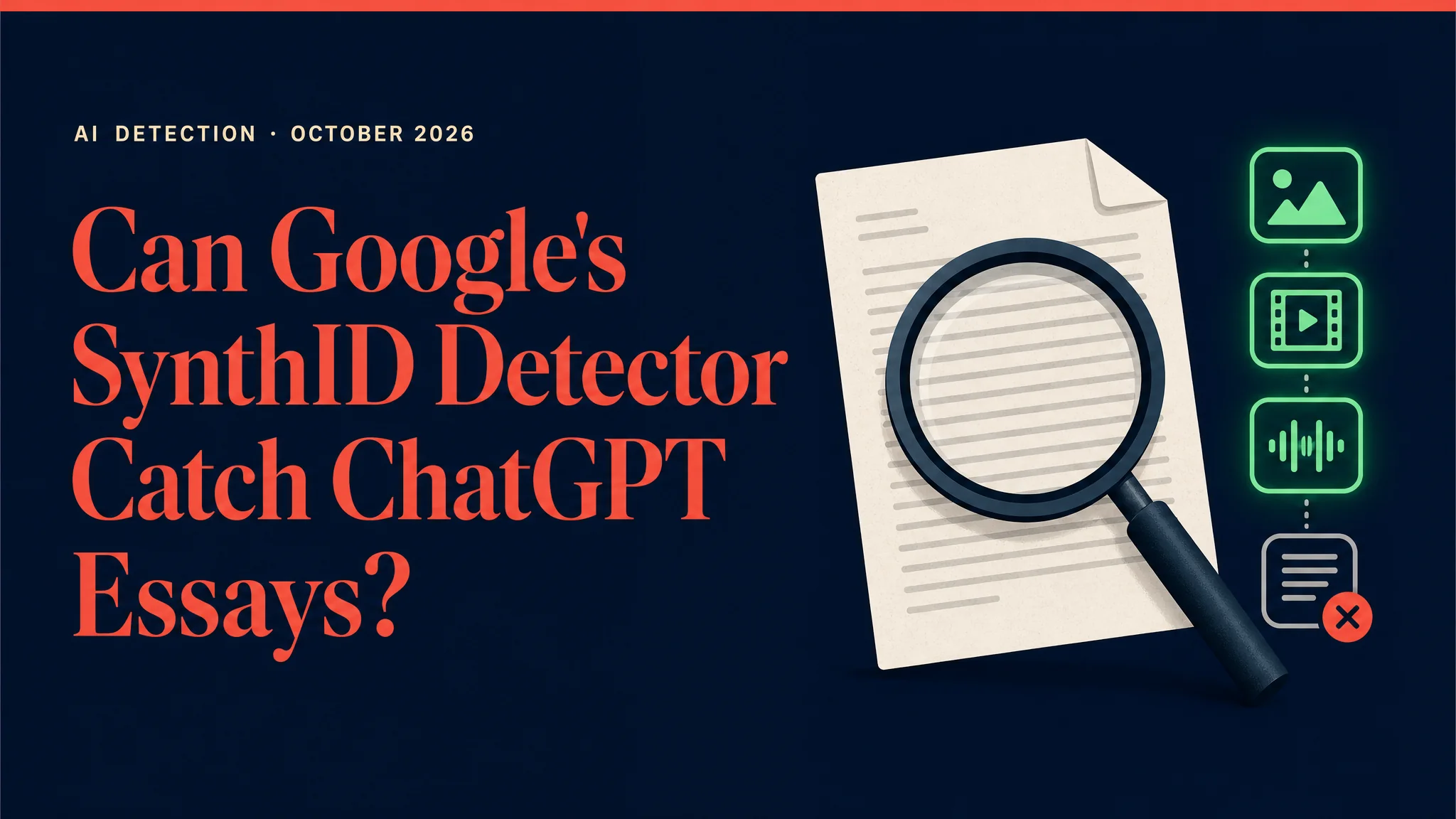
No. Google’s SynthID Detector cannot catch a ChatGPT essay: it only accepts image, video and audio files, and the watermark OpenAI is adding to ChatGPT text in the EU is OpenAI’s own textGrain mark, which only approved researchers can check.

By Vlad Ivanov · Last updated: 11 October 2026
Runs Detection Drama, stress-testing AI detectors and humanizers; publishes Words At Scale to 26,000+ subscribers. This explainer is built from Google DeepMind’s 7 October announcement, the Gemini verification help page and OpenAI’s 5 October text provenance post, all read on 11 October 2026.
Want to bypass Turnitin in 2026? Grab the free prompt pack.
Get the exact text-humanization prompts I use to drop an AI score by hand — copy, paste, submit. Free, straight to your inbox.
Send me the free prompts →Key Takeaways
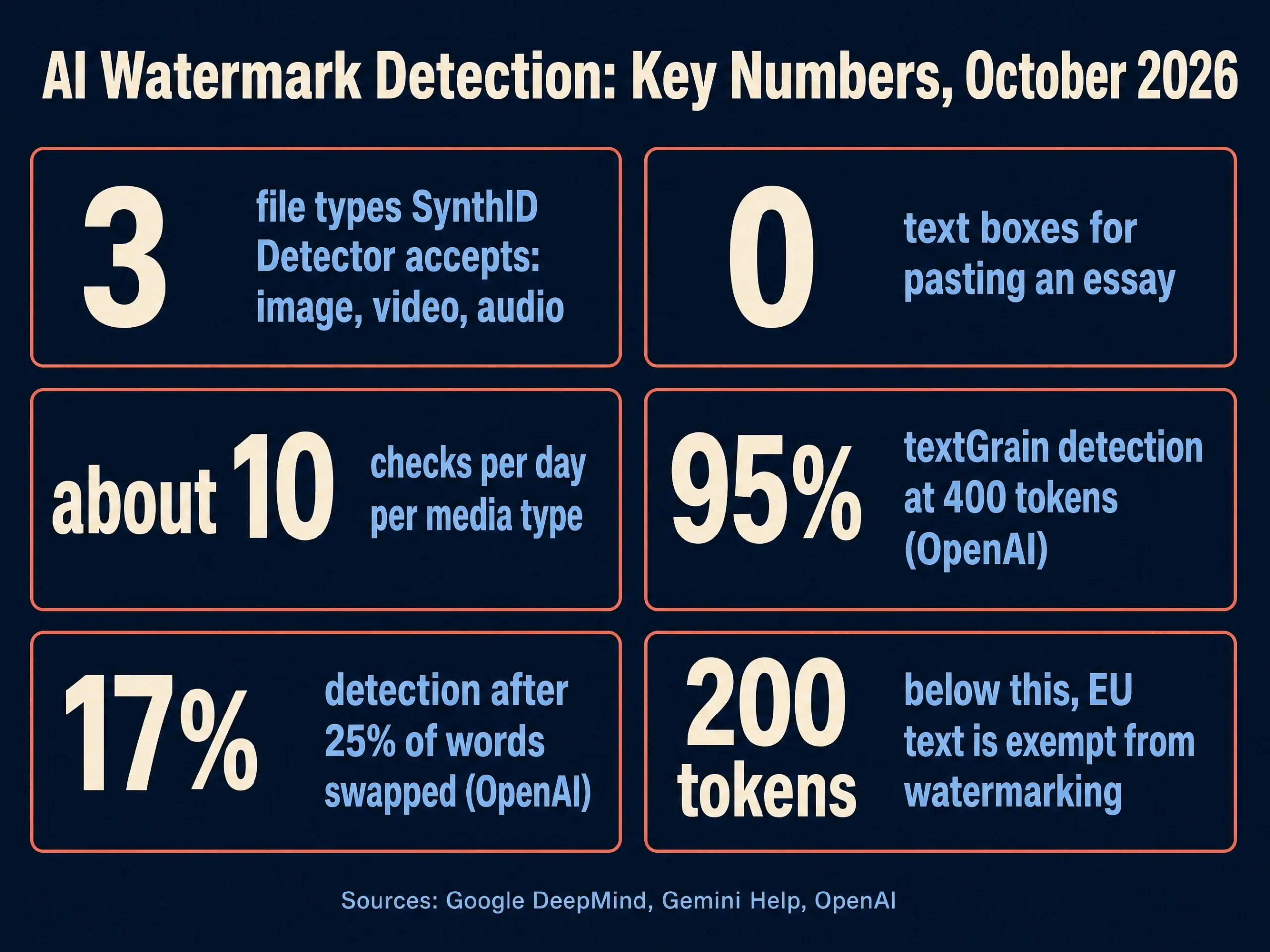
- Google opened SynthID Detector to everyone on 7 October 2026, for “an image, video, or audio file” only. Text is not on the list (Google DeepMind).
- OpenAI is a named SynthID partner, but that covers ChatGPT images and audio, not essays (OpenAI Help Center).
- ChatGPT text in the EU gets OpenAI’s own textGrain watermark “over the coming weeks”, announced 5 October 2026 (OpenAI).
- OpenAI’s text detector is limited to approved researchers, and screening student work is explicitly out of scope (OpenAI Help Center).
- textGrain finds about 95% of 400-token passages, but swapping 25% of the words drops that to about 17% (OpenAI).
- SynthID Detector allows roughly 10 checks a day per media type, and a negative result never proves something is human-made (Gemini Help).
On 7 October 2026, a post titled “Google’s AI detection website is now available” climbed r/ChatGPT. Within hours the comments had split into two camps: people wondering whether Google could now flag ChatGPT homework, and people pointing out that the tool does not take text at all. The second camp was right, and the reason is more interesting than a missing text box.
Two launches landed in the same week. OpenAI said on 5 October that it will watermark ChatGPT text in the EU. Google said on 7 October that its detector now checks content from OpenAI. Put those headlines side by side and it sounds like Google can now read ChatGPT’s watermark. It cannot, and this page explains exactly what each tool checks, who can use it, and what that means if you are a student, a teacher or anyone worried about whether Turnitin can detect ChatGPT.
What is Google’s SynthID Detector?
SynthID Detector is a free Google website, at synthid.com, that checks whether a file carries a SynthID watermark. Google DeepMind says anyone can now use it to see whether “an image, video, or audio file was made with AI from Google or our partners”, and that it is available globally in English from 7 October 2026.
SynthID itself dates from 2023. Google says it has watermarked more than 180 billion images and videos and 240,000 years of audio, and that verification built into Search, the Gemini app and Chrome handles over 1 million requests a day. An earlier version of the detector was limited to journalists and researchers, as TechRepublic notes. The October change is that anyone can upload a file.
Can SynthID Detector check text or essays?
No. Every Google source describing the public detector lists images, video and audio, and none lists text. TechRepublic counts the accepted formats as 11 image types, three video types and six audio types. The Gemini help page on verification covers the same three media and says nothing about pasted text.
The Reddit thread caught this fast. The top correction under the launch post was simply “This is for media, not text.” Another commenter called it worthless for their use because it “detects SynthID only” and only works when the image tool opted in. That second point matters for images too, and it comes up again below.
Why does Google say it can detect OpenAI content, then?
Because OpenAI puts SynthID into its images and audio, not its text. Google names OpenAI, NVIDIA and Kakao as SynthID partners, with Apple coming “soon”. OpenAI’s own provenance page spells out what that partnership covers: images from ChatGPT, Codex and the API include both Content Credentials and SynthID, and audio carries SynthID only.
So the honest version of the headline is narrower. If someone generates a picture in ChatGPT, SynthID Detector is built to spot it. If someone generates an essay in ChatGPT, there is no SynthID in it to find. The same split applies to the AI image detectors we have tested before, which carry their own problems with false positives on human art.
Does ChatGPT watermark text now?
Yes, but only in the EU, and with a different watermark. On 5 October 2026 OpenAI said that “over the coming weeks” it will add an invisible watermark to eligible ChatGPT and Codex text in the European Union, to meet the EU AI Act’s transparency rules (OpenAI). The method is called textGrain, described in an OpenAI technical report co-written with researchers from the University of Pennsylvania and Yale, according to TechCrunch.
Outside the EU, ChatGPT text is not watermarked by default. API customers anywhere can switch it on, but it is off unless they do. Short replies are also left out: the OpenAI help center says outputs under 200 tokens, roughly 150 English words, and code snippets do not need a watermark under the EU code of practice.
Like the Claude watermark we covered in our Claude watermark checker explainer, textGrain is a statistical bias in word choice, not a hidden character. That means tools that strip invisible Unicode do nothing to it, a point we make in our guide to hidden characters in humanizer output.
Who can check a ChatGPT text watermark?
Almost nobody, and not your school. OpenAI says detector access is “initially limited to approved researchers and expert organizations”, granted case by case. Its help center goes further: commercial fraud checks, authentication and “academic integrity checks (such as screening student work)” are outside the program’s scope. Named research partners include Cornell, ETH Zurich and the Slovak institute KInIT.
Even inside that program, the watermark is fragile. OpenAI reports these figures at a 1% false positive rate:
| Condition (OpenAI’s own tests) | Watermark detected |
|---|---|
| 200-token passage, unedited | about 80% |
| 400-token passage, unedited | about 95% |
| 400 tokens, 10% of words swapped for synonyms | about 66% (from about 92%) |
| 400 tokens, 25% of words swapped for synonyms | about 17% |
| Other EU languages, lowest to highest | 42.2% (Romanian) to 69.0% (Spanish) |
OpenAI is blunt about the limits: “The absence of a detected watermark does not prove human authorship.” That cuts both ways. A missing mark proves nothing, and the mark itself only says OpenAI generated some of the text, not how much the person wrote. Our AI text watermarking statistics page collects every independent number on how these schemes hold up, including how often detectors flag human writing.
Which tools can actually check a ChatGPT essay?
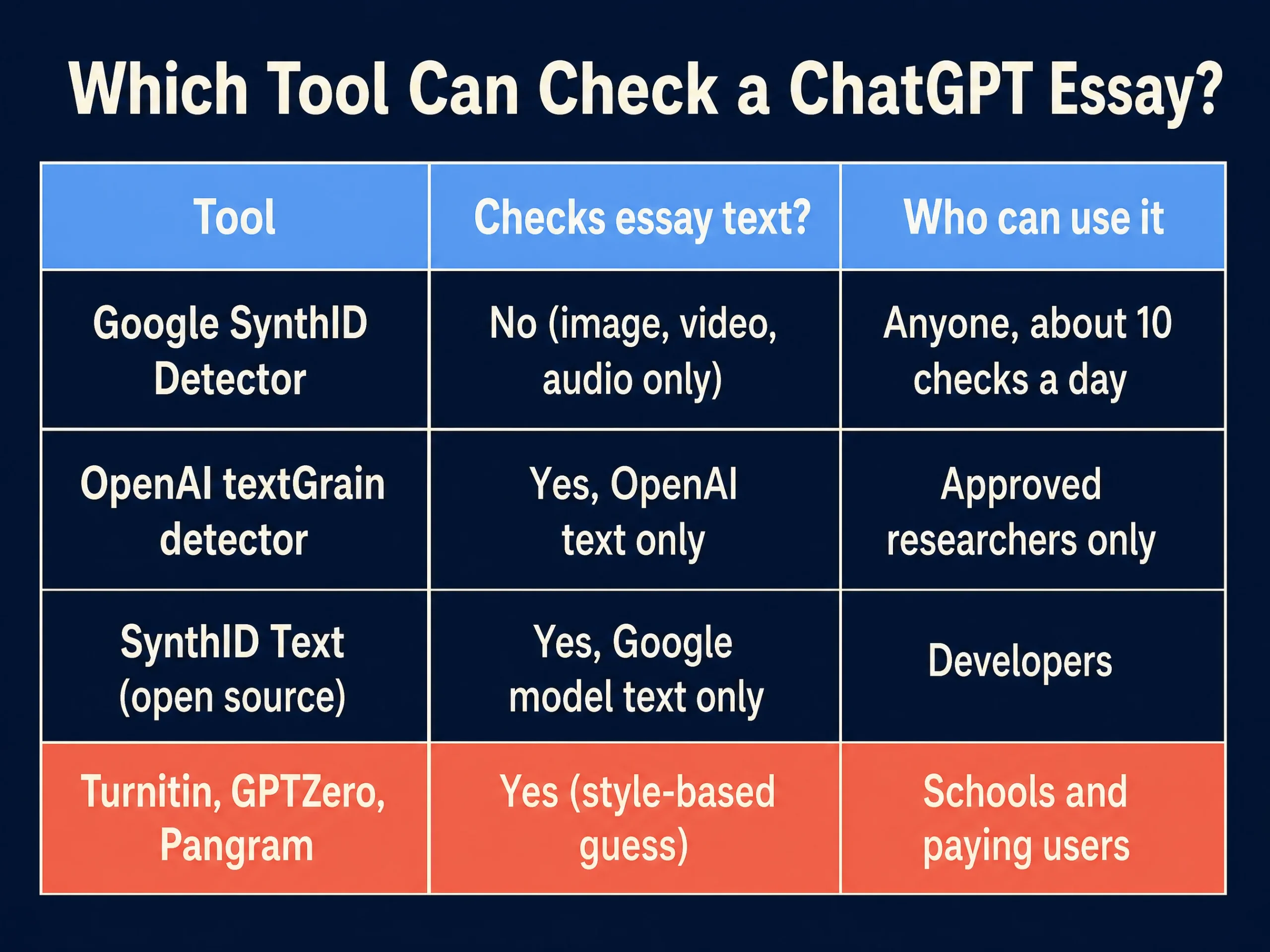
Only style-based AI detectors, and they guess rather than verify. Here is how the four options line up as of 11 October 2026:
| Tool | Checks essay text? | Who can use it | What a hit means |
|---|---|---|---|
| Google SynthID Detector | No, image, video and audio only | Anyone, about 10 checks a day | A Google or partner watermark is in the file |
| OpenAI textGrain detector | Yes, OpenAI text only | Approved researchers; student screening excluded | Some of the text came from OpenAI |
| SynthID Text (open source) | Yes, text from Google models only | Developers | Text came from a model running SynthID Text |
| Turnitin, GPTZero, Pangram | Yes | Schools and paying users | The writing style looks machine-like, a probability not proof |
Google open-sourced SynthID Text in October 2024, but MIT Technology Review reported it only works on content generated by Google’s models and is less reliable when text is rewritten, translated or asked for plain facts. It is a developer toolkit, not a website a teacher can paste an essay into.
That leaves the detectors schools already pay for. If you want to know which one your university runs, start with what AI detector Turnitin uses, and remember that these tools disagree with each other on the same text more often than their marketing suggests.
Can SynthID Detector check it?
Pick what you made and which AI made it. Answers come from Google, OpenAI and Anthropic documentation as of 11 October 2026.
Choose an option above to see the answer.
Will schools start using watermark detectors?
Not soon for text, based on what the providers have published. OpenAI excludes student screening from its detector program. Anthropic’s Claude watermark, which ships on models launched from 2 August 2026, had an announced detection API but no shipped one when we checked, as covered in our piece on whether Claude watermark removers work. Google’s text watermark has no public checker.
A student in r/UTS put the opposite view in September, predicting that watermark detectors would be handed to Turnitin and universities. Another replied that companies have little reason to do that. Nothing published as of 11 October supports the first prediction. The direction of travel at universities has actually been away from automated scores, with a growing list of universities that have switched AI detectors off.
What should students and teachers do now?
Treat SynthID Detector as an image, video and audio tool, and nothing more. For written work, the practical picture has not changed this week.
If you are a student, the check that matters is still the style-based one your school runs. Our test of the best free AI detectors for students shows which ones come closest to Turnitin before you submit. Keep your drafts and version history, because version history is often the strongest proof you have. Short pieces are riskier for false flags, as we explain in why short essays get flagged more often.
If you are a teacher, do not upload a screenshot of an essay to SynthID Detector and read anything into the result. A “not detected” answer on an image of text tells you nothing about who wrote it. If your institution has no Turnitin licence, our guide to an AI detector for professors without Turnitin covers the options and their error rates.
If you have already been accused, a watermark is not part of the evidence against you unless your school has research access, which OpenAI says it does not grant for this purpose. Our checklist for the first 24 hours after an AI accusation covers what to gather.
Worried about a style-based flag, not a watermark?
That is the check that actually reaches your essay. Start with our Pangram review, the detector students and counsellors in our Reddit research named most often, and our Turnitin AI detection statistics.
How we researched this
We read Google DeepMind’s 7 October 2026 announcement, the Gemini verification help page, OpenAI’s 5 October text provenance post and its provenance help page, plus TechRepublic and TechCrunch coverage, on 11 October 2026. We did not upload files to SynthID Detector for this piece, so every capability claim above is attributed to the company that made it. Reddit quotes come from the r/ChatGPT launch thread (89 upvotes, 21 comments when read) and r/UTS, pulled as part of a scan of about 225 AI detection posts from the past month.
Frequently asked questions
Can Google’s SynthID Detector detect ChatGPT text?
No. The public SynthID Detector only checks image, video and audio files. ChatGPT text in the EU carries OpenAI’s own textGrain watermark, which Google’s tool does not read.
Can SynthID Detector detect ChatGPT images?
It is designed to. OpenAI says images from ChatGPT, Codex and its API carry both a SynthID watermark and Content Credentials, and Google names OpenAI as a SynthID partner. A negative result still does not prove an image is human-made.
Is ChatGPT text watermarked in the US or UK?
Not by default. OpenAI announced on 5 October 2026 that the text watermark applies to eligible ChatGPT and Codex output in the European Union. API customers anywhere can opt in, but it is off by default.
Can my teacher check my essay for an OpenAI watermark?
Not through OpenAI. Its detector is limited to approved researchers and expert organisations, and its help center says academic integrity checks such as screening student work are outside the program’s scope.
Does paraphrasing remove the ChatGPT watermark?
Heavily. OpenAI’s own tests show detection on 400-token passages falling from about 92% to 66% when 10% of words are swapped for synonyms, and to about 17% when 25% are swapped. Translation also weakens it.
How many checks does SynthID Detector allow per day?
About 10 per media type in a rolling 24-hour window, one file at a time, up to 100 MB. Videos must be under 90 seconds and audio under 1 hour, according to Google’s Gemini help page.
Is SynthID Text the same as SynthID Detector?
No. SynthID Text is an open-source toolkit Google released in October 2024 for watermarking and detecting text from Google models. SynthID Detector is the public website for checking image, video and audio files.
Does a “not detected” result mean something is human-made?
No. Both Google and OpenAI say a missing watermark does not prove human authorship. The content may come from a tool without a watermark, be too short, or have been edited enough to remove it.
Sources
- Google DeepMind, SynthID Detector public launch, 7 October 2026
- Gemini Apps Help, verifying AI-generated content and daily limits
- OpenAI, Our approach to EU text provenance rules, 5 October 2026
- OpenAI Help Center, Provenance signals in OpenAI-generated content
- OpenAI, textGrain technical report
- TechRepublic, Google’s SynthID Detector is now public
- TechCrunch, OpenAI will start watermarking ChatGPT’s text in the EU
- MIT Technology Review, Google DeepMind is making its AI text watermark open source
