What AI Detector Does Turnitin Use? Inside the In-House Model (2026)
The only tool that bypassed Pangram and Turnitin in 2026.
Most humanizers clear one detector and get caught by the other. StealthWriter is the one that gets past both — run Ghost 5.2 Pro at level 7–8, section by section, and re-check before you submit.
Try StealthWriter →Key Takeaways
- The engine is Turnitin’s own. In Turnitin’s words: “our model is based on an open-source foundation model available from Hugging Face”, then retrained in-house. No detection vendor is licensed underneath it (Turnitin Guides).
- It scores sentences, not documents. Text is cut into overlapping segments of 5-10 sentences, each sentence scored 0 to 1, with the AI threshold set between 0.8 and 1 (Turnitin whitepaper).
- Turnitin publishes error rates, never an accuracy score — it calls accuracy “too easily manipulated.” Recall is 84.2% at document level, 92.3% at sentence level (Turnitin whitepaper).
- The false positive rate moved after launch: 0.2% per sentence in the lab, revised to ~4% in the real world two months later (Turnitin CPO, May 2023).
- Scores under 20% are hidden entirely, shown as *%, because low scores carried disproportionate false positives (Turnitin Guides).
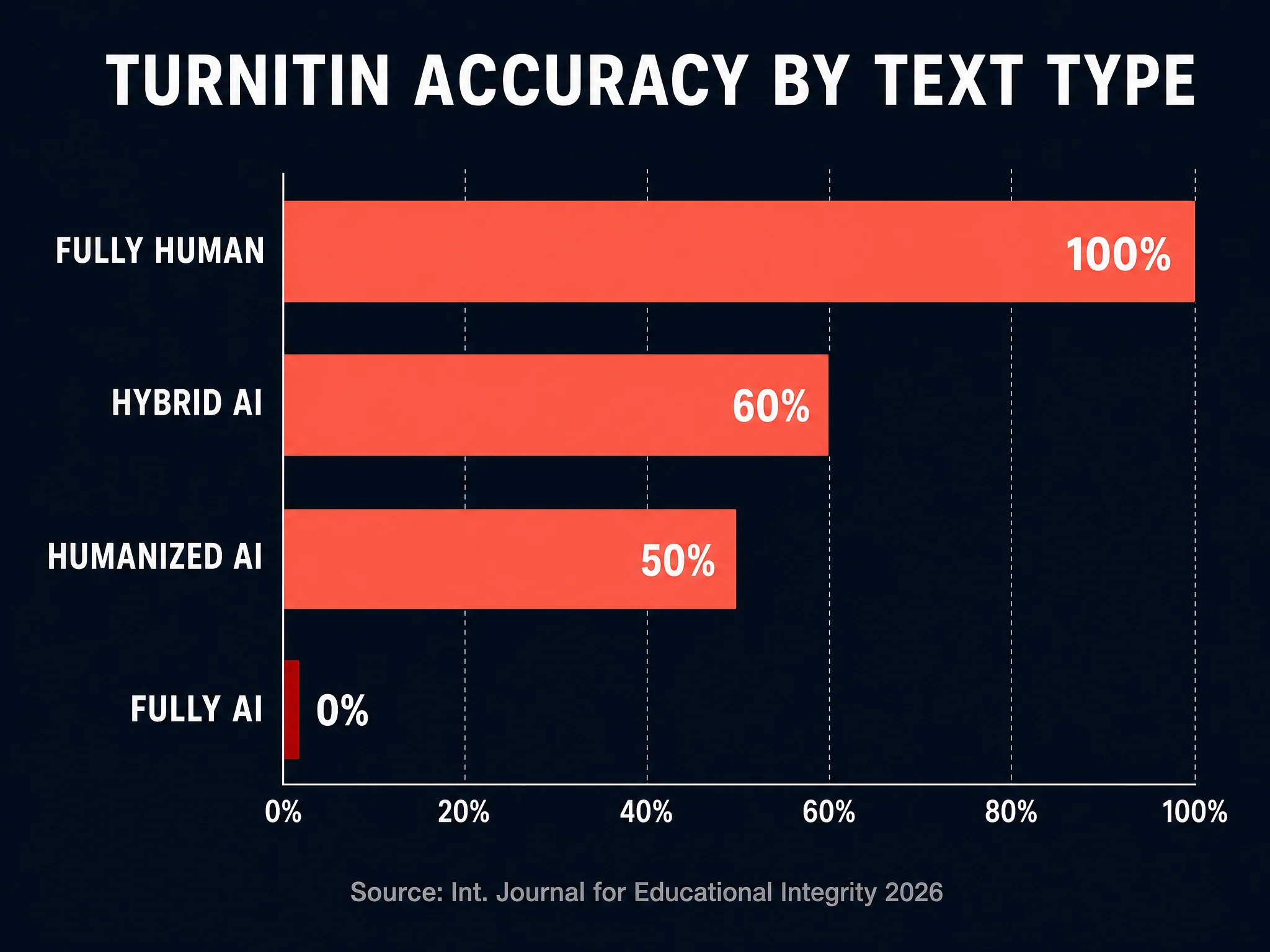
- A June 2026 peer-reviewed test found Turnitin scored 0% on fully AI-generated papers, 60% on hybrid and 50% on humanized text — with zero false positives on human work (Int. Journal for Educational Integrity).
- Scale: 280 million papers scanned since April 2023, 9.9 million flagged at 80%+ AI, and heavily AI-written English submissions rose from 3.3% to 14.8% by early 2026 (Turnitin).
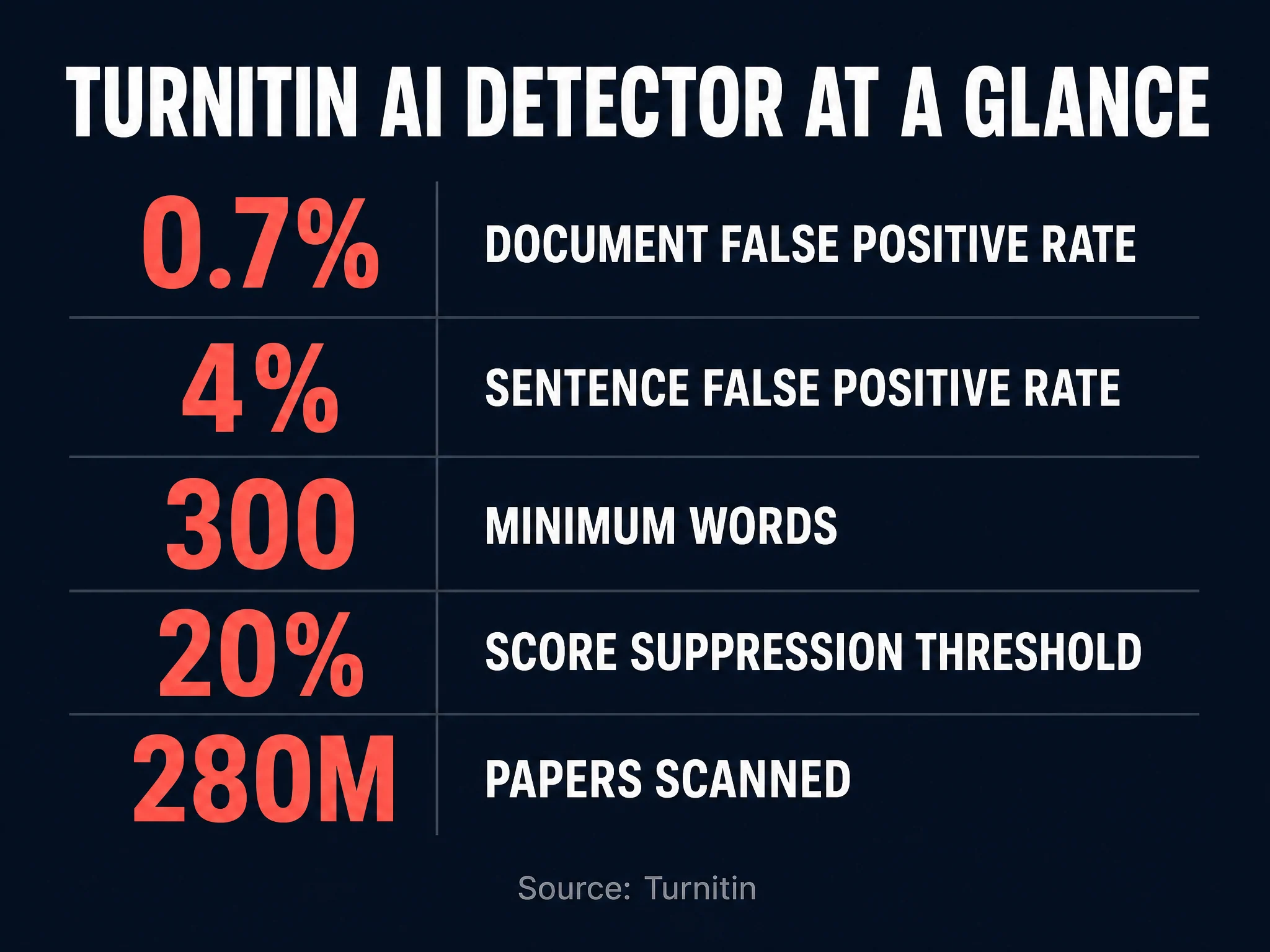
Every few weeks someone asks which detector Turnitin is running under the hood, usually because they have pasted the same essay into GPTZero or ZeroGPT and got a wildly different number. The premise of the question is wrong, and the wrongness is the useful part: Turnitin is not reselling anyone else’s detector. It built its own, it publishes an unusual amount of detail about how it works, and it deliberately withholds the one number everybody wants.
1 Turnitin uses its own detector, not a licensed engine
Turnitin’s AI writing detection is first-party. There is no GPTZero, Copyleaks, Originality.ai, Winston or Pangram engine underneath it.
The confusion is understandable. Plenty of platforms white-label detection. Turnitin does not, and it says so plainly in its own documentation: the model is built and maintained by Turnitin’s AI team, starting from an open-source base. The exact wording is “our model is based on an open-source foundation model available from Hugging Face. We undertook multiple rounds of carefully calibrated retraining, evaluation and fine-tuning.” Turnitin has never named the specific base model.
| Metric | Value | Source |
|---|---|---|
| Detector ownership | First-party, no OEM engine | Turnitin Guides |
| Model base | Open-source Hugging Face foundation model | Turnitin Guides |
| Architecture | Transformer deep-learning classifier | Turnitin whitepaper |
| Training corpus | AI text + authentic academic writing, ~2 decades | Turnitin whitepaper |
| Pre-release validation set | 700,000 pre-ChatGPT academic papers | Turnitin Guides |
| Launch date | April 2023 | Turnitin Blog |
| Customer base | 16,000+ customers, 185 countries | Turnitin Press |
That last row matters more than it looks. The competitive asset is not the architecture — transformer classifiers are commodity — it is the corpus. Turnitin has been ingesting student work for over two decades, which gives it a training set no standalone detector startup can assemble. It is also the reason Turnitin’s output diverges so often from consumer tools, something we broke down when measuring how far apart AI detectors actually land on the same text.
2 The model scores sentences, then adds them up
Your document is cut into overlapping windows of five to ten sentences, each sentence is scored from 0 to 1, and anything above roughly 0.8 counts as AI.
This is the part most explainers get wrong. Turnitin is not running a perplexity-and-burstiness heuristic of the kind free web detectors use, and it is not matching your text against a stored database of ChatGPT answers. It is a supervised binary classifier making a per-sentence prediction, then aggregating.
| Metric | Value | Source |
|---|---|---|
| Segmentation window | ~few hundred words (5-10 sentences) | Turnitin Guides |
| Stride | One sentence, segments overlap | Turnitin whitepaper |
| Per-sentence score range | 0 to 1 | Turnitin Guides |
| Sentence AI threshold | Typically 0.8 to 1 | Turnitin whitepaper |
| Document flag rule | More than 20% of sentences above threshold | Turnitin whitepaper |
| Minimum length | 300 words of prose | Turnitin Guides |
| Maximum length analysed | 30,000 words | Turnitin Guides |
| Accepted file types | .docx, .pdf, .txt, .rtf | Turnitin Guides |
| Languages scored | English, Spanish, Japanese | Turnitin Guides |
The headline percentage is also narrower than most students assume. It represents the share of qualifying text — prose sentences inside long-form writing — not the share of your document. Reference lists, bullet points, tables and code are excluded from the denominator entirely, which is exactly why a flagged references page behaves so strangely and why short, list-heavy assignments often return nothing at all.
3 Turnitin publishes false positive rates, never an accuracy score
Turnitin’s whitepaper states outright that it “does not use accuracy as a metric as it is too easily manipulated.” What it publishes instead are recall and false positive figures — and those figures moved after launch.
| Metric | Value | Source |
|---|---|---|
| Document-level recall | 84.2% (~7,000 docs) | Turnitin whitepaper |
| Sentence-level recall | 92.3% | Turnitin whitepaper |
| Document false positive rate (lab) | 0.7% of 800,000 pre-2019 papers | Turnitin whitepaper |
| Sentence false positive rate (lab) | 0.2% | Turnitin whitepaper |
| Sentence false positive rate (revised) | ~4% | Turnitin CPO, May 2023 |
| Current public commitment | Under 1% for documents above 20% AI | Turnitin Guides |
| Score suppression band | 1-19% shown as *%, no number | Turnitin Guides |
| ELL false positive rate (vendor study) | 0.014 vs 0.013 native | Turnitin |
Turnitin also published where those errors cluster, which is the single most practical detail on this page: 54% of false-positive sentences sit directly next to genuine AI writing, 26% are two sentences away and 10% three away. Errors concentrate at the seams of mixed human-and-AI documents, not randomly through clean human prose. If a paragraph you wrote yourself got highlighted beside a section you drafted with a chatbot, that is the documented failure mode, and it is worth citing when you put together a defence of your own work.
Distribution of Turnitin sentence-level false positives relative to genuine AI writing. Source: Turnitin CPO update, 23 May 2023.
4 Independent studies rate it highest — and still call it unreliable
Turnitin has repeatedly finished first in peer-reviewed comparisons. Those same papers conclude no detector should decide a misconduct case.
| Metric | Value | Source |
|---|---|---|
| Weber-Wulff et al. 2023: rank | 1st of 14 tools, 0 false accusations | Int. J. Educational Integrity |
| Weber-Wulff: overall verdict | All 14 tools scored below 80% | Int. J. Educational Integrity |
| Weber-Wulff: machine-paraphrased text | 26% accuracy across tools | Int. J. Educational Integrity |
| Walters 2023: 16-detector test | Turnitin classified all 126 docs correctly | Open Information Science |
| Perkins et al. 2024: baseline | 39.5% mean accuracy, 7 detectors | Perkins et al. |
| Perkins et al. 2024: after evasion | 17.4% mean accuracy | Perkins et al. |
| Van Vlasselaer 2026: fully AI papers | 100% false negatives for Turnitin | Int. J. Educational Integrity |
| Van Vlasselaer 2026: hybrid / humanized | 60.0% / 50.0% | Int. J. Educational Integrity |
| Van Vlasselaer 2026: human papers | 0% false positives, all four tools | Int. J. Educational Integrity |
Read those rows in order and a clear shape emerges. On clean, unedited AI text in 2023, Turnitin was the best tool anyone tested. On text that has been through any kind of laundering — paraphrasing, manual editing, a humanizer — the whole category collapses, and the June 2026 study is the starkest version yet: Turnitin scored every fully AI-generated paper in the sample between 0 and 20% AI, which is to say it missed all of them.
One caveat worth stating plainly, because vendor marketing rarely does: the most-cited bias study, Liang et al. at Stanford, found seven GPT detectors misclassified 61.22% of non-native TOEFL essays as AI-written — but Turnitin was not one of the seven detectors tested. Turnitin’s own ELL research reports near-identical false positive rates for ELL and native writers. Both facts are true, and the honest position is that no independent study has yet stress-tested Turnitin specifically on non-native writing at scale, which is why the safest move for affected students is still documenting your process as you write rather than arguing about the number afterwards.
5 Three paid layers now sit on top of the base detector
AI paraphrasing detection, AI bypasser detection and Turnitin Clarity are separate products. None of them ships with a published accuracy figure.
| Metric | Value | Source |
|---|---|---|
| AI paraphrasing detection | Launched 16 July 2024 | Turnitin Press |
| AI bypasser (humanizer) detection | Launched 27 August 2025 | Turnitin Press |
| Bypasser detection language support | English only | Turnitin Press |
| Report colour coding | Cyan = AI, purple = AI then paraphrased | Turnitin Guides |
| Turnitin Clarity general availability | 15 July 2025 | Turnitin Press |
| Clarity: students writing own prompts | 94% | Turnitin Press |
| Clarity: prompts judged effective | 36% of feedback prompts | Turnitin Press |
The bypasser model is the interesting one. Turnitin says it “researched and identified the signals and patterns of leading humanizers” and trained against them — an admission that a whole industry now exists downstream of its detector. It requires the Turnitin Originality add-on, so plenty of institutions running plain Feedback Studio do not have it at all. We covered the shipping details in our breakdown of what the 2026 model claims to catch.
Clarity is a different bet entirely: instead of judging the finished text, it watches the writing happen — revision timelines, pasted versus typed text, a summary of AI chat history. It is a paid add-on to Feedback Studio, and it tracks a good deal more than most students realise, as we detailed in our walkthrough of the Clarity data trail.
6 False positive exposure calculator
Vanderbilt disabled the detector by doing this arithmetic once. Run it for your own institution.
How many students would be wrongly flagged?
Enter an annual submission volume and pick which of Turnitin’s published false positive rates to apply.
Document-level rates apply to whole submissions; the 4% figure applies to individual highlighted sentences, so treat it as an illustration of highlight-level noise rather than students accused. Turnitin’s under-1% commitment applies only to documents already scoring above 20% AI.
Vanderbilt ran exactly this calculation on its own 75,000 annual submissions and got roughly 750 students. That number, not any argument about model architecture, is what ended the pilot.
7 Why institutions keep switching it off
The objections are consistent: opaque methodology, uncertain bias, and error rates that become large numbers once multiplied by real submission volumes.
| Metric | Value | Source |
|---|---|---|
| Vanderbilt University | Disabled 16 August 2023 | Vanderbilt Brightspace |
| Michigan State, Northwestern, UT Austin | Opted out by September 2023 | The Register |
| Curtin University | Disabled from 1 January 2026 | Curtin University |
| Institutional enablement (June 2023) | ~98% of Turnitin institutions had it on | Turnitin Press |
| Papers scanned, 3 months | 65 million; 3.3% at 80%+ AI | Turnitin Press |
| Papers scanned, 1 year | 200 million; 3% at 80%+ AI | Turnitin Press |
| Papers scanned, cumulative | 280 million; 9.9 million at 80%+ AI | Turnitin Blog |
| English submissions 80%+ AI, early 2026 | 14.8%, up from 3.3% | Turnitin Press |
Note the tension in that table. Adoption sat near 98% in mid-2023 while the loudest institutions were switching it off, and the volume of heavily AI-written submissions has quadrupled since. Detection is not winning; it is being asked to do more work with the same tooling. That is the backdrop for the growing list of which detectors universities actually run, and for the students who now sanity-check their own drafts with a free pre-submission checker because they cannot see their Turnitin score at all.
One more thing worth saying if you arrived here comparing tools: the reason a consumer detector and Turnitin disagree is not that one is broken. They are different classifiers trained on different corpora with different thresholds, and a public tool has never seen the twenty years of student writing Turnitin trained on. That is the whole story behind Turnitin versus GPTZero, and why a clean score elsewhere proves very little.
Our pick — after testing 100+ humanizers
The only tool that bypassed Pangram and Turnitin in 2026.
Most humanizers are built for one detector and quietly fail the other. StealthWriter is the one that got past both. The settings matter more than the tool, so here is exactly how I run it.
Free plan to start · no credit card · paid from $20/mo. Or get the free prompt pack first →
Affiliate link — I earn a commission if you upgrade. I only point at tools I actually run.
Methodology
Compiled 27 July 2026. Every figure on this page is drawn from either Turnitin’s own published documentation (guides, whitepaper, blog and press releases) or from peer-reviewed studies in the International Journal for Educational Integrity, the International Journal of Educational Technology in Higher Education, Open Information Science and Patterns. Twenty-one sources are cited below out of a larger set consulted; sources that could not be traced to a primary document were excluded rather than paraphrased.
Freshness distribution of the cited set: eight sources published in 2025 or 2026, seven in 2024, and six in 2023 — the 2023 items are Turnitin’s launch-era technical disclosures and the foundational Weber-Wulff, Walters and Liang studies, all of which remain the most recent work of their kind. Limitations: Turnitin has not published a cumulative paper-scanning total since October 2024, has never named its Hugging Face base model, and has released no accuracy figures for either its paraphrasing or bypasser detection add-ons. Turnitin’s ELL bias research is vendor-run and has not been independently replicated. This page is reviewed quarterly.
Frequently asked questions
What AI detector does Turnitin use?
Turnitin uses its own detector. There is no third-party engine underneath it — not GPTZero, not Copyleaks, not Originality.ai, not Winston or Pangram. Turnitin describes a transformer-based classifier fine-tuned in-house: “Our model is based on an open-source foundation model available from Hugging Face. We undertook multiple rounds of carefully calibrated retraining, evaluation and fine-tuning.” The moat is the training corpus — authentic academic student writing spanning roughly two decades. [source]
How does Turnitin’s AI detector actually work?
Your submission is split into overlapping segments of a few hundred words (about five to ten sentences), stepped through one sentence at a time so every sentence is scored in context. Each sentence gets a score from 0 to 1. Sentences above a threshold — typically 0.8 to 1 — count as AI, and the aggregate becomes the 0-100% figure. That figure is a share of qualifying text, not of your whole document, which is why the highlighting can look inconsistent. [source]
How accurate is Turnitin’s AI detector, by Turnitin’s own numbers?
Turnitin refuses to publish a single accuracy figure, calling the metric “too easily manipulated.” Its whitepaper reports document-level recall of 84.2% and sentence-level recall of 92.3% on roughly 7,000 documents, with a 0.7% document false positive rate and 0.2% sentence false positive rate against 800,000 pre-2019 papers. Its live public commitment is a false positive rate under 1% for documents scoring above 20% AI. [source]
Why does my Turnitin AI score show an asterisk instead of a number?
Because it landed below 20%. Turnitin suppresses those scores entirely: “No score or highlights are attributed for AI detection scores in the 1% to 19% range.” The asterisk exists because Turnitin found low scores carried a disproportionate share of false positives. If you want the full breakdown of what each band signals, see our guide to the score threshold and what it really means. [source]
What is the minimum length for Turnitin’s AI detection to run?
300 words of prose in a long-form writing format. The original floor was 150 words; Turnitin doubled it in May 2023 to cut false positives. Documents are also capped at 30,000 words and 100MB, and only .docx, .pdf, .txt and .rtf are scanned. Bullet lists, code and tables do not count as qualifying text. [source]
Can Turnitin detect text run through an AI humanizer?
It ships two paid add-on capabilities aimed at exactly that: AI paraphrasing detection (16 July 2024) and AI bypasser detection (27 August 2025), which targets “text that may have been intentionally modified by AI humanizer tools.” Both are English-only and neither has a published accuracy figure. Independent testing in June 2026 put Turnitin at 50.0% on humanized text — a coin flip. We tracked what changed when that model shipped. [source]
Is Turnitin’s detector biased against non-native English speakers?
Turnitin says no: it tested nearly 2,000 English Language Learner samples and reported a 0.014 false positive rate for ELL writers versus 0.013 for native writers. The most-cited counter-evidence, Liang et al. (Stanford, 2023), found seven GPT detectors misclassified 61.22% of non-native TOEFL essays — but Turnitin was not one of the seven tested. Practical guidance for affected writers is in our ESL revision guide. [source]
Which universities have switched Turnitin’s AI detector off?
Vanderbilt disabled it on 16 August 2023, reasoning that a 1% false positive rate across its 75,000 annual submissions meant roughly 750 students wrongly flagged. The Register reported Michigan State, Northwestern and UT Austin opting out by September 2023. Curtin University disabled the feature from 1 January 2026 while keeping text-matching active. The running list of institutions keeps growing. [source]
The only tool that bypassed Pangram and Turnitin in 2026.
Most humanizers clear one detector and get caught by the other. StealthWriter is the one that gets past both — run Ghost 5.2 Pro at level 7–8, section by section, and re-check before you submit.
Try StealthWriter →Sources
- Turnitin Guides. “Turnitin’s AI writing detection capabilities FAQs.” https://guides.turnitin.com/hc/en-us/articles/28477544839821-Turnitin-s-AI-writing-detection-capabilities-FAQs Accessed 27 July 2026.
- Turnitin. “AI writing detection model architecture and testing protocol (whitepaper).” https://iknow.library.uitm.edu.my/249/2/AI%20Writing%20Detection%20Model.pdf Accessed 27 July 2026.
- Turnitin Guides. “Using the AI Writing Report.” https://guides.turnitin.com/hc/en-us/articles/22774058814093-Using-the-AI-Writing-Report Accessed 27 July 2026.
- Turnitin Blog. “AI writing detection update from Turnitin’s Chief Product Officer (23 May 2023).” https://www.turnitin.com/blog/ai-writing-detection-update-from-turnitins-chief-product-officer Accessed 27 July 2026.
- Turnitin Blog. “Understanding the false positive rate for sentences (14 June 2023).” https://www.turnitin.com/blog/understanding-the-false-positive-rate-for-sentences-of-our-ai-writing-detection-capability Accessed 27 July 2026.
- Turnitin Press. “AI detection feature reviews more than 65 million papers (25 July 2023).” https://www.turnitin.com/press/turnitin-ai-detection-feature-reviews-more-than-65-million-papers Accessed 27 July 2026.
- Turnitin Press. “Turnitin marks one year of its AI writing detector (9 April 2024).” https://www.turnitin.com/press/turnitin-first-anniversary-ai-writing-detector Accessed 27 July 2026.
- Turnitin Blog. “Does Turnitin detect AI writing? Debunking common myths (31 October 2024).” https://www.turnitin.com/blog/does-turnitin-detect-ai-writing-debunking-common-myths-and-misconceptions Accessed 27 July 2026.
- Turnitin Press. “New AI paraphrasing detection feature (16 July 2024).” https://www.turnitin.com/press/turnitin-new-ai-paraphrasing-detection-feature Accessed 27 July 2026.
- Turnitin Press. “Turnitin expands capabilities amid rising threats posed by AI bypassers (27 August 2025).” https://www.turnitin.com/press/turnitin-expands-capabilities-amid-rising-threats-posed-by-ai-bypassers Accessed 27 July 2026.
- Turnitin Press. “Turnitin Delivers Turnitin Clarity (15 July 2025).” https://www.turnitin.com/press/turnitin-delivers-turnitin-clarity Accessed 27 July 2026.
- Turnitin Press. “Turnitin Data Shows Transparency About AI Use Benefits Students And Educators (24 February 2026).” https://www.turnitin.com/press/turnitin-data-shows-transparency-about-ai-use-benefits-students-and-educators Accessed 27 July 2026.
- Turnitin. “AI Writing Detection solutions page (ELL false positive research).” https://www.turnitin.co.uk/solutions/topics/ai-writing/ Accessed 27 July 2026.
- Weber-Wulff et al. (2023). “Testing of detection tools for AI-generated text, International Journal for Educational Integrity.” https://link.springer.com/article/10.1007/s40979-023-00146-z Accessed 27 July 2026.
- Van Vlasselaer, Van Droogenbroeck & Spruyt (2026). “Who wrote this? Evaluating the reliability of AI detection tools in higher education, International Journal for Educational Integrity.” https://link.springer.com/article/10.1007/s40979-026-00226-w Accessed 27 July 2026.
- Perkins et al. (2024). “GenAI Detection Tools, Adversarial Techniques and Implications for Inclusivity in Higher Education.” https://arxiv.org/abs/2403.19148 Accessed 27 July 2026.
- Walters (2023). “The Effectiveness of Software Designed to Detect AI-Generated Writing, Open Information Science.” https://www.degruyterbrill.com/document/doi/10.1515/opis-2022-0158/html Accessed 27 July 2026.
- Liang et al. (2023). “GPT detectors are biased against non-native English writers, Patterns.” https://arxiv.org/abs/2304.02819 Accessed 27 July 2026.
- Vanderbilt University. “Guidance on AI Detection and Why We’re Disabling Turnitin’s AI Detector (16 August 2023).” https://www.vanderbilt.edu/brightspace/2023/08/16/guidance-on-ai-detection-and-why-were-disabling-turnitins-ai-detector/ Accessed 27 July 2026.
- Curtin University. “Update on Turnitin AI-Detection Tool (disabled from 1 January 2026).” https://www.curtin.edu.au/news/oasis-news/update-on-turnitin-ai-detection-tool/ Accessed 27 July 2026.
- The Register. “Universities opting out of Turnitin AI detection (23 September 2023).” https://www.theregister.com/2023/09/23/turnitin_ai_detection/ Accessed 27 July 2026.
Last updated: 27 July 2026. Reviewed quarterly against Turnitin’s published documentation.
