
Reviewed by Vlad Ivanov
Runs Detection Drama, stress-testing AI detectors and humanizers; publishes Words At Scale to 26,000+ subscribers. For this review we ran one small document through HumanDoc’s free tier on 4 November 2026 and read its sales pages, terms, blog and the Reddit threads that mention it. We did not buy a pack and we have no detector score of our own. HumanDoc did not pay for this and this page has no HumanDoc affiliate link. Detection Drama earns commission from some other humanizers.
Want to bypass Turnitin in 2026? Grab the free prompt pack.
Get the exact text-humanization prompts I use to drop an AI score by hand — copy, paste, submit. Free, straight to your inbox.
Send me the free prompts →Last updated: 4 November 2026
HumanDoc Review: Introduction and First Impressions
This HumanDoc review found a good product idea wrapped in weak proof. HumanDoc rewrites AI text inside a Word file and hands back real tracked changes, which most humanizers don’t do. But when we ran a short paragraph through it, the rewrite turned caffeine into coffee and a study into an experiment, and its meaning check flagged 0 issues.
My verdict is 6 out of 10. The Word handling works and the prepaid pricing is fair. The evidence that it beats detectors is mostly its own, and the Reddit praise we could find traces back to a single account.
Product Overview and Specifications
HumanDoc is a web tool that takes one .docx file up to 25 MB. It rewrites the eligible prose and leaves headings, references, captions, tables and front matter alone. You get back a tracked-changes Word file, an accepted copy and an HTML report of possible meaning shifts. PDFs and older .doc files are not supported. There is no text box to paste into.
It is pitched at researchers and students. Its FAQ names research papers, manuscripts and class homework essays, and tells you to follow the disclosure rules for your work. That is sensible advice, and it is the part buyers should take most seriously.
What HumanDoc Costs, and Why the Reddit Price Is Wrong
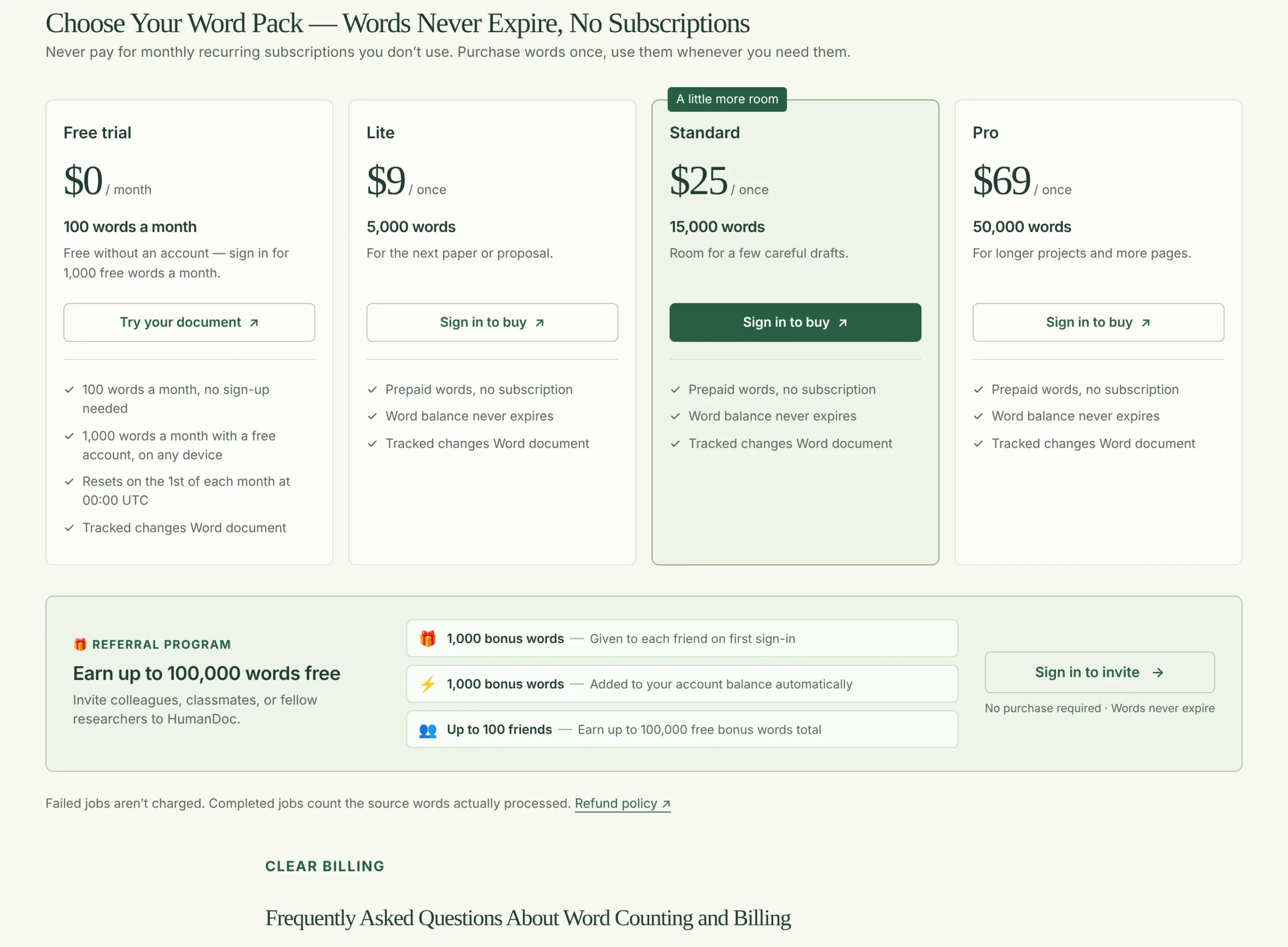
The pricing page is simple. There is no subscription. You buy words once and they never expire: $9 for 5,000 words (Lite), $25 for 15,000 (Standard) and $69 for 50,000 (Pro). Free use is 100 words a month per device, or 1,000 with an account. Referrals add 1,000 words each, up to 100,000.
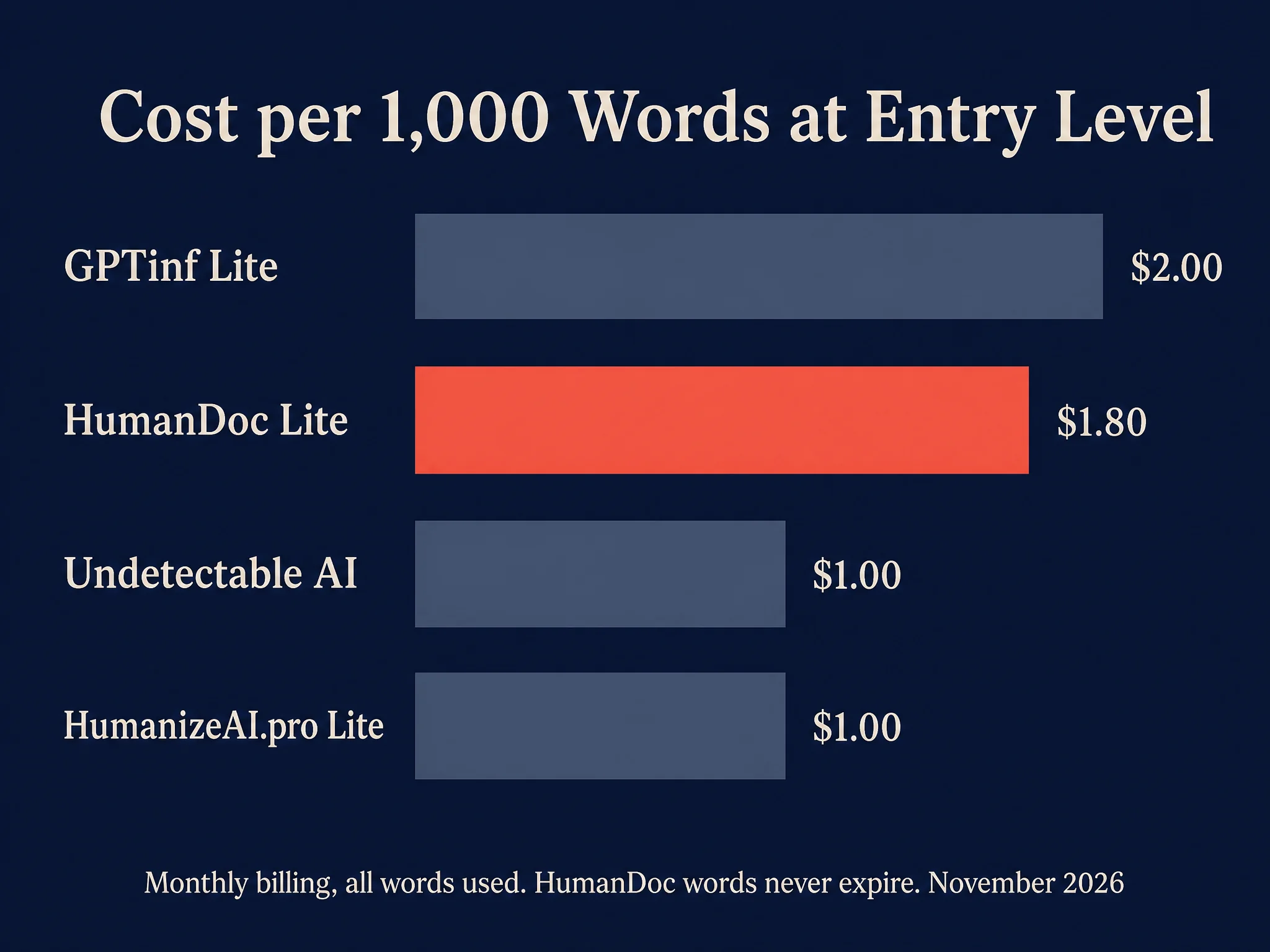
One warning. A Reddit benchmark from 30 October lists HumanDoc at 1,000 free words a day and $5 for 10,000 words. The official page says 1,000 a month and $9 for 5,000. Trust the official page. At entry level HumanDoc costs more per word than a Undetectable AI or HumanizeAI.pro monthly plan, but those words reset and these don’t.
Only prose that gets rewritten counts toward your words. The calculator assumes all your words are eligible, so a paper with long references may cost less.
Design and Interface
The workflow is clear. You upload the file and get a quote before anything runs. Ours read “about 90 words in 1 paragraphs will be rewritten” and “7 paragraphs kept as they are.” Then you press one button. No account was needed for a file this small. The result page shows a full-page preview with an Issues tab, and three downloads. The file link expires after 24 hours, so save what you need.
Performance Analysis
We Ran a Trap Paragraph Through the Meaning Check
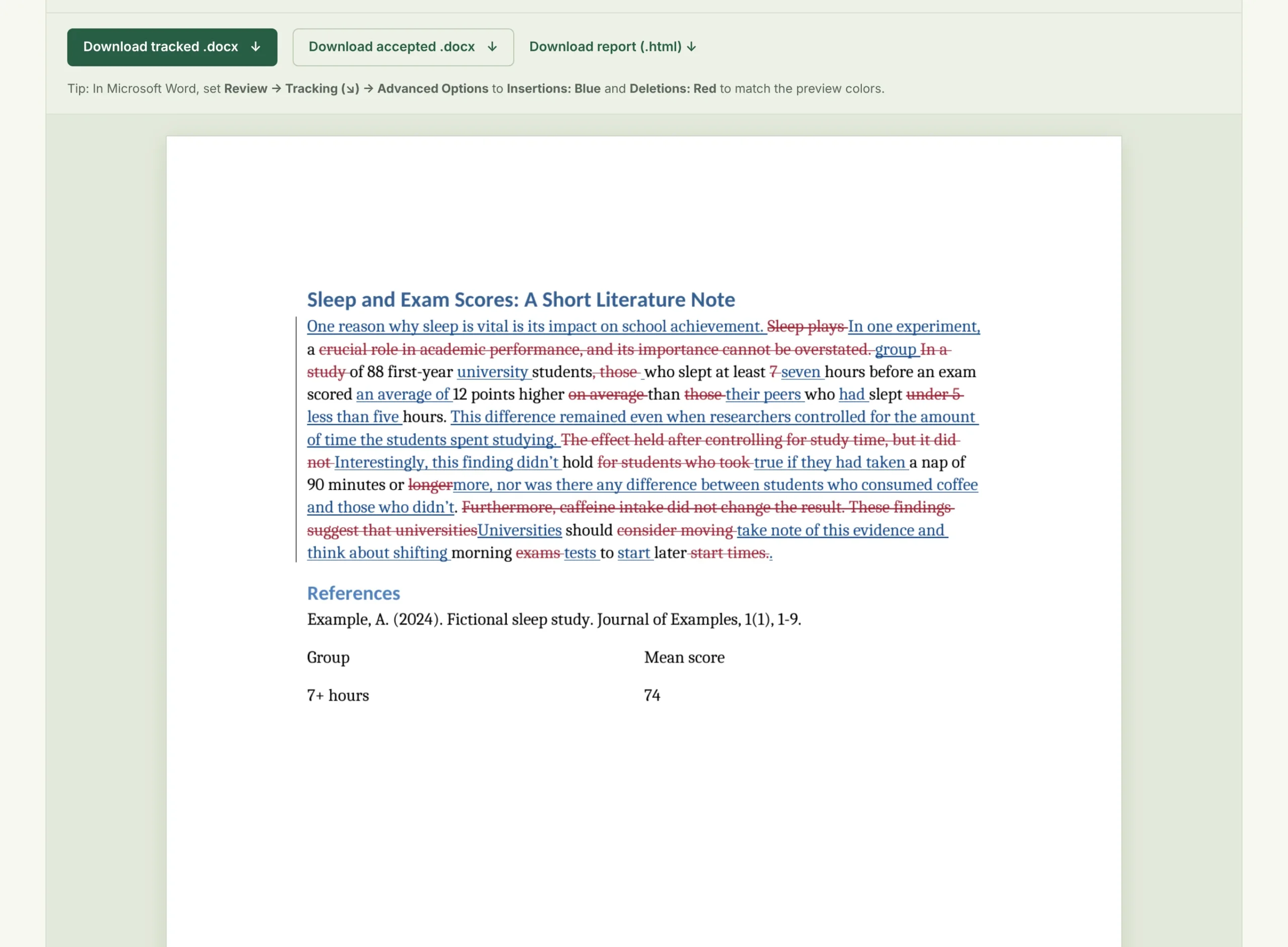
Meaning checks are HumanDoc’s main selling point, so we tested that first. We wrote a fictional 90-word note with details that are easy to damage: a sample size, two thresholds, a nap exception, a caffeine result and a hedged recommendation. We added a heading, a reference and a small table, then ran it on the free tier.
The job took about 10 seconds. The report said: “No factual changes or omissions were flagged.” Here is what we found reading it by hand.
| Our original | HumanDoc’s rewrite | What changed |
|---|---|---|
| In a study of 88 first-year students | In one experiment, a group of 88 first-year university students | A study became an experiment, which is a claim about method. “University” was added. |
| caffeine intake did not change the result | nor was there any difference between students who consumed coffee and those who didn’t | Caffeine became coffee, and the finding became a different comparison. |
| These findings suggest that universities should consider moving morning exams | Universities should take note of this evidence and think about shifting morning tests | The hedge “findings suggest” is gone. |
| Sleep plays a crucial role in academic performance | One reason why sleep is vital is its impact on school achievement | Academic performance became school achievement. Small, but less precise. |
To be fair, it got a lot right. The numbers 88, 12 and 90 survived. 7 became seven and 5 became five, which is harmless. The nap exception stayed, and the heading, reference and table came back unchanged. The rewrite also grew from 90 to 111 words and added a contraction (“didn’t”) to academic text.
This is one short paragraph, so it does not give you a miss rate. It does show that “0 issues” doesn’t mean no issues. HumanDoc says as much: “The review cannot guarantee that it finds every problem.” Read every edit yourself.
What the Detector Claims Rest On
The homepage shows a “95% reported detector-pass success rate.” The FAQ admits this is “HumanDoc’s reported rate, not an independently verified benchmark,” and the terms say it does not guarantee a score. The 100% to 0% result on the examples page comes from a fictional sample chosen by the vendor. The same page’s “competitor” rewrite that loses a control group is labelled hypothetical, not from a tested tool.
We tried to scan our output on GPTZero and the public page gave our automated browser no score, so we have no detector number to report. For Turnitin, nobody outside an institution can check directly. The Reddit tests we found give 10% and 6% on GPTZero, and both came from the account covered below. Meanwhile, published false-positive rates show why one score proves little either way.
Scorecard
Our judgment from the evidence on this page, not a lab measurement.
Do HumanDoc’s Tracked Changes Prove You Wrote It?
The FAQ says its tracked changes can provide “tangible evidence of human editorial oversight to advisors, publishers, or academic integrity panels.” We opened the file’s XML to see what a panel would see. All 35 revisions, 19 insertions and 16 deletions, list the author as “HumanDoc” with one identical timestamp.
So the file documents that software rewrote the text in a single pass. It says nothing about who wrote the draft, and using it as a defense could backfire. If you were wrongly flagged, your own history is stronger evidence. See whether version history is enough as proof and what writing process trackers actually show. Separately, the accepted copy contained no mention of HumanDoc in any of its internal files, so it carries no record of the tool at all. If your course or journal requires disclosure, that part is on you.
Who Is Recommending HumanDoc on Reddit?
HumanDoc looks popular if you search Reddit. “I humanize with HumanDoc” comes up in thread after thread. So we pulled every comment we could find. In our final search pass, 30 of 30 comments naming HumanDoc came from one account, across 11 subreddits, and 29 of them had a single upvote. Adding an earlier pass brought it to 39 comments in 14 subreddits, still all from that account.
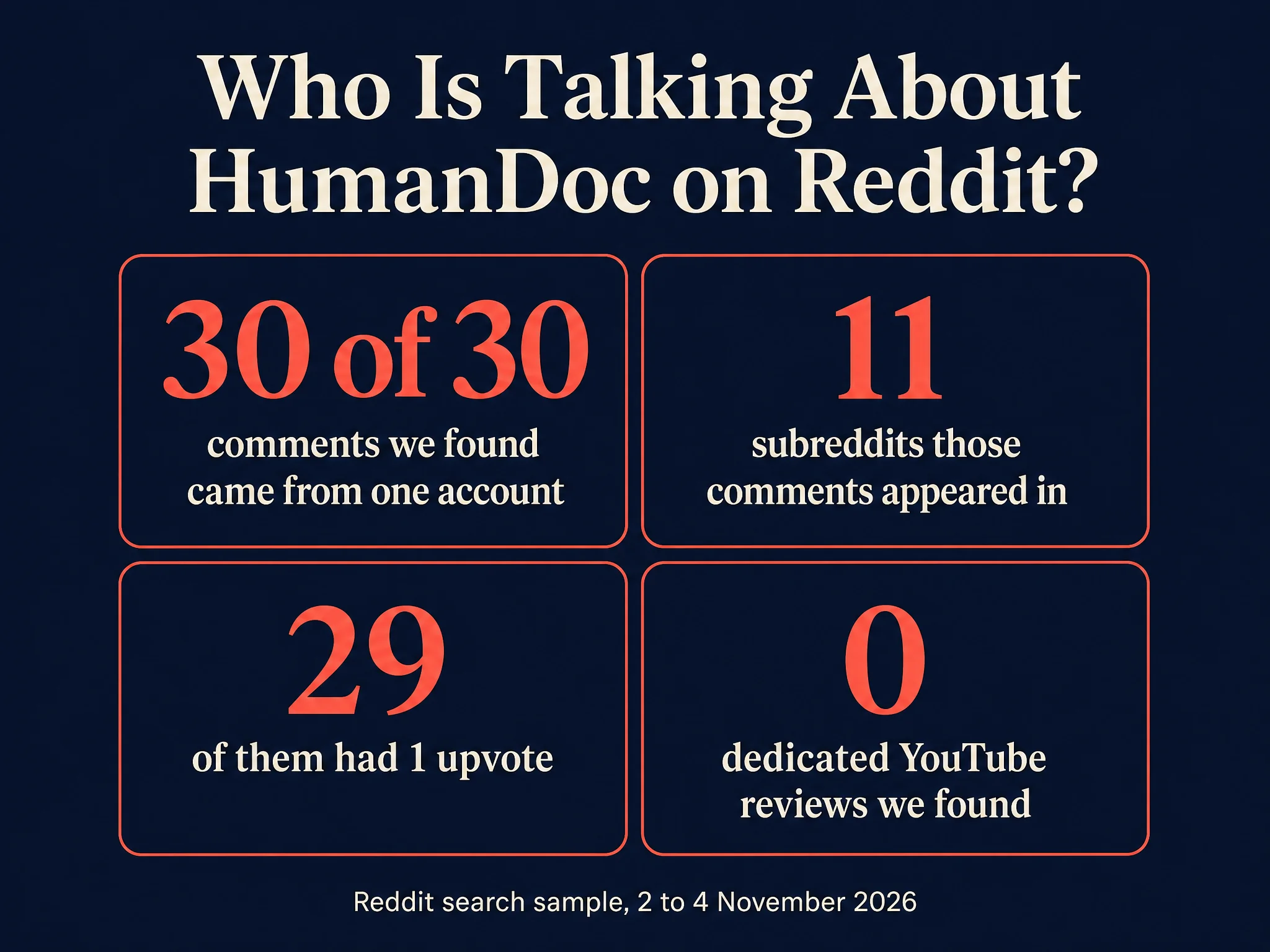
That account writes as a user: “it humanize them using HumanDoc.app.” It also posted the benchmarks, including one where HumanDoc and Clever were the only tools to pass, and the 30 October test landed in a subreddit about US immigration lawsuits. None of the comments we read disclosed a tie to the product. We can’t prove who runs that account, and it may be a very keen user. But its posts can’t count as independent evidence.
Facebook shows a similar pattern. Search snippets show comments under news posts about AI accusations plugging HumanDoc, including “I built HumanDoc around exactly that principle”. We saw those as snippets and did not see every comment thread in full.
The blog needs the same caution. “Best AI Humanizer on Reddit? The Academic Consensus Analyzed” says researchers recommend tools like HumanDoc, by the “HumanDoc Research Team,” with no link to a single Reddit thread. The blog index also showed 31 posts dated 4 October and 20 dated 3 November, on subjects as far off as ISO standards.
User Experience
Setup is close to zero: drag in a file, check the quote, press the button. The learning curve is really just Word’s Review tab, and HumanDoc explains how to change the colors. One limit matters for researchers: any paragraph with a live Zotero or EndNote field is skipped entirely. In a citation-heavy paper, that could be most of your body text. The FAQ suggests converting fields to plain text in a copy, which also gives up the live links. Our test file had no live fields, so we did not test this.
Support is a single email address. We did not contact it.
What Happens to Your Document
The privacy page says text goes to HumanDoc’s servers and “contracted third-party AI processors,” which it doesn’t name. Files expire after 24 hours and are removed by an hourly cleanup. Job records stay for 90 days. It says documents are never used for training. That is a clear policy, but we can’t verify it. Unpublished research deserves a second thought.
Who Runs HumanDoc?
We couldn’t tell from the site. The terms, privacy, refund and contact pages name no company, address or governing law, just support@humandoc.app. That is unusual for a tool that takes payment and handles unpublished papers. Compare the GPTinf review, where the legal terms at least name a registered company. Launch badges from Huzzler, Fazier and PeerPush in the footer are directory listings, not reviews.
Comparative Analysis
| Tool | Billing | Entry price | Words expire? |
|---|---|---|---|
| HumanDoc | Prepaid packs | $9 for 5,000 words | No |
| Undetectable AI | Subscription | $9.99 a month, 10,000 words | Monthly plan |
| HumanizeAI.pro | Subscription | $9.99 a month, 10,000 words | Monthly plan |
| GPTinf | Subscription | $9.99 a month, 5,000 words | Yes, no rollover |
Choose HumanDoc over these if you work in long Word files, need few words now and then, and want to see each edit. Choose a monthly plan if you rewrite a lot of plain text every month. If you want a text box with no document at all, Clever AI Humanizer and GPTHuman are the two names most often set beside it in those Reddit tests. Plain-text tools can also add other problems, like the ones in our guide to hidden characters in humanizer output.
Pros and Cons
- Real Word tracked changes, shown in our file’s XML
- Heading, reference and table unchanged in our run
- Words never expire, no subscription to cancel
- Quote before you spend, no card for free use
- Fast: about 10 seconds for 90 words
- Meaning check flagged 0 issues while real changes went through
- 95% pass rate is self-reported
- Every revision is authored “HumanDoc,” so it is weak authorship proof
- Reddit praise we found comes from one account
- No company named on legal pages, AI processors unnamed
- Paragraphs with live citations are skipped
Evolution and Updates in 2026
We found no public changelog or roadmap. The site’s own assets are dated to September and October 2026, and the earliest blog posts we saw are from September, so this appears to be a young product. The difference between the Reddit prices and the current page may also mean pricing changed recently, though we can’t confirm that.
Purchase Recommendations
Best for
- Writers with long .docx reports or proposals who want to accept or reject each edit
- Occasional users who hate subscriptions
- Non-native English writers polishing their own drafts where tools are allowed
Skip if
- A grade, degree or job depends on a detector result
- Your school or journal bans or requires disclosure of AI rewriting and you wouldn’t disclose it
- You need live citations rewritten, or you work in Google Docs or PDF
If you are facing a false accusation, a humanizer is the wrong next step. Start with evidence, as in how to prove authorship after a flag. And if you’re wondering whether any rewriter gets past newer methods, read do humanizers remove ChatGPT’s watermark.
Where to Buy and Best Deals
Buy only at humandoc.app. There are no coupons we could confirm. The best deal is free: sign in for 1,000 words a month and test your own paragraph before paying. Refunds cover unused balance within 14 days, so buy Lite first. We found a referral program but no affiliate program.
Final Verdict
Evidence and Proof
We found no verified customer testimonials, so we’re not printing any. No independent written review turned up in Google’s top 10 for “humandoc review” on 4 November, and our YouTube searches found no dedicated review. The videos under that name are mostly about a Polish documentary festival, which is unrelated.
Our test file: 1 fictional paragraph, free tier, one run. Result: 90 words charged, 111 words returned, 35 revisions, 0 issues flagged, 4 wording changes we consider worth a human check.
HumanDoc Review FAQ
Is HumanDoc legit?
It is a working product. Our free run returned a real tracked-changes Word file, an accepted copy and a report, and the pricing page matched what the tool charged us in words. But the site’s terms, privacy page and contact page name no company, and we found no independent review.
Does HumanDoc bypass Turnitin?
We cannot confirm it. Students cannot run Turnitin’s AI check themselves, and every Turnitin claim we found on Reddit came from one account. HumanDoc’s terms say it does not guarantee any detection score.
Does HumanDoc beat GPTZero?
HumanDoc reports a 95% pass rate and says that is its own number, not an independent benchmark. Its sample shows 100% AI before and 0% after. Two Reddit tests show 10% and 6%, both posted by the account that keeps recommending it. We could not get a GPTZero score in our own run.
How much does HumanDoc cost?
It is prepaid with no subscription: $9 for 5,000 words, $25 for 15,000 and $69 for 50,000. Words never expire. The free allowance is 100 words a month without an account and 1,000 with one.
Are HumanDoc’s tracked changes proof that I wrote my paper?
No. In our file all 35 revisions were authored by HumanDoc with the same timestamp. That shows software made the edits. It does not show that you wrote the draft.
Does the HumanDoc meaning check catch every error?
No, and HumanDoc says so itself. In our short test it flagged 0 issues while the rewrite turned caffeine into coffee and a study into an experiment.
Does HumanDoc keep Zotero and EndNote citations?
HumanDoc says paragraphs with live citation fields stay unchanged. That also means those paragraphs are not rewritten at all unless you convert the fields to plain text. In our run the reference line, headings and table came back unchanged, but our test file used no live fields.
Can I get a HumanDoc refund?
Unused word balance is refundable on request within 14 days of purchase. Failed or timed-out jobs are not charged.
Does HumanDoc store my document?
Its privacy page says files are removed after a 24 hour access window and job records are kept for 90 days. Text goes to contracted third-party AI processors, which it does not name, and it says documents are not used for training.
