
Tested by Vlad Ivanov
Runs Detection Drama, which tests AI detectors and essay tools on real text. I am not an admissions officer, counselor or tutor, and I do not work for UC. On 11 November 2026 I ran UC’s AI-written PIQ through two GradPilot Full Reviews, one with AI detection on and one with it off. Disclosure: GradPilot gave Detection Drama free review credits for testing, and we earn a commission if you buy through our partner link. UC had no part in this test.
Last updated: 16 November 2026
A UC PIQ written by AI is exactly what the University of California showed its own admissions team in a video on 3 November 2026. I took that same essay and ran it through an AI essay grader twice. With the AI detector on, it scored 100% AI and every rubric score was held at 1.0 out of 5. With the detector off, the same essay scored 2.6 out of 5. UC’s reader never mentioned a detector. Her problem was that the answer said nothing about the student.
Partner link: new users get 20% off their first purchase. Detection Drama earns a commission at no extra cost to you.
Watch the test (7 minutes)
What UC Actually Did
UC’s official channel posted We had AI answer a UC PIQ. Here’s what admissions thought. on 3 November 2026. Jayne Reimel from the UC admissions team reads a response to PIQ 8, the question about what makes you a strong candidate. Every word of the response was written by AI, and she is told so before she starts reading.
The essay opens on how captivated the writer is by UC’s opportunities and community, calls UC a pivotal aspiration, and promises to join the campus’s rich tapestry of ideas. If you have read much AI writing, you can hear it. Early on, Reimel says “I haven’t learned a lot.” By the end, her point is that the student never answered the prompt, and that UC is not grading how polished the writing is.
This was not a blind test. Reimel knew the essay was AI before she read it. Nobody “caught” anything. What she did was judge the content, and the content was empty. That is a different job from what an AI detector does.
UC’s Rule on AI for the PIQs
UC’s rule is more specific than most posts about it. Its Statement of Application Integrity allows AI help for things like readability, but says your “content and final written text must be their own”. Every applicant agrees to that to submit. The same statement says UC runs regular screenings and may ask you to show your work is authentic.
UC also told counselors it runs plagiarism software on all PIQs after the deadline, and says it does not use AI to review applications. What UC has not said is whether that screening includes an AI detector, or which one. Plenty of sites claim UC uses one. I found no UC source for that, and no UC source ruling it out either. The PIQ deadline for fall 2027 is 30 November.
If you are wondering whether to run your own draft through a detector at all, read should you run your college essay through an AI detector first. Our list of AI detection tools used by universities shows how uneven school practice is.
Our Test: UC’s AI PIQ, Graded Twice
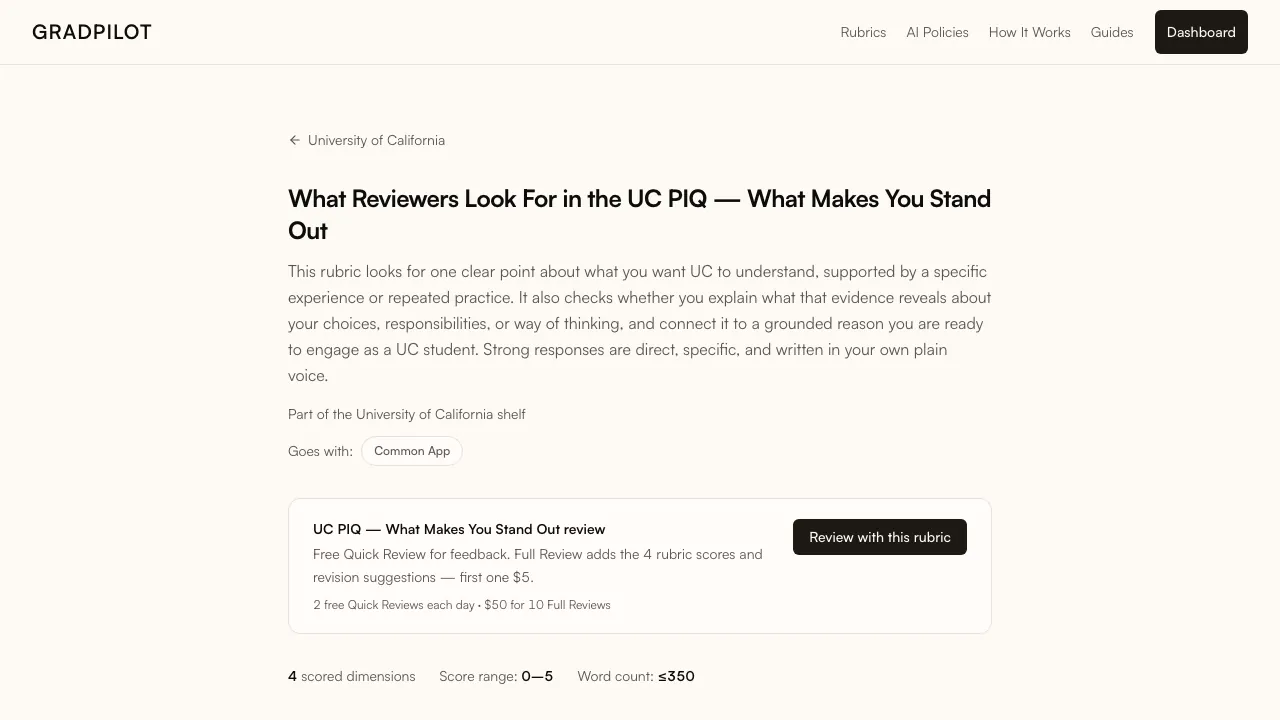
The grader was GradPilot. You pick the rubric for your exact application, paste your draft, and it scores you from 0 to 5. It also runs an AI check from Pangram Labs. It has a dedicated PIQ 8 rubric with four scored sections: what you want UC to know, proof in your own experience, why it adds something, and a grounded candidate case.
- Input: the AI-written PIQ, 289 words, taken from UC’s own video captions. A word or a comma may differ from UC’s original.
- Run 1: one Full Review with AI detection on.
- Run 2: the identical text, one Full Review with AI detection off. GradPilot warns that scores may run higher without detection, and that you should only skip it if your program accepts AI-written text. UC’s does not. I skipped it only to see what the rubric does on its own.
Detection On: 100% AI, and Every Score Capped
Pangram scored the essay 100% AI and flagged 11 of its 14 sentences. The tags explain why: promotional tone, generic claim, rule of three, inflated vocabulary, “not X but Y”, no specifics, grandiose metaphor. For a student, those tags are more useful than the percentage, because they point at actual sentences.
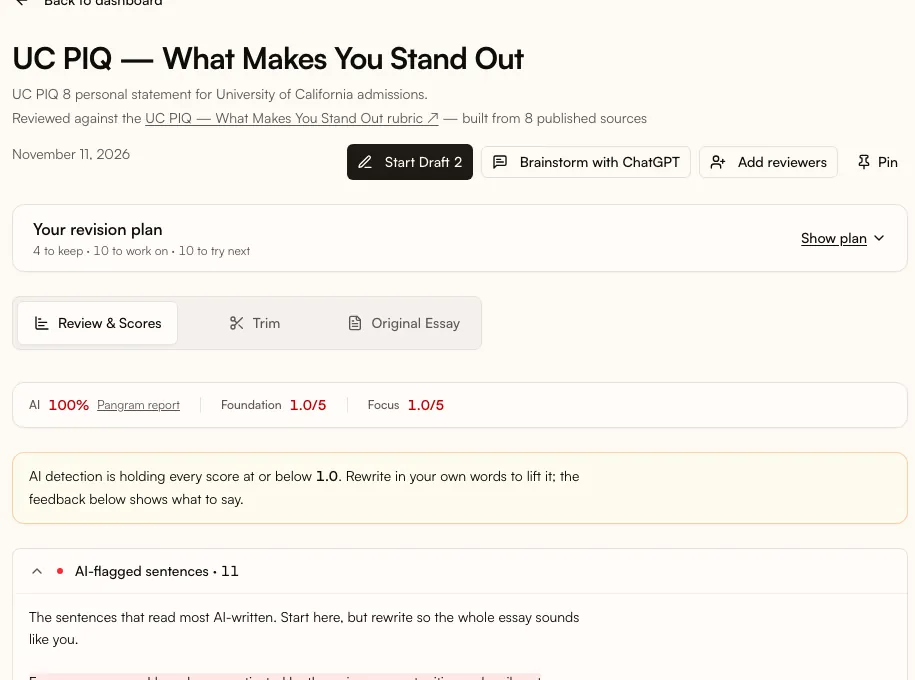
Every score came back 1.0 out of 5. It looks like the grader agreed with UC. It did not. GradPilot’s report says AI detection is holding every score at or below 1.0. That 1.0 is a cap set by the detector, not a reading of the writing.
Detection Off: The Rubric Gave It 2.6
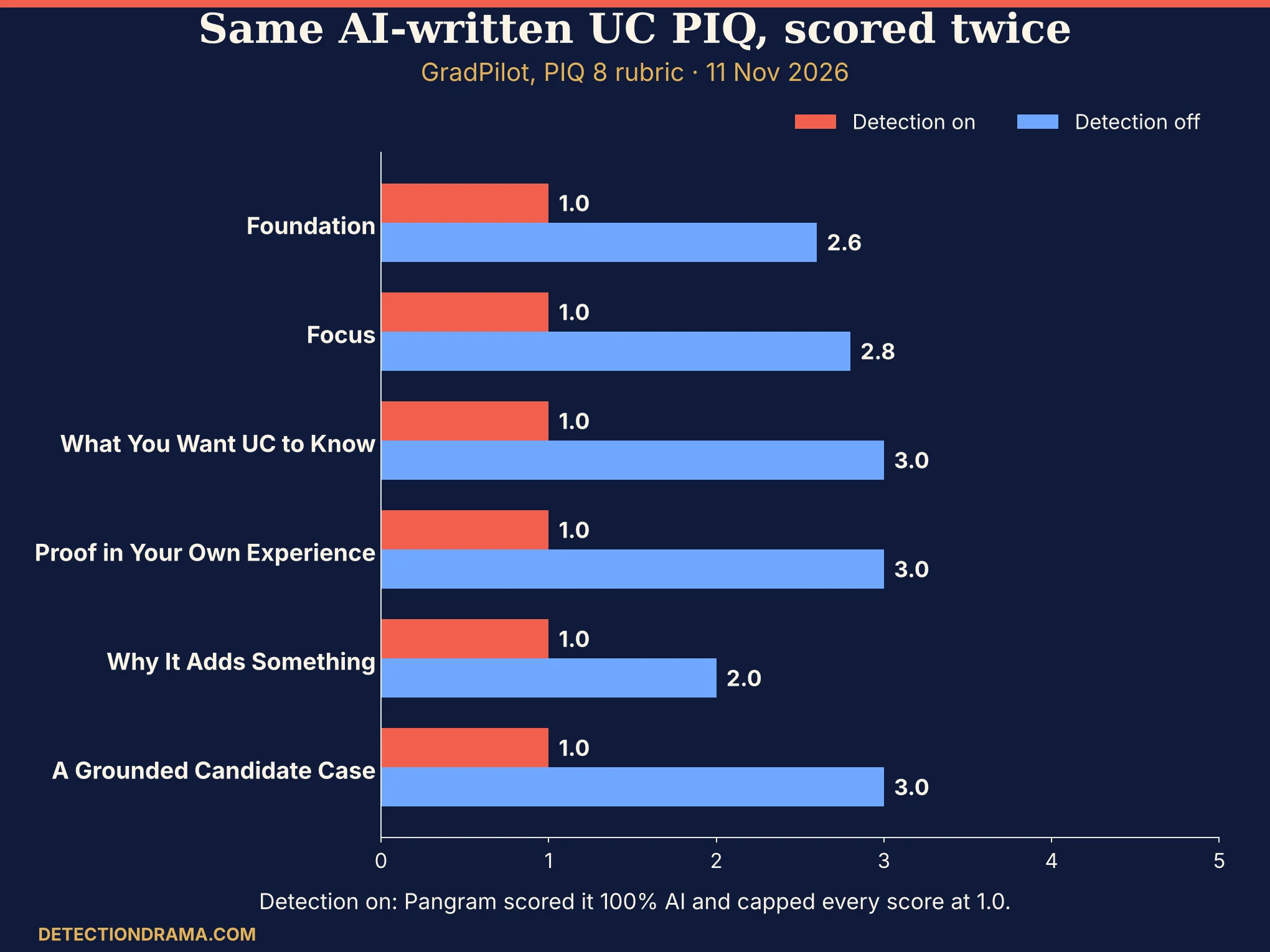
| Score | Detection on | Detection off |
|---|---|---|
| AI | 100%, 11 of 14 sentences | Skipped |
| Foundation | 1.0 | 2.6 |
| Focus | 1.0 | 2.8 |
| What You Want UC to Know | 1.0 | 3.0 |
| Proof in Your Own Experience | 1.0 | 3.0 |
| Why It Adds Something | 1.0 | 2.0 |
| A Grounded Candidate Case | 1.0 | 3.0 |
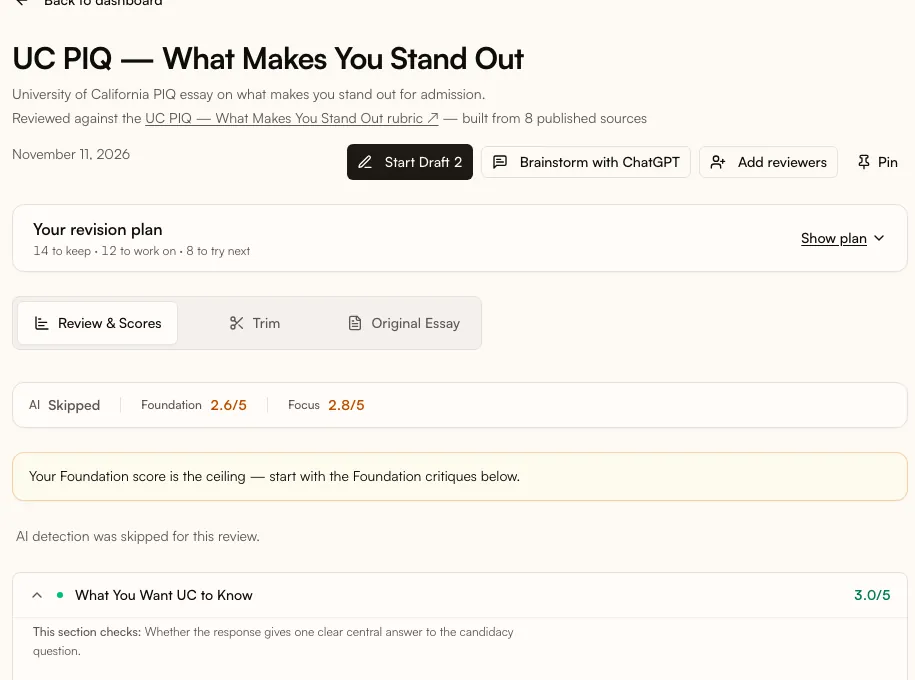
On its own, the rubric put UC’s AI essay in the middle of the scale. UC’s human reader was much harsher on the content than the numbers were. So if a site tells you an essay grader “caught” UC’s AI essay, that is misleading: the detector flagged it, and the rubric alone gave it a passing-looking 2.6.
Where the Grader’s Written Critique Matched UC’s Reader
The scores missed UC’s point. The written critiques did not. With detection off, GradPilot’s comments landed close to what Reimel said on camera:
| UC’s reader, in the video (paraphrased) | GradPilot’s critique (detection off) |
|---|---|
| The student never really talks about themselves | The opening is spent on wanting to attend UC before explaining anything the writer has done |
| It tells her what UC is | The candidate case rests on UC’s opportunities, faculty and community |
| It does not answer the prompt | It never gives UC one specific thing to understand about how the student acts |
| A student asks what exactly they did | UC cannot see what the student actually did from this response |
That is the useful lesson. Read the critiques, not the number. The same pattern showed up when we graded one human essay six times in GradPilot vs ChatGPT: every run agreed on the weakness even when the numbers moved.
What This Means for Your Own PIQs
The real test is “could anyone else have written this?”
UC’s objection was never “this sounds like AI”. It was “this tells me nothing about you”. A PIQ that only a stranger could have written fails both tests. Before you worry about any detector score, ask whether a different applicant could submit your answer unchanged. If yes, rewrite it around one specific thing you did. Our guide on how to check if your essay sounds AI-written walks through that check.
A clean AI result does not make an essay good
Detectors and rubrics fail in opposite directions. A detector can hold down a human writer it wrongly flags. A rubric with detection off can reward specific-sounding details nobody checks. Neither one checks whether your story happened. That is why UC asks for your own content and may ask you to prove it.
Keep your drafts
If anyone ever questions your PIQs, version history and notes are your best evidence. See our safe AI writing workflow for college drafts, and if you are ever accused, what to do in the next 24 hours.
Detectors are not perfect. Pangram’s published error rates are low, but independent tests on short student writing like a 350-word PIQ are thin, and its newest model, Pangram 4.1, shipped on 19 October 2026. One PhD applicant on Reddit said GradPilot flagged sentences they wrote. Read our sourced AI detection false positive rates and our Pangram review before trusting any single result.
Should You Pay for an AI Essay Grader for UC?
You do not need one. A trusted human reader who knows you is still the best check for a PIQ. If you want a structured second opinion, GradPilot’s free Quick Reviews give feedback with no scores. A Full Review with scores and the Pangram check is $5, Pro is $50 for 10, and the Application Season Special is $200 for up to 200 reviews used within 30 days. Our full GradPilot review covers the fine print.
Use any grader the way we did: write first, read the critiques, and do not chase the number. A grader is feedback, not a preview of UC’s decision.
Partner link: new users get 20% off their first purchase, and we earn a commission. GradPilot also gave us free review credits for testing.
What This Test Does Not Prove
- It is one essay and one run per condition. It is not an accuracy study of Pangram or GradPilot.
- The essay text comes from YouTube captions, so a word or comma may differ from UC’s original. UC did not say which AI model wrote it or how it was prompted.
- UC has not said it uses Pangram or any named detector. Nothing here shows how UC screens PIQs.
- No score here predicts a UC decision.
For the wider picture on AI and admissions, see our AI college admissions essay statistics and the list of universities that banned AI detectors.
FAQ
Can you use AI for UC PIQs?
UC allows limited help such as readability, but its Statement of Application Integrity says your content and final written text must be your own. Do not submit AI-written PIQs.
Does UC use an AI detector on PIQs?
UC says it runs plagiarism software on all PIQs and may ask you to show your work is authentic. It has not named an AI detector, and we found no UC source saying it uses one or does not.
What did UC’s admissions reader say about the AI-written PIQ?
She said she had not learned much about the student, and that the response did not answer the prompt. She knew it was AI before reading, so it was not a blind test.
What did GradPilot score UC’s AI PIQ?
With AI detection on: 100% AI, 11 of 14 sentences flagged, and every score capped at 1.0 out of 5. With detection off: Foundation 2.6 and Focus 2.8.
Why did the score jump from 1.0 to 2.6?
When GradPilot detects AI, it holds every score at or below 1.0. With detection off, the rubric scored the writing itself, which landed in the middle of the scale.
Will an AI detector flag my own PIQ?
It can happen. Detectors have low published error rates, but independent tests on short student writing are limited and some users report false flags. Keep your drafts as evidence.
When are UC PIQs due?
The UC application deadline for fall 2027 first-year applicants is 30 November 2026. Check UC’s dates page for your situation.
