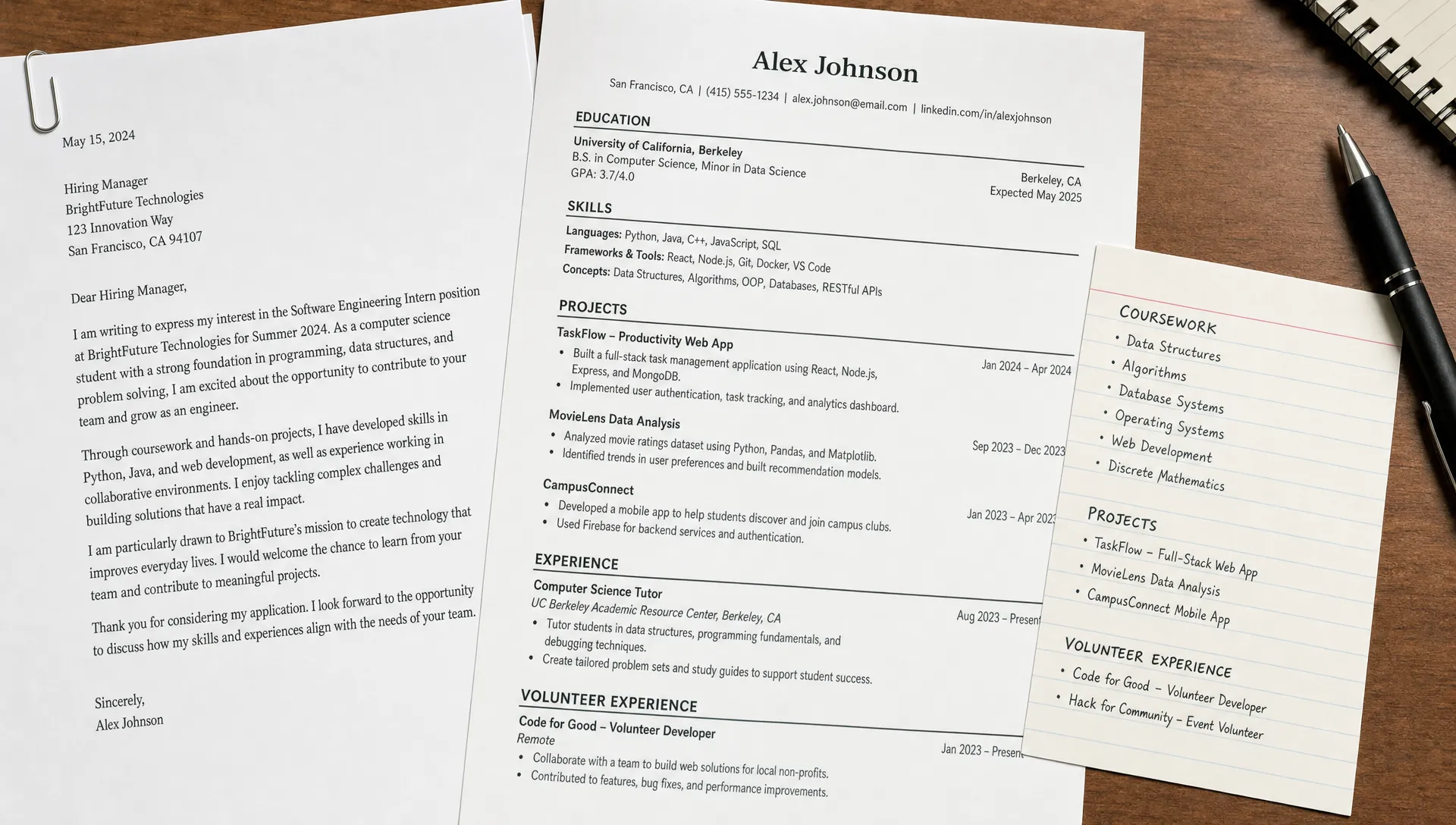
AI can help you get unstuck when an internship application feels too important to start from a blank page. The problem is that AI-generated content often sounds like it was written for every student at once: polished, vague and slightly too confident. For internship applications, that can be a real disadvantage.
Humanizing AI writing is not about hiding weak work. It is about taking a draft that sounds generic and making it truthful, specific and clearly yours. A recruiter, hiring manager or university career office wants to see what you have done, what you are learning and why this internship makes sense for your next step.
The best applications do not sound like perfect marketing copy. They sound like a real person who understands the role and can connect it to concrete coursework, projects, jobs, volunteer work or personal motivation.
Want to bypass Turnitin in 2026? Grab the free prompt pack.
Get the exact text-humanization prompts I use to drop an AI score by hand — copy, paste, submit. Free, straight to your inbox.
Send me the free prompts →What internship reviewers are actually looking for
Internship applications are different from full-time job applications because most candidates do not have years of professional experience. Reviewers know that. They are usually looking for signals of readiness rather than a long achievement record.
Strong internship writing usually shows:
- A real reason you are interested in the organization or role
- Evidence that you understand the work, not just the company name
- Specific academic, project or extracurricular experience
- A learning mindset without sounding passive or helpless
- Clear communication that feels appropriate for an early-career candidate
The National Association of Colleges and Employers career readiness competencies are a useful reference here. Employers often value communication, critical thinking, teamwork, professionalism and technology skills in early-career candidates. Your application should not just claim those traits. It should prove them through small, believable examples.
That is where many AI drafts fail. They say the right things, but they do not give the reader enough evidence to believe them.
Why AI-generated internship writing sounds off
Most AI writing tools are trained to produce fluent, complete responses. That helps with structure, but it can flatten your voice. In an internship application, the result often feels too broad for the role and too polished for the candidate’s actual stage.
| AI writing pattern | Why it hurts your application | Better human fix |
|---|---|---|
| “I am passionate about leveraging innovative solutions” | Sounds abstract and overused | Name the project, class or problem that sparked your interest |
| “My diverse skill set makes me an ideal candidate” | Makes a big claim without proof | Connect one or two skills to the internship duties |
| “I have always been fascinated by this industry” | Feels like a template unless supported | Explain when that interest became practical or specific |
| Perfectly balanced paragraphs of similar length | Creates a machine-written rhythm | Vary sentence length and include natural transitions |
| Inflated confidence | Can seem unrealistic for an intern | Show curiosity, preparation and willingness to learn |
Humanizing AI text means replacing general fluency with personal evidence. The draft can still be clean and professional, but it should carry details that only you could have supplied.
Start with a proof bank before you use a text humanizer
Before editing the AI draft, create a short proof bank. This is a list of real details you can safely use across your resume, cover letter and short-answer responses. It keeps you from relying on generic phrases and helps you avoid accidentally exaggerating.
Your proof bank should include details such as relevant classes, group projects, tools you have used, part-time jobs, campus leadership, volunteer work, research experience, portfolio pieces and moments when you solved a practical problem.
| Proof bank prompt | Example of a useful detail |
|---|---|
| What have I built, researched or organized? | Built a basic sales dashboard in Excel for a business analytics class |
| What tool have I used beyond a tutorial? | Used Canva and Meta Business Suite for a student club campaign |
| What problem did I help solve? | Reduced event check-in delays by reorganizing volunteer roles |
| What feedback have I received? | Professor noted that my final presentation explained technical results clearly |
| Why this role? | The internship combines data analysis with customer research, which matches my coursework and club project |
Use only facts you can defend in an interview. If an AI tool adds a skill, result or award that is not true, remove it immediately. A humanized application should be more accurate than the AI version, not more dramatic.
A practical workflow to humanize AI writing for internship applications
A good workflow starts with meaning, then moves to style. If you run a raw AI draft through a text humanizer too early, you may get smoother wording without fixing the real problem: the content still does not sound like your experience.
Lock the facts first
Highlight every concrete detail in the draft, including dates, project names, company names, class titles, software tools, results and responsibilities. Verify each one. If the AI invented anything, delete it.
This matters because internship reviewers often use your written application to guide interview questions. If your cover letter says you analyzed customer behavior using SQL, you should be ready to explain what you queried, what you learned and how much help you needed.
Rewrite the opening around a real connection
Many AI-generated cover letters begin with a version of “I am thrilled to apply for the internship at your esteemed organization.” That sentence is technically polite, but it tells the reader nothing.
A stronger opening connects the role to a specific reason:
I am applying for the marketing analytics internship because it matches the work I enjoyed most in my consumer behavior class: turning survey responses into a clearer recommendation for a real audience.
This version is not flashy. It gives the reader a reason to keep reading because it connects the internship to a concrete academic experience.
Replace personality claims with evidence
AI writing often leans on traits like hardworking, motivated, adaptable and passionate. Those words are not banned, but they are weak without proof.
Instead of saying you are detail-oriented, describe a moment that required attention to detail. Instead of saying you are a strong communicator, mention a presentation, tutoring role, team project or customer-facing job where communication mattered.
For broader job-search materials, Detection Drama also has a guide on making AI writing sound human for recruiters, which is useful if you are editing a resume, LinkedIn summary or outreach message alongside your internship application.
Match your level of experience
One of the easiest ways to spot AI-generated content is that it makes a student sound like a senior consultant. Internship writing should be confident, but not inflated.
A student can write, “I contributed to a team research project that helped me practice survey design and data cleanup.” That is stronger than “I spearheaded a comprehensive market research initiative that delivered transformative insights,” especially if the project was for a class.
Human writing is often believable because it has proportion. It does not overstate the size of your role.
Vary rhythm without becoming casual
AI drafts often use the same sentence shape repeatedly: claim, comma, explanation. Real writing has more variation. Some sentences can be short. Others can carry more detail. You can use contractions if they fit the tone, but avoid sounding too casual for the employer.
Read the draft out loud. If you would never say a sentence in an interview, rewrite it. If every paragraph sounds like a formal announcement, bring it closer to how you would explain your experience to a career adviser.
If you need a faster editing pass, this related guide on how to make AI writing sound more natural in 10 minutes can help you tighten obvious AI patterns before submission.
Before and after examples
Small rewrites can make a major difference. The goal is not to make your application messy. The goal is to make it sound grounded.
| Application section | AI-sounding version | More human version |
|---|---|---|
| Cover letter opening | I am excited to apply for this prestigious internship because it aligns perfectly with my professional aspirations. | I am applying for this internship because the role combines two areas I have been trying to build this year: research and client communication. |
| Resume bullet | Demonstrated exceptional leadership and organizational skills in a collaborative environment. | Coordinated weekly tasks for a four-person class project and kept the final presentation on schedule. |
| Short-answer response | This opportunity will allow me to grow, learn and contribute meaningfully to your organization’s mission. | I want to learn how a communications team plans campaigns beyond the classroom, especially how ideas change after feedback from real audiences. |
| Outreach message | I would be honored to connect and discuss my qualifications for any available internship opportunities. | I saw your team’s summer internship post and noticed the focus on data cleanup. I recently worked on a similar class project and would be grateful to learn more. |
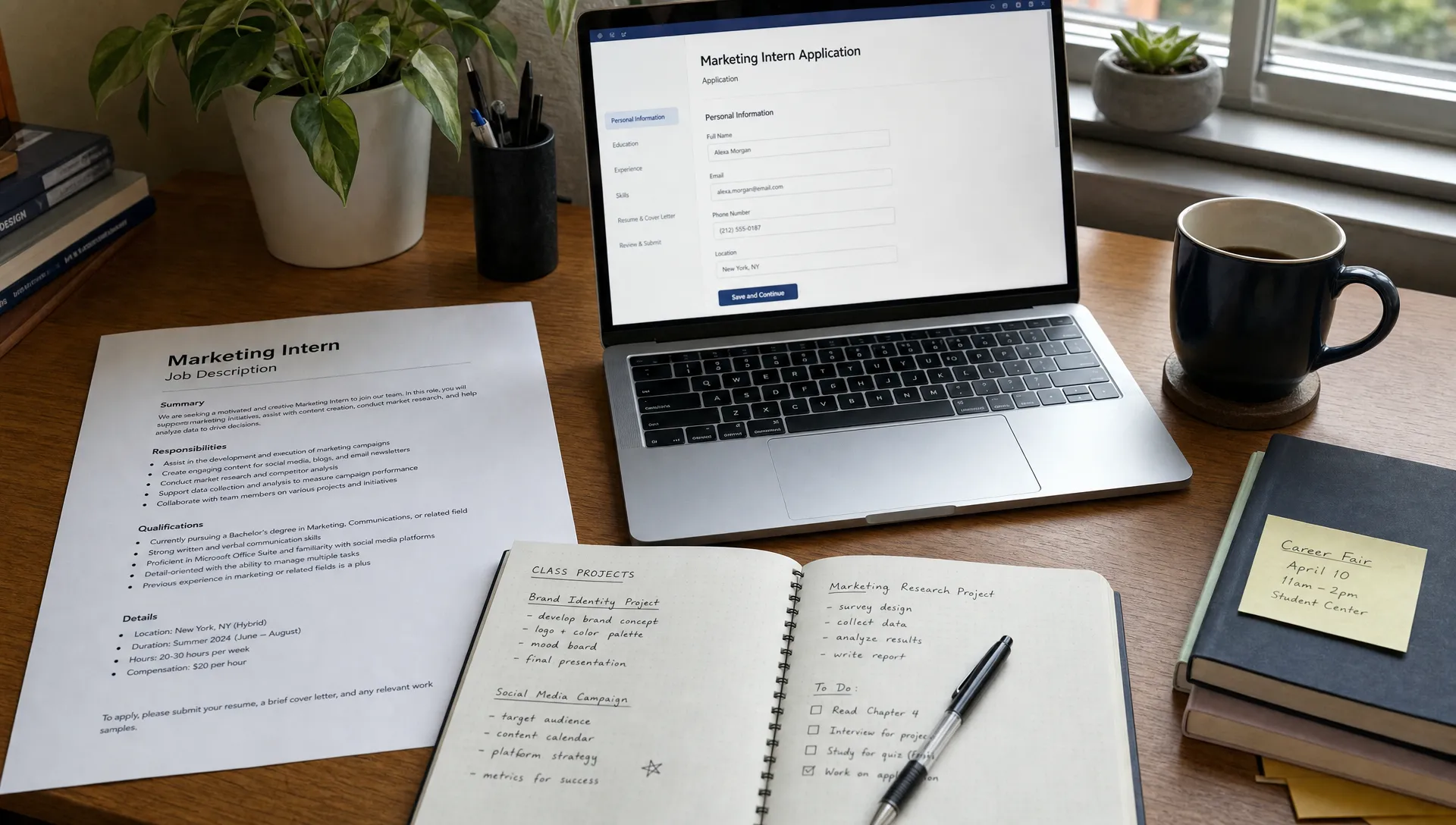
How to humanize different internship application materials
Internship applications often include more than one writing sample. Each piece needs a slightly different editing strategy.
Resume bullets
Resume bullets should be specific and compact. AI tends to make them too broad, especially when describing class projects or campus roles. Start each bullet with what you actually did, then add the context or result if you have one.
For example, “Assisted with social media” is too thin, but “Drafted three Instagram posts per week for a campus club and tracked engagement in a shared spreadsheet” gives the reviewer a clearer picture. You do not need huge numbers. You need believable scope.
Cover letters
A cover letter gives you more room to connect your background to the internship. The most human cover letters usually include one specific reason for applying, one or two proof points and a closing that sounds professional without being stiff.
If your internship requires a cover letter, you may also want to compare your draft against the advice in Detection Drama’s guide to the best AI humanizer for cover letters in 2026. The same principles apply to internship cover letters, but you should keep the tone appropriate for a student or early-career applicant.
Short-answer questions
Short-answer prompts often ask why you want the internship, what you hope to learn or how you handled a challenge. These answers are easy for AI tools to over-polish.
Keep them direct. Use one example, not a full life story. If the question asks about a challenge, explain the situation, what you did and what changed afterward. Avoid turning every answer into a lesson about resilience unless that is genuinely the point.
Personal statements for competitive internships
Some research programs, fellowships and academic internships ask for a personal statement. In that case, humanizing matters even more because the reader expects your motivation and judgment to come through.
Do not let an AI tool replace your reasons with generic ambition. Keep the moments that shaped your interest, even if they sound simpler than the AI version. Specificity is usually more persuasive than polished abstraction.
Mistakes that still trigger an AI detection concern
AI detection tools can be inconsistent, and no AI content detector should be treated as perfect proof of authorship. Still, certain writing patterns can raise suspicion because they look generic, over-optimized or disconnected from the applicant’s real background.
Watch for these common issues:
- Repeated phrases like “ever-evolving landscape,” “foster innovation” or “make a meaningful impact”
- Skills listed without examples, especially leadership, communication and problem-solving
- Paragraphs that all have the same length and structure
- Claims that sound too senior for an internship candidate
- A sudden change in voice between your resume, cover letter and short answers
- Language that does not match how you speak in interviews
Also be careful with copied examples from the internet. A plagiarism checker may flag reused cover letter language, even if you changed a few words. If you use samples for inspiration, rebuild the sentence around your own experience rather than paraphrasing someone else’s application.
How to use AI detection and humanizer tools safely
A text humanizer can help smooth AI-generated content, reduce robotic phrasing and make your draft easier to read. It should not be your only editing step.
Use tools in this order: draft, fact-check, personalize, humanize, then read the final version yourself. If you skip the personalizing step, the final text may pass an AI detection scan but still feel empty to a recruiter.
If a school-run internship portal uses Turnitin-style AI detection or another AI authenticity analysis tool, treat the score as a warning signal rather than the whole story. Your best protection is a document that contains real details, consistent voice and accurate claims. If you are allowed to use AI writing tools, keep notes on how you used them so you can answer honestly if asked.
The final test is simple: could you explain every sentence in an interview without hesitation? If not, revise until you can.
Final checklist before you submit
Use this checklist after the draft has been humanized and before you upload the application.
- The opening names the role and gives a specific reason for your interest
- Every skill claim is supported by a class, project, job or activity
- The tone sounds like an early-career applicant, not an executive bio
- No invented metrics, responsibilities, awards or tools remain in the draft
- The wording matches your resume and LinkedIn profile
- The application answers the actual prompt instead of drifting into generic motivation
- You have read the final version out loud at least once
A strong internship application does not need to sound perfect. It needs to sound prepared, honest and specific.
Frequently Asked Questions
Can I use AI to write an internship application? You can use AI to brainstorm, organize and revise if the application rules allow it. Do not let AI invent experience, change your qualifications or replace your judgment. If an employer or university program asks you to disclose AI use, answer honestly.
Will a text humanizer guarantee that my application passes AI detection? No tool can honestly guarantee a perfect result across every AI detection system. A humanizer can reduce robotic phrasing, but your strongest defense is adding true personal details, correcting facts and making the final draft sound like you.
How do I make an AI-generated cover letter sound less generic? Replace broad claims with specific proof. Mention the role, one reason it fits your interests and one or two examples from coursework, projects, work or campus involvement. Cut phrases that could apply to any company.
Should internship writing sound formal or conversational? Aim for professional and clear. It can sound like a real student wrote it, but avoid slang, jokes that may not land or overly casual phrasing. If you would say it respectfully in an interview, it is usually close to the right tone.
What should I do if an AI detector flags my application? Review the flagged sections for generic wording, repeated structure and unsupported claims. Add real examples, vary sentence rhythm and remove over-polished language. Do not simply spin the same vague content through another tool.
Make your internship application sound like you
AI can help you move faster, but the final application should reflect your real work, goals and voice. Before you submit, use Detection Drama to review AI detection patterns and humanize your draft, then give it one final read as the person who will have to discuss it in the interview.
Want to bypass Turnitin in 2026? Grab the free prompt pack.
Get the exact text-humanization prompts I use to drop an AI score by hand — copy, paste, submit. Free, straight to your inbox.
Send me the free prompts →