Scribbr reports 84% accuracy for its premium AI detector and 78% for the free one, but both figures come from a 30-text study Scribbr ran on itself, and no independent researcher has published a test of Scribbr at all.
Want to bypass Turnitin in 2026? Grab the free prompt pack.
Get the exact text-humanization prompts I use to drop an AI score by hand — copy, paste, submit. Free, straight to your inbox.
Send me the free prompts →Key Takeaways
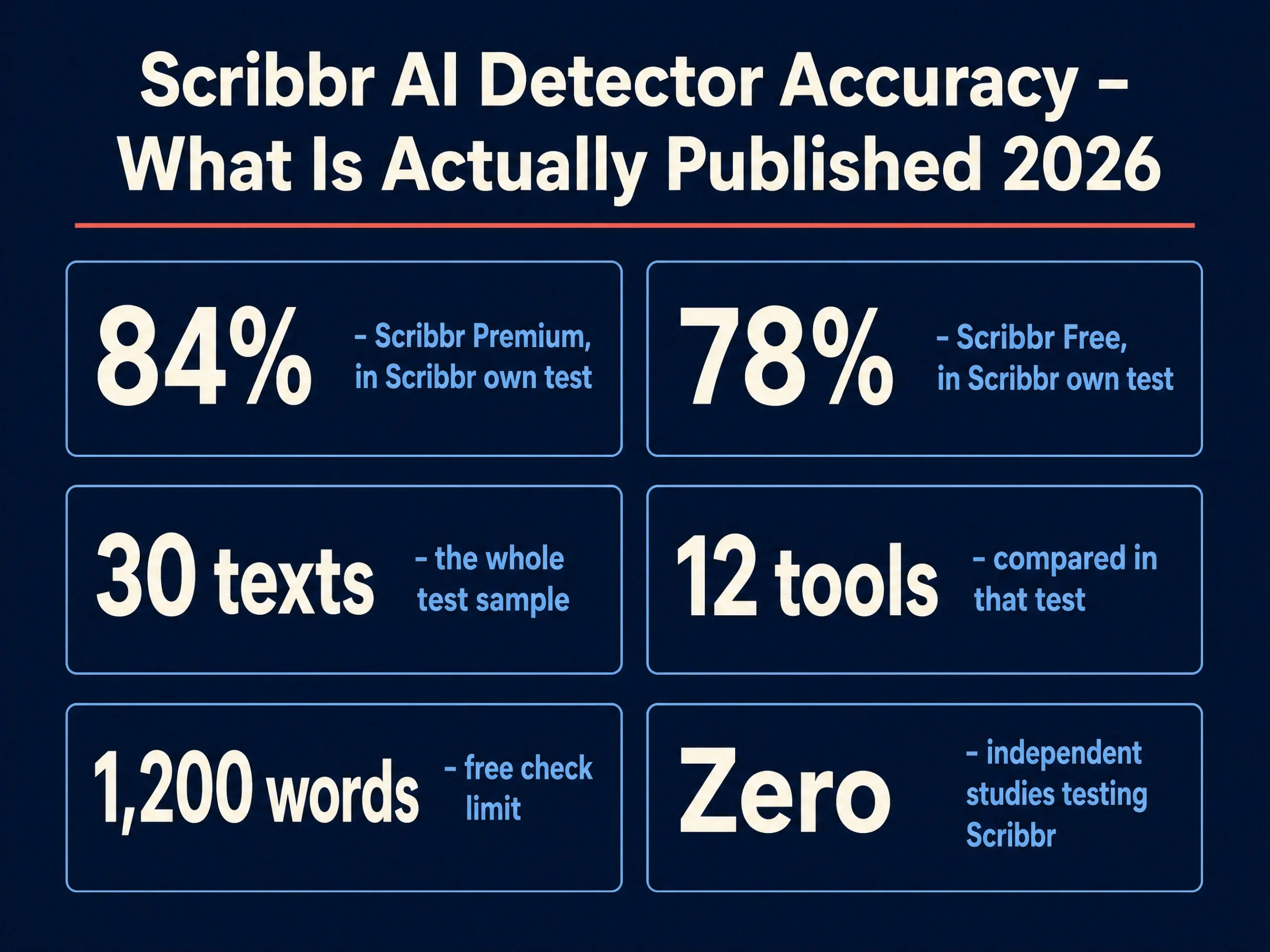
- Scribbr’s published figures are 84% accuracy for premium and 78% for free, with zero false positives claimed, from its own 12-tool comparison.
- That test used 30 texts in total, five per category, each 1,000 to 1,500 characters. Turnitin was not among the tools tested.
- No peer-reviewed or independent study we could find includes Scribbr. Weber-Wulff’s 14-tool comparison and the 2026 Van Vlasselaer study both leave it out.
- Scribbr says so itself, in its own FAQ: “No AI model on the market can guarantee 100% accuracy, including ours.”
- The free detector caps at 1,200 words per submission and is described as covering GPT-2, 3 and 3.5. GPT-4 detection is a premium feature.
- Free and paid Scribbr checks on the same text have been reported returning very different scores, which is a reason to treat any single number as a signal, not a verdict.
Is Scribbr accurate for AI detection?
Accurate enough to be a rough signal, and nowhere near accurate enough to settle an accusation. The more useful answer is about who produced the evidence, because on this tool there is only one source of evidence and it is the vendor.
Scribbr publishes a comparison of AI detectors in which its own premium tool scores 84% and its free tool 78%. Those are the numbers repeated across the internet. They are also the only numbers in existence for this tool.
That is not an accusation of dishonesty. It is a statement about what the figure can carry. A vendor-run benchmark in which the vendor wins is evidence of a kind, but it is not independent verification, and the article you are reading is the first place many people will see that distinction drawn.
What accuracy does Scribbr claim?
From its best AI detector comparison, published 22 April 2026 and revised 21 July 2026, Scribbr reports that across the tools it tested “the highest accuracy we found was 84% in a premium tool or 68% in the best free tool”. In its own results table, Scribbr Premium takes the 84% slot with zero false positives, and Scribbr Free records 78%.
Elsewhere Scribbr is notably more cautious. Its FAQ on detector accuracy states: “No AI model on the market can guarantee 100% accuracy, including ours”, and adds that “there is always at least a small risk of false positives (human text being marked as AI-generated)”. No numeric false-positive rate is published for its own tool on that page.
The free and premium tiers are also described as covering different models. Free is characterised as handling GPT-2, GPT-3 and GPT-3.5, with premium adding GPT-4. If you are checking text written with a current model, the free tier is not the tier Scribbr claims 84% for.
| Claim about Scribbr’s AI detector | Who published it | Independently verified? |
|---|---|---|
| 84% accuracy, premium tier | Scribbr | No |
| 78% accuracy, free tier | Scribbr | No |
| Zero false positives in testing | Scribbr | No |
| Detects GPT-4 on the premium tier | Scribbr | No |
| No detector guarantees 100% accuracy | Scribbr | Supported by peer-reviewed work |
| No tool tested exceeded 80% accuracy | Weber-Wulff et al., peer reviewed | Yes, but Scribbr was not among the tools |
How was that test actually run?
Small, and worth knowing the shape of before quoting the headline.
- 30 texts total, five in each of six categories.
- Each text ran 1,000 to 1,500 characters, roughly 150 to 250 words.
- Categories: fully human, GPT-3.5, GPT-4, human and GPT-3.5 blended, GPT-3.5 paraphrased through QuillBot, and human text paraphrased through QuillBot.
- Scoring gave 1, 0.5 or 0 per text depending on how close the tool came to the ground truth.
- Paraphrased human texts were excluded from the accuracy tally.
- 12 tools were compared. Turnitin was not one of them.
Two implications follow. First, 30 texts is a demonstration, not a benchmark: a single misclassification moves the percentage by more than three points. Second, the absence of Turnitin means this study cannot support any claim about how close Scribbr comes to the tool that will actually score your paper, which we take up separately in Scribbr versus Turnitin’s AI detector.
Has anyone independent tested Scribbr?
Not that we can find, and that absence is the single most useful finding in this article.
The standard peer-reviewed comparison in this field, Weber-Wulff et al. in the International Journal for Educational Integrity, tested 14 tools across 756 test runs and did not include Scribbr. The more recent Van Vlasselaer study in the same journal, published 29 June 2026, tested four tools against 160 synthetic documents and 1,163 real master’s theses, and also did not include Scribbr.
So the picture is: the tools researchers examine are mostly the institutional ones, and the consumer tools students actually reach for go untested. What the research does establish is a ceiling for the category. Weber-Wulff’s conclusion was that no tool tested exceeded 80% accuracy overall, and that roughly half of lightly obfuscated AI text was misattributed to humans.
Against that backdrop, an 84% self-reported score should read as “in line with the best of a category that is not very good”, not as “reliable”. Our summary of how much AI detectors disagree with each other shows what that looks like in practice, and the sourced false-positive rates collect what each vendor is willing to publish.
Why does Scribbr disagree with your university’s score?
Because they are different models trained on different data, scoring different things, and neither of them is measuring a fact about your document. They are producing estimates.
Students report the gap constantly. On r/TurnitinScan, one poster wrote: “I’ve had assignments that Turnitin flagged at 60%, while every free detector said 0%-5%.” The top reply named the reason: “The inconsistency is real, Turnitin uses a private model, so nothing matches it 1:1… It’s more of a black box than a standard.”
Scribbr’s own tiers can disagree with each other too. A German-language thread on r/Studium describes a free preview returning 35% AI and the paid report on the same text returning 9%. One user in that thread ran the balcony scene from Romeo and Juliet through the detector and reported it coming back 29% AI generated.
Treat that last one as the useful calibration. A tool that assigns Shakespeare a 29% AI score is not broken so much as it is doing what all of these tools do: measuring how statistically ordinary the prose looks. Our page on whether detection reads AI or reads patterns goes into the mechanism, and false positives for neurodivergent students and for writers working in a second language cover who pays the price for it.
What are the free detector’s limits?
Scribbr’s free AI detector runs without an account at up to 1,200 words per submission, which is considerably more generous than the 125-word cap on its free paraphrasing tool. Scribbr describes free-tier performance as average and premium as high, without publishing a percentage for either on that page.
The premium detector is bundled with a paid plagiarism check rather than sold on its own, which we set out in the Scribbr plagiarism checker review. There is no standalone price published for the AI detector by itself.
How should you read a Scribbr AI score?
As a smoke alarm, not a verdict. Three rules make it useful rather than misleading.
- Run the same text through more than one tool. Agreement across tools means something. A single number from a single tool means very little.
- Ignore small percentages. Turnitin itself suppresses scores below 20% because of false-positive density. Apply the same scepticism to a Scribbr score of 12%.
- Keep your drafts. Version history is the only evidence that actually settles a dispute. See what proof clears you and what to do when two detectors disagree.
And if the score you are worried about has already been generated by your institution, a Scribbr check after the fact changes nothing about the accusation. The defence checklist is the more useful page.
