Scribbr’s plagiarism checker costs $19.95 to $39.95 per document, and Scribbr states your submission is not added to any public or shared database, so it cannot come back as a self-plagiarism match at your university.
Want to bypass Turnitin in 2026? Grab the free prompt pack.
Get the exact text-humanization prompts I use to drop an AI score by hand — copy, paste, submit. Free, straight to your inbox.
Send me the free prompts →Key Takeaways
- Scribbr states plainly that submissions are “not published in any public database, so no other plagiarism checker (including those used by universities) will see them”.
- Your file is still held for 12 months on Scribbr’s servers under its privacy policy, and you can delete it yourself once the report arrives.
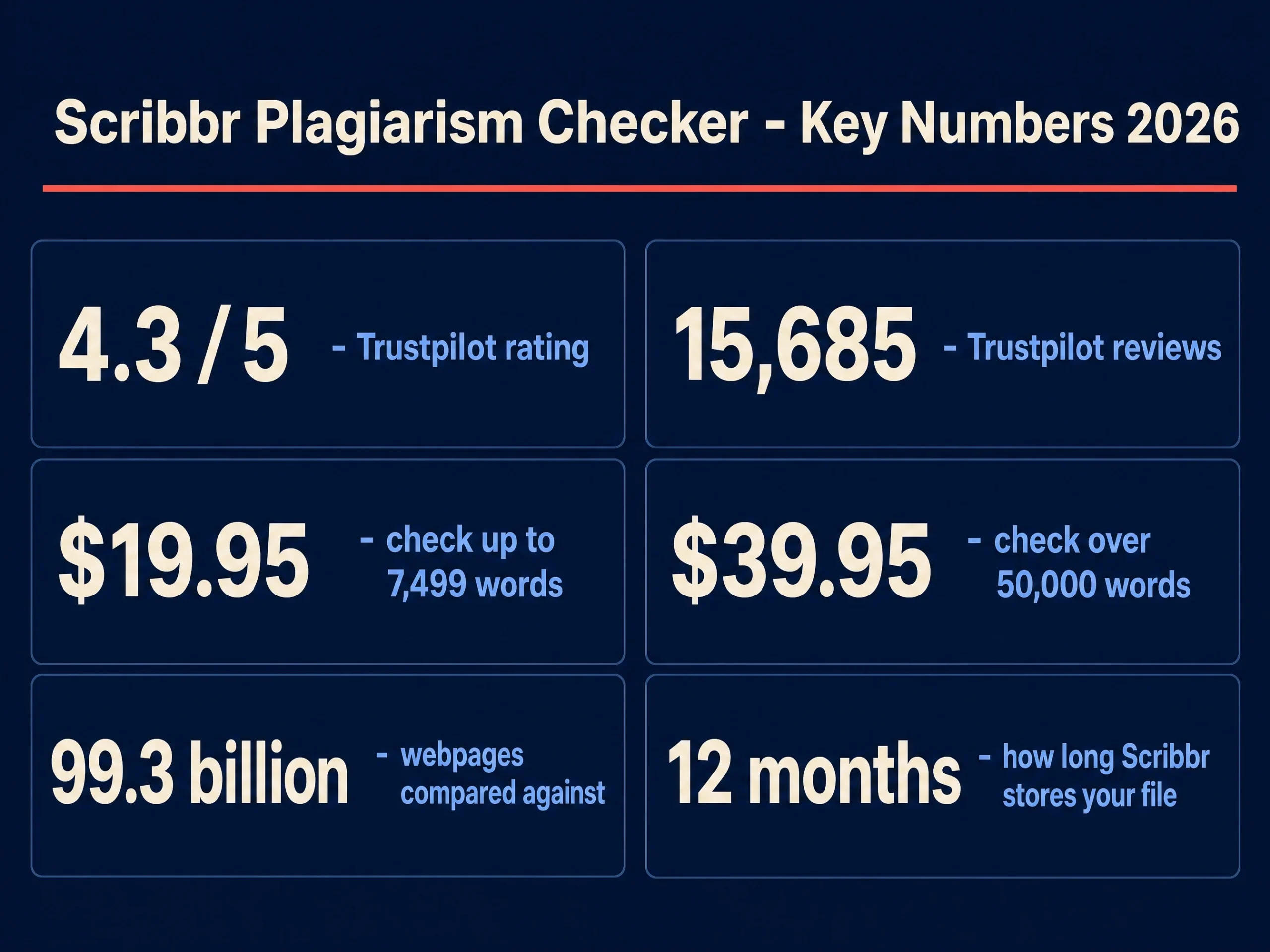
- Pricing is per document, not a subscription: $19.95 up to 7,499 words, $29.95 to 49,999, $39.95 above that.
- Scribbr’s current pages no longer name Turnitin, describing only technology “similar to the software used by most universities”. Turnitin’s own 2018 case study still says otherwise.
- Trustpilot shows 4.3 out of 5 from 15,685 reviews, while an independent test scored the checker 58.6/100 and found it caught only 25% of a deliberately plagiarised essay.
- It compares against 99.3 billion webpages and 8 million publications, but not against your university’s private database of past student papers.
What is the Scribbr plagiarism checker?
It is a paid, one-document-at-a-time similarity check aimed at students who cannot get at their institution’s own tool before submitting. You upload a thesis or essay, pay per document, and get a report showing matched passages and their sources.
Scribbr’s product page states it compares against “99.3 billion current and historical webpages” and “8 million publications from more than 1,700 publishers such as Springer, IEEE, Elsevier, Wiley-Blackwell, and Taylor & Francis”, across 20 languages, with a turnaround of one to ten minutes.
Two things it is not. It is not an AI detector, though a paid check now bundles one, and it is not your university’s check. The gap between those two things is where most of the disappointment in this category comes from, and we cover it in AI detector versus plagiarism checker.
Is Scribbr safe to upload your thesis to?
This is the question people actually mean, and it is not about data breaches. It is the fear that running your own draft through a checker will store it somewhere, so that when you submit the finished paper to your university it matches your own earlier upload and you get accused of plagiarising yourself.
Scribbr answers it directly. From its FAQ: “Your submissions to Scribbr are not published in any public database, so no other plagiarism checker (including those used by universities) will see them.” A second Scribbr FAQ page adds that “your teacher, professor, or admissions officer will not be able to see your submissions at Scribbr because they’re not added to any shared or public databases”.
That is about as unambiguous as a vendor gets, and it is the opposite of how an institutional Turnitin submission behaves, where the paper typically does join a repository.
One detail worth knowing anyway. Scribbr’s privacy policy states that “Both the original and edited versions of your document are saved on our secure server for 12 months. After this period, the files are automatically deleted.” Scribbr also says you can delete everything yourself as soon as the report arrives. Not being in a comparison database and not being stored at all are different claims, and Scribbr is making the first one.
Does Scribbr still use Turnitin?
Unclear, and the ambiguity is Scribbr’s own doing. This is worth setting out carefully, because almost every review you will find asserts it flatly in one direction.
What is documented: Turnitin’s website still hosts a Scribbr partner testimonial, dated 13 July 2018, in which Scribbr says “We added an option to educate students about plagiarism by including Turnitin technology in the Scribbr platform”.
What is also documented: Scribbr’s current plagiarism checker page and its current help-centre article on how the check works do not contain the word Turnitin anywhere. They describe “advanced plagiarism detection technology similar to the software used by most universities and publishers”.
Third parties keep asserting the link. Originality.AI’s review, by Sherice Jacob and dated 26 August 2025, describes Scribbr’s checker as “powered by Turnitin”. Students describe it the same way, as in a widely-read r/AskAcademia thread where a user refers to “a free online plagiarism checker (Scribbr, powered by Turnitin)”.
So: the arrangement was real, Scribbr has stopped naming it, and nobody outside the company can confirm what is running today. Buy it for the report it produces, not on the assumption that you are getting your university’s exact engine at a discount. Our page on what detector Turnitin actually uses covers the adjacent confusion.
What does Scribbr’s plagiarism check cost?
Per document, with three tiers by length, read from the live page on 5 September 2026:
| Document length | Price | Typical use |
|---|---|---|
| Up to 7,499 words | $19.95 | Essay, term paper, article |
| 7,500 to 49,999 words | $29.95 | Dissertation, master’s thesis |
| 50,000 words and above | $39.95 | Doctoral thesis, book manuscript |
Scribbr states “Prices are per check, not a subscription”, and that a paid check includes access to Scribbr’s AI Detector and AI Proofreader. There is a free tier, but it is described as a “basic plagiarism risk assessment” rather than a full report.
The per-document model cuts both ways. One thesis check is cheap. Re-checking after every revision is where it gets expensive, and that is the normal way people actually work. Compare with what Turnitin costs, which for an individual is a different question entirely because of who Turnitin sells to.
How good are the results?
Better than free tools, short of your institution’s check, and not independently verified to any strong standard.
The most useful independent test is A*Help’s, by Johannes Helmold, published 9 August 2023 and updated 20 January 2025. It scored Scribbr 58.6 out of 100. It correctly cleared an entirely original document, which matters, but detected only 25% of plagiarism in an essay assembled from internet sources, and missed AI-paraphrased content altogether.
Scribbr itself names the structural limitation. Its FAQ explains that universities “may check your work against private student paper databases, which Scribbr can’t access, possibly leading to small differences”. That is the honest version of why two similarity scores never match: the databases are not the same, and one of them contains every paper your institution has ever collected.
If your worry is an AI score rather than a similarity score, the bundled detector is a separate product with separate limits, covered in is Scribbr accurate for AI and set against the institutional tool in Scribbr versus Turnitin’s AI detector.
What do real users say?
Trustpilot shows 4.3 out of 5 across 15,685 reviews, with 88% at five stars, checked on 5 September 2026. That is a strong aggregate and it covers Scribbr’s whole business, editing services included, not the checker alone.
The dissenting reports cluster around the paid human services rather than the automated check. One r/academia thread describes paying $479.15 for a 24-hour editing turnaround and receiving edits the customer called “completely incorrect and unusable”. That is one invoice from one person, not a rate card and not a pattern, but it is the sharpest published complaint we could find.
On the checker itself, the recurring theme in student threads is proxy anxiety rather than product failure: people buy it because they cannot reach Turnitin. A r/studentsph poster put it exactly that way: “I discovered [there] isnt any individual services for TurnitIn and I heard scribbr is one of the alternatives.”
Who should buy it, and who should not?
Worth it if you are submitting a thesis you cannot pre-check any other way, you have quoted and paraphrased heavily from published literature, and a $20 to $40 report before submission buys you a night’s sleep. The web and publisher coverage is real, and the safety answer is clean.
Not worth it if your institution already gives you a draft submission or a self-check option, in which case you are paying for a worse version of something free. Also not worth it if you are buying it to predict an AI score, because that is a different tool with different numbers.
Before spending anything, work through how to check your AI risk without a Turnitin account and the best free pre-submission checks. And if a score has already gone against you, our false-positive defence checklist is more useful than any report you can buy after the fact.
Get the free text-humanization prompts
Get the exact text-humanization prompts I use to drop an AI score by hand — copy, paste, submit. Free, straight to your inbox.
Free · No credit card · Straight to your inbox
