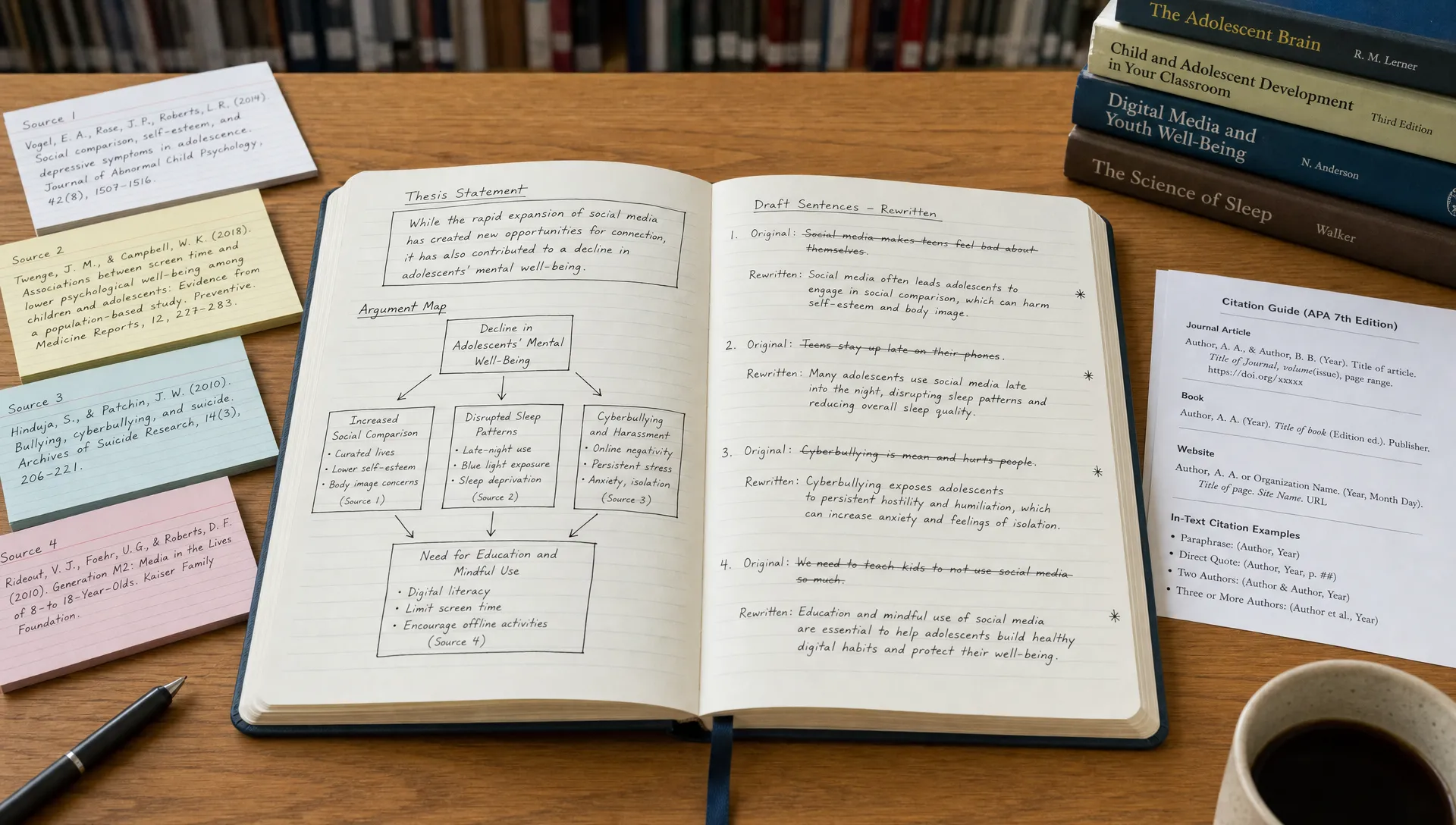
If you are using AI as a drafting aid, rewriting is where the real academic work begins. For Turnitin clarity checks, the goal is not to make a draft “look less AI” by adding random mistakes or swapping words. The goal is to make the writing clearer, more specific, properly sourced, and recognizably yours.
That distinction matters. Turnitin’s tools, similarity reports, AI-writing indicators, and instructor review workflows are usually used together, not in isolation. A paper can be grammatically polished and still raise concerns if the reasoning is vague, the citations do not support the claims, or the voice suddenly changes from your normal writing style. Rewriting AI text well means turning a generic machine-assisted draft into a defensible academic submission.
The only tool that bypassed Pangram and Turnitin in 2026.
Most humanizers clear one detector and get caught by the other. StealthWriter is the one that gets past both — run Ghost 5.2 Pro at level 7–8, section by section, and re-check before you submit.
Try StealthWriter →Below is a practical, ethical process for revising AI-generated content before a Turnitin clarity review, without relying on risky “humanizer” shortcuts or compromising academic integrity.
What Turnitin clarity checks are really asking
Students often treat “Turnitin check” as one thing, but several different concerns can be involved. A similarity or plagiarism checker asks whether your wording overlaps with existing sources. An AI content detector estimates whether text may have been generated by AI. A clarity or instructor readability review asks whether the paper communicates a coherent argument with evidence.
Those checks overlap, but they are not the same. A rewrite that only changes synonyms may reduce surface repetition while making the paper less clear. A rewrite that adds personal reasoning, fixes unsupported claims, and aligns sources with the argument is much stronger.
| Review area | What it notices | What your rewrite should improve |
|---|---|---|
| Similarity | Matching phrases, copied structure, missing quotation marks | Accurate paraphrasing, quotation control, citations |
| AI-writing risk | Generic phrasing, predictable structure, uniform tone | Specific reasoning, natural voice, documented drafting process |
| Clarity | Vague claims, weak transitions, unsupported conclusions | Coherent argument, source integration, reader-friendly flow |
| Instructor judgment | Whether the work matches the assignment and your known ability | Course-specific language, draft history, defensible choices |
Turnitin describes its AI-writing capabilities as indicators that support educator review, not as a substitute for human judgment. You can read Turnitin’s own overview of AI writing detection for context. The safest approach is to write and revise in a way that you can explain if asked.
Start by identifying what AI actually contributed
Before rewriting anything, separate your work from the AI’s work. This is the step most students skip, and it is one of the main reasons rewritten drafts still feel synthetic.
Ask yourself: Did AI generate the thesis? Did it summarize sources you had not read? Did it create an outline? Did it write paragraphs from scratch? Did it only help with grammar or brainstorming?
The more AI contributed to the substance of the paper, the more revision you need. If a model invented the argument, rewriting sentence by sentence will not fix the authorship problem. You need to rebuild the paper around your own reading, notes, and interpretation.
If your institution requires disclosure of AI use, follow that policy. Rewriting should never be used to hide prohibited assistance. It should be used to clarify your actual thinking and remove generic filler from a draft.
Build a source-and-claim map before rewriting
AI-generated academic text often sounds confident because it moves smoothly from claim to claim. The problem is that those claims may not be anchored in the assigned material. Turnitin clarity checks and instructors both tend to notice this gap.
Create a simple source-and-claim map before you edit the prose. For each paragraph, write down the main claim, the evidence that supports it, and the reason that evidence matters. If you cannot fill in one of those columns, the paragraph needs more than a wording change.
| Paragraph element | Question to answer | Rewrite action |
|---|---|---|
| Main claim | What am I actually arguing here? | Make the topic sentence more precise |
| Evidence | Which source, example, data point, or lecture concept supports this? | Add or correct citation support |
| Analysis | How does the evidence prove the claim? | Explain the reasoning in your own words |
| Relevance | Why does this matter for the prompt? | Connect back to the assignment question |
This process turns a “smooth” AI draft into a traceable academic argument. It also helps you avoid accidental plagiarism, because you are checking whether every borrowed idea is clearly attributed.
Rewrite for meaning first, wording second
A common mistake is to open an AI paragraph and begin replacing words. “Important” becomes “significant,” “shows” becomes “demonstrates,” and “society” becomes “the broader social environment.” The result may sound different, but it often becomes less clear.
Instead, rewrite from intention. Look away from the AI sentence and answer the question in plain language: What am I trying to say? Then write the sentence from scratch.
For example, an AI-style sentence might say:
The increasing use of digital tools in education has created a wide range of opportunities and challenges for students in modern learning environments.
A clearer student rewrite would be:
In this paper, I focus on one challenge of digital learning: students can access more resources than before, but they also need stronger judgment to decide which sources are credible.
The second version is not just “more human.” It is narrower, more arguable, and easier to support. That is what clarity revision should do.
If you struggle to preserve your own style during revision, use a voice-first approach. Detection Drama’s guide to rewriting AI text without losing your original voice is a useful next step if your draft sounds polished but not like you.
Replace generic transitions with real logic
AI drafts often rely on transitions that create the feeling of structure without adding much meaning: “Furthermore,” “In conclusion,” “It is important to note,” and “This highlights the significance of.” These phrases are not wrong, but overusing them can make a paper feel automated.
A better transition tells the reader how the next idea relates to the previous one. Is it a contrast? A cause? A limitation? A more specific example? A consequence?
Try replacing vague transitions with logical ones:
| Generic transition | Clearer revision |
|---|---|
| Furthermore | A second reason this matters is |
| It is important to note | This matters for the argument because |
| This shows that | This supports the claim by showing |
| On the other hand | The limitation of this evidence is |
| In conclusion | Taken together, these examples suggest |
This kind of revision improves readability and makes your reasoning easier to follow. It also reduces the “template” feeling that many AI-generated essays have.
Add your course context and thinking process
Turnitin clarity checks may not know your course, but your instructor does. One of the strongest ways to revise AI-generated content is to add details only a real student in the class would know: assigned readings, lecture concepts, lab findings, class debates, feedback from a prior draft, or a specific interpretation you developed while researching.
That does not mean stuffing the paper with personal anecdotes. It means grounding your claims in the actual learning environment. Instead of saying, “Many scholars argue that social media affects political discourse,” name the assigned author, define the relevant concept, and explain how it applies to your example.
This is also where your notes matter. If you have reading annotations, outline drafts, search history, or comments from a professor, keep them. If a Turnitin AI false positive ever becomes a concern, authorship evidence can be more persuasive than a detector score. For a broader strategy, see Detection Drama’s guide on how to lower a Turnitin AI score without “humanizer” tricks.
Use a three-pass rewrite system
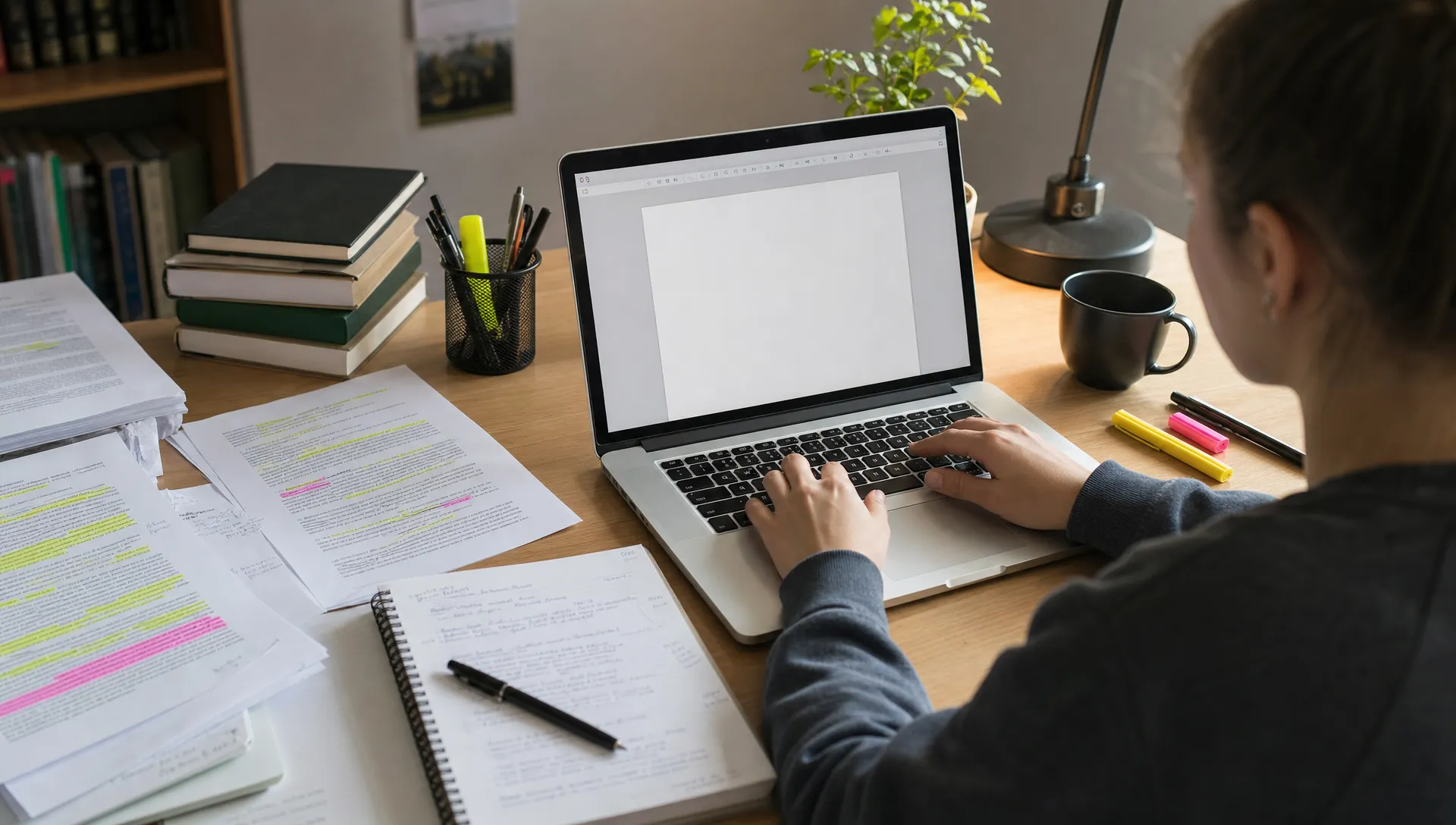
Trying to fix everything in one edit usually leads to messy writing. A better approach is to revise in passes, with each pass focused on one problem.
- Argument pass: Check whether every paragraph answers the prompt and supports the thesis. Delete filler, merge repeated points, and move paragraphs that appear in the wrong order.
- Evidence pass: Verify every citation, quotation, paraphrase, and factual claim. Make sure the source actually says what your sentence claims it says.
- Voice and clarity pass: Read the paper aloud, simplify stiff phrasing, vary sentence length naturally, and replace vague academic padding with direct explanation.
This system works because AI-generated text often fails at the paragraph and evidence level, not just the sentence level. If you only polish grammar, the deeper weaknesses remain.
Keep citations accurate and visible
One of the biggest risks of AI-generated content is source distortion. AI tools can summarize real sources incorrectly, blend multiple ideas together, or invent citations. Even if the wording passes an AI content detector, inaccurate citations can create plagiarism or academic integrity problems.
Before submission, check every source manually. Confirm page numbers, publication details, quotation marks, and paraphrased ideas. If you used AI to summarize a source, compare the summary against the original text yourself. Do not cite a source you have not read closely enough to explain.
For clarity, integrate sources with signal phrases instead of dropping citations at the end of broad claims. A sentence like “Smith argues that online learning changes student motivation by reducing informal peer accountability” is easier to evaluate than “Online learning changes motivation (Smith, 2022).” The first version shows what the source contributes.
The Purdue OWL guide to paraphrasing is a reliable refresher if you are unsure how to restate source material without copying structure too closely.
Avoid risky “humanizer” habits
In 2026, simply running a draft through a text humanizer and submitting the result is a weak strategy. Humanizers can introduce awkward phrasing, change meaning, damage citations, and create a new pattern that detection tools may recognize. Detection Drama has covered why it matters that Turnitin now detects AI humanizers, but the practical takeaway is simple: do not treat rewriting as camouflage.
Avoid these habits when preparing for Turnitin clarity checks:
- Randomly adding typos or grammar mistakes to seem more human.
- Replacing words with unnatural synonyms that you would never use.
- Shortening complex ideas until the argument loses precision.
- Adding fake personal opinions that do not connect to the evidence.
- Removing citations because they make the paper look “too academic.”
- Submitting a rewritten draft you cannot explain in conversation.
Good rewriting should make the paper easier to defend, not harder.
Run a final clarity check like an instructor
Before submitting, review the paper from the perspective of someone grading it. Do not ask only, “Will this pass Turnitin?” Ask, “Can a reader follow my argument, verify my sources, and recognize my thinking?”
Use this final checklist:
| Final question | What a strong answer looks like |
|---|---|
| Does the thesis answer the exact prompt? | It takes a specific position, not a broad topic |
| Does each paragraph have a job? | Every paragraph advances one part of the argument |
| Are sources connected to claims? | Evidence is introduced, cited, and analyzed |
| Does the voice sound consistent? | The tone matches your usual academic writing level |
| Can you explain your process? | You have notes, drafts, and reasons for key choices |
| Is AI use allowed and disclosed if required? | Your submission follows the course policy |
If you want an additional pre-submission read-through, Detection Drama’s guide on how to check if your essay sounds AI written before you submit can help you spot generic phrasing and uneven voice before an instructor does.
Where AI writing tools still help
AI writing tools are not useless. They can help you brainstorm angles, identify unclear sentences, suggest possible outlines, or flag overly long paragraphs. A text humanizer can also show you how a sentence might be rephrased. The problem begins when you outsource judgment, evidence, and final authorship.
Use tools as assistants, not as a replacement for revision. If a tool suggests a sentence, ask whether it is accurate, whether it matches your voice, and whether it strengthens the argument. If it changes a cited claim, verify the source again. If it makes your paper sound more sophisticated but less precise, reject the suggestion.
The safest final draft is not the one with the lowest possible AI detection score. It is the one that is clear, sourced, policy-compliant, and recognizably connected to your own work.
Frequently Asked Questions
Can I rewrite AI text so Turnitin will not flag it? No rewrite can guarantee a Turnitin result. The better goal is to revise the draft into original, clear, source-supported writing that reflects your own thinking and follows your institution’s AI policy.
Is using AI to improve clarity considered cheating? It depends on your course rules. Some instructors allow grammar or brainstorming support, while others restrict generative AI use. Check the policy and disclose AI assistance when required.
What is the biggest mistake when rewriting AI-generated content? The biggest mistake is changing wording without changing substance. If the argument, evidence, and analysis remain generic or unsupported, the draft may still feel AI-written.
Should I use a text humanizer before submitting to Turnitin? Be careful. Humanizers can distort meaning, weaken citations, and create unnatural wording. A manual revision process that improves clarity, evidence, and voice is safer than relying on automated camouflage.
How do I know if my rewritten draft sounds like me? Compare it with your older writing. Look at sentence length, vocabulary, tone, and how you explain evidence. If the paper sounds like a different person, revise from your notes instead of polishing the AI draft.
A better way to think about Turnitin clarity checks
Rewriting AI text for Turnitin clarity checks is not about hiding. It is about taking responsibility for the final draft. That means verifying claims, rebuilding vague paragraphs, using sources honestly, and making sure the writing reflects your own reasoning.
If you treat AI output as raw material, not finished work, your revision will be stronger. You will also be in a better position to explain your choices if a teacher asks how the paper was written. In academic writing, that defensibility is just as important as the words on the page.
