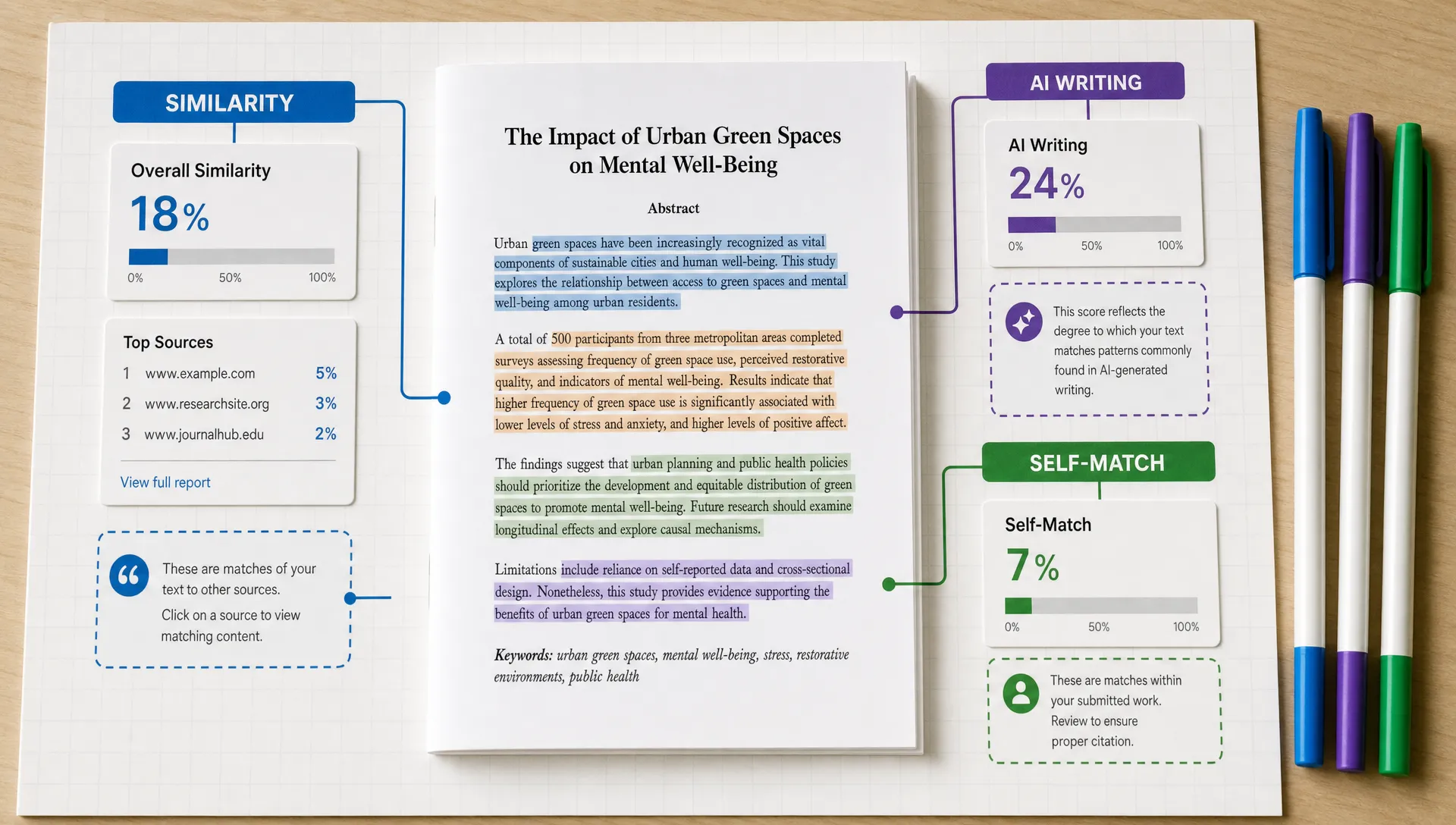
A Turnitin flag on an abstract feels especially unfair because the abstract is often the most polished, compressed, and formulaic part of a paper. It has to summarize the research question, method, findings, and conclusion in a small space, so it naturally sounds more standardized than the rest of your writing.
The first thing to know is this: a flagged abstract is not automatically proof of plagiarism or AI writing. It is a signal that needs interpretation. Turnitin may be showing a similarity match, an AI writing indicator, or highlighted text inside a larger report. Each one calls for a different response.
Before rewriting anything, slow down and check what Turnitin actually flagged.
Want to bypass Turnitin in 2026? Grab the free prompt pack.
Get the exact text-humanization prompts I use to drop an AI score by hand — copy, paste, submit. Free, straight to your inbox.
Send me the free prompts →Start by identifying the type of Turnitin flag
Students often say “Turnitin flagged my abstract” when they mean one of several different things. The difference matters because a similarity flag and an AI detection flag are not the same problem.
| What you see in Turnitin | What it usually means | First thing to check |
|---|---|---|
| Colored matching text in the Similarity Report | Turnitin found overlapping text in another source, database, website, paper, or submitted work | Which source is matched and whether exclusions were applied |
| AI writing percentage or highlighted prose | Turnitin’s AI content detector identified text patterns it associates with AI-generated content | Whether only the abstract is highlighted or the same pattern appears across the paper |
| Match to your own earlier submission | Self-match or overlap with a proposal, draft, preprint, repository file, or previous class submission | Whether your institution allows reuse and whether you cited or disclosed it |
| Match to assignment prompt or template wording | The abstract includes required wording, headings, or stock phrasing | Whether the instructor can exclude templates or prompts |
| Match to published abstracts | Your abstract uses common discipline phrasing or overlaps with a source abstract | Whether the overlap is generic, cited, or too close to a source |
If the report is showing similarity, your job is to trace the matched source and context. If the report is showing AI, your job is to gather process evidence and review whether the abstract’s style became unusually generic or over-polished.
Turnitin itself presents AI detection as an indicator used for review, not as a standalone misconduct verdict. Its AI writing detection information explains the tool at a high level, but your school’s academic integrity policy is what determines how the result is handled.
Why abstracts are more likely to look “AI-like”
An abstract has unusual writing constraints. It needs to be concise, complete, neutral, and often written in a formal academic register. That combination can produce the exact traits that AI detectors tend to scrutinize: smooth transitions, predictable sentence structures, low personal voice, and broad summary language.
This does not mean the detector is wrong every time. It means the abstract deserves a more careful review than a longer section with more varied reasoning, evidence, and drafting traces.
Common innocent triggers include:
- Very uniform sentence length, especially if every sentence follows a similar academic pattern.
- Generic phrases such as “This study examines,” “The findings suggest,” or “The results indicate.”
- Heavy compression of complex ideas, which can remove your natural writing quirks.
- Editing tools that make every sentence cleaner, smoother, and more formal.
- Abstract templates required by the department, journal, or conference.
- Reusing wording from your introduction, conclusion, proposal, or previous abstract.
If you want a broader explanation of how ordinary style choices can be misread, this guide to normal writing habits that can trigger Turnitin AI flags is a useful companion.
Check whether the abstract repeats your title, intro, or conclusion too closely
Abstracts often borrow language from the paper itself. That is normal, but it can create problems in two ways.
First, a similarity report may show overlap because the same sentence appears in your introduction, conclusion, conference proposal, or earlier draft submitted to the same system. Second, an AI report may highlight the abstract because it condenses the most polished sentences from the rest of the paper, making it read more uniform than the surrounding sections.
Compare the abstract against these parts of your work:
| Section or document | What to look for | Why it matters |
|---|---|---|
| Title | Repeated key phrase or full title wording | Some repetition is normal, but full sentence reuse can look formulaic |
| Introduction | Same research aim sentence | This is common, but you may need to vary the sentence or cite context properly |
| Methods section | Identical method summary | Technical wording may be unavoidable, but copied phrasing should be intentional |
| Conclusion | Same implication or “findings suggest” sentence | Repeated polished summary language can make the abstract look artificially uniform |
| Proposal or thesis plan | Reused project description | Self-overlap may need disclosure depending on your course rules |
| Conference abstract or preprint | Reused public abstract | Publicly available wording can appear as a direct source match |
You do not need to rewrite every repeated phrase. Some overlap is expected in academic writing. The issue is whether the abstract looks like a copied block rather than a fresh summary of the final paper.
Check whether the flag is coming from citations, DOIs, or technical names
Most abstracts do not have a reference list, but some disciplines allow brief citations, trial registration numbers, database names, organism names, legal cases, statutes, software packages, or DOI-like strings in the abstract. These can inflate similarity or create strange highlights.
If your abstract includes technical identifiers, check whether Turnitin matched the identifier itself or the surrounding sentence. A DOI, statute name, official title, clinical trial number, or exact instrument name may be unavoidable. But if the entire sentence around it matches a source abstract, you should examine whether the wording is too close.
This is similar to what happens when Turnitin flags bibliographies and source metadata. If the issue extends beyond the abstract, the guide on what to check when Turnitin flagged your references page can help you separate harmless source information from real overlap.
Check whether the abstract is too generic for your actual paper
A strong abstract is specific. A risky abstract often sounds correct but vague. AI-generated summaries commonly lean on broad claims because they are designed to sound polished without necessarily reflecting the exact choices, limitations, or findings of your work.
Even if you wrote the abstract yourself, heavy last-minute polishing can strip out the details that prove authorship. Look for sentences that could describe hundreds of papers in your field.
For example, a generic abstract sentence might say:
This study explores the relationship between social media use and academic performance, highlighting important implications for educators and policymakers.
A more specific sentence might say:
Using survey responses from 184 first-year students, this study compares daily TikTok use with self-reported study time and final course grades in an introductory psychology cohort.
The second version is harder to mistake for generic AI writing because it carries concrete research fingerprints: sample size, platform, variables, population, and course context. You are not adding detail to “beat” a detector. You are making the abstract more accurate and accountable.
Check your drafting history before you contact anyone
If your abstract was flagged, your best defense is not a dramatic explanation. It is a calm paper trail.
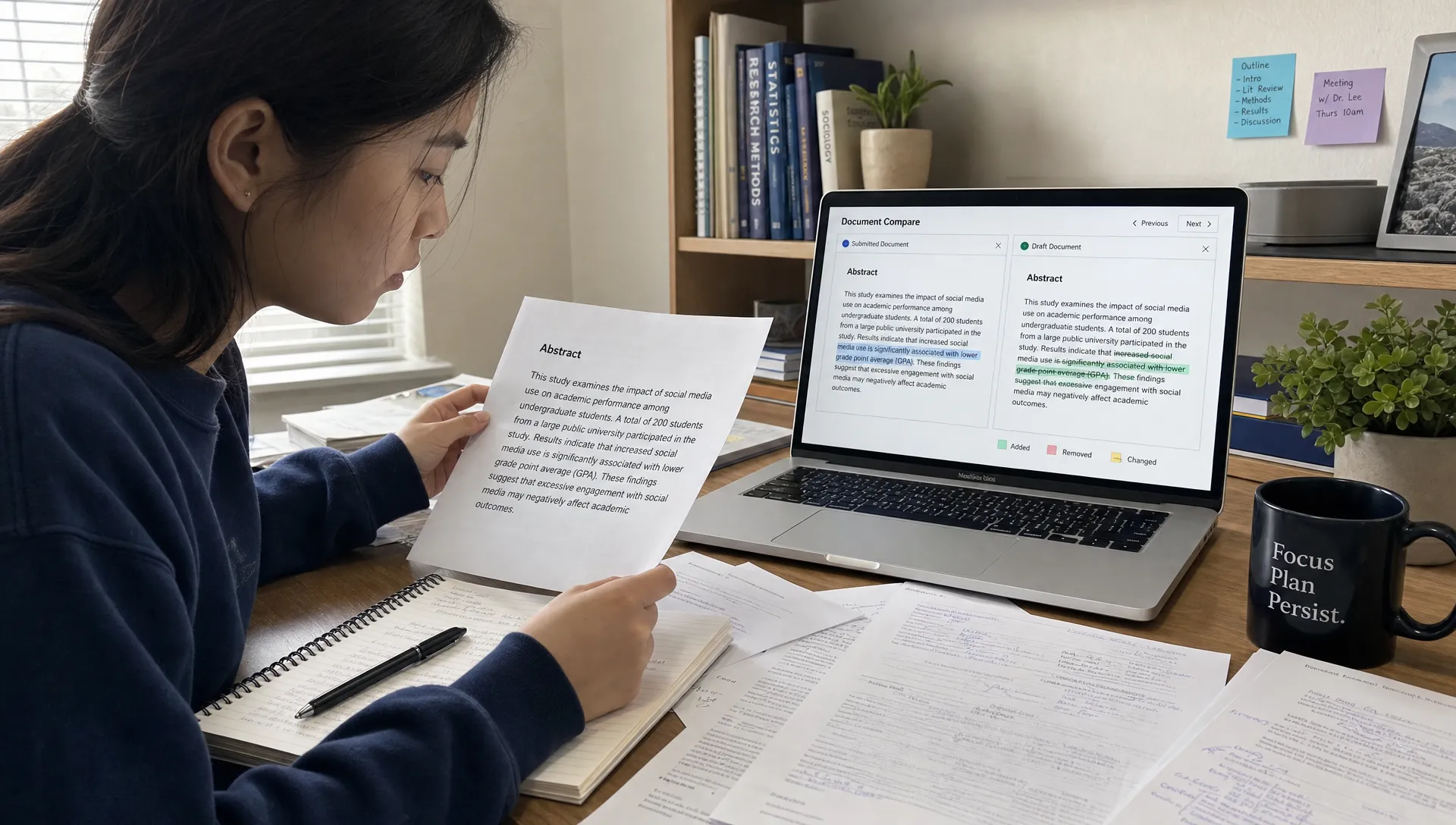
Gather evidence before you email your instructor, especially if the flag involves AI writing rather than simple similarity. Good evidence usually includes your document version history, outline, notes, research logs, saved PDFs, handwritten planning, advisor comments, and earlier drafts of the abstract.
The most useful evidence shows development over time. A single final document proves very little. A sequence of drafts showing changes to the research question, methods wording, results summary, and conclusion is much stronger.
If you used writing assistance, document it honestly. There is a major difference between using a grammar tool to fix punctuation and asking an AI writing tool to generate the abstract. Policies vary, so check your syllabus, department rules, and assignment instructions. If your work was wrongly flagged, this Turnitin AI false positives checklist gives a more detailed structure for organizing your response.
Check whether editing tools changed your voice
Many abstract flags happen after a student runs the abstract through several rounds of editing. The final version may be grammatically excellent but stylistically flat. This can happen with AI writing tools, paraphrasers, grammar checkers, translation tools, and even well-meaning peer edits.
Ask yourself these questions:
- Did I paste the abstract into an AI tool and ask it to “make it academic”?
- Did a grammar checker rewrite whole sentences rather than only correcting errors?
- Did I translate the abstract into English and then heavily polish it?
- Did I accept every suggested edit without reviewing whether it still sounded like me?
- Did I write the body of the paper myself but generate the abstract separately?
If the answer is yes to any of these, do not panic. Instead, reconstruct your process. Save the earlier version if you still have it. Note which tool you used, when you used it, and what kind of changes it made. If your institution allows limited editing assistance, the key is transparency and documentation.
Check whether the highlighted text is only the abstract
A flag limited to the abstract usually means something different from a flag spread throughout the entire paper.
If only the abstract is highlighted, the issue may be caused by structure, compression, template language, or last-minute polishing. If the introduction is also highlighted, the issue may be that the opening sections are written in a more generic, explanatory style than the rest of the paper. Detection Drama has a separate guide on what it usually means when Turnitin AI highlights an introduction, and many of the same principles apply to abstracts.
If the abstract, introduction, literature review, and conclusion are all highlighted, review your entire drafting workflow. That pattern may suggest that large parts of the paper were written or heavily rewritten in the same polished style. It may still be explainable, but you will need stronger evidence.
How to revise a flagged abstract without making things worse
Do not blindly run the abstract through a text humanizer or paraphrasing tool after receiving a Turnitin flag. That can create a second problem: your revised version may no longer match your actual research, or it may introduce errors you cannot defend.
A better revision process is to rebuild the abstract from the paper itself.
Start by writing one plain sentence for each of these questions:
| Abstract element | Question to answer | What makes it credible |
|---|---|---|
| Purpose | What exact problem or question did the paper address? | Names the issue, population, text, dataset, or case |
| Method | How did you investigate it? | Identifies method, evidence, sample, corpus, or framework |
| Findings | What did you actually find? | Uses concrete results rather than vague claims |
| Significance | Why does it matter within the course or field? | Connects to a specific debate, limitation, or implication |
Then combine those sentences into a concise paragraph. Keep the wording natural. You can still sound academic without using stock phrases in every sentence.
Instead of writing, “This paper aims to explore,” you might write, “I examine” if first person is allowed, or “The paper examines” if your department prefers impersonal style. Instead of “The findings provide valuable insights,” state the actual insight. Instead of “various factors,” name the factors.
The goal is not to trick an AI content detector. The goal is to make the abstract more specific, more faithful to your work, and easier for a human reader to evaluate.
What to say to your instructor if the abstract was flagged
If you need to respond, keep the message short, factual, and cooperative. Avoid accusing the software, and avoid overexplaining before you know what the instructor is concerned about.
A reasonable message might say:
I saw that the abstract was flagged in the Turnitin report. I would like to understand whether the concern is similarity, AI writing, or both. I can provide my outline, draft history, notes, and earlier abstract versions if helpful. I am also willing to revise the abstract to make the wording more specific to my paper.
This tone shows that you take the report seriously without admitting wrongdoing. It also directs the conversation toward evidence rather than assumptions.
When a flagged abstract is a real problem
Not every abstract flag is harmless. You should treat the situation more seriously if the abstract closely mirrors a published abstract, if it summarizes sources you did not read, if it claims results that are not in your paper, or if it was generated by AI in a course that prohibits that use.
A problematic abstract often has one or more of these signs:
- It contains claims broader than the actual paper supports.
- It uses source wording without quotation or citation where citation is required.
- It describes a method you did not use.
- It includes results that are missing from the paper.
- It was copied from a proposal, article, classmate, or AI output without permission or disclosure.
If any of those apply, the best next step is not concealment. Correct the record, revise the abstract, and follow your school’s policy. Instructors are often more receptive when students address the problem early and honestly.
Frequently Asked Questions
Can Turnitin flag only my abstract as AI? Yes. An abstract can be highlighted even when the rest of the paper is not, especially if it is more polished, compressed, or formulaic than the body. That does not automatically prove AI use.
Does a similarity match in my abstract mean plagiarism? Not always. It may be matching technical phrases, your own previous work, a proposal, a public abstract, or required template language. You need to inspect the matched source and context.
Should I delete citations or technical terms from the abstract? No. Do not remove necessary information just to reduce a score. Instead, check whether the surrounding wording is too close to a source and whether citations are allowed in your required abstract format.
What proof helps if my abstract was falsely flagged? Version history, outlines, notes, source annotations, earlier abstract drafts, advisor feedback, and evidence of your research process are usually more persuasive than a simple denial.
Should I use a humanizer after Turnitin flags my abstract? Be careful. If you are submitting academic work, your priority should be accuracy, policy compliance, and documentation. Mechanical rewriting can introduce errors and make your process harder to explain.
Need help understanding what the flag means?
A Turnitin flag on an abstract is stressful, but it is also manageable if you separate similarity from AI detection, inspect the highlighted text, and gather your drafting evidence before responding.
For more practical guides on Turnitin, AI detection, and responsible ways to understand detection reports, visit Detection Drama. Use the report as a starting point for review, not as the final word on your work.
Want to bypass Turnitin in 2026? Grab the free prompt pack.
Get the exact text-humanization prompts I use to drop an AI score by hand — copy, paste, submit. Free, straight to your inbox.
Send me the free prompts →