Translated writing does get flagged as AI, but not by the system most people blame. Turnitin’s Translated Matching is a plagiarism tool that ignores your own writing entirely; it is the separate AI detector that reacts to machine translation, because translation output reads like a machine wrote it.
Want to bypass Turnitin in 2026? Grab the free prompt pack.
Get the exact text-humanization prompts I use to drop an AI score by hand — copy, paste, submit. Free, straight to your inbox.
Send me the free prompts →Key Takeaways
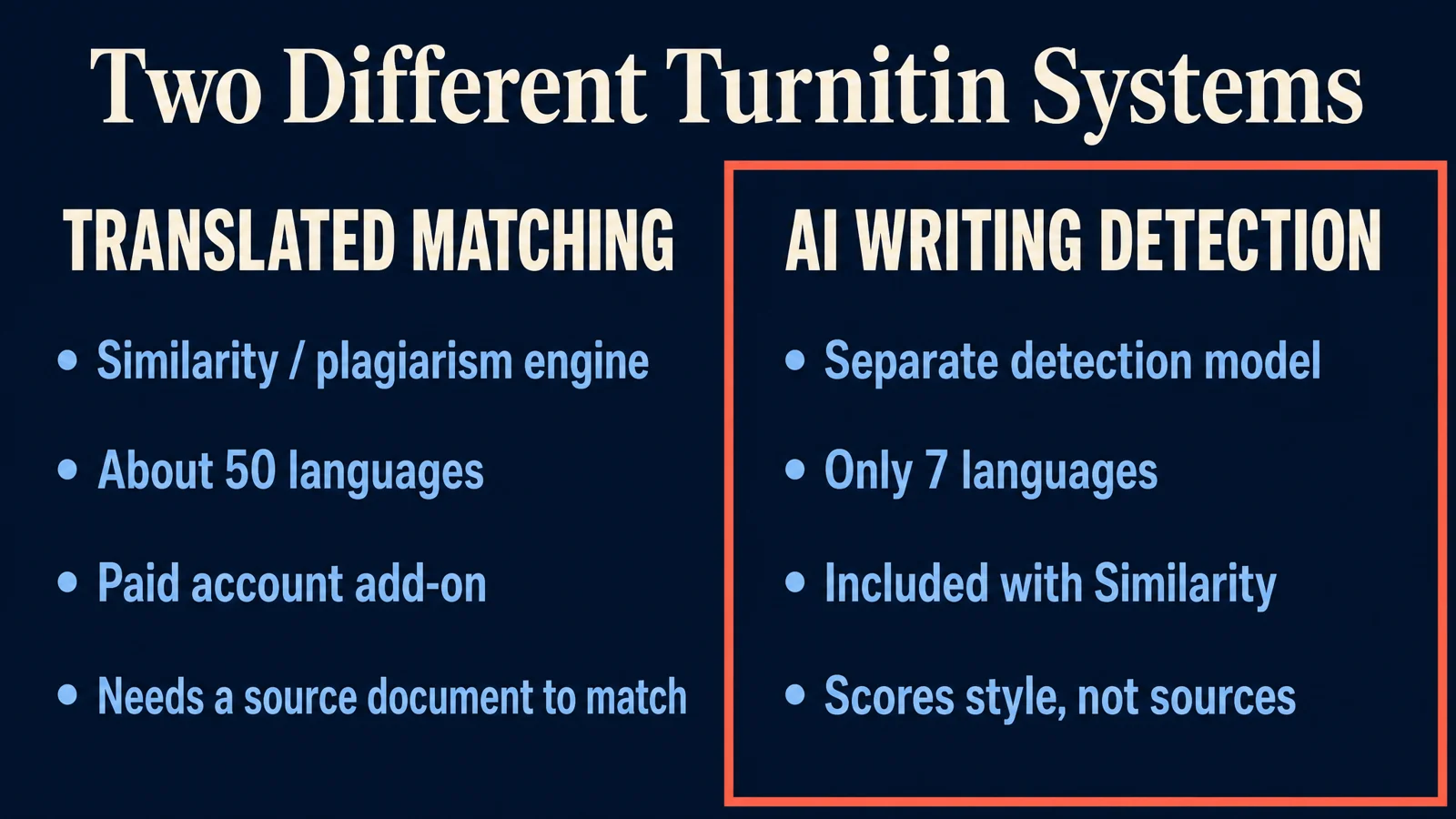
- Turnitin runs two separate systems. Translated Matching is a similarity/plagiarism feature covering roughly 50 languages and sold as a paid add-on; AI writing detection is a different model supported in only seven languages. Vendor blog posts routinely conflate them.
- Translated Matching cannot flag your own writing as plagiarised, because it works by finding a source document to match against. Your original draft is not in any database.
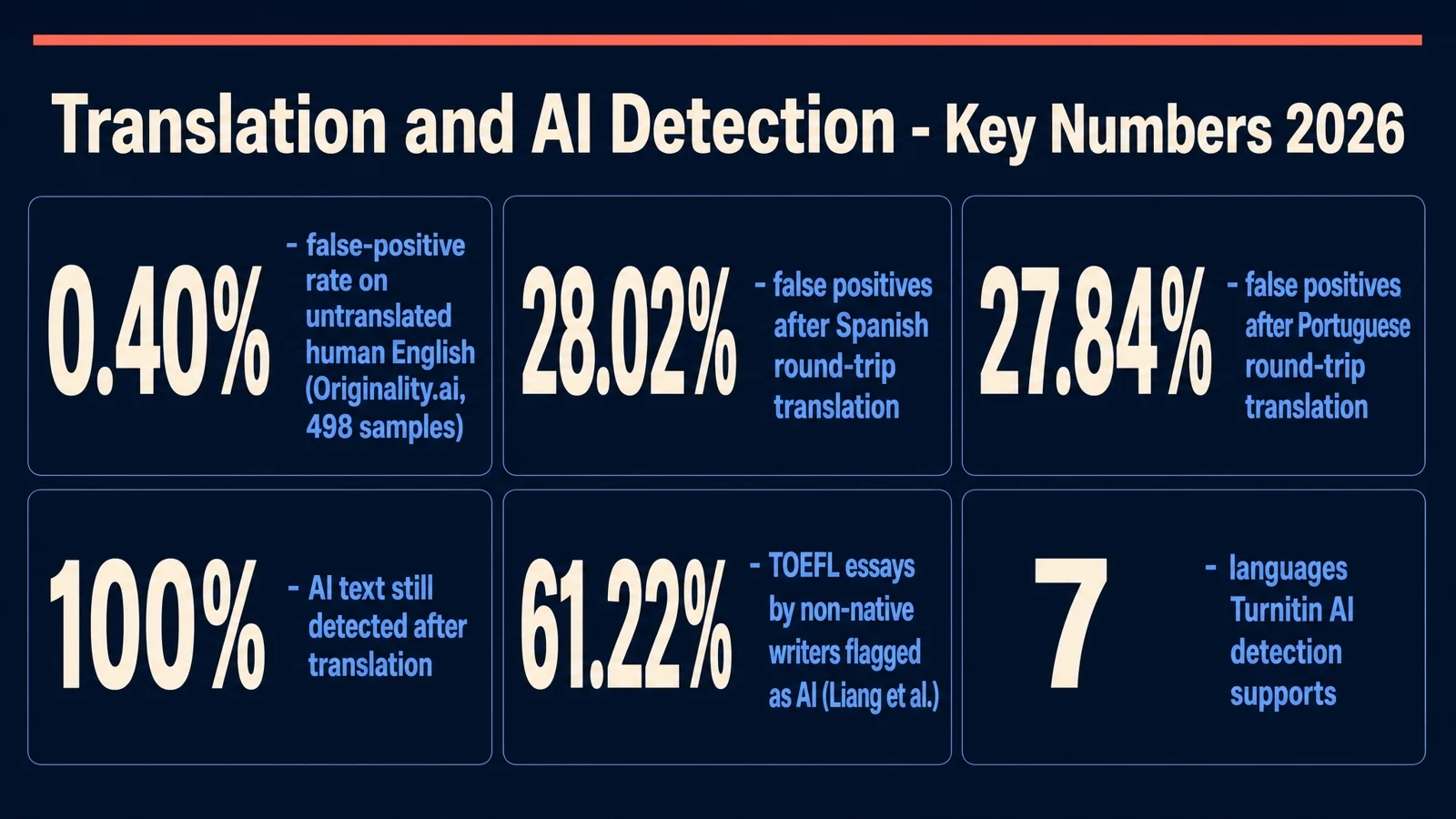
- Machine translation raises false-positive risk sharply. Originality.ai measured a jump from 0.40% false positives on untranslated human English to 28.02% after a Spanish round trip and 27.84% after Portuguese — roughly a seventyfold increase.
- Translation is a poor bypass. In the same study, GPT-4o text stayed detected at a 100% true-positive rate through every translation path tested.
- The research disagrees across time. The 2024 ESPERANTO paper found back-translation cut detection meaningfully across nine detectors; the 2026 Originality.ai run found it did not. Detector versions changed in between.
- Non-native writers already carry a penalty before translation enters the picture: seven detectors flagged 61.22% of TOEFL essays by non-native speakers as AI, against near-zero for US-authored essays.
- The single defence that works is not a tool. It is keeping the original-language draft, timestamped, before you submit.
Why does translated writing get flagged as AI at all?
Because AI detectors score how text is written, not who wrote it. They look for low perplexity — writing that is unusually predictable, evenly paced, and free of the odd word choices human drafting produces. Machine translation manufactures exactly that. A translation engine picks the highest-probability rendering of each phrase, smooths idiom into standard construction, and flattens sentence rhythm. The output is fluent, regular English that reads statistically like a model produced it, because in a real sense a model did.
Nothing about that process cares whether the ideas underneath were yours. This is the part that catches people off guard: you can write every thought yourself, in your own language, and still hand a detector a text with a machine’s fingerprints on the surface. It is the same mechanism that makes detectors misfire on neurodivergent writers and on anyone whose prose happens to be tidy.
So the honest answer to “does translating get me flagged” is: it raises your risk, measurably, and the size of that risk depends on which system is doing the looking.
What is Translated Matching, and is it the thing flagging you?
Almost certainly not. Translated Matching is part of Turnitin’s Similarity Report — the plagiarism side of the product. When it is enabled, Turnitin identifies the language a paper was written in, translates it into English, and matches the result against its content databases. It exists to catch a specific trick: taking a published source in one language, translating it, and passing it off as original.
Three facts about it are worth knowing before you accept a vendor’s explanation of your score:
- It is a paid account add-on. Many institutions have not bought it, so for a large share of students it is not running at all.
- It covers roughly 50 languages, from Albanian and Arabic through to Vietnamese — far broader coverage than the AI detector.
- It has a hard ceiling of 150,000 characters, about 25,000 words. Longer files fail to process.
The decisive point is structural. Translated Matching works by finding a source to match against. If you wrote the draft yourself, there is no source. Your essay is not in Turnitin’s repository, not on the open web, not in a journal. Translated Matching has nothing to compare it to, so it returns nothing. That is why an 85% AI score cannot be blamed on it — the AI score and the similarity score come from two entirely different engines with different inputs and different failure modes.
Which languages does Turnitin’s AI detector actually support?
Seven. According to Turnitin’s own AI writing detection FAQs, as of March 2026 the AI detector supports English, Spanish, Portuguese, French, German, Italian and Japanese. Detection in the six non-English languages is materially less reliable than in English, and dozens of languages have no AI detection support whatsoever.
That asymmetry produces a counterintuitive result. Submitting in a language the AI detector does not cover means no AI score is generated for that text. Translating it into English is what puts it in front of the detector — in the language where the model is most confident, wearing the exact style the model penalises. The act of translating is what creates the exposure. For a fuller breakdown of how accuracy varies across languages, see our data on AI detection accuracy by language, and on the in-house model Turnitin runs.
What do the numbers say about translation and false positives?
There is exactly one recent study that isolates this, and it comes from a detector vendor — which is worth holding in mind, though the methodology is published and the sample is real. In June 2026 Originality.ai tested 498 human-written and 498 GPT-4o-written samples, translating each through Spanish and Portuguese with Google Translate and then back into English.
| Condition | Human text flagged as AI | AI text caught |
|---|---|---|
| Original English, no translation | 0.40% | 100% |
| Direct translation to Spanish | 2.21% | 100% |
| Direct translation to Portuguese | 0.40% | 100% |
| Spanish round trip back to English | 28.02% | 100% |
| Portuguese round trip back to English | 27.84% | 100% |
Read the two columns against each other and the picture is unambiguous, and unflattering to the tools selling you a fix. Translation did almost nothing to help AI-generated text escape — it stayed caught at 100% every time. What translation did was take genuinely human writing and push it from a 1-in-250 chance of being wrongly flagged to better than 1-in-4.
One caveat matters for students, and no page currently ranking for this question makes it. The study translated English outward and back. A student writing in Mandarin or Arabic and translating into English is doing something closer to the round-trip condition than the direct one, because what lands on the marker’s desk is English that has been through a translation engine. The 28% figure is the closer analogue to that workflow — but it is an analogue, not a measurement of it. Nobody has run the study that matches what students actually do.
Does translating actually work as a way to bypass AI detection?
It used to. It largely does not now, and the change is documented rather than asserted.
In September 2024 the ESPERANTO paper tested back-translation — pushing AI text through several languages and returning it to English — against nine detectors, six open-source and three proprietary, using a dataset of 720,000 texts. It worked. The manipulated text kept its meaning while significantly reducing detectors’ true-positive rates, which is why the technique spread through bypass tooling in the first place.
Twenty-one months later, the same manoeuvre returned a 100% true-positive rate against Originality.ai’s current models. Detectors were retrained in between, in part on this exact attack. The broader lesson is the one that governs this whole category: a bypass method that was demonstrated once has a shelf life, and the pages recommending it rarely revisit whether it still holds. We have watched the same decay pattern in Turnitin’s 2026 model, which now targets humanizer output directly.
There is also the awkward corollary. If translation reliably scrubbed AI text, it would also reliably scrub the machine signature from your honestly-translated human text — and the false-positive numbers say it does the opposite. The technique fails in both directions at once: it does not hide the machine, and it does make you look like one.
What happens to non-native writers before translation is even involved?
They start with a penalty. In the study by Liang and colleagues, seven widely used GPT detectors flagged 61.22% of TOEFL essays written by non-native English speakers as AI-generated, against a near-zero misclassification rate on US eighth-grade essays. The traits driving it — simpler sentence construction, repeated vocabulary, formulaic phrasing — are the traits of someone writing carefully in a second language.
The Center for Democracy and Technology has documented the same disproportionate effect on English learners as a policy failure rather than a technical curiosity. Stack machine translation on top of that baseline and you are compounding two independent risk factors in the same document. If that is your situation, our guides on safer revision for ESL writers and how much detectors disagree with each other are the two most useful things to read next.
What do faculty actually do when a student says “I translated it”?
They ask for the original. This came up on r/Professors in February 2026, when an instructor posted about submissions flagged at 85% AI and a student who explained he had written in his mother tongue and used Google Translate. The two highest-voted replies, at 162 and 100 upvotes, were the same move:
Notice what that request does. It is not a detector, so no accuracy debate applies. It costs the instructor nothing. And it separates the two populations instantly: a student who genuinely drafted in another language has the file, and a student using the claim as cover does not.
This is why buying a humanizer is the wrong response to this particular problem. A humanizer rewrites the English. It cannot retroactively produce a Mandarin draft with a plausible edit history. Whatever a bypass tool does to your score, it does nothing about the one question a suspicious marker will actually ask — and if you have already been accused, the score was never the evidence anyway. Most institutions’ own rules say a detector score is not proof.
What should you do if you write in another language first?
Keep the evidence, and keep it in the right order. The whole defence rests on being able to show a document that existed before the English one.
- Draft in your own language in a versioned editor. Google Docs or Word with autosave both retain revision history. A file with three weeks of edits behind it answers the question a detector score cannot. Our guide to what writing-process trackers actually prove covers what that history does and does not establish.
- Save the original-language file separately, before translating. Do not overwrite it. This is the artefact your instructor will ask for.
- Translate once, not repeatedly. The round-trip data is clear that each additional machine pass smooths the text further toward the detector’s idea of a machine. One direct translation, then stop.
- Edit the English yourself afterwards. Rework the translation in your own words — break the uniform sentence length, restore the specific examples the engine generalised away. This is the step that most reduces the machine signature, and it is free.
- Disclose the workflow up front if your policy is ambiguous. A one-line note that you drafted in your first language and translated is far cheaper to write before submission than to argue after a flag. Bear in mind some English-medium institutions treat unassisted English composition as an implicit requirement — check before assuming translation is permitted.
- Assemble the packet before you submit, not after. Original-language draft, revision history, translation record. Our walkthrough on building an authorship packet lists what to include.
Do you need a humanizer for translated text?
For this specific problem, mostly no — and it is worth being clear about why, since this site reviews these tools for a living.
A humanizer targets surface style. Translated text has a surface-style problem, so on paper the fit looks right, and a good multilingual rewriter will move a score. But three things limit how much that is worth. It does not produce the original-language draft your marker will ask for. It introduces its own detectable signature, which Turnitin’s 2026 model is specifically trained to find. And self-editing the translation achieves a large share of the same effect at no cost.
Where a tool does earn its place is checking before you submit rather than rewriting. Running your translated draft through a detector tells you whether you are walking into a 5% score or a 60% one, which changes whether you spend another hour editing. If you want to compare options, we have written up Originality.ai’s accuracy and false-positive record, the humanizers that hold up for ESL students, and multilingual rewriters for Spanish, French and German. And if a score has already come back against you, what to do when the detector and your professor disagree is the more useful page.
Frequently asked questions
Can Turnitin detect Google Translate?
Will writing in my native language and translating to English get me in trouble?
Does translating AI-generated text bypass AI detection?
What languages does Turnitin’s AI detector support?
How do I prove I wrote something in another language first?
Are AI detectors biased against non-native English speakers?
Should I use a humanizer on translated text?
Does translated text get flagged for plagiarism as well as AI?

Runs detectiondrama.com, where he has tested AI detectors and humanizer tools against Turnitin, GPTZero, Originality.ai and Pangram across more than 240 published teardowns. He writes about detection accuracy from measurements rather than vendor claims.
Sources
- Turnitin Guides — Using Translated Matching
- Turnitin Guides — AI writing detection capabilities FAQs
- Originality.ai — Does AI Translation Impact AI Detection? (June 2026, 996 samples)
- Sadasivan et al. — ESPERANTO: Evaluating Synthesized Phrases to Enhance Robustness in AI Detection for Text Origination (arXiv, 2024)
- Liang et al. — GPT detectors are biased against non-native English writers (Patterns)
- Center for Democracy and Technology — Disproportionate Effects of Generative AI Detectors on English Learners
- Macko et al. — MULTITuDE: Large-Scale Multilingual Machine-Generated Text Detection Benchmark
- r/Professors — “I wrote my assignment in [their mother tongue] and used google translate” (February 2026)
Last updated: August 15, 2026. Figures verified against primary sources on August 15, 2026.
