Scribbr’s AI detector is not Turnitin’s. Scribbr calls it “powered by Scribbr’s proprietary software”, and the Turnitin connection people remember applies to plagiarism checking, not AI detection.
Want to bypass Turnitin in 2026? Grab the free prompt pack.
Get the exact text-humanization prompts I use to drop an AI score by hand — copy, paste, submit. Free, straight to your inbox.
Send me the free prompts →Key Takeaways
- Scribbr’s own FAQ states the AI detector “is powered by Scribbr’s proprietary software”. Turnitin is not named on that page.
- The Turnitin link students remember comes from a 2018 partner testimonial about plagiarism technology, which predates AI detection entirely.
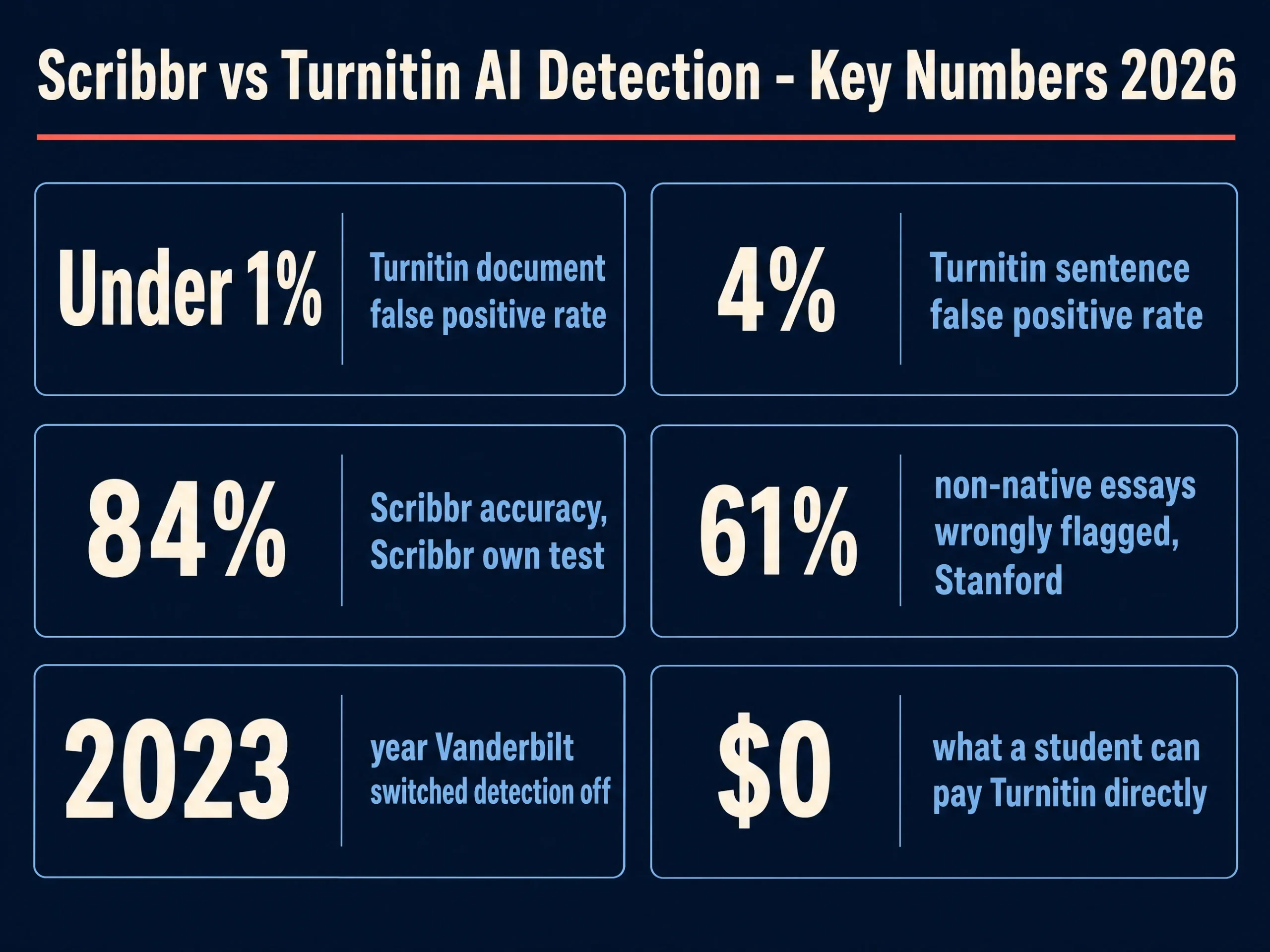
- Turnitin publishes under 1% document-level and around 4% sentence-level false positive rates. Scribbr publishes no false positive rate for its own tool.
- Stanford researchers found detectors flagged non-native English essays as AI-written 61% of the time, versus almost never for native writers.
- Turnitin does not sell to individuals: “Turnitin does not sell individual licenses or single-use subscriptions.” No student can buy the score their institution sees.
- Vanderbilt switched Turnitin’s AI detector off in 2023, Western followed in 2024 and Waterloo in 2025, all citing accuracy.
Is Scribbr’s AI detector the same as Turnitin’s?
No, and Scribbr says so in its own words. Its FAQ states that “the add-on AI detector is powered by Scribbr’s proprietary software and is capable of detecting texts generated by ChatGPT, Perplexity and other generative AI tools with high accuracy”. The word Turnitin does not appear on that page.
This matters because the assumption runs the other way round in most student advice. People buy a Scribbr check believing it previews the Turnitin AI score their university will generate. It does not, and it never claimed to.
There is a further wrinkle that reinforces the point. Scribbr’s paraphrasing tool page describes itself as “powered by QuillBot”, and Scribbr’s about page confirms Scribbr is “part of QuillBot, within the broader Learneo family of businesses”. Whatever is behind Scribbr’s tooling, it belongs to that family, not to Turnitin.
So where does the Turnitin connection come from?
From plagiarism checking, and from 2018. Turnitin’s website hosts a Scribbr partner testimonial dated 13 July 2018 in which Scribbr states: “We added an option to educate students about plagiarism by including Turnitin technology in the Scribbr platform.”
Note what that sentence is about. Plagiarism. Similarity matching against a database. It was written years before either company shipped an AI writing detector, so it cannot possibly be a statement about AI detection.
Scribbr’s current pages have also stopped naming Turnitin even for plagiarism, describing “advanced plagiarism detection technology similar to the software used by most universities and publishers”. We work through what can and cannot be confirmed about that in the Scribbr plagiarism checker review.
Scribbr is explicit that the two products do different jobs: “our AI content checker can only identify AI-generated, AI-refined, and human-written content. Our Plagiarism Checker can help prevent unintentional plagiarism in your writing.” If the distinction is unfamiliar, start with AI detector versus plagiarism checker.
How do their published numbers compare?
They are not comparable, which is itself the finding. The two vendors publish different kinds of claims and neither has been independently tested against the other.
| Scribbr AI detector | Turnitin AI writing detection | |
|---|---|---|
| Whose model | Scribbr’s own, per Scribbr | Turnitin’s own, proprietary |
| Published accuracy | 84% premium, 78% free, in Scribbr’s own 30-text test | No overall accuracy figure published |
| Published false positive rate | None for its own tool | Under 1% document level, around 4% sentence level |
| Independent testing | None found | Included in peer-reviewed comparisons |
| Who can buy it | Anyone, free tier at 1,200 words | Institutions only |
| What a student sees | A percentage, instantly | Whatever the institution chooses to show |
Turnitin’s figures come from putting 800,000 pre-ChatGPT academic samples through the detector, and Turnitin attaches its own caveats, warning of “a higher incidence of false positives when the percentage is between 0 and 19” and stating the score “should not be used as the sole basis for adverse actions against a student”.
Why does your Scribbr score never match Turnitin’s?
Because Turnitin’s model is private and nothing on the consumer market is built to imitate it. Every free or cheap detector is making its own independent estimate, and estimates from different models on the same text routinely land far apart.
Students describe the gap in exactly those terms. On r/TurnitinScan: “I’ve had assignments that Turnitin flagged at 60%, while every free detector said 0%-5%.” The most-upvoted answer: “Honestly, none of the public detectors consistently line up with Turnitin. Their model is proprietary, so everything else is basically guessing.”
The reverse error is more dangerous. A clean Scribbr score is not protection, because it is not the check that will be run on you. Our comparison of which detectors come closest to Turnitin tests that question directly, and how much detectors disagree quantifies the spread.
How reliable is Turnitin’s detector anyway?
Reliable enough to have been adopted at scale, and contested enough that institutions keep switching it off.
Stanford researchers Liang, Yuksekgonul, Mao, Wu and Zou found that detectors “consistently misclassify non-native English writing samples as AI-generated, whereas native writing samples are accurately identified”. Reporting on the study noted essays by non-native speakers being flagged as AI-written around 61% of the time, against almost never for native speakers.
Institutions have acted on it. Vanderbilt University disabled Turnitin’s AI detector in August 2023, doing the arithmetic publicly: a 1% false positive rate across 75,000 papers a year is roughly 750 papers wrongly flagged. Their conclusion was that “we do not believe that AI detection software is an effective tool that should be used”. Western University stopped using it in January 2024, and the University of Waterloo discontinued the functionality in May 2025.
We track the full list on universities that banned AI detectors and the 2026 update.
Can a student buy Turnitin directly?
No. Turnitin’s help centre is unambiguous: “Turnitin does not sell individual licenses or single-use subscriptions.” It points individuals to iThenticate, a separate product aimed at researchers and publishers, and Turnitin does not confirm that iThenticate runs the identical model your instructor sees.
That single policy explains the entire market this article sits in. Students cannot see the number that will be used to judge them, so they buy proxies, and the proxies disagree. One r/EngineeringStudents poster summed it up: “my institution only gives access to profs for turnitin and not students… this is the case where i am writing it on my own like at least 80% of it and majority of it is getting flagged.”
Our guides to checking AI risk without a Turnitin account and what teachers actually see cover the workarounds and their limits.
Which should you use, and when?
Use Scribbr when you want a free, instant, no-account signal on a draft, and you understand it is one model’s opinion. The free tier handles 1,200 words and costs nothing, which makes it a reasonable smoke alarm.
You cannot use Turnitin as an individual, so the real decision is not between two products. It is between acting on a proxy score and building the evidence that actually protects you: draft history, notes, version timestamps.
If a flag has already happened, neither tool helps retrospectively. Go to the false-positive checklist, what proof can clear you, and what to do when the detectors disagree. And if you want the accuracy question on Scribbr alone, that is is Scribbr accurate for AI.
Get the free text-humanization prompts
Get the exact text-humanization prompts I use to drop an AI score by hand — copy, paste, submit. Free, straight to your inbox.
Free · No credit card · Straight to your inbox
