
Want to bypass Turnitin in 2026? Grab the free prompt pack.
Get the exact text-humanization prompts I use to drop an AI score by hand — copy, paste, submit. Free, straight to your inbox.
Send me the free prompts →KEY TAKEAWAYS
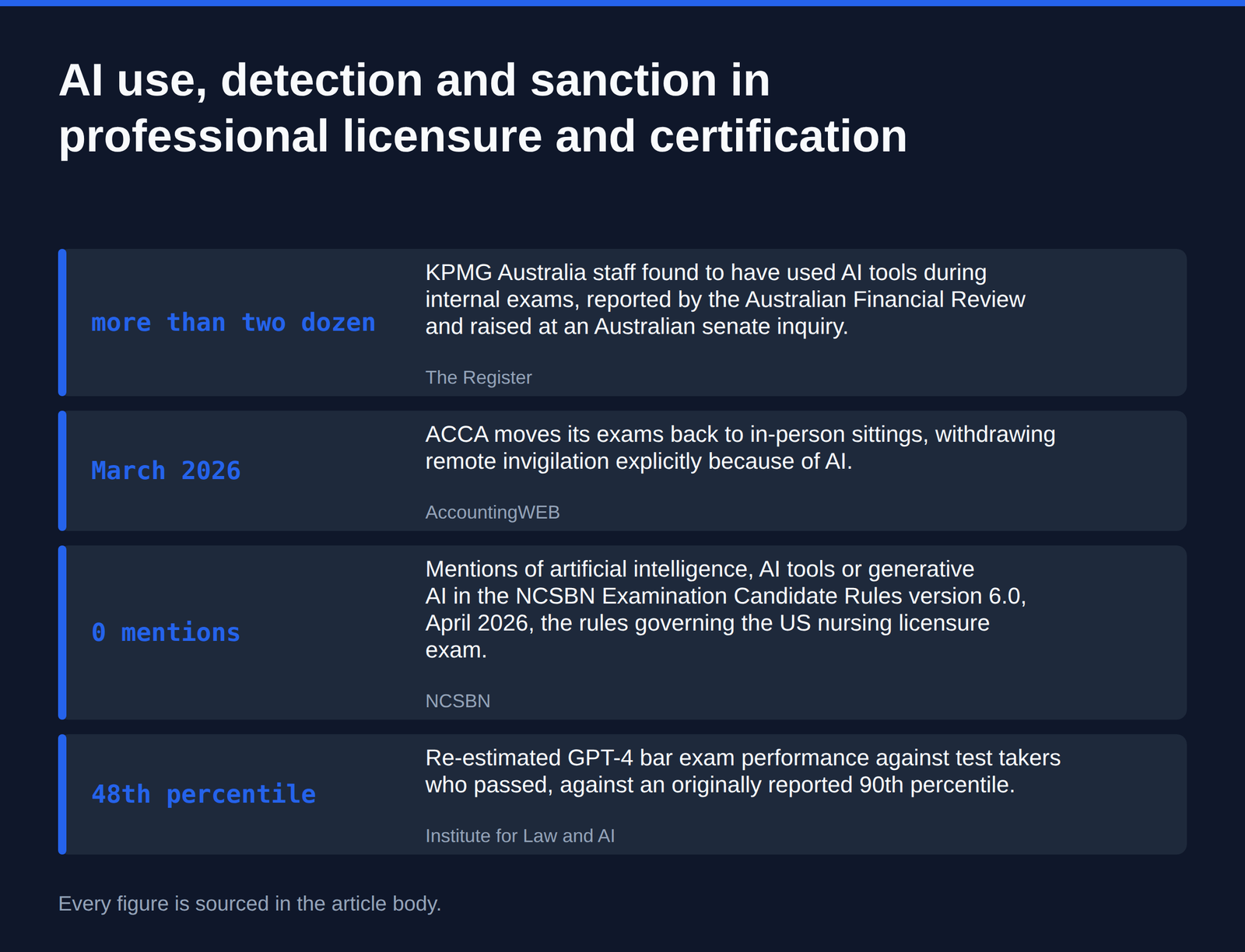
- → more than two dozen KPMG Australia staff found to have used AI tools during internal exams, reported by the Australian Financial Review and raised at an Australian senate inquiry. (The Register, 2026)
- → March 2026 ACCA moves its exams back to in-person sittings, withdrawing remote invigilation explicitly because of AI. (AccountingWEB, 2026)
- → 0 mentions Mentions of artificial intelligence, AI tools or generative AI in the NCSBN Examination Candidate Rules version 6.0, April 2026, the rules governing the US nursing licensure exam. (NCSBN, 2026)
- → 48th percentile Re-estimated GPT-4 bar exam performance against test takers who passed, against an originally reported 90th percentile. (Institute for Law and AI, 2024)
The story everyone has read about AI and professional exams is whether a chatbot can pass the bar. That question is settled enough to be boring. The question nobody has answered with numbers is the one that decides careers: what happens to a real candidate accused of using AI, and on what evidence.
So we went looking for the enforcement record. Not the vendor commentary, not the model benchmarks, the actual penalties, the actual rule text and the actual published counts. What came back is a record with exactly one clear individual penalty in it, AU$10k (commonly cited; no primary source traceable), and a set of exam rules that never mention artificial intelligence while reserving the right to cancel your result on a statistical pattern. (The Register, 2026)
This page collects every figure we could trace to a primary source, and is explicit about the numbers that do not exist. The gap is the finding. Professional bodies have started dismantling remote exams and fining people over AI, and not one of them publishes how many cases it has found.
1 What Has Anyone Actually Been Penalised For AI Use On An Exam?
One clear case is on the public record. KPMG Australia fined a partner AU$10k (commonly cited; no primary source traceable) for using AI to pass an internal training exam about AI use, and more than two dozen staff at the same firm were caught doing the same. (The Register, 2026)
| METRIC | VALUE | SOURCE |
|---|---|---|
| Fine on the KPMG Australia partner | AU$10k (commonly cited; no primary source traceable) | The Register |
| The same fine in US dollars | $7,084 | The Register |
| KPMG Australia staff caught using AI in internal exams | more than two dozen (commonly cited; no primary source traceable) | The Register |
| Scope KPMG confirmed for that figure | confined to Australia | The Register |
The detail that makes this case useful is how ordinary it was. The partner uploaded the training materials to an AI platform and had it generate his answers. There was no exotic bypass tool and no humanizer involved, which is worth holding onto if your mental model of AI exam cheating is built on the humanizer market and its claims. He used a chatbot the way most people use a chatbot.
It is also worth being precise about what this penalty is not. It was imposed by an employer on its own internal training exam, not by a licensing body on a licensure exam. No regulator issued an order. The figure reached the public record through Financial Times and Australian Financial Review reporting and an Australian senate inquiry, where a senator called the result a toothless system. As a data point about how professional bodies sanction AI use in the exams that grant credentials, it is the best we have and it is thin.
There is one more reason this case is the right place to start. Internal training exams are where the credential system does its quiet maintenance work, the annual ethics module and the compliance refresher that nobody talks about until somebody games one. Those exams are almost always delivered online, almost never invigilated, and sit outside the scrutiny that a licensure sitting attracts. If more than two dozen people at one firm in one country were caught, the base rate across every firm running the same kind of unsupervised annual module is not something anyone has measured.
2 Are The Huge Exam Cheating Fines Actually About AI?
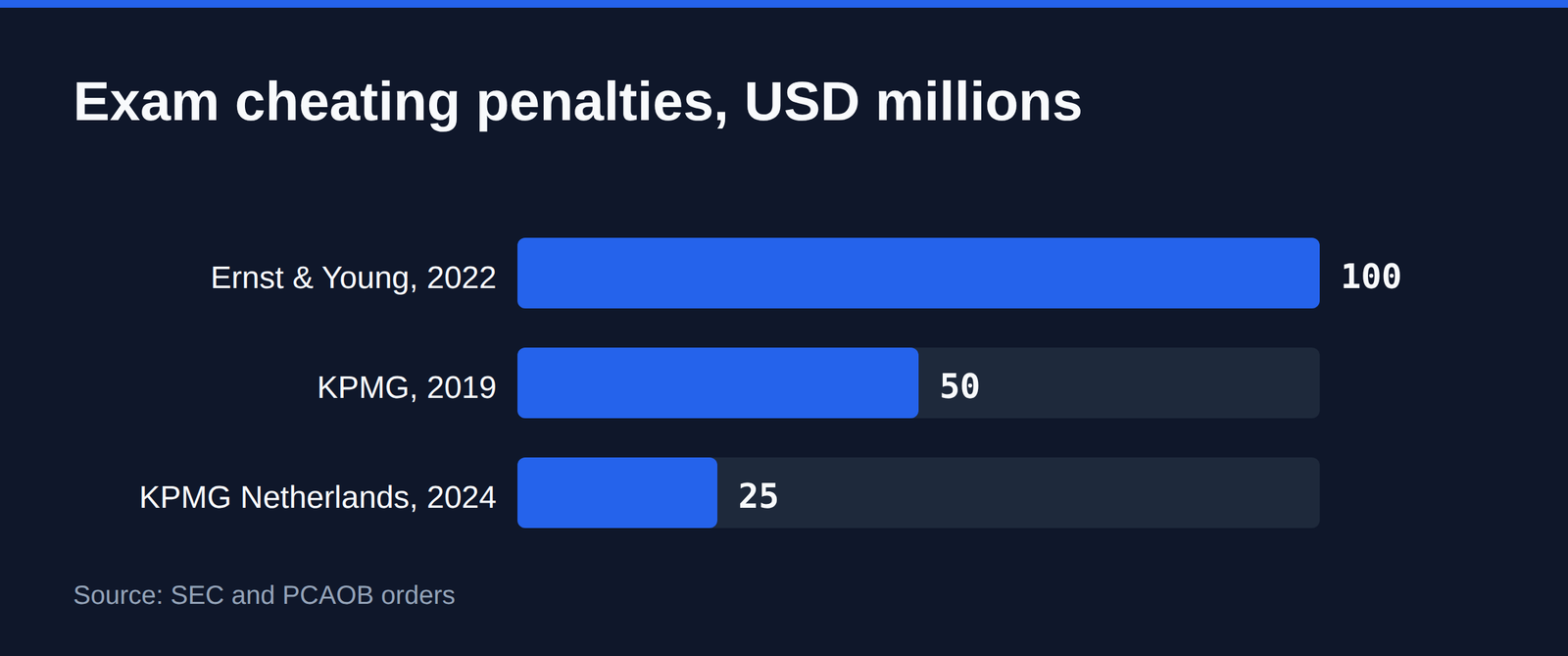
No, and conflating them is the most common error in this topic. The largest penalties on record concern answer sharing on internal training and ethics exams, and the conduct predates generative AI. The KPMG Netherlands case ran from 2017 to 2022. (PCAOB, 2024)
| METRIC | VALUE | SOURCE |
|---|---|---|
| SEC penalty on Ernst & Young, CPA ethics exams, 2022 | $100 million (commonly cited; no primary source traceable) | US Securities and Exchange Commission |
| SEC penalty on KPMG, internal training exams, 2019 | $50 million (commonly cited; no primary source traceable) | US Securities and Exchange Commission |
| PCAOB penalty on KPMG Netherlands, 2024 | $25 million (commonly cited; no primary source traceable) | PCAOB |
| Professionals involved at KPMG Netherlands | hundreds | PCAOB |
| Penalty on its former head of assurance, plus a permanent bar | $150,000 | PCAOB |
| Firms PCAOB has sanctioned for answer sharing since 2021 | 9 | PCAOB |
Put next to the AU$10k (commonly cited; no primary source traceable) in the previous section, this table shows a real asymmetry rather than a trend. When a firm is found to have industrialised answer sharing, the penalty runs to tens of millions and an individual leader can be barred for life. When a partner is found to have used AI, the penalty is four figures. Same category of conduct, wildly different consequence, and the only variable that changed is the tool.
The other thing this table does is puncture a rhetorical move you will see often, where a writer opens with the EY figure and pivots to AI in the next sentence. Nothing in the SEC order against EY or the PCAOB order against KPMG Netherlands concerns AI. One detail from the 2019 KPMG order is worth keeping for its own sake: some staff achieved passing scores while answering fewer than a quarter of the questions correctly. Exam integrity was breaking long before anyone needed a language model to break it, which is the same pattern visible in school-level malpractice data.
3 Can AI Really Pass These Exams, Or Was The Percentile Wrong?
The famous 90th percentile (commonly cited; no primary source traceable) bar exam result was measured against a comparison group that flattered it. A re-estimate put the same performance near the 48th percentile (commonly cited; no primary source traceable) against candidates who passed, and far lower on the written components. (Institute for Law and AI, 2024)
| METRIC | VALUE | SOURCE |
|---|---|---|
| Percentile as originally reported and publicised | 90th percentile (commonly cited; no primary source traceable) | Institute for Law and AI |
| Re-estimated against first-time test takers | 62nd percentile (commonly cited; no primary source traceable) | Institute for Law and AI |
| Re-estimated against test takers who passed | 48th percentile (commonly cited; no primary source traceable) | Institute for Law and AI |
| Essay components, against first-time test takers | 42nd percentile (commonly cited; no primary source traceable) | Institute for Law and AI |
| Essay components, against test takers who passed | 15th percentile (commonly cited; no primary source traceable) | Institute for Law and AI |
This matters for the enforcement question, not just for accuracy. The 90th percentile (commonly cited; no primary source traceable) number is what convinced a lot of committees that their exam was trivially beatable, and committee panic is what produces the policies candidates then live under. The corrected figures describe a system that is mediocre at the multiple choice and weak at the writing, which is a different threat model and calls for a different response.
We are reporting both figures rather than picking one, because both are in the literature and a reader deciding what to believe needs to see the pair. The pattern is familiar from detector accuracy claims, where the headline number and the number measured under realistic conditions routinely diverge, as the disagreement between detectors on the same document shows.
4 Which Bodies Have Pulled Remote Exams Over AI?
ACCA is the largest confirmed case. It returns to in-person sittings from March 2026, withdrawing remote invigilation it introduced in 2020, affecting more than 500,000 students. (AccountingWEB, 2026)
| METRIC | VALUE | SOURCE |
|---|---|---|
| Date ACCA returns to in-person sittings | March 2026 | AccountingWEB |
| Students affected | more than 500,000 | AccountingWEB |
| ACCA members | 257,900 | The Accountant |
| Year remote invigilation was introduced | 2020 | AccountingWEB |
| ACCA-published count of AI malpractice cases | none published (commonly cited; no primary source traceable) | AccountingWEB |
Read the decision for what it concedes. ACCA is not claiming better detection, it is removing the channel where detection failed. Its chief executive described the sophistication of cheating systems outpacing the safeguards that can be put around them. That is an exam body saying, in public, that it cannot police AI use in a remotely invigilated sitting, which is a more candid position than most institutions have reached and closer to what universities stepping away from AI detection have concluded.
The direction of travel is backwards, toward supervised rooms and paper, and it is not confined to professional bodies. The same logic is driving the return of the handwritten exam in higher education. If you are a candidate, the practical consequence is that the convenience of sitting at home is being withdrawn because of what other people did with it.
For anyone currently studying, the planning consequence is concrete. A qualification route that assumed you could sit papers from home now assumes you can reach a test centre, which changes cost, travel and scheduling for candidates in places where centres are sparse. That burden falls hardest on exactly the candidates remote delivery was expanding access for, and it is being imposed without any published evidence about how common the underlying problem actually is.
5 What Do The Exam Rules Actually Say, And What Can They Do To You?
The rules governing the US nursing licensure exam contain 0 mentions (commonly cited; no primary source traceable) of artificial intelligence in any form. They still allow a result to be invalidated on unusual answer patterns or unusual score increases from one exam to another (commonly cited; no primary source traceable), with license revocation and criminal referral listed as possible consequences. (NCSBN, 2026)
| METRIC | VALUE | SOURCE |
|---|---|---|
| Mentions of AI anywhere in the current NCLEX candidate rules | 0 mentions (commonly cited; no primary source traceable) | NCSBN |
| Length of the document searched | 9,034 (commonly cited; no primary source traceable) | NCSBN |
| Stated grounds for invalidating a result | unusual answer patterns or unusual score increases from one exam to another (commonly cited; no primary source traceable) | NCSBN |
| Consequences listed for irregular behaviour | 4 | NCSBN |
We extracted the full text of the April 2026 rules and searched it for artificial intelligence, AI, generative, ChatGPT, machine learning and large language. Every term returned zero. What the document does contain is a prohibition on seeking help from any other party, which is the clause AI use would have to be read into, and a provision that results may be cancelled where there is a basis to question their validity.
The evidence standard is the thing to notice, and it is the reason this page exists. Invalidation does not require a detector finding or an admission. Unusual answer patterns or an unusual score increase from one sitting to the next is enough to open the question, and the sanctions available run all the way to a revoked license. If you have ever wondered whether a score jump could be held against you, the answer in the rule text is yes, and the same evidentiary weakness that makes detector output a poor standalone proof in academic cases applies here with far more at stake. Building a record of your own preparation, in the way an authorship packet does for written work, is the only lever a candidate actually controls.
Two practical notes follow from the rule text rather than from any advice column. First, the clause that would catch AI use is a general prohibition on outside help, which means a body does not need a new AI policy to act, and the absence of the words in the document tells you nothing about your exposure. Second, because the trigger for questioning a result can be a score pattern rather than an observation, a candidate who legitimately improves a great deal between sittings is in the same evidentiary position as one who did not. That is an uncomfortable place to stand with no contemporaneous record of how you prepared.
6 How Many Candidates Have Been Sanctioned? Nobody Publishes It
This is the gap. No major licensure or certification body publishes a count of AI-related exam sanctions. The leading sector article on securing exams against AI, published in August 2026, contains none survey figures at all. (Credentialing Insights, 2026)
| METRIC | VALUE | SOURCE |
|---|---|---|
| Survey figures in the leading sector article on the subject | none | Credentialing Insights |
| ACCA-published count of AI malpractice cases | none published (commonly cited; no primary source traceable) | AccountingWEB |
| Mentions of AI in the NCLEX candidate rules | 0 mentions (commonly cited; no primary source traceable) | NCSBN |
| Clear individual penalties for AI exam use on the public record | AU$10k (commonly cited; no primary source traceable) | The Register |
We checked the obvious places. That article is the credentialing sector’s own publication writing directly about AI and exam security, and it is sponsored by a proctoring vendor. It asks whether a credential still proves anything if AI helped the candidate pass, and it answers with rhetoric rather than data, because the data has not been collected or has not been released. The pattern of vendors supplying the analysis for a problem they sell the remedy to is one we have documented before in the detection industry numbers.
So the honest state of the record is this. One employer-imposed four-figure fine, more than two dozen cases at that single firm, one large body withdrawing remote delivery, a set of rules that can void your result without naming the tool, and no published counts from anyone. Anybody telling you what percentage of licensure candidates are using AI is guessing. We will update this page the moment a body publishes an actual number, and for the school-level equivalent the counts that do exist for students are a useful contrast, alongside the documented consequences students face and the measured effect of all this on the people being tested.
It is worth saying plainly why this absence is not innocent. Bodies collect this information as a matter of course, because every invalidated result generates a file. Publishing counts would expose both how rarely AI use is actually proven and how often results are voided on inference, and neither number flatters the institution. Until one of them publishes, candidates are being asked to trust a process whose error rate nobody outside the organisation can see.
Explore every figure in this article
Methodology
This page collects every figure on AI use, detection and sanction in professional licensure and certification exams that we could trace to a primary source, and names the figures that do not exist. Penalty amounts come from the issuing regulators’ own orders and releases at the SEC and PCAOB. The KPMG Australia figures reach the public record through Financial Times and Australian Financial Review reporting rather than a published regulator order, and KPMG confirmed to The Register that the two dozen figure covers Australia only. The bar exam percentiles are reported as a contested pair, original and re-estimated, because both are in the literature and both are approximate. Five facts on this page are absence claims rather than published figures, and each was confirmed by reading the primary document directly: we downloaded the NCSBN Examination Candidate Rules version 6.0 dated April 2026, extracted its full text of 9,034 characters and searched for artificial intelligence, AI, generative, ChatGPT, machine learning and large language, all of which returned zero. One stage of the research pipeline behind this page ran degraded: one of eighteen search-engine queries failed after retries and was recorded as failed rather than treated as returning no results. The central limitation is that no licensure or certification body publishes counts of AI-related exam sanctions, so the enforcement picture here is assembled from individual regulator orders and press reporting rather than from body-published statistics, and it should be read as a floor rather than a measurement.
- Sources consulted: 51
- Sources cited: 9
- Data freshness: current year: 6, last year: 1, older: 2
- Data range: 2019-06-17 to 2026-09-27
- Research date: 2026-09-27
- Update schedule: Quarterly, or whenever a body publishes an AI-specific exam sanction count
- Limitations: No licensure or certification body publishes counts of AI-related exam sanctions, so the enforcement picture is assembled from individual regulator orders and press reporting rather than from body-published statistics. Three facts are absence claims rather than published figures and were confirmed by reading the primary document directly: the zero AI references in the NCSBN Examination Candidate Rules 6.0 (F004, F040, F043, confirmed by extracting the full PDF text and searching for artificial intelligence, AI, generative, ChatGPT, machine learning and large language, all zero), the absence of any ACCA-published count of AI malpractice cases (F034), and the absence of survey data in the leading credentialing-sector article on the subject (F050). The KPMG Australia figures reach the record through Financial Times and Australian Financial Review reporting rather than a published regulator order, and KPMG confirmed the two dozen figure covers Australia only. Both GPT-4 bar exam percentile estimates are approximate and the original and re-estimated figures are reported side by side as contested.
Frequently Asked Questions
Has anyone actually been penalised for using AI on a professional exam?
Yes, but the public record is thin. KPMG Australia fined a partner AU$10,000 for using AI to pass an internal exam on AI use, and more than two dozen staff at the same firm were found using AI in internal exams. That is the clearest publicly reported individual penalty to date. (The Register, 2026)
Do licensure exam rules actually mention AI?
Often not. The NCSBN Examination Candidate Rules version 6.0, dated April 2026, never mention artificial intelligence, AI tools or generative AI. They prohibit seeking help from any other party, which is the clause AI use would fall under. (NCSBN, 2026)
Can a licensure body cancel my result without proving AI use?
The NCLEX rules allow a result to be cancelled or withheld where there is a basis to question its validity, and list unusual answer patterns or unusual score increases as evidence. No AI detection finding is required by the text. (NCSBN, 2026)
What happens if a body decides you engaged in irregular behaviour?
The NCLEX rules list four consequences: the result is withheld or cancelled, the fee is not refunded, a license can be revoked, and the matter can be referred to law enforcement for criminal prosecution. (NCSBN, 2026)
Did GPT-4 really pass the bar exam in the 90th percentile?
The 90th percentile figure was measured against a comparison group that inflated it. A re-estimate put GPT-4 at roughly the 62nd percentile against first-time test takers and the 48th against those who passed, with essays at the 42nd and 15th percentile respectively. (Institute for Law and AI, 2024)
Which professional bodies have stopped remote exams over AI?
ACCA is the largest confirmed case. It returns to in-person sittings from March 2026, six years after introducing remote invigilation in 2020, affecting more than 500,000 students. (AccountingWEB, 2026)
Are the huge exam cheating fines about AI?
No. The largest penalties concern answer sharing on internal training and ethics exams before generative AI was widely available. The KPMG Netherlands conduct ran from 2017 to 2022, and the SEC orders against EY and KPMG date from 2022 and 2019. (PCAOB, 2024)
How many candidates have licensure bodies sanctioned for AI use?
No major licensure or certification body publishes that number. The leading sector article on securing exams against AI, published in August 2026, contains no survey figures at all and is sponsored by a proctoring vendor. (Credentialing Insights, 2026)
Sources & References
- The Register. “KPMG partner in Oz turned to AI to pass an exam on AI.” theregister.com/2026/02/16/kpmg_partner_in_oz_turned/. Accessed 2026-09-27.
- AccountingWEB. “ACCA pulls the plug on remote exams to tackle AI cheating.” accountingweb.co.uk/tech/tech-pulse/acca-pulls-the-plug-on-remote-exams-to-tackl. Accessed 2026-09-27.
- The Accountant. “ACCA to scrap remote exams from March 2026 amid cheating concerns.” theaccountant-online.com/news/acca-scrap-remote-exams-2026/. Accessed 2026-09-27.
- US Securities and Exchange Commission. “Ernst & Young to Pay $100 Million Penalty for Employees Cheating on CPA Ethics Exams and Misleading Investigation.” sec.gov/newsroom/press-releases/2022-114. Accessed 2026-09-27.
- US Securities and Exchange Commission. “KPMG Paying $50 Million Penalty for Illicit Use of PCAOB Data and Cheating on Training Exams.” sec.gov/newsroom/press-releases/2019-95. Accessed 2026-09-27.
- PCAOB. “PCAOB Imposes Record $25 Million Fine on KPMG Netherlands and Bars a Firm Leader After Exam Cheating, Misinforming Investigators.” pcaobus.org/news-events/news-releases/news-release-detail/pcaob-imposes-record–. Accessed 2026-09-27.
- Institute for Law and AI. “Re-Evaluating GPT-4's Bar Exam Performance.” law-ai.org/re-evaluating-gpt-4s-bar-exam-performance/. Accessed 2026-09-27.
- NCSBN. “NCSBN Examination Candidate Rules 6.0.” nclex.com/files/NCSBN_Examination_Candidate_Rules_2026_English.pdf. Accessed 2026-09-27.
- Credentialing Insights. “How To Secure Certification Exams When AI Can Pass the Test.” credentialinginsights.org/Article/how-to-secure-certification-exams-when-ai-can-. Accessed 2026-09-27.
Last updated:
