Do publishers use AI detectors? Some do, mostly Pangram, but most publishers and agents still rely on contracts and author disclosure, and in 5 of the 6 public cases below the scan that caused the damage was run by someone else after the book was out.

Written by Vlad Ivanov
Runs Detection Drama, stress-testing AI detectors and humanizers; publishes Words At Scale to 26,000+ subscribers. This piece is built from publisher statements, the Authors Guild's guidance and test, Pangram's own pricing and claims, news reports on each case, and the Reddit threads where authors asked this question, all read on 29 and 30 October 2026. I have not worked inside a publishing house, so I report what publishers say, not what I have seen.
Want to bypass Turnitin in 2026? Grab the free prompt pack.
Get the exact text-humanization prompts I use to drop an AI score by hand — copy, paste, submit. Free, straight to your inbox.
Send me the free prompts →Last updated: 30 October 2026
Key Takeaways
- Hachette dropped Shy Girl after a Pangram test put it at 78% AI. The test was run by Pangram's own founder, after publication, not by the publisher (The Week).
- A scan can happen at four points: the query, the offer, the contract and after release. Most public cases started after publication.
- Agents told Jane Friedman they hesitate above 20 to 25 percent likely AI. That is reported, not an industry rule (Jane Friedman).
- Canadian houses Coach House and ECW say they use warranties and disclosure, not detectors (BNN Bloomberg, 23 Oct 2026).
- Since 9 October 2026, getting an ISBN in Canada means declaring a human author (Global News).
- Pangram's Individual plan is $20 a month for up to 300,000 words, enough for three full novels (Pangram pricing).
Do literary agents and publishers actually run AI detectors?
Some do, and the tool they reach for is almost always Pangram. Wired's reporting, summarised by AI Weekly, describes publishers as the company's most relied on users, and The Week cites the Wall Street Journal reporting that publishers use Pangram to vet manuscripts and have added AI clauses to book deals.
The same houses rarely say so on the record. The Big Five have avoided sweeping statements, and Jane Friedman notes that Penguin Random House has said it uses AI detection software while most others stay quiet. Her read is that many publishers use detection without disclosing it, which she flags as her suspicion rather than a fact.
On the other side, the most upvoted answer in the r/publishing thread where an author asked this exact question was a flat no. Editors in that thread said their staff are the detectors. Both things can be true: a slush reader may never run a scan, while an acquisitions team checks the one manuscript it is about to pay for.
Where in the publishing process does a scan happen?
A manuscript can be checked at four points, and the risk is different at each one. Treating "publishers use detectors" as one question hides where the damage has actually come from.
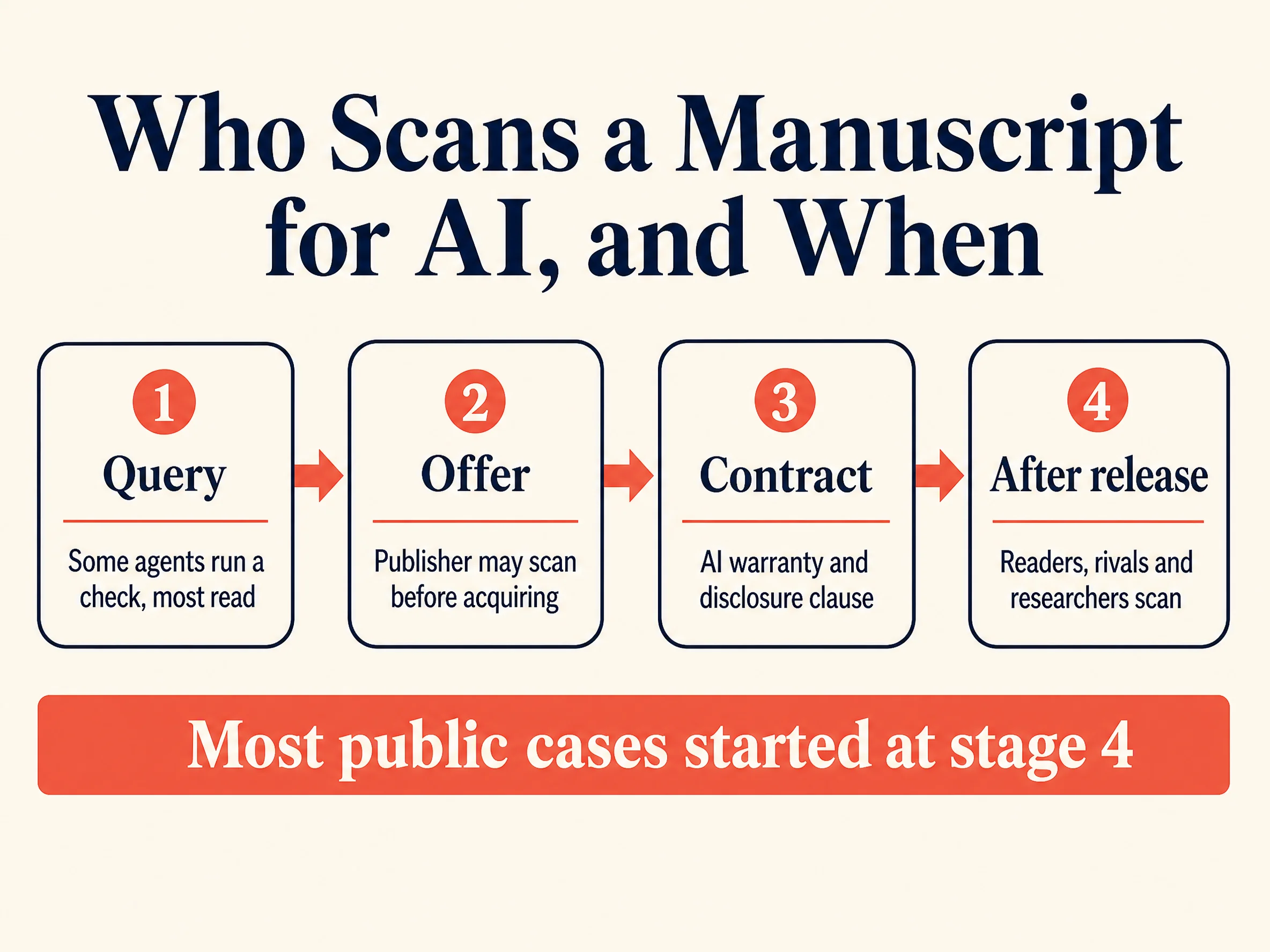
| Stage | Who might scan | What the evidence says |
|---|---|---|
| Query | Agents, assistants | A few agents disclose they run Pangram, per Reddit commenters. Friedman reports agents filter very high scores on uncontracted work. |
| Offer | Acquiring editor | WSJ, via The Week, reports publishers vet manuscripts with Pangram. A $2.4M thriller deal was pulled after a 97% flag. |
| Contract | Legal, contracts team | Disclosure and warranty clauses: Bloomsbury, Coach House and ECW all ask the author to declare AI use. |
| After release | Readers, rivals, researchers, prize juries | Shy Girl, the Caine Prize winner, a Commonwealth prize winner and Daggermouth were all flagged after publication. |
The Authors Guild's 13 October 2026 best practices name publishers, editors and agents as the people who should disclose when and why they use detectors. That list is the clearest admission in the SERP that all three are doing it.
Which books have actually been flagged, and who ran the scan?
Six cases from the last eight months show the pattern: the score that ended up in the news was rarely run by the author's own publisher before acquisition. It came from a vendor, a reader, a researcher or a journalist after the book was public.
| Case | Who scanned | Score | Outcome |
|---|---|---|---|
| Shy Girl, Mia Ballard (Hachette) | Pangram founder Max Spero, after UK release | 78% AI | US edition blocked, UK edition discontinued; author denies AI use (source) |
| Unnamed thriller, $2.4M deal | Not named in reporting | 97% AI | Deal pulled before publication (source) |
| "The Blue Fighter", Caine Prize winner | Pangram, after the award | Almost the entire story | Author denies AI use; dispute ongoing (source) |
| Commonwealth Short Story Prize winner | Pangram, after the award | 100% AI | Reported by the Authors Guild and The Week (source) |
| C'était ça ou mourir, Thélyson Orélien (Boréal) | No detector; document metadata analysis | None | Publisher cut ties; removed from Prix Goncourt contention (source) |
| Daggermouth, H.M. Wolfe | Academic researchers, reported by The Atlantic | Not stated | Publisher kept supporting the author, per Friedman (source) |
Only the $2.4M thriller looks like a pre-acquisition check, and even there the reporting does not say who ran it. The Boréal case matters for a different reason: the evidence was file metadata, which no detector score can argue with. If you want to know what your files say about you, our guide to Google Docs and Word version history as proof covers what survives and what does not.
How accurate is Pangram on fiction?
Pangram is the most accurate detector in most published tests, but its error rate is not zero, and fiction is where the arguments start. The company claims about 1 false positive in 10,000 on its publishing page, while The Week quotes a 1 in 24,000 claim. A University of Houston and UC Berkeley study cited by Wired found 97% accuracy, falling to 94% after back-translation attacks.
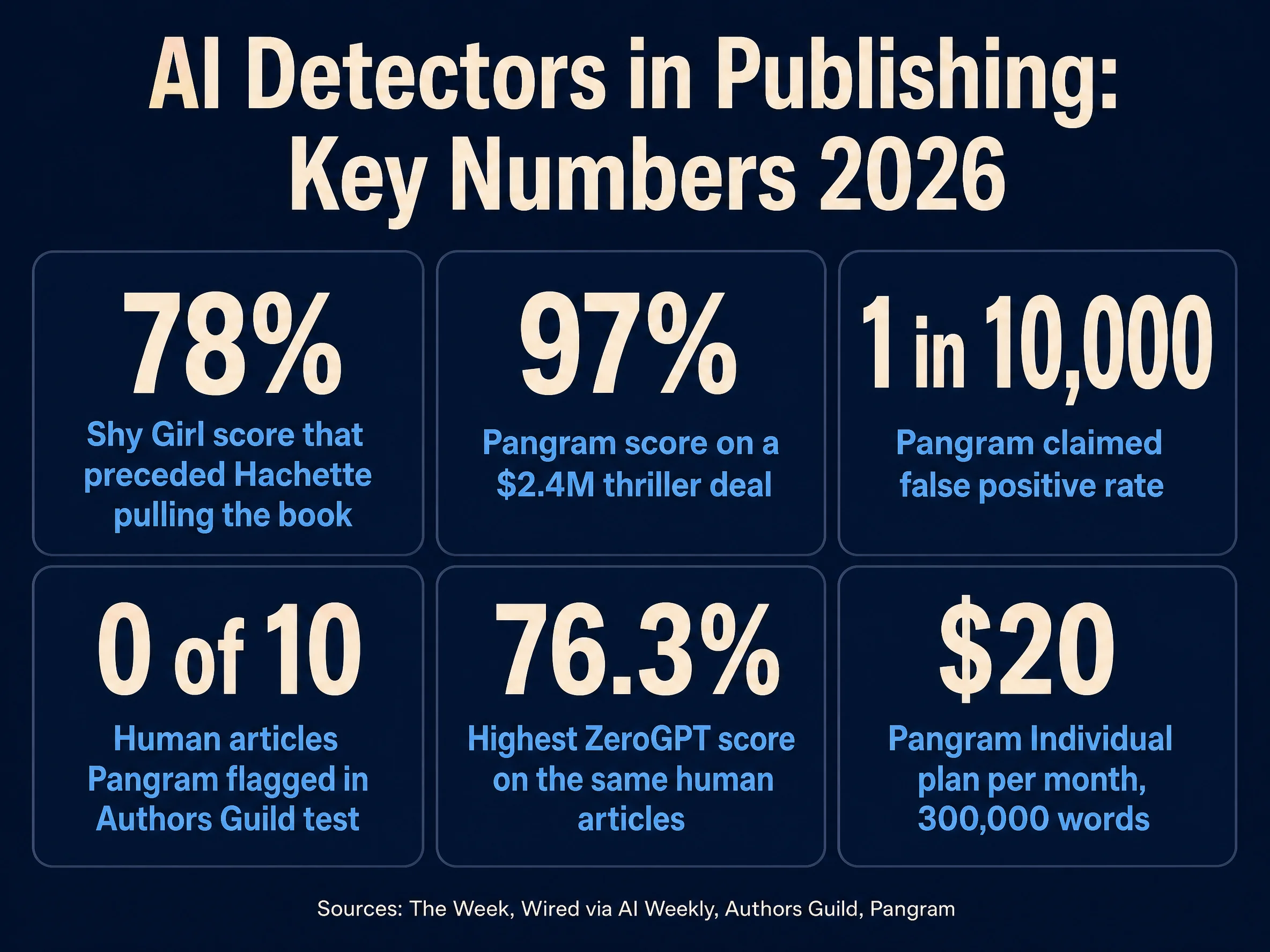
The Authors Guild ran ten of its own articles from 2022 or earlier through five tools. Pangram scored all ten at 0%, Originality.ai stayed at 0% or 1%, and ZeroGPT ranged from 5.3% to 76.3%, including 66% on a Joan Didion obituary. That spread is why the choice of tool matters more than whether a scan happens; we tracked the same pattern in how much AI detectors disagree.
The weak point is scale. Princeton's Arvind Narayanan argued, per AI Weekly, that even a tiny error rate produces many misflags when applied to every manuscript. Our Pangram review found the false positive claim holds up while the false negatives are the bigger story, and the false positive statistics roundup has the numbers for every other tool.
What changed in October 2026?
Two things moved this month, and neither involves a detector. On 9 October, Library and Archives Canada updated its ISBN rules: registering now counts as a declaration that the publication "was written by a human author," and ISBNs are limited for works primarily generated by AI, according to Global News. Enforcement is by self-declaration; the Canadian Authors Association is still asking how it will be verified.
On 23 October, Canadian publishers told The Canadian Press they rely on trust, not tech. Coach House's contract asks the author to affirm the book has no AI-generated material, and ECW Press puts AI language in its warranty clause. Alana Wilcox of Coach House said: "we don't imagine the existing tools will become more reliable."
The practical effect is that your signature, not a score, is becoming the thing that can end a deal. A false warranty is a contract problem whether or not any detector ever flags you.
What do publishing contracts now say about AI?
Most new contracts ask you to disclose AI use and warrant the work is yours. Bloomsbury's AI policy for authors and illustrators sets out how far AI may be used in ideation, creation and development, and asks authors to disclose use beyond research and brainstorming.
The Authors Guild's October guidance asks publishers to put the AI policy in the agreement, never cancel over AI use unless a signed policy clearly prohibited it, never rely on a detector alone, and talk to the author first. It also says publishers should check that any third-party detector does not retain or train on manuscripts, and get the author's permission before uploading. That last point is worth raising with your agent, because uploading a manuscript is a privacy decision as much as an accuracy one; we cover the same issue for humanizers in what happens to text you paste in.
Should you run your own manuscript through a detector before you query?
Only if you will act on the result, and only with a tool that is accurate on long fiction. Running a free checker that scores human prose at 70% teaches you nothing and tempts you to rewrite clean pages. Writers on r/Substack describe leaving typos in on purpose to avoid flags, which damages the manuscript to beat a test nobody may run.
If you do check, Pangram is the tool agents and publishers reportedly use, so it is the one worth matching. The Individual plan is $20 a month with up to 300,000 words and a 7-day trial; a 90,000 word novel uses under a third of that. A commenter in r/royalroad said API pricing works out at about $1.50 for a 3,000 word chapter; that is a Reddit figure, not a published price.
A clean score is not proof, and a high one is not a verdict. What protects you is a record of how the book was written: drafts, dated files and notes. Our authorship packet guide was written for students but the steps transfer directly, and writing process trackers explains which logs actually prove anything.
Where is your manuscript right now?
Pick your stage to see who may scan it and what to do.
What should you do if a publisher says your book scored as AI?
Ask which tool, which version and what score, then ask for the passages it flagged. The Authors Guild says publishers should talk to the author first and give a chance to address flagged sections, and that canceling a contract on detector results alone would be a material breach. Members can contact the Guild for legal help.
Then produce your process evidence before you argue about the score. Our first 24 hours after an AI accusation checklist covers what to gather. If a freelance editor or a grammar tool touched the text, say so early: Mia Ballard's defence was that an editor made the changes, and the same pattern shows up in why human writing can still look AI-generated.
Frequently asked questions
Do literary agents use AI detectors on queries?
Some do. Reddit commenters report a few agents disclose they run Pangram, and Jane Friedman reports agents filter very high scores on uncontracted submissions. Most agents still say they rely on reading, and no agent body publishes a standard.
What AI detector do publishers use?
Pangram, in almost every reported case. Wired describes publishers as its most relied on users, and the WSJ, via The Week, reports publishers use it to vet manuscripts.
What AI score will get a manuscript rejected?
There is no published threshold. One agent and one editor told Jane Friedman they hesitate above 20 to 25 percent likely AI, and she says no reasonable agent rejects a 1% score.
Can a publisher cancel my book deal over an AI detector score?
It has happened: Hachette dropped Shy Girl after a 78% Pangram result. The Authors Guild says canceling on detector results alone is a material breach unless a signed policy clearly prohibited AI use.
Does Pangram keep or train on manuscripts I upload?
Pangram says submissions are processed without retention, indexing or use in training, and that it holds SOC 2 Type 2 certification. The Authors Guild still advises publishers to confirm this and get the author's permission before uploading.
Does using Grammarly or a freelance editor make my book look AI-written?
It can. Heavy rewrites by an editor or a grammar tool can raise a score, which is why the Shy Girl author blamed an editor's changes. Keep the version before and after any edit pass.
Do I need to declare AI use to get an ISBN?
In Canada, yes. Since 9 October 2026, registering with ISBN Canada is a declaration that the work was written by a human author, and ISBNs are limited for works primarily generated by AI.
Want to see how a detector reads your own writing before anyone else does? Start with our Pangram review, then compare it with Originality.ai and Winston AI.
