AI humanizer skills for Claude do not reliably beat AI detectors: they strip the style tells people notice, but the best available evidence says those tells are not what GPTZero or Pangram score, and the most popular skill says so itself.
Key Takeaways
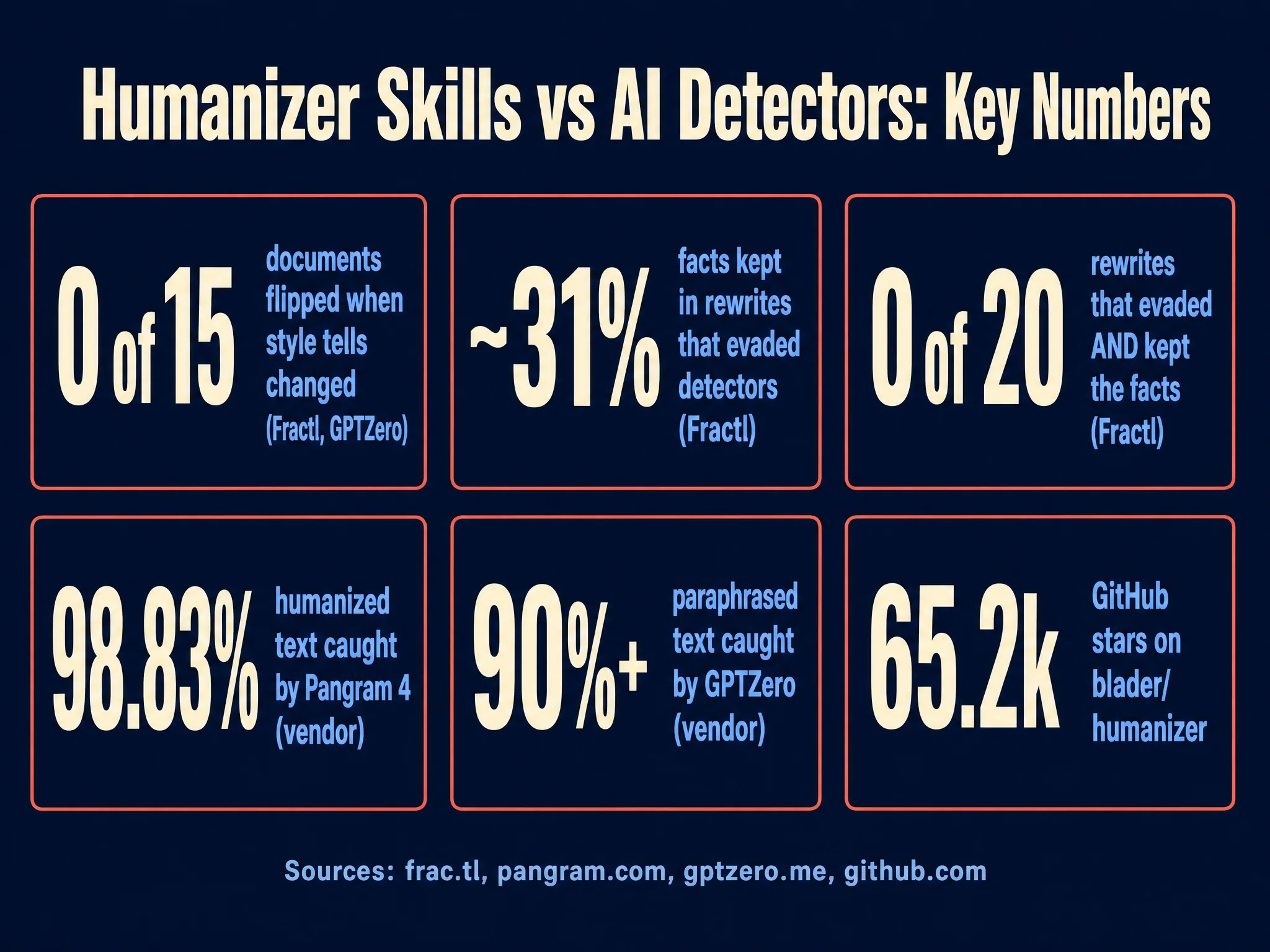
- The most popular skill, blader/humanizer (65.2k GitHub stars), states in its README that getting past AI detectors "is not a goal, and detectors still flag most of its output" (GitHub).
- Style tells barely move detector scores: when Fractl added classic tells to 15 human documents, GPTZero's mean AI probability went from 0.01 to 0.02 and none flipped (Fractl Research, July 2026).
- Evasion costs accuracy: Fractl's 20 rewrites that fooled both GPTZero and Pangram kept only about 31% of the source facts, and 0 of 20 did both.
- Paid humanizers are not the escape hatch either: Pangram reports catching 98.83% of humanized output from 13 commercial tools (Pangram, vendor).
- The only published head-to-head test of the skill against GPTZero comes from a company that sells a rival humanizer, and it used one 190-word sample.
- A humanizer skill is a readability edit, not a bypass. Use it where AI help is allowed, and keep your drafts.
Do AI humanizer skills actually beat AI detectors?
Not reliably, and not by design. A humanizer skill is a set of instructions (a SKILL.md file) that tells Claude, Codex or another agent to rewrite a draft without the habits that make AI text easy to spot. It changes how the text reads to a person. It was not trained against a detector.
The demand is real. In r/claudeskills, a blog writer whose employer caps drafts at 40% AI asked for humanizer skills that can bypass ZeroGPT. A student in the same subreddit asked for a high quality academic humanizer skill after finding that ZeroGPT and Originality.ai still caught almost everything. Neither thread ended with a skill that clearly works.
That matches what the evidence below shows. Reader reports vary by detector, but nothing published so far shows a free skill reliably moving a modern detector like GPTZero or Pangram.
What is a humanizer skill, and which one are people using?
The one most threads point to is blader/humanizer, an MIT-licensed skill with 65.2k stars and 5.1k forks on GitHub. Its README describes it as making "AI-written text sound like a person wrote it, without changing what it says." It says it checks for 26 patterns, drawn from Wikipedia's Signs of AI writing guide maintained by WikiProject AI Cleanup.
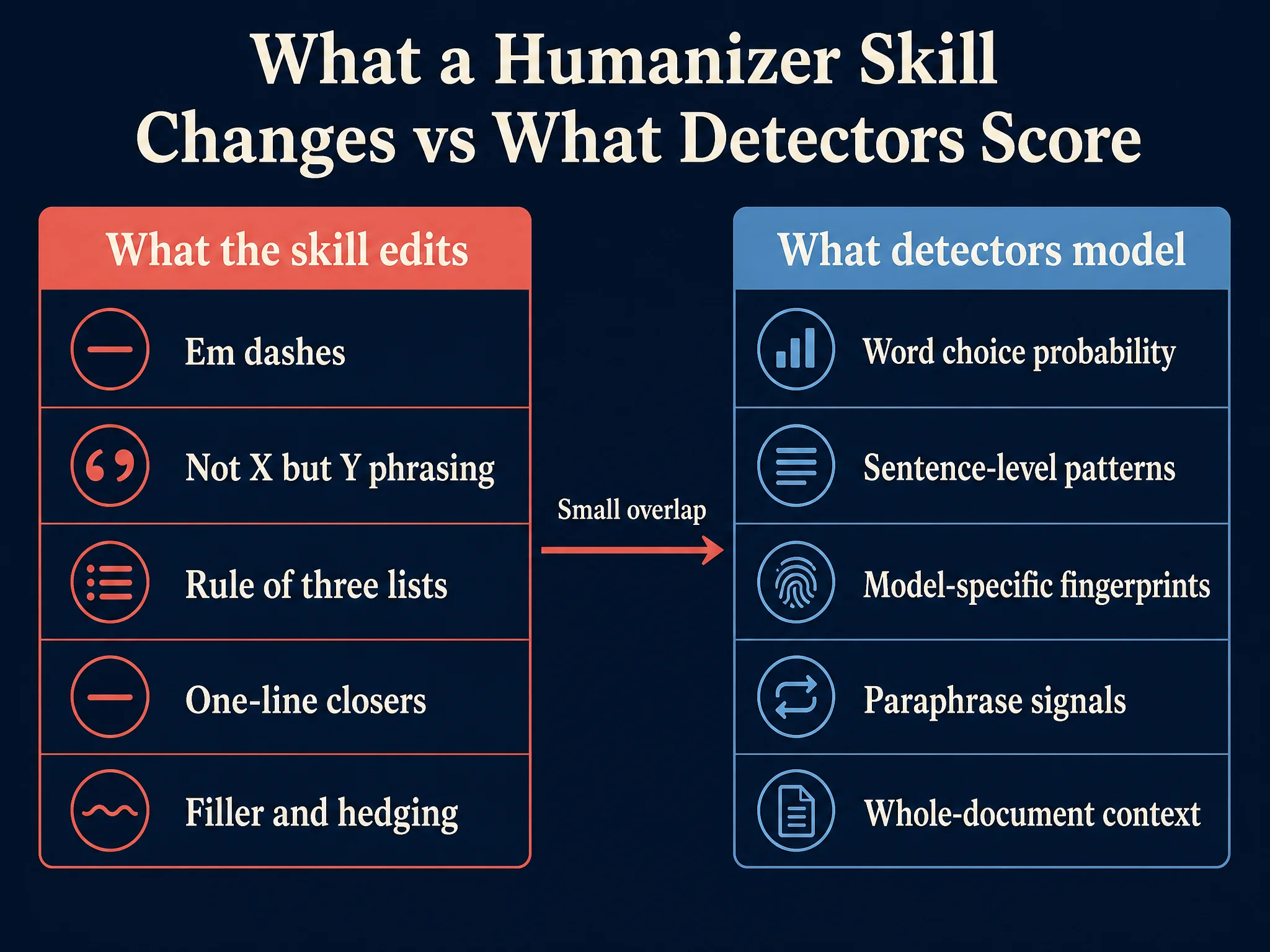
The patterns are style habits: "not X but Y" contrasts, one-line closers, rule-of-three lists, inflated significance, filler and hedging. You install it in Claude Code through the plugin marketplace, add it to Codex with npx skills add, or upload the ZIP as a skill in Claude.ai settings, per the same README.
Plenty of copies and forks exist. Width.ai published a marketing-focused version that protects keywords, links and CTAs, and a commenter in r/claudeskills pointed to a more conservative remove-ai-slop skill. They share one design choice: they edit surface style. For the older, app-style humanizer repos, see our ranking of open-source humanizers on GitHub.
What does the skill's own README say about detectors?
It says detectors are not the target. The README states that getting past AI detectors "is not a goal, and detectors still flag most of its output." A May 2026 install guide reached the same reading and added that some detectors look at perplexity rather than surface patterns.
That is unusual honesty in this niche, and it should set expectations. If the author of a 65,000-star project tells you the output still gets flagged, a Reddit comment saying it passed one checker once is weak evidence the other way.
What happens to a detector score when you strip the style tells?
Very little, on the best test available. In July 2026, Fractl Research ran the closest thing to a controlled check of the skill's core idea. They added the classic tells (em dashes, no contractions, chopped paragraphs, extra headings) to 15 clean human documents and scored them with GPTZero. Mean AI probability moved from 0.01 to 0.02. Zero of 15 documents flipped to AI (Fractl).
That test ran in one direction, adding tells to human text. The inference for skills is that if adding the tells does not push human text toward AI, removing them is unlikely to pull AI text toward human. Fractl drew the same conclusion: surface tells do not move detector scores. Fractl is a marketing agency and says it has a stake in the topic, so treat it as strong but not neutral.
A smaller test points the same way. A LessWrong writer found that swapping em dashes in a Claude Opus 4.6 essay only took Pangram 3.2 from 94% to 83% AI, and rewording three flagged phrases sent it back to 100% (LessWrong, March 2026). That is one text on an older Pangram version, so it is an illustration, not a result.
Does evading a detector cost you accuracy?
In Fractl's data, yes, sharply. Their rewriters did get 20 of 20 documents past both GPTZero and Pangram, but those versions kept only about 31% of the source facts. None of the 20 both evaded and stayed faithful. A version tuned to stay faithful reached about 98% recall but evaded nothing (Fractl).
They also asked 326 language models to rewrite the same detectable text. The median model was caught 100% of the time and about four could evade consistently. Optimising against their own copy of a detector cut its AI probability from 0.89 to 0.03, while the real GPTZero score stayed at 1.00. A score you can move on a practice checker may not move on the one that counts.
For a student or a client writer, that trade is the whole problem. A rewrite that loses two thirds of its facts is a worse document. Our guide to humanizers that ruin facts covers how to check meaning after any rewrite.
Who published the tests on humanizer skills, and can you trust them?
Mostly companies selling something else. The only published head-to-head we found of blader/humanizer against GPTZero comes from HumanizerPRO, which sells its own humanizer and promotes a sister product. They ran one 190-word GPT-4o text through each tool once. The skill's output scored 100% AI on GPTZero, while their own product scored 100% human after a proofread pass.
StealthGPT published a similar argument in October 2026, saying skills remove visible phrases but miss deeper statistical patterns. The reasoning lines up with the independent data. But the paid-tool numbers in both posts are vendor-reported, and neither publisher is a neutral party.
| Source | Who ran it | Sample | Finding | Stake |
|---|---|---|---|---|
| blader/humanizer README | Skill author | Not stated | Detectors "still flag most of its output" | None in passing detectors |
| Fractl Research | Marketing agency | 15 docs (tells), 326 models, 20 evasions | Tells: 0 of 15 flipped; evasion kept ~31% of facts | Self-declared interest |
| HumanizerPRO | Humanizer vendor | 1 text, 190 words | Skill output 100% AI on GPTZero | Sells a rival tool |
| StealthGPT | Humanizer vendor | Own announcements | Skills miss deeper patterns | Sells a rival tool |
| LessWrong post | Independent writer | A few single texts | Em dash swaps barely moved Pangram 3.2 | None stated |
No one has published a multi-sample, independent test of a humanizer skill against current GPTZero and Pangram models. This article does not fill that gap either. It is built from the sources above, not from our own runs.
Is a paid humanizer the answer if the skill fails?
Not on the detectors' own numbers. Pangram says its July 2026 model identifies AI involvement in humanized output 98.83% of the time across 13 commercial humanizing tools, and that a GPT 5.6 agent given 24 hours of API access found a single bypass (Pangram). GPTZero says it catches 90%+ of text from 12+ paraphrasing tools across 1,000 samples (GPTZero).
Those are vendor figures, and the vendors contradict each other. GPTZero's test credits Pangram v3 with 50.2% on paraphrased text, while Pangram's January 2025 test put GPTZero at 34.53% on humanized text. Each detector wins its own benchmark. What both agree on is that commercial humanizers are a training target now, which is the point our Pangram bypass breakdown and Turnitin humanizer detection explainer make in more detail.
So the free-versus-paid question is narrower than the threads suggest. A paid tool may beat a weaker checker more often than a skill does, but neither beats a current Pangram or GPTZero model reliably. Our free vs paid humanizer comparison covers where the real differences sit: limits, privacy and workflow.
Why do readers say the skill worked for them?
Because detectors disagree, and the weaker ones move more easily. The r/claudeskills blog writer reported the skill worked against ZeroGPT, a detector that readers often say scores far higher than other tools. In the academic thread, another commenter said they tested it and it did not work against stronger checkers. Both can be true at once. Our Pangram vs GPTZero comparison shows how far two detectors can split on the same text.
Human readers are a separate test, and the skill helps more there. When blader/humanizer was shared on r/BestGitHubRepos, the top comment, with 104 points, joked that the README itself reads like AI. Removing tells does not add a voice. That still takes your own examples, opinions and details, which is the method in our detector-free humanization guide.
When is a humanizer skill the right tool?
When you are allowed to use AI and want cleaner prose, not a clean score. A copywriter cutting the "AI voice" from captions, as in this r/ClaudeAI thread, is the use case these skills were built for. So is a student whose course permits declared AI help, as one poster in the academic thread said theirs did.
| Your situation | Does a skill help? | Better move |
|---|---|---|
| Marketing copy, no detector involved | Yes, as an edit pass | Run it, then add your own specifics |
| Client or employer caps AI percentage | Unreliable | Ask which detector they use and how they score drafts |
| Course allows AI with disclosure | Fine for readability | Disclose it and keep your draft history |
| Course bans AI | No, and it is a policy breach | Write it yourself and keep your process |
| Your own writing got flagged | No | Build an authorship record instead |
If AI use is allowed, our guide on disclosing AI use without overexplaining covers the wording. If your own work is the issue, an authorship packet does more than any rewrite.
What does running a humanizer skill cost you?
Money, almost nothing; tokens and time, more than a plain rewrite. The skill is free, but the install guide above estimates around 12,000 input tokens for an 800-word round trip on Claude Sonnet and two to four times the wait of a single rewrite. Those are the guide's estimates, not measurements.
The other cost is data. Your draft goes to whichever model runs the skill, under that provider's terms, which is the same question we cover for humanizer privacy. It also does nothing about provider watermarks, a separate issue covered in our look at Claude watermark removers.
How was this article researched?
We read six Reddit threads from the last 60 days in r/claudeskills, r/BestGitHubRepos, r/ClaudeAI, r/PromptEngineering and r/codex, the blader/humanizer README, the Fractl Research report, vendor posts from Pangram, GPTZero, HumanizerPRO and StealthGPT, and seven of the pages ranking for this question. No detectors or humanizers were run for this article, and reader reports are labelled as reports. Vendor numbers are labelled as vendor numbers.
Frequently Asked Questions
Does the Claude humanizer skill bypass GPTZero?
Not reliably. The skill's README says detectors still flag most of its output, and the only published GPTZero test, run by a rival humanizer vendor on one 190-word text, scored the skill's output 100% AI.
Does a humanizer skill bypass Turnitin?
No published test shows it does. Turnitin added bypasser detection aimed at humanizer tools in 2025, and the skill was not built to target any detector.
Is blader/humanizer free?
Yes. It is an MIT-licensed open-source skill on GitHub. You pay only for the model usage it runs on, which one install guide estimates at around 12,000 input tokens per 800-word rewrite on Claude Sonnet.
Is a paid AI humanizer better than a free skill?
A paid tool may beat weaker detectors more often, but Pangram reports catching 98.83% of humanized output from 13 commercial tools and GPTZero reports catching 90%+ of paraphrased text. Neither option is a reliable bypass.
Why did my humanized text pass ZeroGPT but fail Pangram?
Detectors use different models and thresholds, so the same text can score very differently. Weaker checkers move more easily, which is why reader reports of success usually involve them.
Can I make my own humanizer skill?
Yes, and several Reddit users do, often by feeding Claude samples of their own writing. That helps the text sound like you, but no evidence shows it changes how modern detectors score it.
Is it allowed to use a humanizer skill on schoolwork?
That depends entirely on your course policy. If AI help is allowed with disclosure, a skill is a reasonable editing step. If AI is banned, using one to hide AI text is a policy breach.
Sources
- blader/humanizer on GitHub (README, stars, license)
- Fractl Research: Can you make AI writing undetectable? (July 2026)
- Pangram 4 technical report (vendor, July 2026)
- Pangram: detecting AI humanizers (vendor, January 2025)
- GPTZero: detecting AI humanized text (vendor, January 2026)
- LessWrong: Pangram can be evaded (March 2026, Pangram 3.2)
- HumanizerPRO: Claude humanizer skill test (vendor with rival product)
- StealthGPT: skill vs humanizer (vendor with rival product)
- Agentpedia: humanizer Claude Code skill guide (May 2026)

