Scribbr’s paraphrasing tool is free with no account, capped at 125 words per submission and two rewriting modes, and Scribbr’s own page names QuillBot as the engine running it.
Want to bypass Turnitin in 2026? Grab the free prompt pack.
Get the exact text-humanization prompts I use to drop an AI score by hand — copy, paste, submit. Free, straight to your inbox.
Send me the free prompts →Key Takeaways
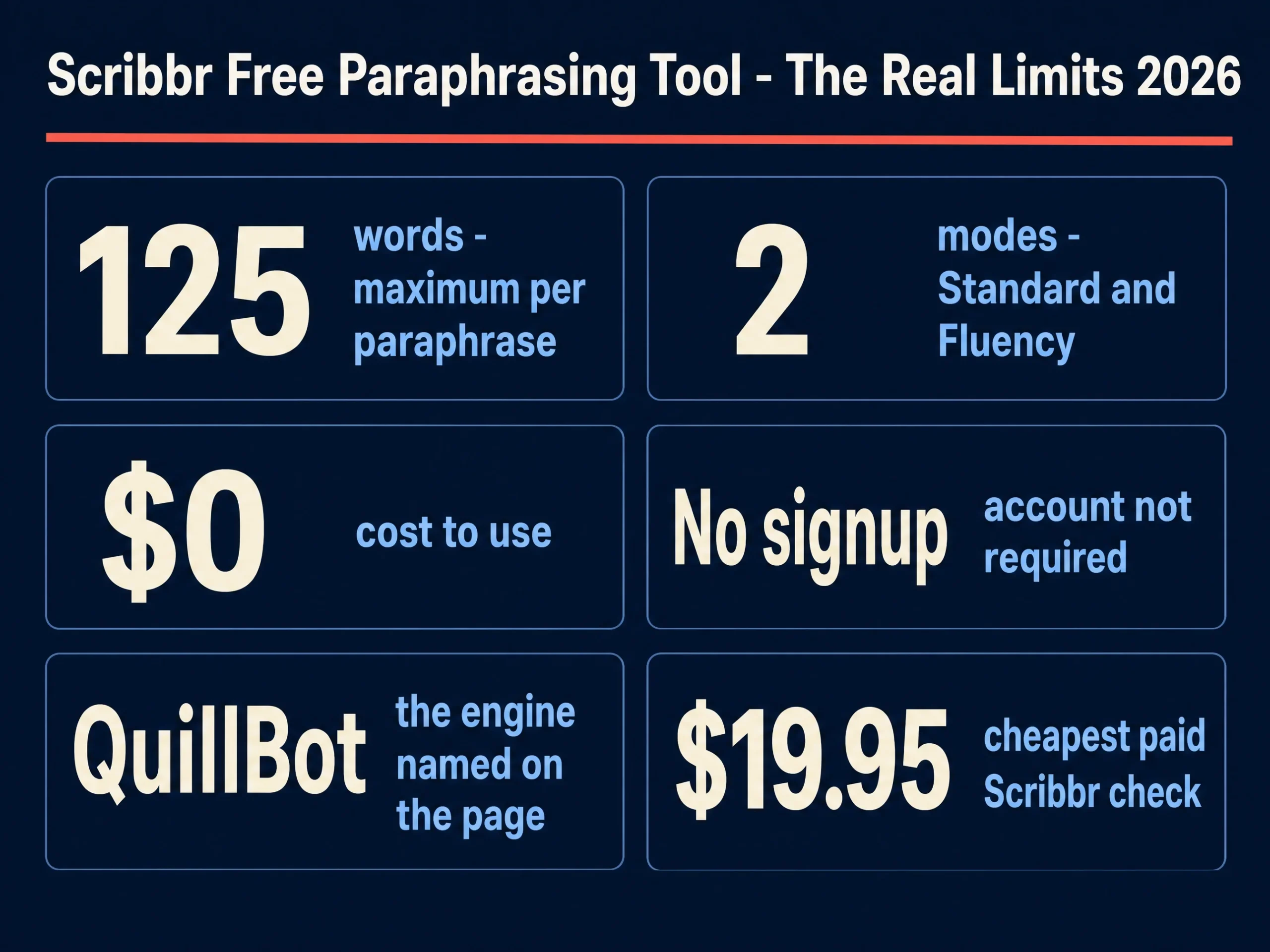
- The free tool is capped at 125 words per submission with an on-screen 0/125 counter, and Scribbr states there is no signup and no cost.
- Two modes only on the free tier: Standard and Fluency. There is no paid upgrade of the paraphraser itself listed anywhere on Scribbr’s site.
- Scribbr’s paraphraser page describes itself as an “AI Paraphrasing Tool powered by QuillBot”. That is Scribbr’s own wording, on the live page.
- Scribbr and QuillBot are sister brands. Scribbr’s about page states it is “part of QuillBot, within the broader Learneo family of businesses”.
- QuillBot’s free paraphraser has the same 125-word cap and the same two modes, which is what you would expect from one engine behind two front doors.
- Scribbr explicitly disclaims detection evasion: “our focus is on improving writing quality and readability, not evading detection”.
Is Scribbr’s paraphrasing tool actually free?
Yes, and unusually so for this category. There is no account, no email capture and no trial clock. Scribbr’s own paraphrasing tool page states “No sign-up required: We don’t need your data for you to use our AI paraphrasing tool”, and describes the tool as “100% free”.
Scribbr repeats the point in its FAQ, saying the paragraph rewriter “is absolutely free to use. You can access its features and benefits without any cost”. There is no stated daily cap. The page says you can “rephrase as many texts as you want”.
What is not free is everything else Scribbr sells around it, which is the actual business model. More on that below.
What are the limits on the free Scribbr paraphraser?
One limit does most of the work: 125 words per submission. The input box carries a visible 0/125 counter, and longer text has to be fed through in chunks.
For a 250-word abstract that means two passes. For a 4,000-word essay it means 32 passes, pasted and re-pasted by hand, which is where the free tier stops being convenient and starts being a funnel.
The other constraints are softer. No login, no watermark, no export limit, and no published daily quota. Scribbr’s related AI Humanizer tool carries the same 125-word counter, and its free AI detector uses a different and much larger 1,200-word cap.
| What | Scribbr free paraphraser | QuillBot free paraphraser |
|---|---|---|
| Words per submission | 125 | 125 |
| Free modes | 2 (Standard, Fluency) | 2 (Standard, Fluency) |
| Account required | No | No |
| Stated daily cap | None stated | “No daily limits on free paraphrases” |
| Paid upgrade of the paraphraser | Not offered | Premium, 9 modes |
Which modes does it offer, and what do they change?
Two, and Scribbr defines both on the page. Standard “offers a compromise between modifying and preserving the meaning of the original text”. Fluency “improves language and corrects grammatical mistakes”.
In practice Standard is the rewriter and Fluency is the copy-editor. Fluency changes the fewest words, which makes it the safer choice when the text is already yours and you want it tidied rather than transformed.
Neither mode is a restructuring tool. Sentence order, paragraph order and argument structure come out the way they went in, which is worth knowing if you are reaching for a paraphraser to fix a piece that reads as flat or formulaic. Our page on what makes an essay sound too polished covers what actually drives that impression.
Who actually powers Scribbr’s paraphrasing tool?
QuillBot, and Scribbr says so itself. The subheading on the live paraphrasing tool page reads: “AI Paraphrasing Tool powered by QuillBot.”
That is not a hidden detail, but it is one that most write-ups about this tool miss entirely, and it explains the matching specifications. Scribbr’s about page states that “Today, Scribbr is proud to be a part of QuillBot, within the broader Learneo family of businesses”, alongside LanguageTool.
So the choice between “Scribbr’s paraphraser” and “QuillBot’s paraphraser” at the free tier is close to a choice of interface. QuillBot’s own free tool states the same 125-word cap and the same two modes.
The difference appears the moment you pay. QuillBot sells Premium at $8.33 per month billed annually, which unlocks nine modes instead of two. Scribbr sells no paraphraser upgrade at all. If the two-mode ceiling is what is limiting you, the upgrade path runs through QuillBot, not Scribbr.
Does paraphrasing with Scribbr lower an AI detection score?
Scribbr does not claim that it does, and is careful about the framing. On its humanizer page Scribbr writes that “our focus is on improving writing quality and readability, not evading detection”, while conceding in the same breath that “this may result in AI detection tools being less likely to flag the text”.
Read that as an honest description of a side effect rather than a product promise. Paraphrasing rewrites surface features, which is exactly the signal a statistical detector is measuring, so scores do move. Whether they move in the direction you want is another matter.
Two things complicate it. Detectors have been retrained specifically on paraphrased output, which we cover in Turnitin’s 2026 model and humanizer detection and which humanizers survive bypasser detection. And paraphrasing genuinely human writing can push it toward the flat, evenly-distributed phrasing detectors associate with generated text.
Our tested write-up on whether QuillBot bypasses Turnitin applies directly here, given the shared engine. For the underlying mechanism, see how AI humanizers work and why detectors still flag text, and for the approach that does not involve a rewriter at all, lowering a Turnitin AI score without humanizer tricks.
What does Scribbr charge for everything else?
The paraphraser is free. The plagiarism check is not, and it is priced per document rather than by subscription. From Scribbr’s plagiarism checker page, checked on 5 September 2026:
- Up to 7,499 words: $19.95
- 7,500 to 49,999 words: $29.95
- 50,000 words and above: $39.95
Scribbr states “Prices are per check, not a subscription”, and that a paid check includes access to its AI Detector and AI Proofreader. Its free AI detector runs without payment at up to 1,200 words per submission.
Whether that check is worth buying is a separate question, and it turns on what database sits behind it. We work through it in the Scribbr plagiarism checker review, and the accuracy of the bundled detector in is Scribbr accurate for AI.
Should you use it?
For tidying a paragraph you wrote, yes. It is free, it asks for nothing, and Fluency mode is a competent copy-editor for a single dense paragraph at a time.
For rewriting a whole essay, the 125-word cap makes it impractical, and the reason to reach for it in the first place is usually the wrong reason. If the goal is to move a detection score, start with a pre-submission check and our comparison of AI detectors against plagiarism checkers, because the two problems have different fixes.
