
Reviewed by Vlad Ivanov
Runs Detection Drama, stress-testing AI detectors and humanizers; publishes Words At Scale to 26,000+ subscribers. Tested over the past two weeks.
Want to bypass Turnitin in 2026? Grab the free prompt pack.
Get the exact text-humanization prompts I use to drop an AI score by hand — copy, paste, submit. Free, straight to your inbox.
Send me the free prompts →This PaperBleach review starts with the thing no other AI humanizer does. Open paperbleach.ai and it tells you, in its own words, that detection is “a probability, not a verdict” and that no tool can honestly guarantee beating every detector, because detectors use different models and thresholds and regularly disagree. Then it publishes a benchmark of more than 10 humanizers in which it does not come first.
After two weeks of reading everything this company publishes, my verdict is split down the middle. The product behaves the way the marketing says it does. The evidence behind the marketing does not survive a click.
What it is: an AI humanizer with a built-in AI detector, an APA converter and an AI editor, from 10 US dollars a month billed annually.
What is unusual: it refuses the “100 percent undetectable” claim that every competitor makes, and it published a test where it placed third.
What does not hold up: the benchmark uses one detector, scores its own tiers with the labels visible, calls itself “independent” while admitting it is a vendor self-evaluation, and says source data and scoring scripts “are published” while linking to neither.
What PaperBleach actually is
PaperBleach is a browser-based AI humanizer aimed squarely at students and academic writers. You paste AI-generated text into the left pane, pick a mode, and get a rewrite on the right. The homepage describes it as humanizing AI text from ChatGPT, Claude and Gemini “so it reads naturally,” then checking your score with the built-in AI detector, and claims it is trusted by 500,000 or more students and writers.
Two modes ship: Balance and Extreme. Balance rewrites conservatively. Extreme pushes harder at the detector and, on the company’s own numbers, damages more of your text doing it. There is also an APA converter, an AI editor and, oddly for a humanizer, a live transcription feature with 40 free hours a month on Premium.
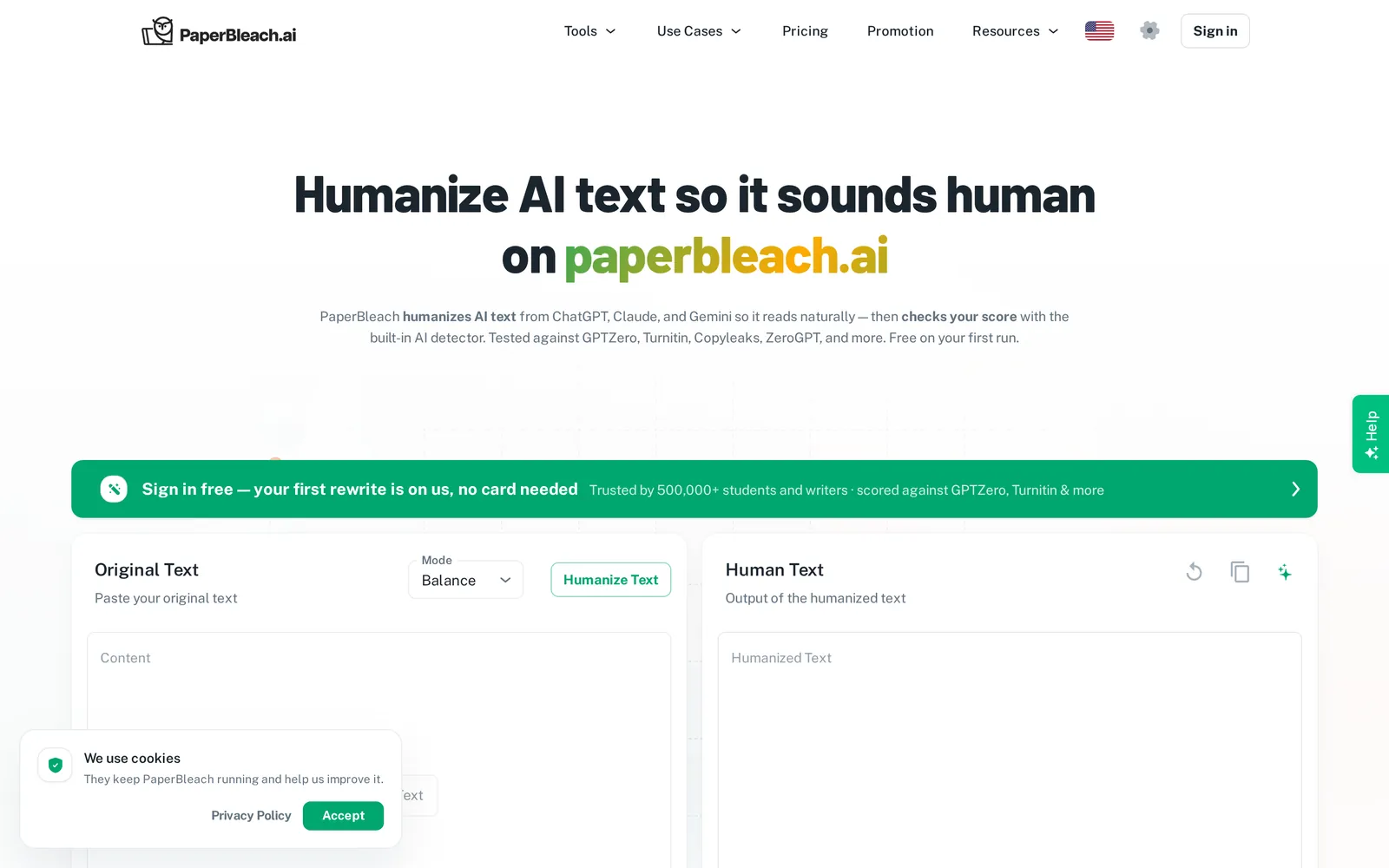
The built-in detector is the part that matters most, and it is the reason this tool is worth a look at all. Most humanizers ask you to take the rewrite on faith, then quietly sell you a subscription on the assumption you will never check. PaperBleach shows you a score on every pass and flags the sentences it changed. That is the same design instinct behind the tools we recommend for rewriting without changing meaning, and it is rare in this category.
It is also not a neutral score. The number you see comes from the company selling you the rewrite. Treat it as a smoke alarm, not a verdict, and confirm with something the vendor does not own. Our ZeroGPT review covers the free option most students reach for, and how much AI detectors disagree explains why a clean score in one tool tells you very little about the next one.
Pricing, and the 2,500 word wall
Pricing is refreshingly legible by the standards of this category, with one limit that matters more than the price.
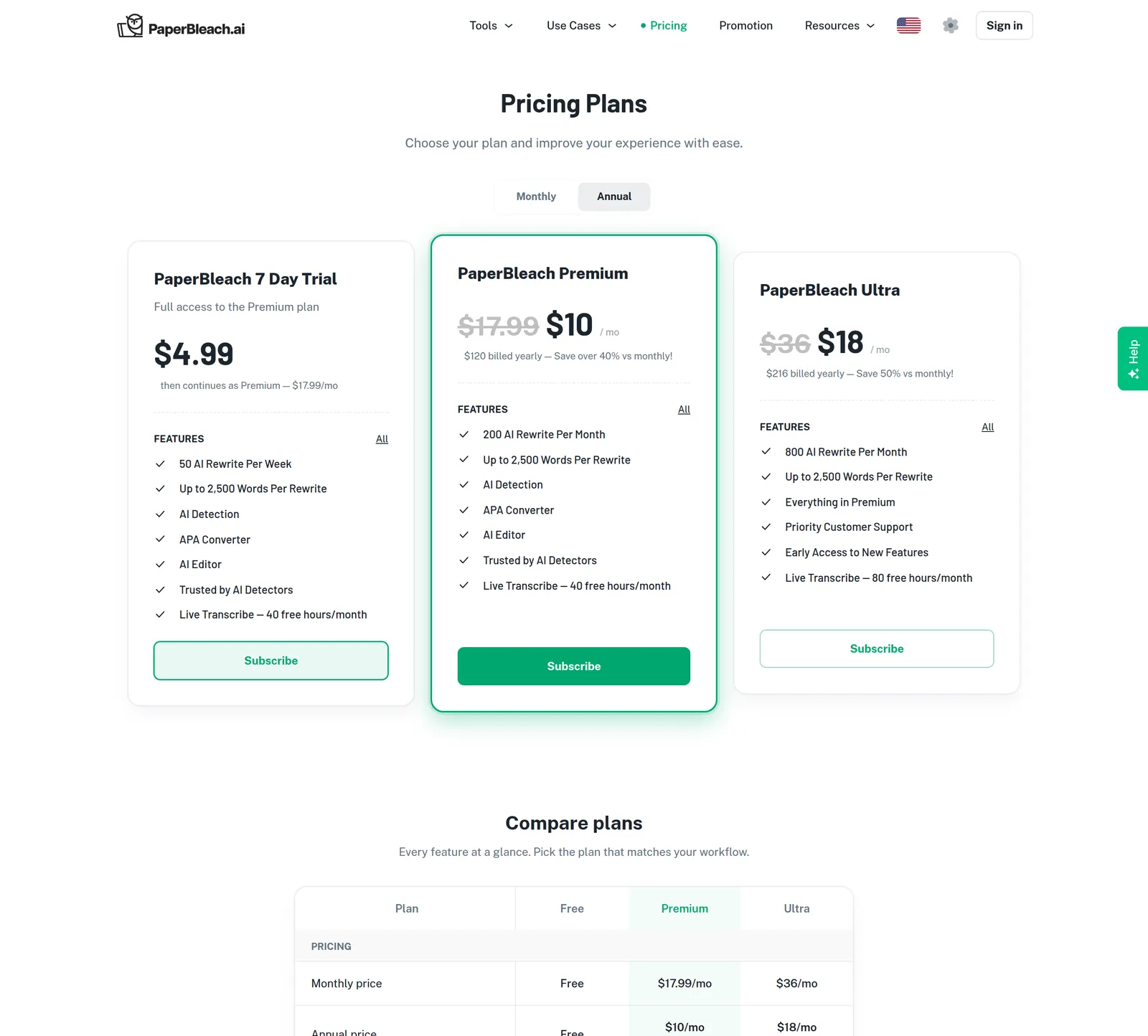
| Plan | Price | Rewrites | Detector checks | Cap per pass |
|---|---|---|---|---|
| Free | 0 | 1 rewrite, once | 300 a month | 2,500 words |
| 7 day trial | 4.99 once, then 17.99 a month | 50 a week | Premium level | 2,500 words |
| Premium | 17.99 a month, or 10 a month billed 120 a year | 200 a month | 10,000 a month | 2,500 words |
| Ultra | 36 a month, or 18 a month billed 216 a year | 800 a month | 10,000 a month | 2,500 words |
Every tier, including Ultra at 216 US dollars a year, caps a single pass at 2,500 words. A 9,000 word dissertation chapter is four passes, and four passes means four separate rewrites that the tool never sees as one document. Tone drifts across the seams, and so does terminology. If you are working on a thesis rather than an essay, read our guide to the best AI humanizer for academic papers first, because citation and structure handling matters more at that length than any detector score.
One feature bullet on the pricing page reads “Trusted by AI Detectors.” It appears on all three paid tiers. It is not explained anywhere on the site, and no detector company endorses humanizers. Treat it as decoration.
The benchmark, and the claim at the centre of this review
In August 2026 PaperBleach published a comparison of more than 10 AI humanizers and pushed it across Reddit. The page is the most interesting document any humanizer has released this year, and the most revealing.
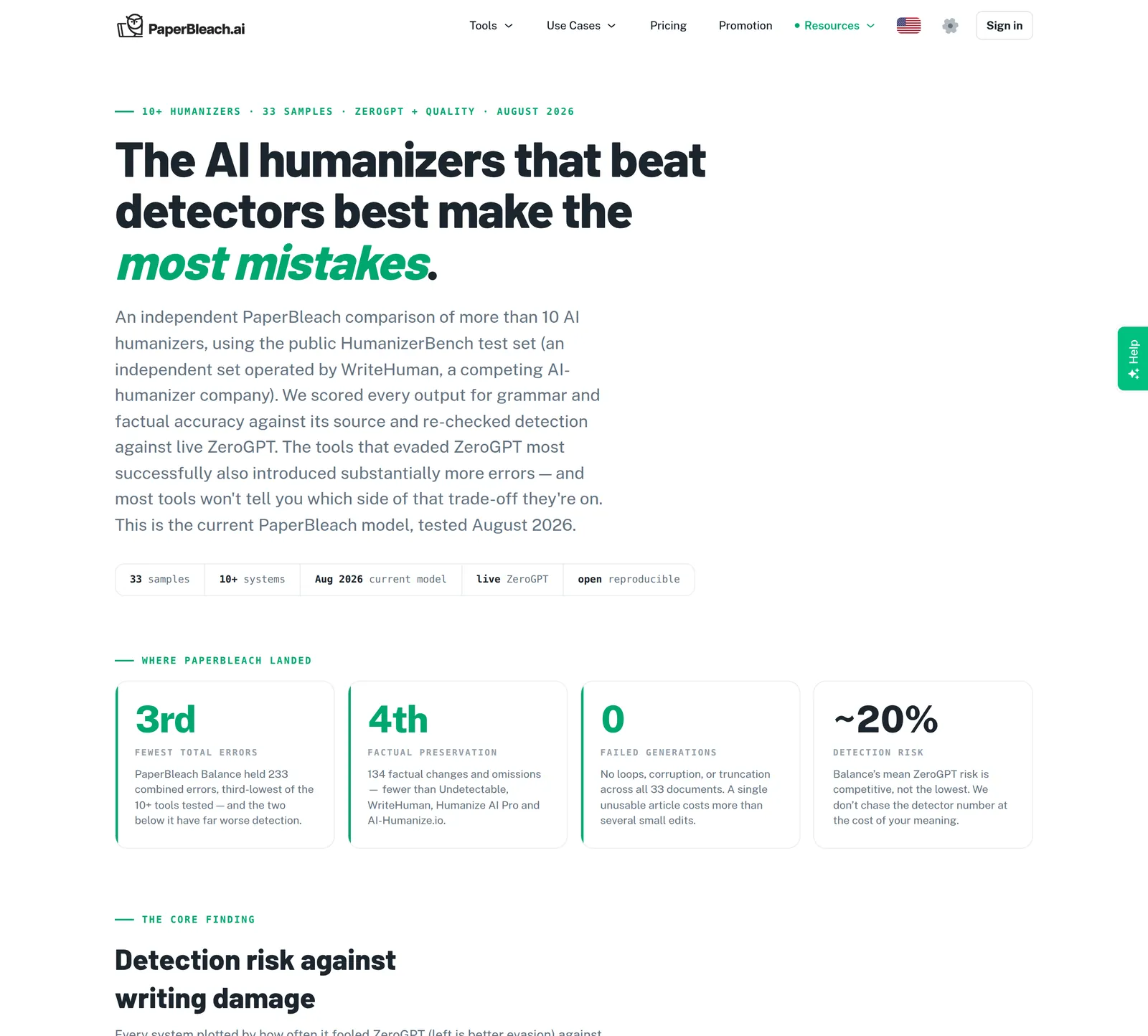
Here is what it gets right. It scores tools on two axes instead of one: how well the rewrite evades a detector, and how much damage the rewrite does to the writing, counted as factual changes, omissions, grammar errors and documents broken outright. It names its limitations in its own copy: PaperBleach tiers were audited with their labels visible rather than blind, cross-product ranks may carry auditor calibration drift, and the whole exercise is a vendor self-evaluation on a public and therefore gameable document set. And it puts PaperBleach third, not first.
The finding itself is the most useful thing in the humanizer category right now, and it is not flattering to anyone.
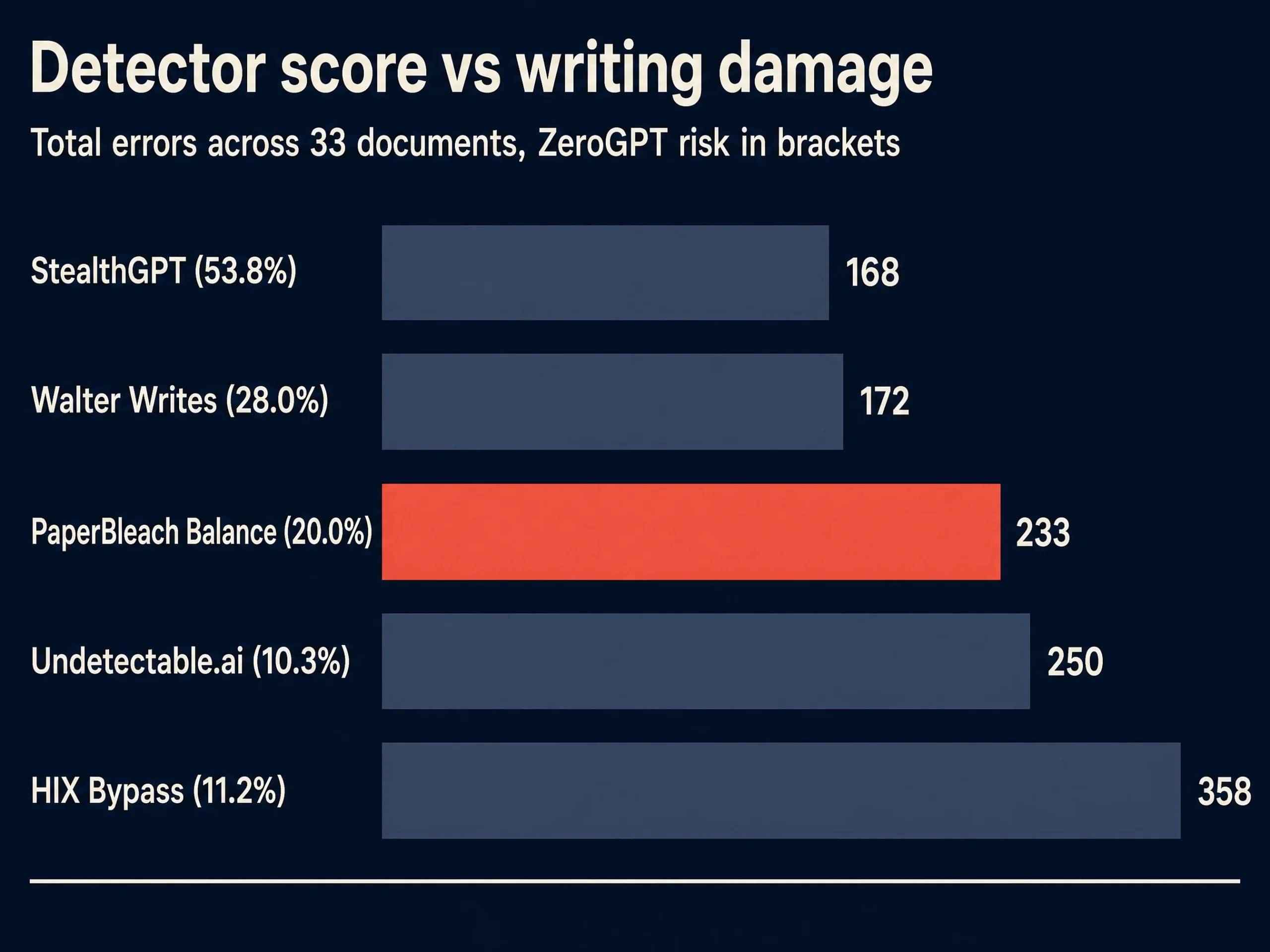
| Tool | ZeroGPT risk | Total errors | Docs broken | Our verdict on it |
|---|---|---|---|---|
| StealthGPT | 53.8% | 168 | 1 | Does StealthGPT bypass Turnitin? |
| Walter Writes | 28.0% | 172 | 1 | Walter Writes review |
| PaperBleach Balance | 20.0% | 233 | 0 | This review |
| Phrasly | 33.3% | 235 | 0 | Does Phrasly bypass GPTZero? |
| WriteHuman | 15.2% | 237 | 2 | Does WriteHuman bypass Turnitin? |
| Undetectable.ai | 10.3% | 250 | 1 | Does Undetectable AI bypass ZeroGPT? |
| PaperBleach Extreme | 18.8% | 269 | 0 | This review |
| Super Humanizer | 31.5% | 277 | 0 | Does SuperHumanizer bypass ZeroGPT? |
| AI-Humanize.io | 14.5% | 278 | 2 | Not yet reviewed |
| Stealth Writer | 11.4% | 314 | 3 | StealthWriter review |
| Humbot | 16.3% | 321 | 2 | Does Humbot bypass GPTZero? |
| Humanize AI Pro | 9.5% | 323 | 1 | Not yet reviewed |
| HIX Bypass | 11.2% | 358 | 3 | HIX Bypass review |
Read the two number columns together and the pattern is hard to miss. The three tools that evaded ZeroGPT best, Humanize AI Pro at 9.5 percent, Undetectable.ai at 10.3 percent and HIX Bypass at 11.2 percent, carried 250 to 358 errors and broke documents. The two cleanest writers, StealthGPT and Walter Writes, posted the worst detection scores in the set. Nobody sits in the corner the marketing implies exists. That is the same trade we documented in AI humanizers that ruin facts, now with a vendor’s own numbers attached.
Where it falls apart
The benchmark page carries a strip of chips under its introduction: 33 samples, 10+ systems, Aug 2026 current model, live ZeroGPT, and open reproducible. Further down it states plainly:
They are not. I pulled the raw HTML of that page and searched every link on it. There is no CSV, no JSON, no zip, no GitHub repository, no gist, no notebook, no download of any kind. The page that calls itself open and reproducible ships a claim about reproducibility and nothing to reproduce it with. That is the single biggest problem with this tool’s evidence, and it is entirely fixable: upload the files.
Three more things weaken it before you even get to the missing data.
One detector. Every number in that table is ZeroGPT. The page admits the official HumanizerBench leaderboard uses five detectors and that results shift across them. ZeroGPT is also not the detector that decides your grade. If your university runs Turnitin, the useful reading is which AI detectors are closest to Turnitin, and the honest answer is that ZeroGPT is a weak proxy for it.
Borrowed from a competitor. The 33 document test set is HumanizerBench, which PaperBleach describes on its own page as “an independent set operated by WriteHuman, a competing AI-humanizer company.” We reviewed that benchmark in July. Our finding then was that its transparency is real, with published prompts, published outputs and a public GitHub repository, but its neutrality is not, because its July 2026 cycle ranked its own owner WriteHuman first at 73.07. The full workings are in our HumanizerBench review. So PaperBleach ran a competitor’s self-serving test set, on one detector, and graded itself. Notably, the competitor at least shipped the repo.
Independent is the wrong word. The page opens by calling itself “An independent PaperBleach comparison,” then lists “this is a vendor self-evaluation” among its own caveats, roughly 1,200 words later. Both sentences cannot be true. The caveat is the honest one, and it should be in the first line rather than the small print.
How it got in front of you
The benchmark did not spread on its own. In late August 2026 one Reddit account, u/Medium-Winter385, posted the same table three times inside 24 hours: to r/paperbleach, to r/AIToolBench, and to r/GeminiAI. Each carried a disclosure that the poster works with PaperBleach, which is more than most vendors manage.
The detail worth your attention is what the posts linked to. In r/paperbleach the top comment pointed at the benchmark page as “full data, charts, and the scoring script.” In r/AIToolBench the same account pointed at a different URL, a listicle that ranks PaperBleach number one and contains none of the numbers. The disclosure in the post says “we didn’t come out on top.” One of the two links it offers as proof says otherwise.
In r/GeminiAI the same account left a long comment in pros and cons review format, recommending Balance over Extreme and stating that Extreme adds roughly 28 percent more factual changes. That figure is not on the benchmark page and I could not verify it. In the same thread the account also asserted that you need to be under 10 percent on ZeroGPT to land under 20 percent on Turnitin. That claim has no published source anywhere, it picked up three upvotes, and students are making submission decisions on it. If you are in that position, our note on what to do when one detector says human and Turnitin says AI is the safer starting point.
The one reply under the data link, in full: “it doesn’t bypass ai detectors.”
Now put that next to the affiliate page.
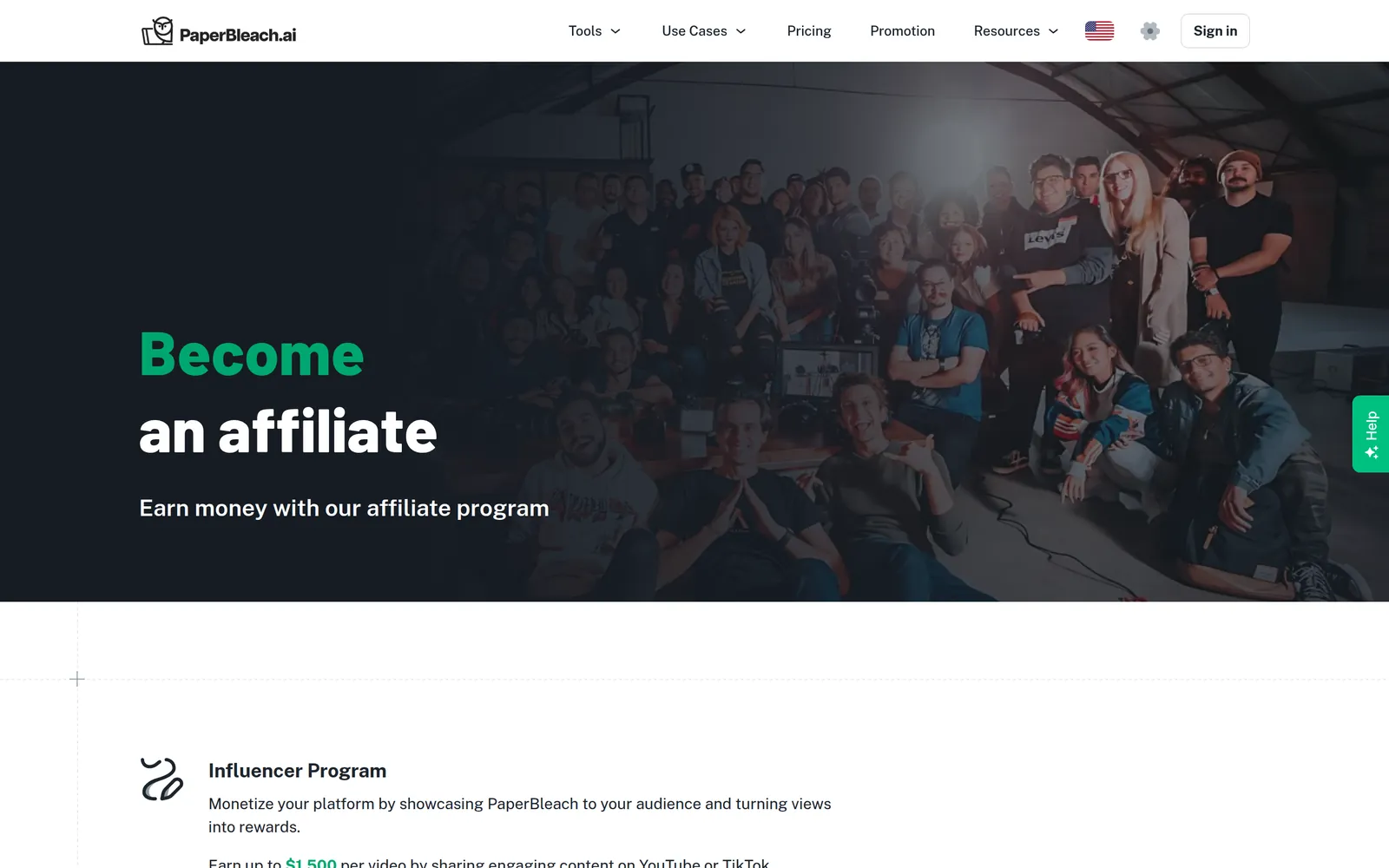
PaperBleach pays affiliates 10 percent, on first month purchases only, and runs an influencer programme advertising up to 1,500 US dollars per video on YouTube or TikTok. No cookie window, payout minimum or payment schedule is published. That 1,500 figure is not a scandal on its own, plenty of software pays for video, but it sets the reading frame for every PaperBleach video review you will find: assume paid placement until the creator says otherwise, and weigh the ones that disclose accordingly. For context on how thick that layer gets in this niche, see best underground AI humanizers, where we track 56 tools and who is paying whom.
Performance: what the numbers say about the writing
Strip out the marketing and the vendor’s own data supports three claims about the product, all of them modest and all of them useful.
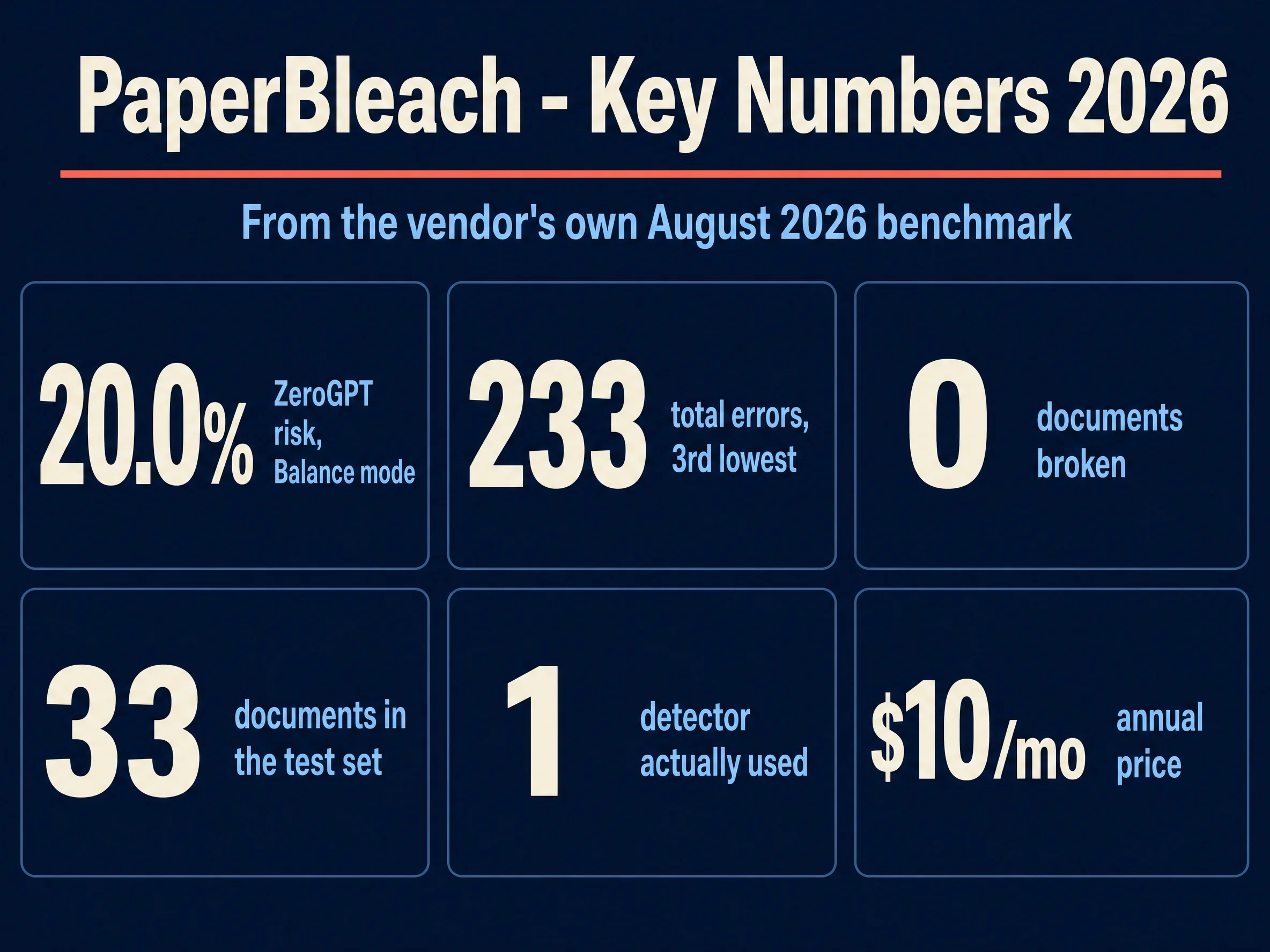
It keeps your meaning better than the aggressive tools. 233 combined errors on Balance, third lowest of the field, and 134 factual changes and omissions, fewer than Undetectable.ai, WriteHuman, Humanize AI Pro and AI-Humanize.io. For work you have to defend in a viva or a meeting, that is the number that matters, not the detector score.
It does not break documents. Zero failed generations across all 33 test documents, no loops, no corruption, no truncation. Stealth Writer and HIX Bypass broke three each. One unusable article costs more than several small edits.
It will not get you a clean detector score. Roughly 20 percent mean ZeroGPT risk on Balance and 18.8 on Extreme is mid-table, and the company says so. If a clean number is the whole job, the tools that deliver it in this table do so by rewriting what you actually said.
Extreme mode is the trap. It buys you 1.2 percentage points of detector score and costs you 36 more errors. Use Balance, read the flagged sentences, and fix them yourself. That is also the advice in our guide to what to remove before using an AI humanizer, which will move your score further than any mode toggle.
Work out what PaperBleach would actually cost you
The plan you need is set by the 2,500 word cap, not by your total word count. Put in a real month of work and see which tier it lands in.
PaperBleach plan calculator
Every pass is capped at 2,500 words on every plan, so long documents burn several rewrites each.
Pros and cons
What works
- Refuses the guaranteed bypass claim in writing, on the homepage, where buyers see it
- Built-in detector scores every pass and flags the sentences it changed
- Third lowest combined error count of 13 tools and modes on the vendor’s own test
- Zero broken documents across 33 test files
- Published a comparison in which it does not place first, with its own limitations listed
- 10 US dollars a month billed annually is cheap for this category
- Free first rewrite at the full 2,500 words, no card needed
What does not
- Says source data and scoring scripts are published, then links to neither
- Calls its own vendor self-evaluation “independent” in the opening line
- Whole benchmark rests on one detector, ZeroGPT, and it is a weak proxy for Turnitin
- Test set belongs to a competitor that ranked itself first on it
- Same account seeded the same table across three subreddits, pointing at two different pages as the data
- 2,500 word cap on every tier, including Ultra at 216 a year
- “Trusted by AI Detectors” appears as a paid feature bullet and means nothing
- Detector score is mid-table, so it is not the tool if a clean number is the only goal
Who should buy it, and who should not
Buy it if
You write things you will have to defend, and you care more about the rewrite preserving your argument than about the number on a free detector. You want to see a score and the changed sentences on every pass rather than trusting a rewrite blind. Your documents run under 2,500 words. Ten dollars a month annually is inside your budget for a second pair of eyes.
Skip it if
You are chasing the lowest possible detector score, in which case this table names the tools that do that better and the damage they do getting there. You are humanizing a thesis, a dissertation chapter or anything long, because the per pass cap will fragment it. You need a Turnitin specific answer, which no consumer humanizer can give you honestly; start with which humanizers still beat Turnitin’s bypasser detection instead. Or you were about to buy on the strength of that Reddit benchmark, in which case wait for the files.
Alternatives worth reading first
Netus AI is the other tool in this category that stopped pretending, and it lands in a similar place: honest pitch, unreliable as a detector bypass. Best AI humanizer for Turnitin sets out what to check before you pay anyone. And if you are dealing with a flag on work you actually wrote, no humanizer is the answer at all.
What is new in 2026
Two things changed the ground under every tool in that table. Turnitin shipped dedicated bypasser detection on 27 August 2025, letting instructors check submissions for content “that may have been further modified by leading bypassers,” per its own press release. And Turnitin’s AI writing percentage already counts paraphrased output, not just raw model text: its documentation describes the score as covering prose identified as “likely AI-generated or AI-generated text subsequently modified by paraphrasing tools,” while warning the model “may misidentify human-written, AI-generated, and AI-paraphrased text, so it should not be used as the sole basis for adverse actions against a student.” That is in the Turnitin AI writing report guide.
Read those two together and PaperBleach’s refusal to promise a bypass looks less like modesty and more like the only defensible position left. The company that ships the detector your university actually uses has been building against this product category for a year.
The verdict
PaperBleach is the best-behaved humanizer I have reviewed this year and the one whose evidence I trust least, which is an unusual sentence to write about the same product. The refusal to guarantee a bypass is real and it is on the homepage. The trade it documents, that the tools which fool detectors best damage the writing most, is true, useful, and no other vendor will tell you. The product itself preserves meaning better than most and does not break documents.
Then it puts the word “reproducible” on a page with nothing to download, calls its own self-evaluation independent, runs one detector, borrows a competitor’s test set, and pushes the result through one Reddit account pointing at two different pages as the proof. Every one of those is a choice, and every one of them is reversible.
Six and a half out of ten. Buy the Balance mode and the built-in detector at 10 dollars a month if your documents are short. Do not buy the benchmark until the CSV is on the page. I will re-test and raise this score the day it is.
Evidence and sources
Verified user comments on PaperBleach, in full, with dates:
Third-party coverage is thin and mostly commercial. Page one for “paperbleach review” is made up of marketing sites and competitor blogs; its Trustpilot profile showed four reviewers and would not serve to our crawler. There is one dedicated long-form video about PaperBleach on YouTube and it is on PaperBleach’s own channel. That is the whole independent footprint, which is the other reason this review exists.
Methodology. Claims were taken from paperbleach.ai’s homepage, pricing page, affiliate page and benchmark page, all captured on 24 September 2026. The reproducibility check was run against the raw HTML of the benchmark page, searching every anchor on it for a data or script file. Reddit posts and comments were pulled through the ScrapeCreators API, and comment dates are as returned by Reddit. We did not buy a subscription; the detector and error figures in this review are PaperBleach’s own published numbers, reported as such, not results we reproduced. That is the point of the review.
PaperBleach review FAQ
Does PaperBleach bypass Turnitin?
It does not promise to, and it is the only humanizer in this category that says so on its own homepage. Its own benchmark reports roughly 20 percent mean ZeroGPT risk on Balance, which is mid-table, and ZeroGPT is not Turnitin. Turnitin counts paraphrased output inside its AI writing percentage and shipped dedicated bypasser detection in August 2025, so no consumer humanizer can honestly answer yes to this question.
Is PaperBleach’s benchmark trustworthy?
Partly. The structure is good, it scores writing damage alongside detector evasion and it lists its own weaknesses. But it uses one detector, it scores PaperBleach’s own tiers with the labels visible rather than blind, it calls itself independent while admitting it is a vendor self-evaluation, and it states that source data and scoring scripts are published while linking to neither. Read the findings as a useful hypothesis, not as a result.
How much does PaperBleach cost?
Premium is 17.99 US dollars a month, or 10 a month if you pay 120 for the year, and includes 200 rewrites and 10,000 detector checks a month. Ultra is 36 a month, or 18 a month billed 216 a year, for 800 rewrites. A 7 day trial is 4.99 and then rolls into Premium at 17.99. The free tier is one rewrite up to 2,500 words plus 300 detector checks a month.
What is the word limit?
2,500 words per rewrite on every plan, including Ultra. Longer documents have to be split, and each chunk is rewritten without sight of the others, which is where tone and terminology drift in.
Balance or Extreme?
Balance. On the company’s own figures Extreme lowers the detector score by 1.2 percentage points and raises combined errors from 233 to 269. You are paying for a slightly better number with a measurably worse document.
Is the built-in AI detector accurate?
It is a useful smoke alarm and it is owned by the company selling you the rewrite, so it is not independent evidence. Any humanizer that scores its own output has an obvious incentive. Check the result in a detector the vendor does not control before you submit anything.
Why do so many PaperBleach video reviews sound positive?
PaperBleach advertises up to 1,500 US dollars per video to creators on YouTube and TikTok, alongside a 10 percent affiliate commission on first month purchases. That does not make any individual review dishonest, but it does mean you should look for a disclosure before you weigh one.
Is PaperBleach better than Undetectable.ai or WriteHuman?
On writing preservation, yes, on its own numbers: 233 combined errors against 250 for Undetectable.ai and 237 for WriteHuman, with zero broken documents against one and two. On detector evasion, no: 20 percent against 10.3 and 15.2 percent. Which matters more depends on whether you have to defend the text.
Is there a refund policy?
None is published on the pricing page. The 7 day trial at 4.99 is the cheapest way to test it, and it converts to Premium at 17.99 a month unless you cancel, so set a reminder.
