
Tested by Vlad Ivanov
Runs Detection Drama, which tests AI detectors and essay tools on real text. I am not an admissions officer, counselor or tutor. For this article I ran three GradPilot Full Reviews (11 November 2026) and three logged-out ChatGPT chats (16 November 2026) on the same essay, and logged every score. Disclosure: GradPilot gave Detection Drama free review credits for testing, and we earn a commission if you buy through our partner link. ChatGPT gave us nothing. Neither saw this article before it went live.
Last updated: 16 November 2026
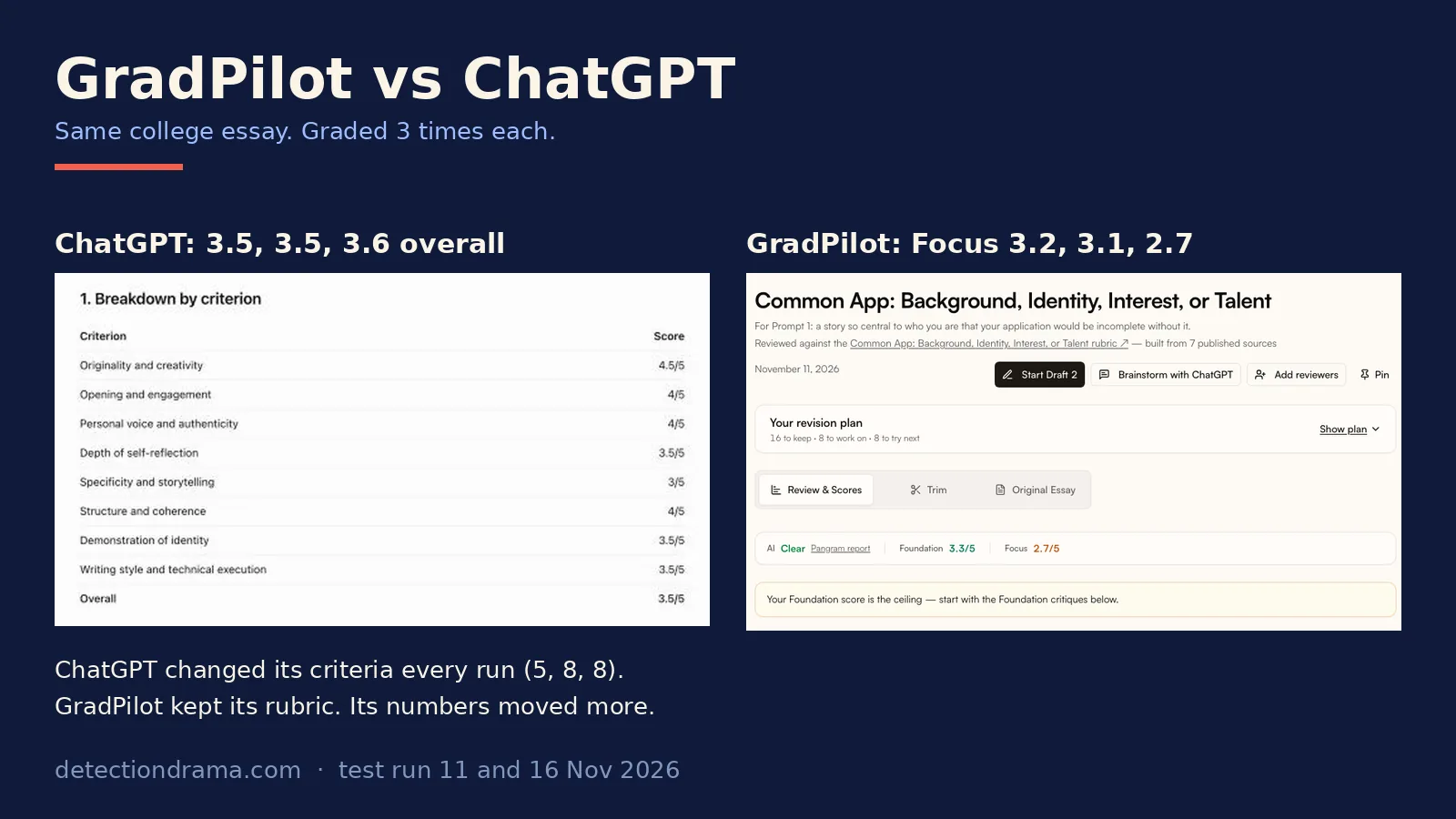
GradPilot vs ChatGPT comes down to one question: when your essay score changes, is it your writing or the grader? I gave the same real college essay to each tool three times, so it was graded six times with zero edits. ChatGPT’s overall score barely moved (3.5, 3.5, 3.6), but it invented a new list of criteria every run. GradPilot kept the same rubric every time, but its numbers moved more, by up to a full point on one criterion.
Partner link: new users get 20% off their first purchase. Free Quick Reviews have no scores; a Full Review with scores is $5.
Watch the test (7 minutes)
Introduction and First Impressions
Students already use ChatGPT on their essays. One Reddit applicant put it plainly: they had no one to review their essay “other than bs ai stuff”. GradPilot is a paid alternative built for this job. It scores your draft against a published rubric for your exact prompt and adds an AI check from Pangram Labs.
GradPilot’s pitch against ChatGPT is consistency. A GradPilot partner, the founder of WriteIvy, wrote that “standard chatbots improvise review criteria with every draft”. GradPilot’s own article on ChatGPT grading tells students to run a three-chat test, but it never reports running one. Nobody in the current search results had put both tools on the same essay. So I did. The essay was graded six times, and the result was more mixed than either side’s marketing.
If you only want to know whether to run your essay through a detector at all, read should you run your college essay through an AI detector first. This article is about grading.
Product Overview: What Each Tool Actually Is
| GradPilot | ChatGPT (free) | |
|---|---|---|
| What it is | Rubric-based essay grader for applications | General chatbot |
| Criteria | Fixed, published rubric per prompt (Common App Prompt 1 has 5 scored criteria) | Whatever it chooses each time unless you supply them |
| Scores | 0 to 5 per criterion, plus Foundation and Focus | Any scale you ask for |
| AI check | Yes, Pangram Labs, on Full Reviews | No AI score |
| Price | Quick Review free (no scores), Full Review $5, $50 for 10, $200 for up to 200 in 30 days | Free |
| Writes for you | No, it grades | Yes, if asked, which is the risk |
For the full product breakdown, our GradPilot review covers every plan and the fine print. This page sticks to the head-to-head.
Our test: one essay, graded six times
The essay is a real one. Johns Hopkins published it in its Essays That Worked series, labelled Class of 2025, which means it was written before ChatGPT launched in November 2022. It is 624 words about a crochet unicorn that keeps coming out as a tangled blob. I am not naming the student.
- Same text, unedited, pasted fresh every run.
- ChatGPT: chatgpt.com, logged out (free, no memory, no account), three brand-new chats on 16 November 2026, identical prompt each time. The page did not say which model answered.
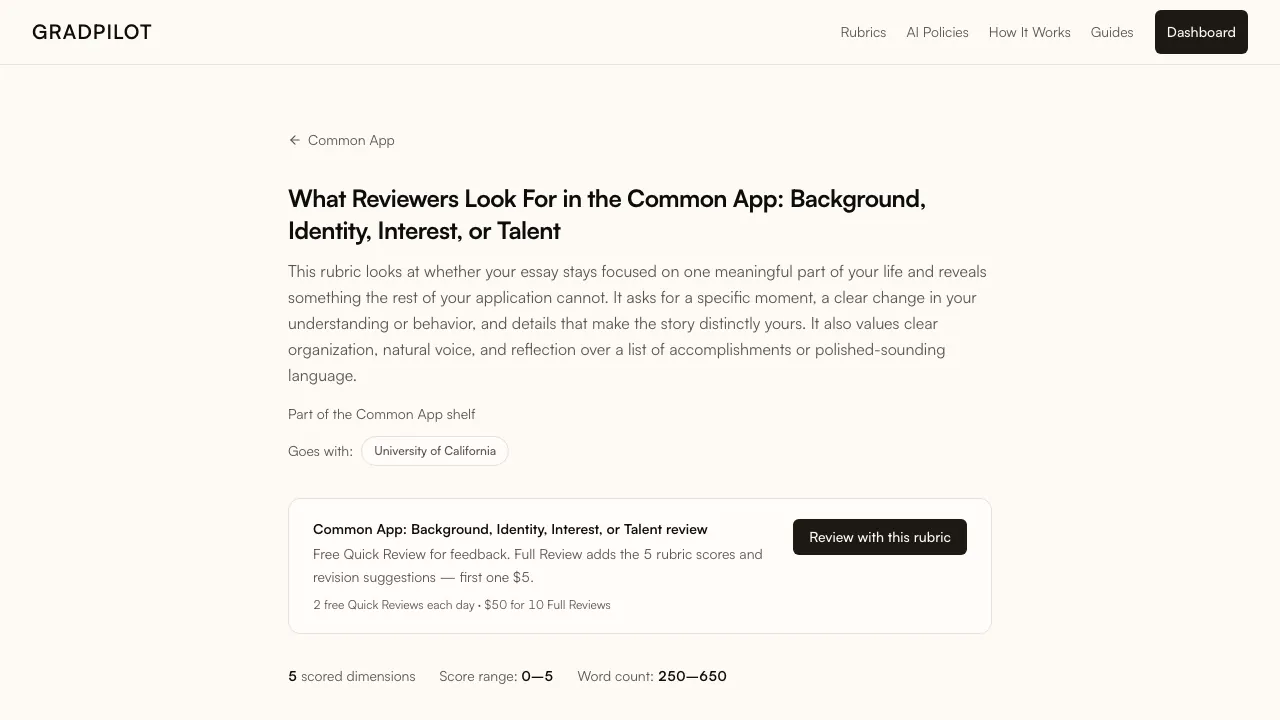
- GradPilot: Common App “Background, Identity, Interest, or Talent” rubric, Full Review, AI detection on, three separate reviews on 11 November 2026.
- No edits between runs, so any change comes from the grader.
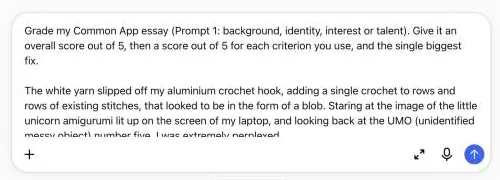
The ChatGPT prompt was: Grade my Common App essay (Prompt 1: background, identity, interest or talent). Give it an overall score out of 5, then a score out of 5 for each criterion you use, and the single biggest fix. I let ChatGPT pick its own criteria on purpose, because that is how most students use it.
Design and Interface
ChatGPT answers in a long chat reply. Each of my three answers ran roughly 1,600 to 2,100 words: a score table, strengths, weaknesses and rewrite suggestions. It is friendly and easy to read, and it is also a wall of text you have to sort yourself.
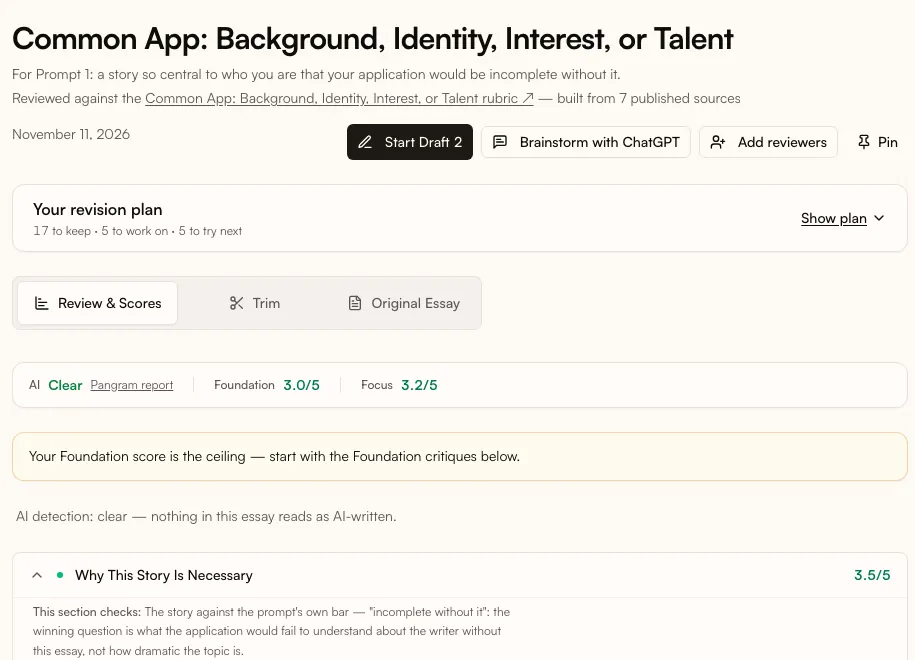
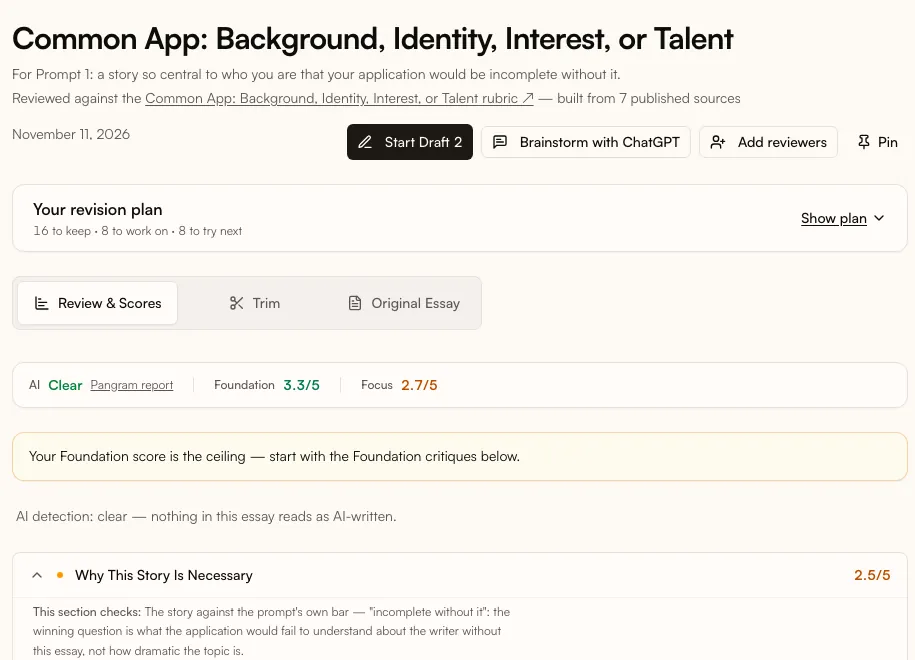
GradPilot shows a report page. The top line holds the AI result, Foundation and Focus. Below that, each rubric criterion opens to show what it checks, a score, critiques that quote your own sentences, and suggestions. A revision plan sorts lines into “keep”, “work on” and “try next”.
Performance Analysis: The Scores
We ran the three-chat test on ChatGPT
GradPilot’s own article, Is ChatGPT Good at Grading College Essays?, which ranks first for this search, gives a fair rule: open three new chats, and if the scores differ by more than one point, ignore them. It describes the test but reports no results. Here are ours.
| ChatGPT run | Overall | Criteria used | Its “single biggest fix” |
|---|---|---|---|
| Run 1 | 3.5/5 | 5 | Show the environmental activism earlier, with one real experience |
| Run 2 | 3.5/5 | 8 | Swap abstract reflection for one concrete experience |
| Run 3 | 3.6/5 | 8 | Make it about identity, not about finding a passion |
On the headline number, ChatGPT passed easily. A spread of 0.1 is far inside the one-point rule. On the criteria, it failed. Run 1 used five criteria, runs 2 and 3 used eight, and the eight were different each time. Only one criterion name appeared in all three runs: “Originality and creativity”, scored 4.5 every time. Authenticity appeared under three different names (“Authenticity and personality”, “Personal voice and authenticity”, “Authenticity and voice”) and scored 3, then 4, then 4.
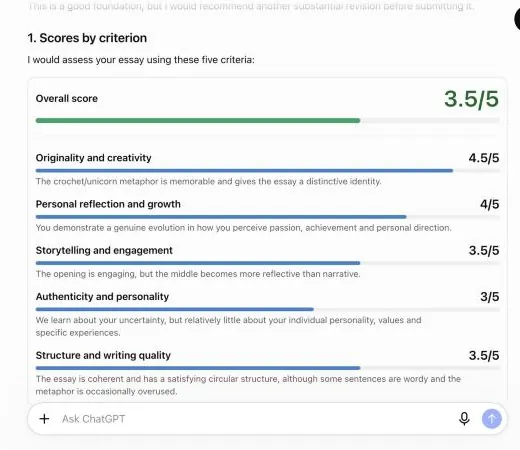
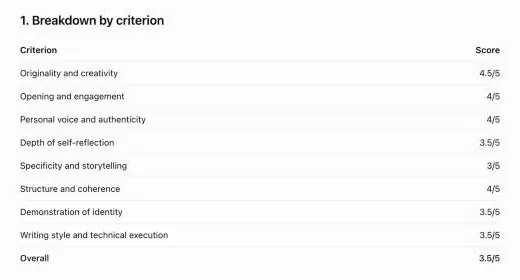
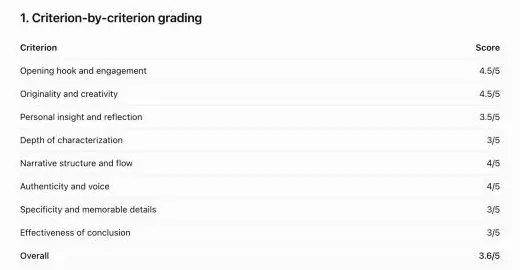
So the WriteIvy line holds up in this test: ChatGPT improvised its criteria. You cannot track “Demonstration of identity” from draft 1 to draft 2 if it may not exist next time.
Is GradPilot consistent? Same essay, three reviews
GradPilot’s article says fixed criteria make results comparable across drafts, so a change in score reflects a change in the draft. I could not find any page that tested that claim, so I ran the same unedited essay three times.
| GradPilot review | AI | Foundation | Focus | Why This Story Is Necessary | One Thread, Not Four | Real Scenes, Not Summary | Before and After | Only You Could Write This |
|---|---|---|---|---|---|---|---|---|
| Review 1 | Clear | 3.0 | 3.2 | 3.5 | 3.5 | 3.5 | 3.5 | 2.0 |
| Review 2 | Clear | 3.3 | 3.1 | 3.5 | 3.5 | 3.0 | 3.5 | 2.0 |
| Review 3 | Clear | 3.3 | 2.7 | 2.5 | 3.5 | 3.0 | 3.5 | 1.0 |
The yardstick never moved: same five criteria, same names, same two headline scores, AI Clear three times. The numbers did move. Focus dropped 0.5 from review 1 to review 3. “Why This Story Is Necessary” dropped a full point. “Only You Could Write This” went 2.0, 2.0, 1.0. That last one sits right on GradPilot’s own one-point line, with zero edits.
Score spread, side by side
The bars show the gap between the highest and lowest score each tool gave the same essay. Smaller is steadier.
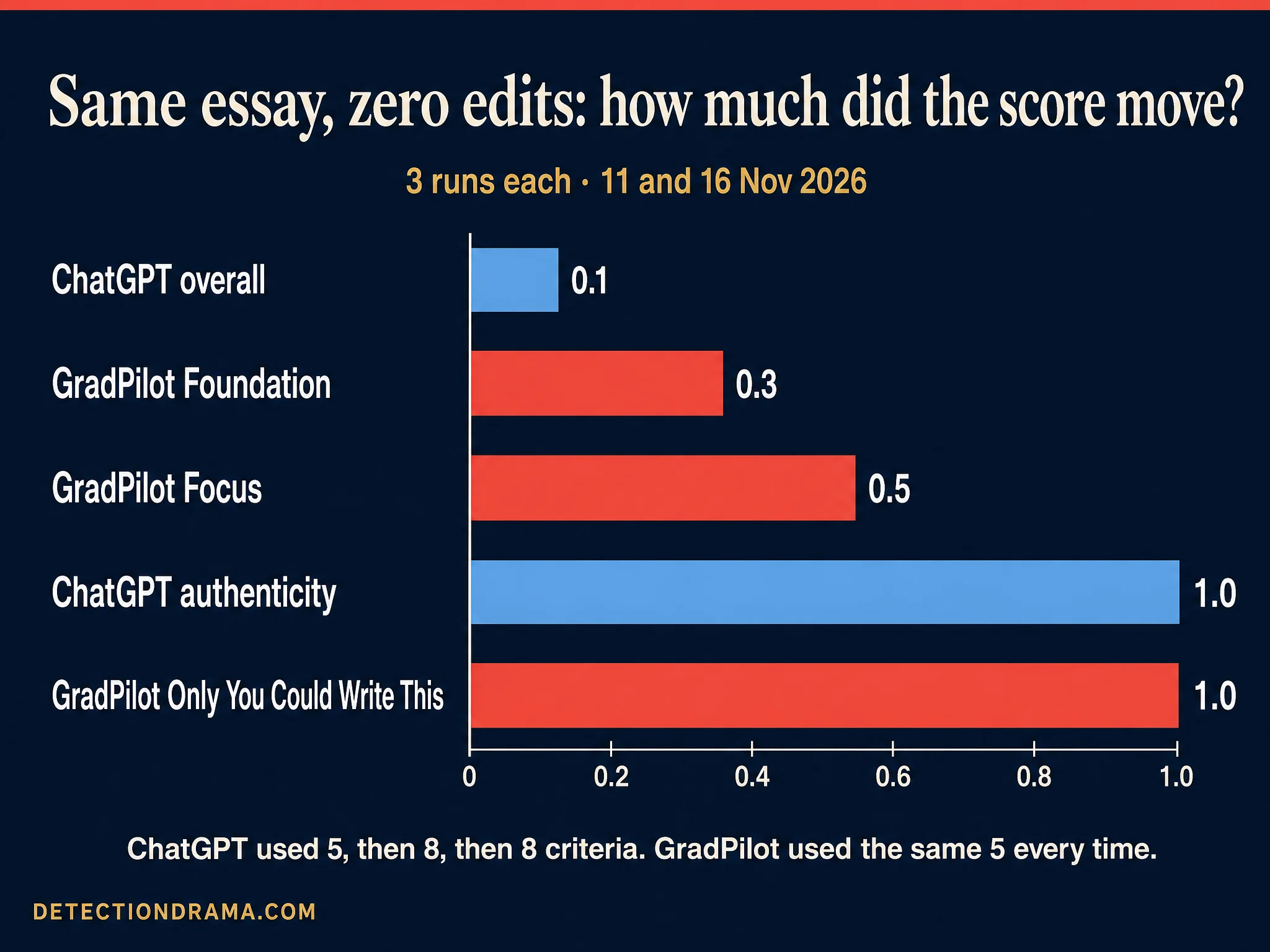
Honest read: on these three runs, ChatGPT’s headline score was steadier than GradPilot’s. GradPilot’s advantage is that its criteria stay the same, not that its numbers do. Three runs on one essay is a consistency check, not an accuracy study.
Where all six runs agreed
The most useful finding is the overlap. In every ChatGPT run, the lowest score went to authenticity or specificity. In every GradPilot review, the lowest score went to “Only You Could Write This”. Both tools, six times, said the same thing: the essay tells the reader who the writer is more than it shows it. When every run agrees, that is the fix to make first. Our guide on how to check if your essay sounds AI-written covers the same “could anyone have written this?” test from another angle.
User Experience: Using Each for Revision
How to read a score change between drafts
Both tools are sold, directly or by students, as revision tools. That only works if you can tell a real improvement from grader noise. Based on what moved with zero edits in this test:
- GradPilot Foundation or Focus: a change of 0.5 or less proved nothing here. Focus moved 0.5 on its own.
- A single GradPilot criterion: even a full point appeared with no edits. Look for the same criterion improving across two reviews of the new draft.
- ChatGPT: the overall number was steady, but compare criteria only if you paste the same criteria list into every chat. Otherwise you are comparing different tests.
Use the checker below to sanity-check a change between two drafts.
Did my draft really improve?
Which GradPilot option fits?
Setup takes a minute either way. ChatGPT needs no account for a quick read. GradPilot needs an account, a rubric choice and, for scores, a paid Full Review. A Reddit user in a pre-PA thread said the free tier matched human feedback early on, then became repetitive (u/nocomplaintsmich_, June 2026).
Comparative Analysis
| What you need | GradPilot | ChatGPT (free) |
|---|---|---|
| Same criteria every draft | Yes, 5 named criteria every review | No, 5 then 8 then 8 in our test |
| Steady headline number | Moved up to 0.5 (Focus) | Moved 0.1 |
| AI check | Yes (Pangram) | No |
| Quotes your own sentences in critiques | Yes | Yes, in our runs |
| Brainstorming and talking it through | Has a “Brainstorm with ChatGPT” button | Its strength |
| Cost for scores | $5 per Full Review, less in packs | Free |
If the AI check is the reason you are looking, compare detectors directly: our Pangram review and Pangram vs GPTZero cover the engine GradPilot uses.
GradPilot vs ChatGPT pricing in November 2026
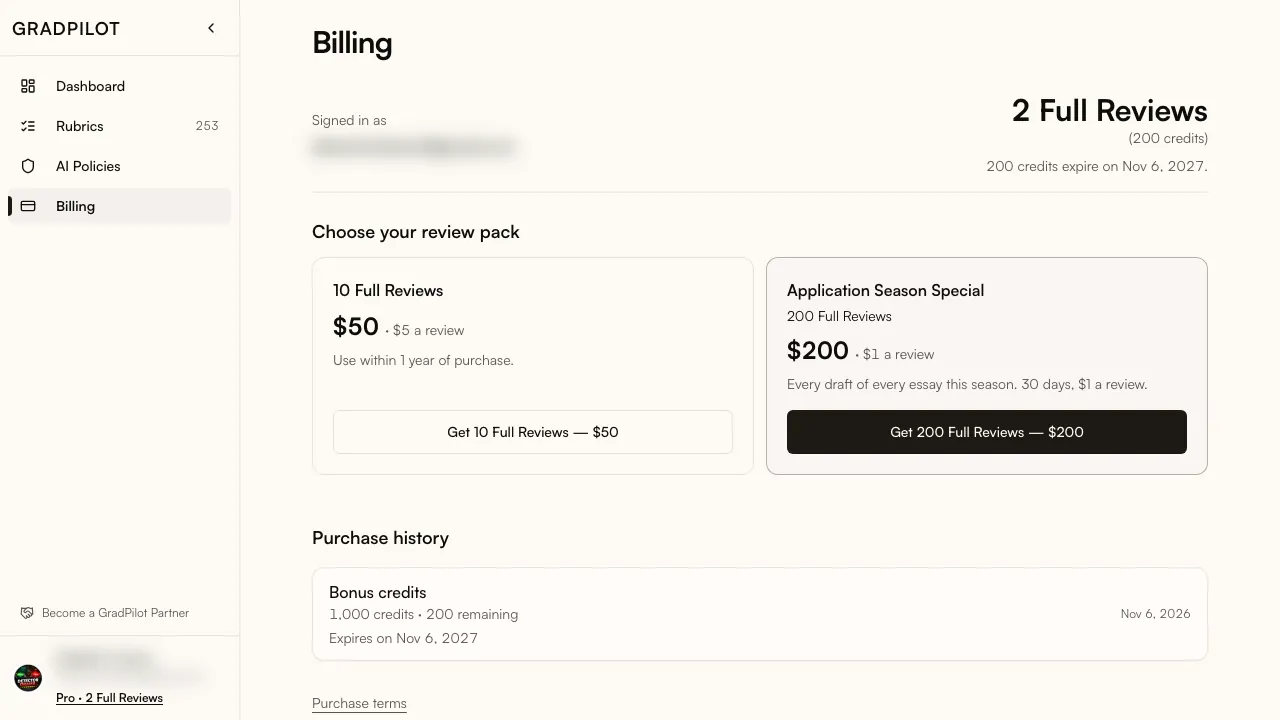
- ChatGPT: free for this use. I did not need an account.
- GradPilot Quick Review: free, but no scores and no AI check.
- Full Review: $5, with scores and Pangram detection.
- Pro: $50 for 10 Full Reviews.
- Application Season Special: $200 for up to 200 reviews, used within 30 days.
Given the wobble above, a pack makes more sense than a single review if you plan to compare drafts, because you will want two reviews of the draft that matters.
Pros and Cons
GradPilot: pros
- Same 5 criteria every review, so drafts are compared on one yardstick
- AI check came back Clear 3 of 3 times on a human essay
- Critiques quote your actual sentences
- Revision plan sorts what to keep and fix
GradPilot: cons
- Scores moved with zero edits: up to 0.5 on Focus, 1.0 on one criterion
- Scores cost money; free Quick Reviews have none
- Pangram can flag human sentences (see below)
- When AI is detected, scores are capped, so a flag hides the rubric result
ChatGPT: pros
- Free and instant
- Overall score held at 3.5 to 3.6 across 3 chats
- Long, readable feedback; good for brainstorming
ChatGPT: cons
- Changed its criteria every run (5, 8, 8)
- Its “biggest fix” changed every run
- No AI check
- Will rewrite your essay if asked, which can cross your school’s line
The AI check is not perfect. Our human essay came back Clear three times, but Pangram does flag some human-written sentences. A PhD applicant on Reddit said GradPilot flagged sentences they wrote and that they turned detection off for their reviews (u/Skier_1234, 3 November 2026). And when GradPilot detects AI, it holds every score at or below 1. A Clear result is not a guarantee, and a flag is not a verdict. If you are flagged by a school, see what to do in the next 24 hours and our sourced AI detection false positive rates.
Evolution and Updates in 2026
GradPilot now offers the $200 Application Season Special, and its rubric library listed 253 rubrics when we checked on 11 November 2026. Pangram, its detection partner, shipped Pangram 4.1 on 19 October 2026. Which Pangram version ran on our reviews is not shown on the report. ChatGPT’s logged-out experience did not show the model name either, so a rerun next month could behave differently. That is one more reason to save your reviews and compare like with like.
Research on chatbots as graders predates both. The three studies GradPilot cites tested school essays and TOEFL writing, not admissions essays: Kundu and Barbosa (2024), Mansour et al. (2024) and Xia, Mao and Zheng (2024). None of them tested GradPilot.
Purchase Recommendations
Use ChatGPT if
- You are brainstorming, outlining or talking through what your essay is really about
- You want quick, free feedback on an early draft
- You will paste the same criteria list into every chat (then it is fairer to compare)
Use GradPilot if
- You have real drafts and want them scored on the same rubric each time
- You want an AI check before you submit, and you understand its limits
- You are applying to programs with prompt-specific rubrics in its library (Common App, UC PIQs, statements of purpose, medical and PA essays)
Skip both if
- You want a prediction of admission. Neither tool gives one
- You want something to write the essay for you. That is the fastest way into an integrity problem; see our safe AI writing workflow for college drafts
Applying to medical school? Read do medical schools check for AI. Writing in a second language? Read about AI detection and ESL bias before trusting any detector.
Where to Buy
ChatGPT is at chatgpt.com. GradPilot is at gradpilot.com; through our partner link below, new users get 20% off their first purchase. Start with the free Quick Review to see the format before you pay. Buy the pack that matches how many drafts you will really compare: most applicants need a handful of Full Reviews, not 200.
Partner link: new users get 20% off their first purchase, and we earn a commission. GradPilot also gave us free review credits for testing.
Final Verdict: GradPilot vs ChatGPT
ChatGPT: a steady number on a moving yardstick. Free, fast and good for thinking out loud. Its criteria and “biggest fix” changed every time, so it is a poor tool for tracking drafts unless you fix the criteria yourself.
GradPilot: a fixed yardstick with numbers that wobble. Same five criteria and an AI check every time, worth $5 to $50 for most applicants. Its scores moved by up to a point with no edits, so read the critiques, ignore small changes, and confirm big ones.
Our pick: write it yourself, talk it through with ChatGPT, then check your last one or two drafts on GradPilot and get at least one human reader. We keep our overall GradPilot rating at 7.5 out of 10.
Evidence and Proof
What this test does not prove
- It is one essay and three runs per tool. It is not an accuracy study.
- The two tools ran five days apart (11 and 16 November 2026).
- ChatGPT scores and GradPilot scores use different scales and criteria, so 3.5 in one is not “better” than 3.2 in the other.
- The essay is a published, pre-ChatGPT essay by a strong writer, not a typical draft.
What real users say
Scored well in GradPilot, then a human reader found real problems in the statement.
Paraphrased from u/huewonder on r/MSCS, December 2024
“I had to turn off AI detection for my reviews”
u/Skier_1234 on r/gradpilot, PhD statement, November 2026
The free tier matched human feedback early, then became repetitive.
Paraphrased from u/nocomplaintsmich_ on r/prephysicianassistant, June 2026
The WriteIvy quote at the top comes from a GradPilot partner, so we tested it rather than repeat it. For wider numbers on AI in applications, see our AI college admissions essay statistics.
FAQ
Is GradPilot better than ChatGPT for college essays?
For comparing drafts on fixed criteria and checking for AI, yes. For brainstorming and free feedback, ChatGPT is fine. In our test ChatGPT’s overall score was steadier, but its criteria changed every run.
Is ChatGPT consistent when grading the same essay?
Its overall score was: 3.5, 3.5 and 3.6 across three fresh chats. Its criteria were not: 5, then 8, then 8, with different names each time.
Does GradPilot give the same score every time?
No. Same essay, no edits: Foundation 3.0, 3.3, 3.3 and Focus 3.2, 3.1, 2.7. One criterion went 2.0, 2.0, 1.0. The rubric itself never changed.
Can ChatGPT detect AI in my essay?
It did not give any AI score in our test. GradPilot runs Pangram on Full Reviews. No detector is perfect; Pangram can flag some human sentences.
How much does GradPilot cost compared with ChatGPT?
ChatGPT is free for this. GradPilot Quick Reviews are free with no scores; a Full Review is $5, Pro is $50 for 10, and the Application Season Special is $200 for up to 200 reviews used within 30 days.
Does a high GradPilot or ChatGPT score mean I will get in?
No. Neither predicts admission. They grade the writing against criteria, and a human reader may still find problems.
Is it allowed to use ChatGPT for my college essay?
It depends on the school. Feedback is often allowed; AI-written content usually is not. Check each school’s policy, and never submit text you did not write.
What is the best way to use both?
Write it yourself, use ChatGPT to brainstorm, score your final drafts on GradPilot’s fixed rubric, ignore changes of half a point or less, and fix whatever every run agrees on.
