Royal Road’s AI detector checks chapters at submission, boosts stories it reads as human, and by Royal Road’s own numbers wrongly flags about 1 human chapter in 26,000. Spell-check and basic Grammarly fixes are safe; tools that rewrite your sentences are not.

Written by Vlad Ivanov
Runs Detection Drama, which covers AI detectors and humanizers. I ran no detector test for this piece and I have no access to Royal Road’s detector. It is based on published sources (Royal Road’s 16 November 2026 announcement and its 2023 AI-text policy) and reader reports from 11 Reddit threads in r/royalroad and r/WritingWithAI, all read on 24 November 2026. Reddit comments are people’s claims, not verified facts.
Last updated: 24 November 2026
Key Takeaways
- Royal Road tested its detector on 542,434 known human chapters and got 20 false positives, which it rounds to 1 in 26,000 (Royal Road, 16 Nov 2026).
- It says it catches about 99.5% of AI-generated chapters, and its threshold is set to call borderline text human rather than AI.
- The rule of thumb from Royal Road’s FAQ: anything that rewrites your sentences or paragraphs raises the chance of a chapter reading as AI. Basic Grammarly fixes do not trigger it; Grammarly’s AI features may.
- That is a change from 2023, when Royal Road’s policy put Grammarly Go in the untagged “general assistive” bucket (AI-text policy).
- For the Writathon, an entry is disqualified if more than 30% of its chapters come back AI-generated. Outside the event, flagged stories lose a list boost rather than get tagged.
- Royal Road runs its own classifier and does not show authors their score, so a paid third-party detector or a humanizer cannot tell you what Royal Road sees.
- If you think you were falsely flagged, Royal Road points authors to editing software that keeps a full writing and editing history.
What is Royal Road’s AI detector?
It is a text classifier Royal Road added to its submission process in November 2026, announced in a blog post on 16 November. Royal Road describes it as “a proper text classifier”, not a chatbot asked to guess, trained to separate pre-AI human chapters on the site from AI-generated and AI-assisted ones.
It was introduced to back the Writathon’s new “no AI-Generated” rule, but it now runs on submissions generally. Royal Road also says it is scanning its whole catalog for statistics and to find examples that improve the model.
The demand for it came from authors. One reader’s scrape of every fiction ID, posted to r/royalroad, counted 35.6% of September 2026’s new books carrying an AI label, up from 8.4% in January 2024. That is one person’s count, corrected once after posting, not a Royal Road figure.
How does Royal Road use the detector score?
It changes visibility, not tags. Royal Road says it will not force an AI tag onto any novel, automatically or by staff, because enforcing tags with the detector would teach people how to avoid it. Instead, novels detected as human-written get a boost in the lists, which makes Rising Stars easier to reach.
The score itself stays hidden. The FAQ says the visibility modifiers “will not be exposed” to reduce the window for reverse engineering. So an author cannot look up how a given chapter scored.
Honest tagging still matters. Royal Road’s FAQ says adding an AI-Assisted, AI-Translated or AI-Generated tag does not by itself cut visibility; the modifiers depend on what the detector says. Readers who want no AI content can filter those tags out with the global filter, which is where a tagged story loses readers.
| Situation | What Royal Road says happens |
|---|---|
| Chapters detected as human | Boost in the lists, easier route to Rising Stars |
| Chapters detected as AI, story untagged | No forced tag; no human-written boost (exact modifiers not disclosed) |
| Story honestly tagged AI-Assisted or AI-Generated | Tag alone does not reduce visibility; readers can filter the tag out |
| AI-translated story | New AI Translated tag, separate from AI-Generated |
| Writathon entry with more than 30% of chapters flagged | Disqualified from the event |
Which writing tools are safe to use on Royal Road?
Tools that fix your words are safe; tools that replace them are the risk. Royal Road’s FAQ gives the rule of thumb directly: anything that rewrites your sentences or paragraphs increases the chance of a chapter being detected as AI.
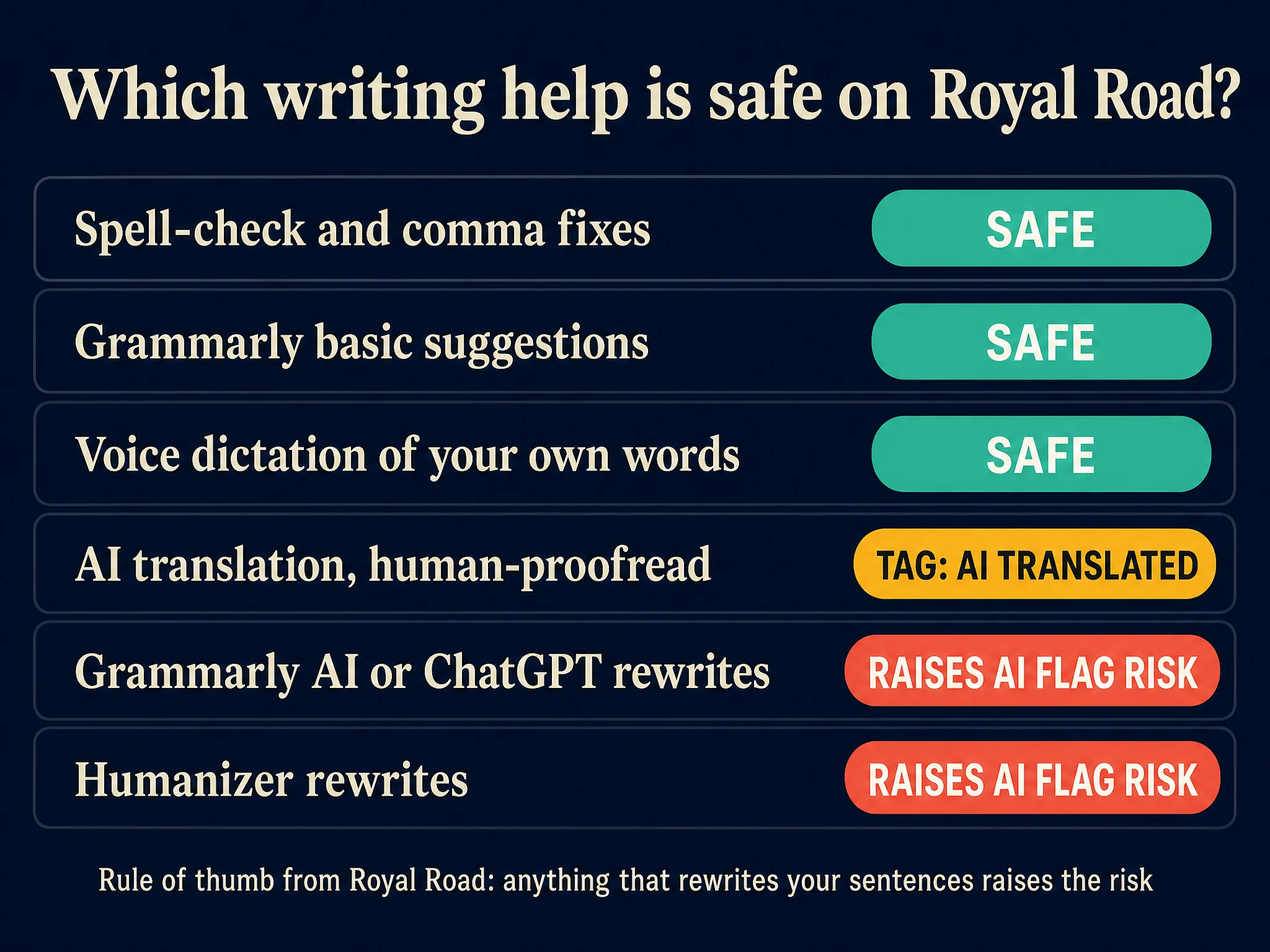
| Tool or habit | Royal Road’s position | Tag needed? |
|---|---|---|
| Spell-check, comma and clarity fixes in Grammarly | Will not trigger the detector; authors who used Grammarly heavily on pre-AI chapters came back fully human | No |
| Grammarly’s generative AI features | May make edits that read as AI-generated; Royal Road suggests turning off all gen-AI features in Grammarly settings | AI-Assisted if used heavily |
| ChatGPT or Claude “improve this paragraph” | Counts as AI-Assisted under the 2023 policy: your structure, the AI’s voice | AI-Assisted |
| Prompting AI to write the chapter | AI-Generated; banned from the Writathon | AI-Generated |
| AI translation of your own story | New AI Translated tag, kept separate from AI-Generated | AI Translated |
| Voice dictation of your own words | Not addressed by Royal Road; r/royalroad replies treat it as your writing | Not stated |
| AI humanizer run on a chapter | A full rewrite of your sentences, which is exactly what the FAQ says raises the risk | AI-Assisted at least |
Dictation came up in its own thread. The most upvoted answers in “Is voice dictation considered AI?” say dictating your own story is your writing, and dictating a prompt is not. One author said chapters dictated with Wispr Flow scored fully human on Pangram. Another warned that the built-in Windows tool sometimes changes sentences, which is the part worth checking.
The same Grammarly question ran in “Will Grammarly be tagged A+I?”, where the top reply drew the same line Royal Road later wrote into its FAQ: grammar and spelling are fine, restructuring and “smoothing out” prose is not. Grammarly’s own documentation makes a similar split for its detector, which we covered in how accurate Grammarly’s AI detector is.
How did Royal Road’s AI rules change from 2023 to 2026?
The tags stayed; the enforcement changed. Royal Road’s June 2023 AI-text policy split AI use into three buckets: general assistive technology, AI-Assisted and AI-Generated. It said detection was not reliable enough to enforce, citing research that the best commercial detector was only 84% accurate, so it allowed AI-Generated stories as long as they were tagged.
The 2023 policy put “Grammarly (including Grammarly Go)” in the untagged general assistive bucket and said Royal Road encouraged the Grammarly plugin. The 2026 FAQ is narrower: basic Grammarly fixes are still fine, but Grammarly’s AI features “may make extensive edits that read as AI-generated”. If you set up your workflow under the old guidance, check your Grammarly settings now.
Translation changed too. In 2023, a human-proofread AI translation needed no tag. In 2026 Royal Road added an AI Translated tag because of an increase in AI-translated submissions from non-English-speaking authors.
| Rule | 2023 policy | November 2026 |
|---|---|---|
| Detector in use | No; detection judged unreliable | Yes, at submission and across the catalog |
| Grammarly AI features | Grammarly Go listed as general assistive, no tag | May read as AI; turn gen-AI features off |
| AI translation | No tag if a human proofread it | AI Translated tag |
| Consequence of AI detection | None; tags were self-declared | No human-written list boost; Writathon cutoff at 30% of chapters |
How accurate is Royal Road’s AI detector?
By Royal Road’s own test, very accurate on human writing. It checked 542,434 known human chapters on the site and 20 came back as AI, which it reports as 99.9962% correct on human content and 1 false positive in 26,000 checks. It puts the catch rate on AI-generated content at around 99.5%.
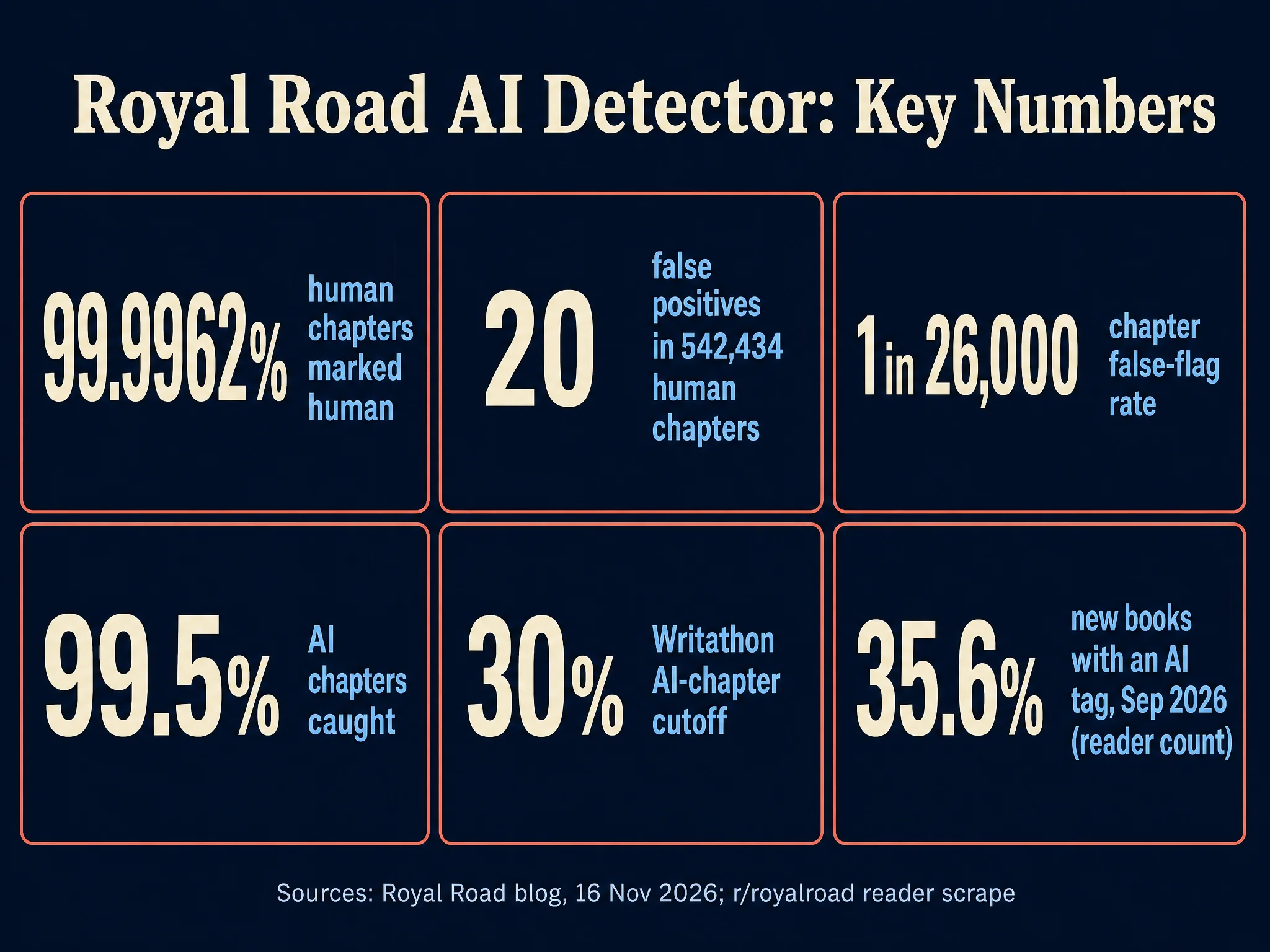
Three caveats keep these numbers honest. First, they are Royal Road’s own figures on its own data, not an independent benchmark. Second, the test set is pre-AI human chapters; Royal Road also shows that some human chapters “read as AI-edited”, and newer writing styles were not part of that set. Third, 20 in 542,434 works out to about 1 in 27,000, so “1 in 26,000” is a rounded, slightly cautious figure.
For context, the published false positive rates for commercial detectors vary widely, from near zero to double digits depending on the tool and the text. Our roundup of AI detection false positive rates collects them.
What does a 1-in-26,000 false flag rate mean for your fiction?
For a single fiction it means a false flag on one chapter is unlikely, and losing a Writathon entry to false flags is far less likely still. At 1 in 26,000 per chapter, a 100-chapter story has roughly a 0.4% chance of any one chapter being wrongly flagged. Going over the 30% Writathon cutoff would take 31 wrong flags.
That math assumes each chapter is an independent coin flip, and it may not be. A writing style the classifier misreads once will probably be misread again, a point the author of “About the AI detector, want to clear some technical deets up” conceded in the same post that argued the odds were tiny. Use the numbers below as a floor, not a guarantee.
False flag odds for your story
Enter how many chapters your fiction has. This uses Royal Road’s published rate of 1 false positive in 26,000 human chapters and assumes chapters are independent. It runs in your browser and sends nothing anywhere.
Should you pre-check chapters with Pangram or another AI detector?
Only as a rough signal, and not as a reason to buy anything. Royal Road says it uses its own classifier, trained on its own pre-AI chapters, and it does not show authors their scores. No outside tool can tell you what Royal Road’s model sees.
Some authors assume the site simply runs Pangram. A commenter in the 215-comment announcement thread said the site could not afford Pangram at about $1.50 a chapter for a catalog of over 4 million chapters. That is a Reddit claim, not a Royal Road statement, and the $1.50 figure also appears only as a Reddit number in our piece on whether publishers run AI detectors.
A third-party score can still be useful if it is very high on a chapter you wrote yourself, because that points to edits worth reviewing. Pangram scores well in published tests, as our Pangram review and Pangram vs GPTZero comparison explain, and Substack readers already run it on posts, as covered in Substack’s AI detector. Free checkers with high false positive rates will mostly add worry.
A humanizer is the wrong purchase here. Humanizers rewrite sentences wholesale, which is the exact behaviour Royal Road’s FAQ names as raising the chance of an AI read, and classifiers trained on AI-edited text often still pick up what is left. Our data on which AI markers survive humanization shows why. If you wrote the chapter, keep your own words.
What can you do if you think your chapters were falsely flagged?
Build a record of how you wrote, because the score itself is hidden. Royal Road’s FAQ says the best way to prove human authorship is editing software that keeps a full track of your writing and editing history online, and that dedicated writing programs offer authorship guarantees for this purpose.
- Keep drafting where history is saved. Google Docs version history, Word with autosave, or a writing app with a revision log all leave a dated trail. Our guide on whether Google Docs or Word version history is enough as proof covers what each one shows.
- Treat the trail as corroboration. Keystroke and revision logs show that a person typed the words, not who composed them, which is why our analysis of what writing process trackers prove calls them supporting evidence, not proof on their own. Royal Road treats them as the best evidence available; both can be true.
- Check your tool settings. Turn off Grammarly’s generative AI features, as Royal Road recommends, and undo any full-sentence rewrites you accepted in older chapters.
- Tag honestly if you did use AI. Royal Road says a correct tag does not by itself cut visibility. A wrong “100% human” claim is what the system is built to catch.
- Contact Royal Road support with your drafts if a Writathon entry is disqualified. The blog post does not describe an appeal process, so ask before assuming there is none.
The steps mirror what students do when a school detector flags them. Our guides on proving authorship after a Grammarly-triggered flag and building an authorship packet transfer to fiction with little change.
Is Royal Road’s AI detector fair to authors?
Most of the reaction on r/royalroad was positive. The top comment in the announcement thread, with 155 upvotes, praised the “pro-human stance” and the choice to boost human work rather than hunt for AI. A separate thread was titled “New Royal Road AI Detection Rules: They Seem Fair”.
Writers who use AI see it differently. In r/WritingWithAI, a 59-comment thread described the change as shadowbanning AI-written stories, and replies pointed to Amazon KDP, which allows disclosed AI-assisted work. Translators worried in “Could the AI-translated tag be harmful?” that readers who filter out AI tags will drop translated work too.
The open question is transparency. Hidden scores make the system harder to game, and they also mean an author cannot see or contest a specific result. The same tension runs through every platform detector, from Substack to the literary prize disputes we covered earlier this month.
Frequently asked questions
Does Royal Road use an AI detector?
Yes. Since November 2026 Royal Road runs an AI text classifier on submissions and is scanning its catalog. Stories it reads as human-written get a boost in the lists, and Writathon entries with more than 30% of chapters flagged as AI are disqualified.
Will Grammarly get my Royal Road chapters flagged as AI?
Basic Grammarly spelling, comma and clarity fixes will not, according to Royal Road’s FAQ. Grammarly’s generative AI features may make edits that read as AI-generated, so Royal Road recommends turning those features off.
Does Royal Road use Pangram?
Royal Road has not named a vendor. It describes the detector as its own text classifier trained on pre-AI human chapters from the site. Reddit comments suggest Pangram was too expensive at the site’s scale, but that is unconfirmed.
How often does Royal Road’s detector flag human writing?
Royal Road says 20 of 542,434 known human chapters were flagged, about 1 in 26,000. That is the platform’s own test on pre-AI chapters, not an independent benchmark.
Is voice dictation considered AI on Royal Road?
Royal Road has not addressed dictation directly. Replies on r/royalroad treat dictating your own story as your own writing. Check that your dictation tool does not rewrite sentences, since some add their own corrections.
Do I need to tag a story I translated with AI?
Royal Road added an AI Translated tag in November 2026 for AI-translated works. It is separate from the AI-Generated tag, and Royal Road says a correct tag does not by itself reduce visibility.
Can I see my Royal Road AI detection score?
No. Royal Road says the visibility modifiers will not be exposed, to make the detector harder to reverse engineer. Authors cannot look up how a chapter scored.
Should I run my chapters through a humanizer to avoid a flag?
No. A humanizer rewrites your sentences, which Royal Road says raises the chance of an AI read, and it turns a human-written chapter into an AI-edited one. Keep your own words and a dated drafting history instead.
