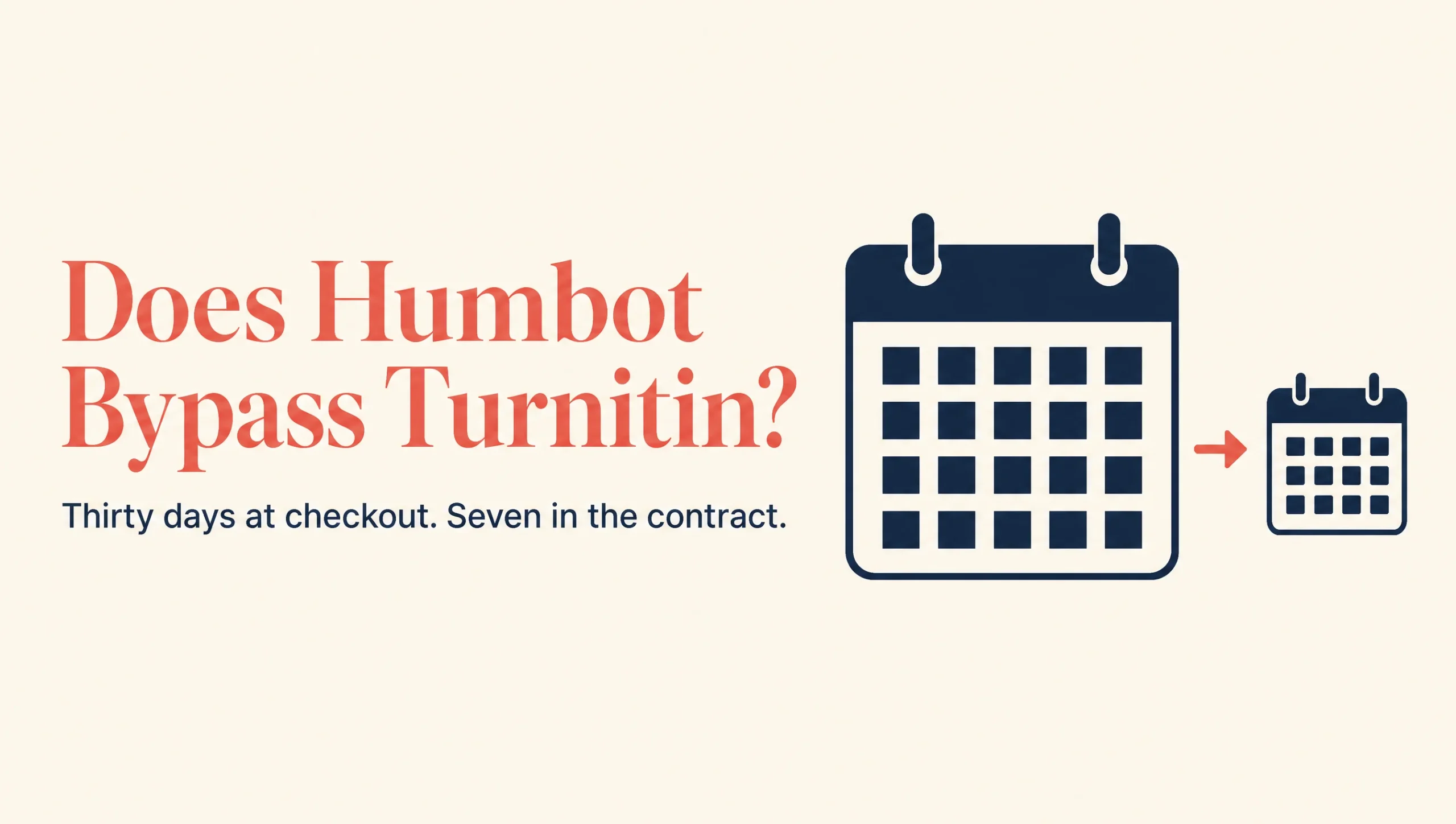
Does Humbot bypass Turnitin? It promises so plainly — and is the only tool here that never wrote itself a way out of the promise.
Want to bypass Turnitin in 2026? Grab the free prompt pack.
Get the exact text-humanization prompts I use to drop an AI score by hand — copy, paste, submit. Free, straight to your inbox.
Send me the free prompts →Key Takeaways
- Humbot promises content that “passes even the strictest AI detectors like Turnitin” — with no figure, no date, no method and no screenshot behind it.
- It is the only tool in this cluster whose Terms contain no detector-performance disclaimer at all. There is no contractual retreat from the claim.
- Its Terms also contain no academic-integrity clause of any kind — on a product headlined “Your All-in-One AI Study Assistant” claiming 6,300+ schools and teams.
- The checkout promises a “30-Day money back guarantee.” The Terms say 7 days, and under 1,000 words used. Those Terms carry no date at all.
- On the 500-word Basic plan, two documents of use extinguishes the refund the pricing page just promised.
- Pangram’s DAMAGE paper gives Humbot the harshest description of all 19 tools audited: sentences that are “uninterpretable” and text that is “unreadable.”
- The same homepage frames Turnitin twice — once as something to verify against, once as something to pass.

Does Humbot bypass Turnitin?
It says so, in one of the most direct sentences in this market: its output “ensures your content passes even the strictest AI detectors like Turnitin, Originality.ai, GPTZero, ZeroGPT and Copyleaks.”
There is no figure attached. No test date, no sample size, no corpus, no methodology, and no screenshot anywhere on the site. Every number on the homepage — 4.9 out of 5, 30M+ users, 6,300+ schools, 86% off — is a marketing or discount figure, not a detector reading.
Curiously, the same homepage frames Turnitin twice, in opposite directions. Once as something to check against: “Humbot empowers you to verify your work against top-tier detection platforms including Originality.ai, ZeroGPT, Turnitin, and GPTZero.” And once as something to defeat.
This page reports no first-party test; everything below was fetched on 31 August 2026.
The unusual part: nothing takes the claim back
Every other tool in this cluster hedges. Clarity Bubble disclaims passing any detector in capitals. HueWrite’s terms say no marketing statement is a guarantee. Phrasly’s say it cannot guarantee output will always pass. WriteHuman’s say it does not guarantee bypassing third-party detection systems.
Humbot’s Terms of Service contain no detector-performance disclaimer at all. No clause about detection outcomes, no warranty carve-out, nothing. And no academic-integrity clause either — no prohibition on cheating, academic dishonesty, or misleading educational institutions — on a product whose hero headline is “Your All-in-One AI Study Assistant” and which claims 6,300+ schools and teams.
Those Terms also carry no effective date and no last-updated date, so there is no way to tell when any of it was written.
The refund promise and the refund clause

The pricing page advertises a flat “30-Day money back guarantee.”
The Terms say: “You are only eligible for a refund if you request it within 7 days of your purchase, and your word usage does not exceed 1000 words during this 7-day period.” Plus: refunds only for purchases made directly on humbot.ai, only for the original purchaser, and “we reserve the right to deny a refund request if we reasonably believe you are exploiting the refund policy.”
Twenty-three days and a word cap separate the two documents. And note what 1,000 words means in practice: the Basic plan caps input at 500 words per request, so two documents of ordinary use extinguishes the guarantee the checkout page just made.
This is the most consumer-legible gap in the cluster, because it does not require any technical judgement to see.
Why can nobody check the Turnitin claim?

| Who | Can see a Turnitin AI writing score? |
|---|---|
| Instructors at licensed institutions | Yes |
| Students, even at their own institution | No — the report is not visible to them |
| Anyone buying an individual licence | No such licence is sold |
| Draft Coach users | No — it has no AI detection |
| A humanizer vendor | No lawful route |
Turnitin’s help centre states it “does not sell individual licenses or single-use subscriptions”, and that “AI writing detection reports are not visible to students”. Draft Coach, the only student-facing Turnitin product, has no AI detection.
So “passes even the strictest AI detectors like Turnitin” describes an outcome Humbot had no lawful way to measure, and that its customers have no way to verify before submitting.
A falsification test for elsewhere: Turnitin’s documentation says “no score or highlights are attributed for AI detection scores in the 1% to 19% range”, showing an asterisk instead. Any image displaying a specific Turnitin AI figure like 3% or 12% is not a genuine current report.
What does independent research say?
Humbot appears in Pangram’s DAMAGE paper, which audited 19 humanizers, and its entry is the harshest in the table:
“Humbot AI — Sentences are uninterpretable and random additions to the text make it unreadable.” Tier: L3, the lowest of three.
No other tool among the nineteen is described as producing text that is unreadable. Humbot is absent from Pangram’s August 2025 benchmark of 20 scored tools.
Two caveats have to travel with that. The paper states it classifies tools “based on faithfulness and fluency, not on their effectiveness at bypassing AI detectors”, and it separately observes that less fluent output can be harder to detect. So the L3 rating is not a detection verdict. It is information about what you would be handing in — and on a study assistant marketed to schools, that is the more immediately useful finding of the two.
What can be checked on Turnitin’s side?
Very little. Turnitin shipped paraphrasing detection in July 2024 and dedicated bypasser detection in August 2025, publishing no accuracy figure for either since. It has never published an overall accuracy percentage. On 4 August 2026 it merged the AI-paraphrased highlight into AI-generated, removing the last signal instructors had.
Independently, Hadra, Cambridge and Mesbah (February 2026, 192 texts) measured Turnitin at 0.61 overall accuracy and 0.51 recall, performing poorly on hybrid human-and-AI text. Weber-Wulff et al. (2023) put field-wide accuracy on machine-paraphrased text at 26%, with Turnitin the best of 14 tools tested.
What should you take from this?
Humbot makes the plainest Turnitin promise in this cluster and backs it with the least. No figure, no method, no screenshot, no disclaimer, no academic-use clause and no date on the contract — sold as a study assistant, with a refund guarantee that shrinks from 30 days to 7 days and 1,000 words between the checkout page and the terms.
The independent read on the output is not encouraging either, and it is the part that affects you regardless of any detector: the one audit that examined it called the sentences uninterpretable.
Turnitin’s own guidance says its model “may misidentify human-written, AI-generated, and AI-paraphrased text, so it should not be used as the sole basis for adverse actions against a student”, and four universities have disabled it — Vanderbilt, Waterloo, Curtin and Washington State. The detector is unreliable in both directions, which is an argument against trusting either side’s confidence.
If your real worry is being wrongly flagged on your own writing, keep your drafting history — it costs nothing and it survives a detector being wrong. It matters most for the writers detectors treat worst: ESL writers and AI detection and false positives for neurodivergent students. Check before you submit with the best pre-submission check and the Turnitin self-check, and strip the obvious tells by hand first via what to remove before using an AI humanizer.
For the same question against Pangram, see does Humbot bypass Pangram. Other Turnitin cells: Clarity Bubble, WriteHuman, Ryne AI, UnAIMyText, AuraWrite, Text Polish, HueWrite, AiTextools, RewriteIQ, GenZWrite, GPT Scrambler, Rephrasy, StealthWriter, Phrasly and QuillBot.
Get the free text-humanization prompts
Get the exact text-humanization prompts I use to drop an AI score by hand — copy, paste, submit. Free, straight to your inbox.
Free · No credit card · Straight to your inbox
Frequently asked questions
Does Humbot bypass Turnitin?
It claims to and publishes nothing to support it. The homepage says its output “passes even the strictest AI detectors like Turnitin” with no percentage, no test date, no sample size and no screenshot. No independent test exists, and no vendor can lawfully obtain a Turnitin AI score to produce one.
Why does the missing disclaimer matter?
Because every competitor in this cluster has one. Humbot’s Terms contain no clause disclaiming that output will bypass or be scored human by AI detectors — while the homepage promises exactly that outcome. There is no contractual retreat from the marketing claim, which is both more honest than a hidden hedge and a materially riskier position for the vendor.
What is the refund contradiction?
The pricing page advertises a flat “30-Day money back guarantee.” The Terms of Service say: “You are only eligible for a refund if you request it within 7 days of your purchase, and your word usage does not exceed 1000 words during this 7-day period.” On the Basic plan, which caps input at 500 words, two documents’ worth of use extinguishes the guarantee the checkout page just made. Those Terms carry no last-updated date at all.
Does it restrict academic use?
No. The Terms contain no clause prohibiting academic dishonesty, cheating or misleading educational institutions — unusual in this market, where competitors like StealthWriter and Phrasly carry explicit prohibitions. Humbot meanwhile brands itself “Your All-in-One AI Study Assistant” and claims 6,300+ schools and teams.
What does independent research say?
Pangram’s DAMAGE paper audited 19 humanizers and rated Humbot AI “L3”, the lowest tier, with the harshest description in the table: “Sentences are uninterpretable and random additions to the text make it unreadable.” No other tool in the paper is described as producing unreadable output. Humbot is absent from Pangram’s August 2025 benchmark of 20 scored tools.
Does a bad quality rating mean it fails detectors?
Not directly, and it would be unfair to say so. The paper states it classifies tools on faithfulness and fluency “not on their effectiveness at bypassing AI detectors”, and separately notes that less fluent output can be harder to detect. The L3 rating is information about what you would be submitting, not a detection verdict.
Why can nobody verify the Turnitin claim?
Turnitin states it “does not sell individual licenses or single-use subscriptions”, its AI writing report is instructor-facing and “not visible to students”, and Draft Coach — the only student-facing Turnitin product — has no AI detection. There is no legitimate consumer route to a Turnitin AI score.
What does Humbot cost?
Three tiers — Basic (3,000 basic and 1,000 advanced words, 500-word input cap), Premium (30,000 and 5,000, 1,200-word cap) and Pro (unlimited basic, 10,000 advanced, unlimited input) — with monthly and yearly toggles carrying 15%, 43%, 63% and 86% off badges. The dollar figures did not render on the page when we checked; the pricing table showed placeholder dashes.
