Want to bypass Turnitin in 2026? Grab the free prompt pack.
Get the exact text-humanization prompts I use to drop an AI score by hand — copy, paste, submit. Free, straight to your inbox.
Send me the free prompts →What AI detector do colleges use? Turnitin, in most cases. It is bundled into the learning-management systems that 16,000+ institutions covering 71M+ students already pay for, so switching it on costs a college nothing extra. Beyond Turnitin, GPTZero (19M+ users), Copyleaks, Originality.ai and Pangram Labs compete on standalone detection, while Grammarly Authorship and Cadmus track how a document was written instead of scoring the finished text.
Which AI detector an educational institution runs in 2026 increasingly depends on which side of the accuracy argument it landed on. The tool-by-tool breakdown, the universities that switched detection off, and the independent accuracy research are all below.
Key Takeaways
- → Turnitin is still the dominant detector, licensed to 16,000+ institutions and 71M+ students, with a paper database of 1.9 billion as of June 2025 (The Markup, 2025)
- → At least seven named universities have disabled or declined AI detection — Vanderbilt, Georgetown, Western, Waterloo, Curtin, plus Stanford and Cal Poly SLO (institutional statements, 2023–2026)
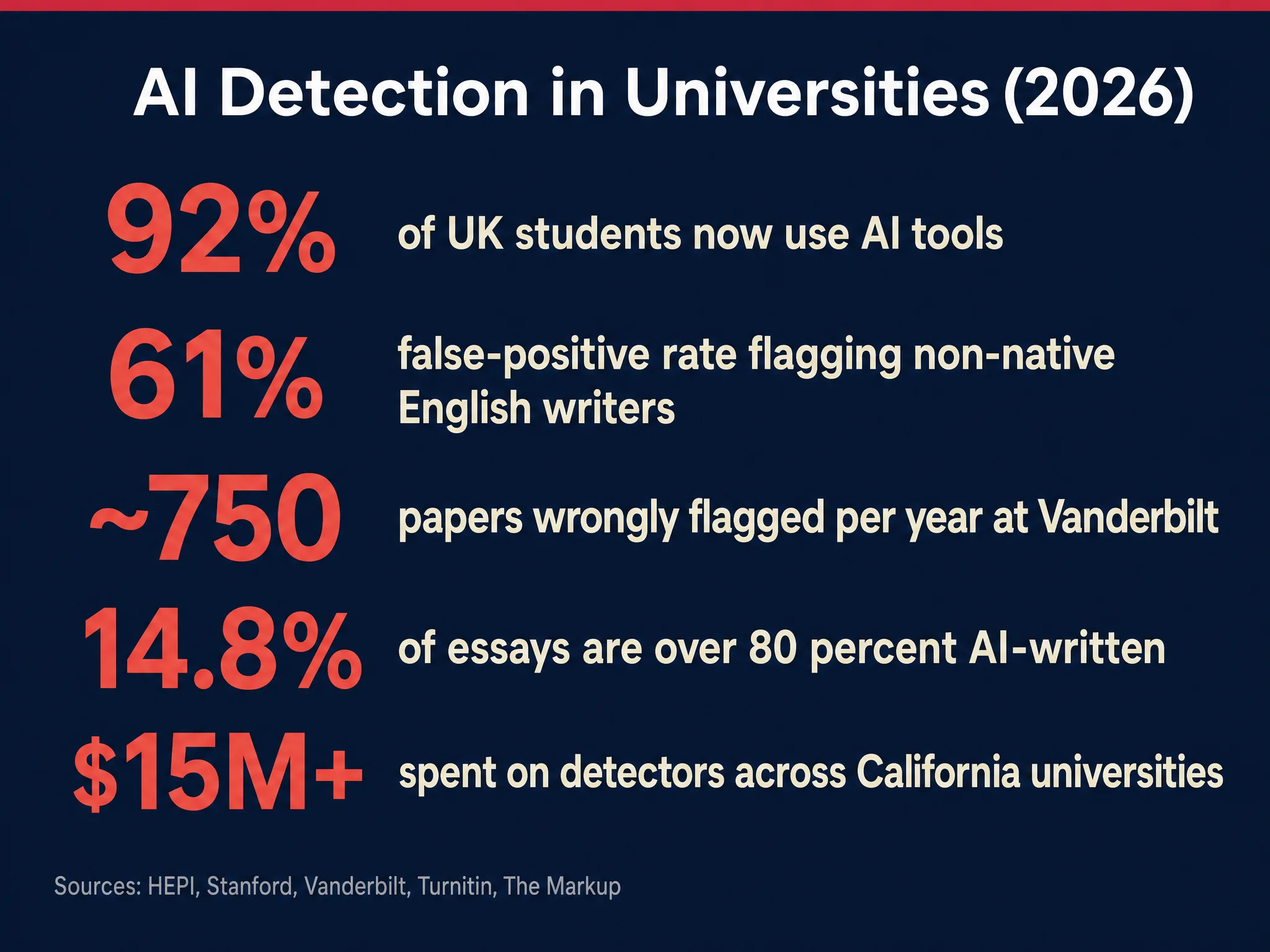
- → A 2023 Stanford study found detectors falsely flagged 61.3% of essays by non-native English writers as AI (Liang et al., Patterns)
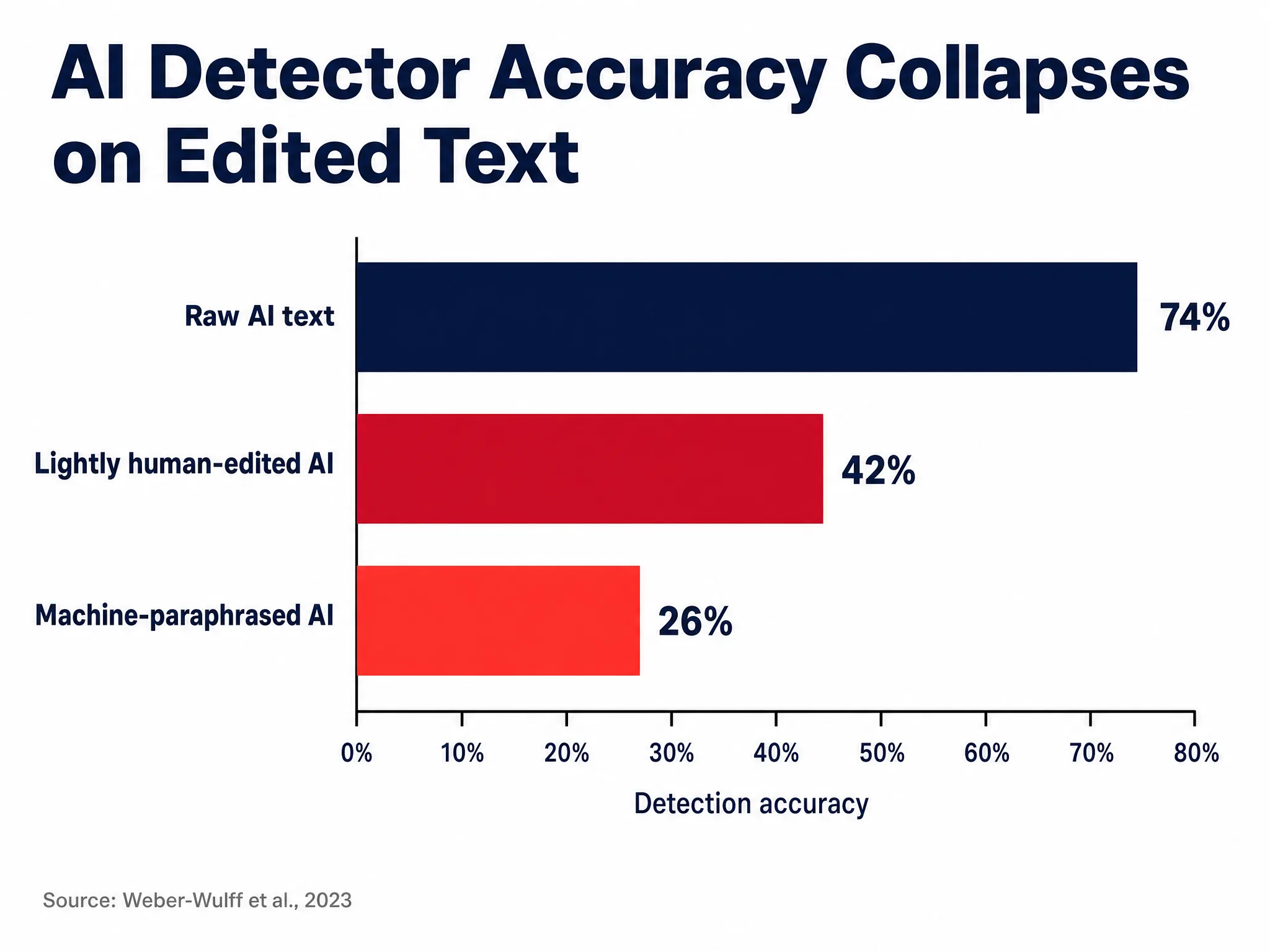
- → Detector accuracy falls to 26% on machine-paraphrased AI text and 42% on lightly edited AI text (Weber-Wulff et al., 2023)
- → 92% of UK students now use AI tools and 88% use them for assessments — up from 53% a year earlier (HEPI/Kortext, 2025)
- → One 2025 investigation tracked $15M+ in detector purchases across 57 California institutions, even as peers walked away (The Markup, 2025)
- → GPTZero, with 19M+ users and $30M ARR, was acquired by Grammarly’s parent in June 2026 — consolidating the “authenticity” market (TechCrunch, 2026)
Three years into the generative-AI era, the question on campus has shifted from “can we detect AI writing?” to “should we even try?” The data from 2025 and 2026 shows a higher-education sector split down the middle: one camp is quietly switching detection off, while another is signing seven-figure renewals. This report maps which AI detection tools universities actually use in 2026, names the institutions that have abandoned them, and lays out what the independent research says about whether any of it works.
Want to bypass Turnitin in 2026? Grab the free prompt pack.
Get the exact text-humanization prompts I use to drop an AI score by hand — copy, paste, submit. Free, straight to your inbox.
Send me the free prompts →1 Which AI detectors do colleges and universities actually use in 2026
Turnitin remains the default in most institutions, but the market has fractured. GPTZero, Copyleaks, Originality.ai and the high-accuracy newcomer Pangram compete on detection, while Grammarly Authorship and Cadmus push a process-tracking model that watches how a document is written rather than scoring the finished text.
| Tool | What it is | 2026 status / scale |
|---|---|---|
| Turnitin | Incumbent similarity + AI detector | 16,000+ institutions; 71M+ students; 1.9B paper database |
| GPTZero | Standalone AI detector | 19M+ users |
| Copyleaks | AI + plagiarism detector, 30+ languages | Self-reported 99.1% accuracy (vendor claim) |
| Originality.ai | Detector aimed at web publishers | Often “too aggressive” for grading |
| Pangram Labs | High-accuracy detector | Independently favored on false-positive rate |
| Grammarly Authorship | Process tracker (not a detector) | ~75K reports/week |
| Cadmus / Packback | Process-based “authentic writing” | In-LMS drafting, prevention model |
| Sources: The Markup (2025); TechCrunch (2026); Grammarly (2026); vendor materials | ||
Turnitin’s reach is the reason it stays in the conversation: it is bundled into the learning-management systems most universities already pay for, so switching it on costs nothing extra. That ubiquity is also why the schools turning it off make news. The newer entrants split into two philosophies. Pangram competes head-on with Turnitin on raw accuracy — useful context if you have ever wondered why Turnitin flags AI when other detectors don’t, since each tool weighs the same statistical signals differently. Grammarly Authorship and Cadmus reject scoring altogether in favour of recording the writing process, a model that looks a lot like the version-history evidence students are already told to keep. The market’s biggest 2026 story is consolidation: Grammarly’s parent company acquired GPTZero in June, putting a detector and a process-tracker under one roof.
2 The universities walking away from detection in 2026
The retreat is real and documented. Vanderbilt was first to publicly disable Turnitin’s AI detector in 2023; Georgetown, Western, Waterloo and Curtin followed, and Stanford never licensed it at all. Their stated reasons are remarkably consistent: false positives, bias against non-native English writers, and no way to see how the tool reaches its verdict.
| Institution | When | Action & stated reason |
|---|---|---|
| Vanderbilt University | Aug 2023 | Disabled Turnitin AI detector; ~750 papers/yr could be wrongly flagged at a 1% error rate |
| Georgetown University | Oct 2023 | Turned it off; “harms of false positives worse than any advantages” |
| Western University (CA) | Jan 2024 | Removed it; “no fully effective tools” for detecting AI |
| University of Waterloo | Sep 2025 | Discontinued; internal tests flagged human text as 100% AI |
| Curtin University (AU) | Jan 2026 | Disabling across all campuses; reliability concerns |
| Stanford University | N/A | Never licensed; cites trust, privacy and IP concerns |
| Cal Poly San Luis Obispo | 2024 | Cancelled Turnitin contract |
| Sources: institutional statements; The Markup (2025); EdTech Innovation Hub (2025) | ||
Vanderbilt’s reasoning became the template the sector now repeats. Its team did the arithmetic out loud: even at Turnitin’s advertised sub-1% false-positive rate, the roughly 75,000 papers it submits each year would mean about 750 students wrongly accused — and that math is exactly why a false-positive defense checklist has become standard student advice. The list of universities that banned AI detectors keeps growing, with Indiana University among the more recent additions. The throughline is institutional risk: administrators concluded that the reputational and legal exposure of false accusations — now the subject of a rising number of lawsuits — outweighs whatever deterrence the score provides.
3 The universities doubling down on detection
Walking away is not universal. The California State and University of California systems kept and expanded their Turnitin licenses through 2025, collectively spending millions — proof that the sector is genuinely split rather than uniformly retreating.
| Buyer | Spend | Detail |
|---|---|---|
| California (57 institutions) | $15M+ | Total tracked Turnitin purchases |
| Cal State system | $1.1M+ | 2025 spend; ~$6M since 2019 (all campuses but Cal Poly SLO) |
| UC Berkeley | ~$1.2M | Multi-year, ~10-year contract |
| LA Community College District | $265K | 2025 license alone |
| Source: The Markup / CalMatters investigation, June 2025 | ||
The spenders are not ignorant of the criticism; they are making a different bet — that some deterrent is better than none, especially as Turnitin ships features to detect AI humanizer tools. Whether that bet pays off depends entirely on the question the next section answers: do the detectors actually work? For a full breakdown of the budgets involved, see our deeper analysis of how much universities spend on AI detection in 2026.
4 What independent research says about detector accuracy
Detectors are good at one narrow job — catching raw, unedited AI output — and unreliable at almost everything else. Accuracy collapses on edited and paraphrased text, and false-positive rates climb sharply for non-native English writers. No independent benchmark has found a detector that is both accurate and safe at scale, with the partial exception of Pangram.
| Finding | Figure | Source (year) |
|---|---|---|
| False-positive rate, non-native English essays | 61.3% | Liang et al., Patterns (2023) |
| Accuracy on machine-paraphrased AI text | 26% | Weber-Wulff et al. (2023) |
| Accuracy on lightly edited AI text | 42% | Weber-Wulff et al. (2023) |
| DetectGPT accuracy after paraphrasing | 70.3% → 4.6% | Krishna et al., NeurIPS (2023) |
| Genuine human essays falsely flagged | 1–2% | Bloomberg test (2024) |
| Black teens reporting false AI flags | 20% | Common Sense Media (2024) |
| Peer-reviewed studies and independent journalism, 2023–2024 (no superseding research as of 2026) | ||
The headline number is the 2023 Stanford finding that seven detectors misclassified 61.3% of non-native English essays as AI — the single most damning statistic in the field, and the reason ESL bias in AI detection shows up in nearly every disabling university’s rationale. The bias is mechanical, not malicious: detectors penalize low lexical variety, which reads as “AI” but is also a hallmark of second-language writing. The disparity extends along racial lines too, with Common Sense Media finding Black teens roughly twice as likely as white teens to be falsely flagged. Independent verification is hard to come by — OpenAI quietly retired its own detector in 2023 over poor accuracy — which is why the documented false-positive rates across detectors matter more than any vendor’s marketing figure.
5 Why detection is losing the arms race
Even a perfect detector would be fighting demographics. Student AI use has gone effectively universal, and a parallel industry of “humanizer” tools is engineered specifically to strip the statistical fingerprints detectors look for. The result is a moving target that detection vendors are structurally behind on.
| Metric | Value | Source |
|---|---|---|
| UK students using AI tools (2025) | 92% | HEPI/Kortext |
| Students using AI for assessments | 88% | HEPI/Kortext (up from 53%) |
| Students globally using AI in study | 86% | Digital Education Council (2024) |
| US teens using ChatGPT for schoolwork | 26% | Pew (2025, double 2023) |
| Undetectable AI humanizer users | 20M | AiThority (2025) |
| Sources: HEPI (2025); DEC (2024); Pew (2025); AiThority (2025) | ||
The demand side is overwhelming: when 88% of students use AI for assessed work, a detector that flags even a small fraction generates an unmanageable volume of cases — which is partly why faculty themselves are split, and why professors are quietly using ChatGPT too. The supply side is worse for vendors. Humanizer tools have grown into a real industry, and the research is blunt about their effect: a 2025 study of 19 humanizer tools showed mainstream detectors routinely fail on humanized text. That is the mechanism behind measured detector bypass rates after humanization, and it explains why the whole AI humanizer industry exists. When students who never used AI can be falsely accused and students who did can pass cleanly, the detector’s signal stops being useful — a tension explored further in the largest undergraduate study on assessment reform.
6 Calculate the false-positive math for any campus
Vanderbilt’s decision came down to one calculation: submissions multiplied by the false-positive rate. Enter any campus’s numbers below to see how many students could be wrongly flagged in a year — the same arithmetic administrators are running before they switch detection off.
The non-native estimate applies the 61.3% false-positive rate from Liang et al. (2023) to the share of submissions you specify. Figures are illustrative projections from published rates, not measured counts at any named institution.
Methodology
This report compiles only verified, dated figures from primary sources — institutional statements, peer-reviewed studies, vendor press releases, and reporting by The Markup, Bloomberg and TechCrunch. Vendor-reported accuracy figures are labelled as claims, not independent facts. Aggregator-sourced figures that could not be traced to a primary source were excluded.
- Sources consulted: 25+ across peer-reviewed journals, university statements, vendor releases and investigative journalism
- Data range: 2023–2026, with current-year sources prioritized
- Last verified: June 27, 2026
- Update schedule: Quarterly, or when a major institution changes its detection policy
Frequently Asked Questions
What AI detection tool do most universities use in 2026?
Turnitin remains the most widely deployed AI detector, licensed to more than 16,000 institutions and over 71 million students worldwide (The Markup, 2025). GPTZero, Copyleaks, Originality.ai and Pangram compete on detection, while Grammarly Authorship offers process tracking instead of scoring. For a head-to-head, see how Turnitin and GPTZero compare.
Which universities have disabled AI detection tools?
Vanderbilt (2023), Georgetown (2023), Western University (2024), the University of Waterloo (2025) and Curtin University (from January 2026) all disabled Turnitin’s AI detector. Stanford never licensed it and Cal Poly San Luis Obispo cancelled its contract in 2024. We track the wider retreat in our report on universities walking away from Turnitin AI detection in 2026.
How accurate are AI detectors really?
They are reliable on raw AI text but unreliable on anything edited. A 2023 benchmark found accuracy fell to 42% on lightly edited AI and 26% on machine-paraphrased AI, and no tool tested topped 80% overall (Weber-Wulff et al., 2023). No superseding benchmark has overturned this as of 2026.
Do AI detectors falsely accuse students?
Yes, and unevenly. A 2023 Stanford study found detectors misclassified 61.3% of essays by non-native English writers as AI (Liang et al., Patterns), and a 2024 Bloomberg test falsely flagged 1–2% of genuine human essays. If it happens to you, here is what to do in the next 24 hours.
Are universities still paying for AI detection?
Many are. A 2025 investigation tracked more than $15 million in Turnitin purchases across 57 California institutions, with the Cal State system spending over $1.1 million in 2025 alone (The Markup). The sector is genuinely split between abandoning and expanding detection.
Can students get around AI detectors?
Research says yes. A 2025 study of 19 humanizer tools found mainstream detectors routinely failed to flag humanized AI text, and paraphrasing alone dropped one detector’s accuracy from 70.3% to 4.6% (Krishna et al., 2023). Here is how AI humanizers work, and why detectors still flag some text.
Sources & References
- Turnitin. “Data Shows Transparency About AI Use Benefits Students and Educators.” turnitin.com. Feb 2026.
- The Markup / CalMatters. “AI Detector Investigation.” themarkup.org. Jun 2025.
- Vanderbilt University. “Guidance on AI Detection and Why We’re Disabling Turnitin’s AI Detector.” vanderbilt.edu. Aug 2023.
- Liang et al., “GPT detectors are biased against non-native English writers.” Patterns (Cell). cell.com. 2023.
- Weber-Wulff et al., “Testing of detection tools for AI-generated text.” Int’l Journal for Educational Integrity. springer.com. 2023.
- Krishna et al., “Paraphrasing evades detectors of AI-generated text” (DIPPER). arxiv.org. NeurIPS 2023.
- Bloomberg Businessweek. “Do AI Detectors Work? Students Face False Cheating Accusations.” bloomberg.com. Oct 2024.
- Common Sense Media. “The Dawn of the AI Era.” commonsensemedia.org. 2024.
- HEPI / Kortext. “Student Generative AI Survey 2025.” hepi.ac.uk. Feb 2025.
- TechCrunch. “Superhuman Acquires AI Detection Startup GPTZero.” techcrunch.com. Jun 2026.
- EdTech Innovation Hub. “Curtin University to Disable Turnitin AI Detection Tool in 2026.” edtechinnovationhub.com. Sep 2025.
- University of Waterloo. “Discontinuing Use of AI Detection Functionality in Turnitin.” uwaterloo.ca. 2025.
- Grammarly. “Grammarly Authorship Update.” grammarly.com. 2026.
- Pew Research Center. “Teens using ChatGPT for schoolwork doubled.” pewresearch.org. Jan 2025.
Last updated: June 27, 2026
