Pangram vs Originality.ai comes down to which mistake costs you more: Pangram makes fewer false accusations and catches more pure AI text in independent tests, while Originality.ai catches more AI-edited drafts in its own tests.
Runs Detection Drama and covers AI detectors and humanizers. I ran no detector checks for this piece. It is based on published studies, both vendors’ pricing and blog pages, and reader reports on Reddit, all read on 16 and 17 November 2026. Reddit comments are people’s claims, not verified facts. Neither company paid for this article.
Want to bypass Turnitin in 2026? Grab the free prompt pack.
Get the exact text-humanization prompts I use to drop an AI score by hand — copy, paste, submit. Free, straight to your inbox.
Send me the free prompts →Last updated: 17 November 2026
Key Takeaways
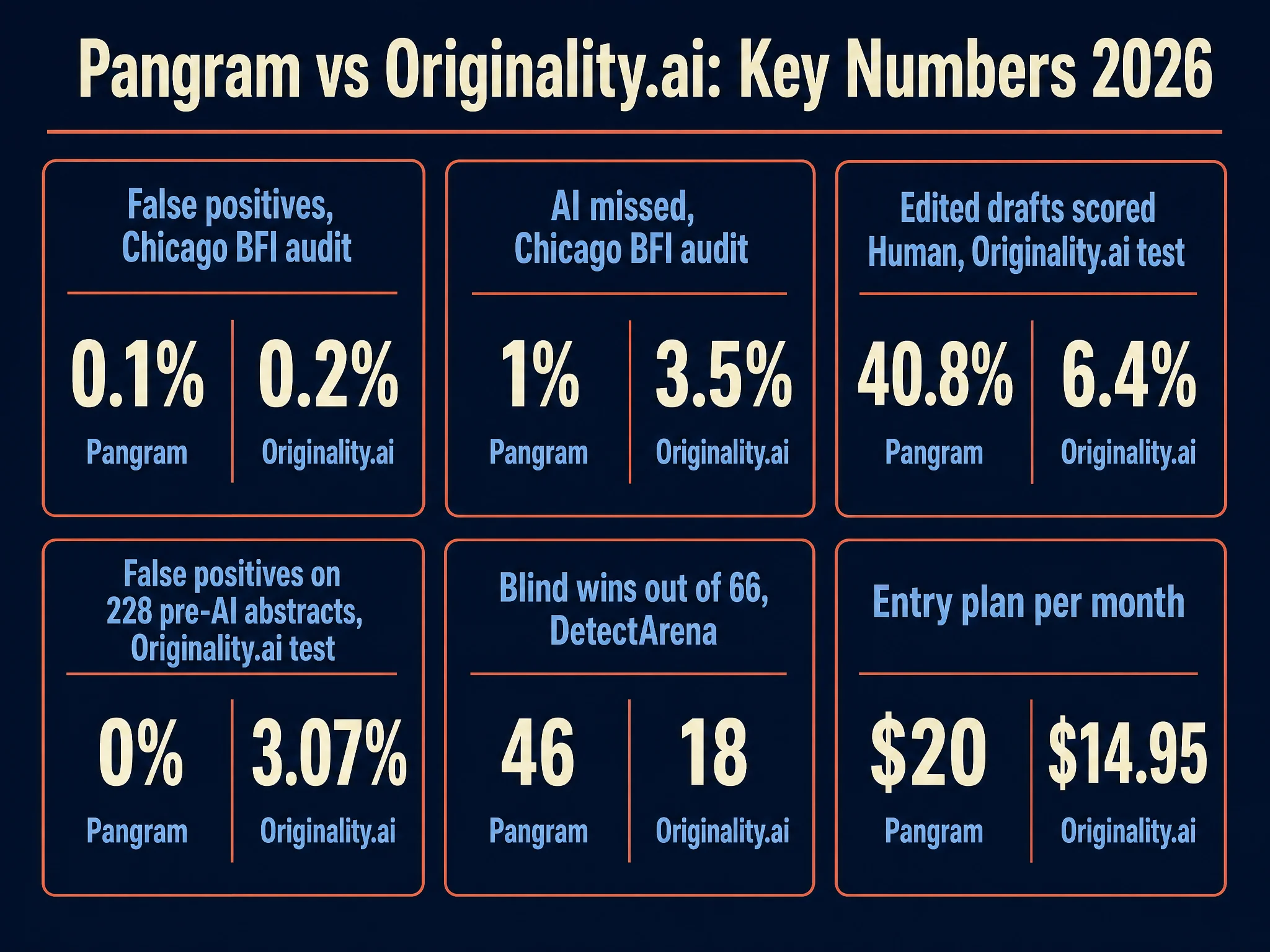
- On the independent University of Chicago audit, Pangram flagged 0.1% of human text and missed 1% of AI text, against 0.2% and 3.5% for Originality.ai (audit table).
- On edited drafts the order flips in Originality.ai’s own test: Pangram 4 called 40.8% of 1,000 AI-rewritten documents human, Originality.ai 6.4% (Originality.ai, Oct 2026).
- On human writing even Originality.ai’s study favours Pangram: 0 false positives on 228 pre-AI abstracts against 7 for Originality.ai (Originality.ai, Oct 2026).
- Almost every test is won by whoever ran it, so check who paid for a result before you trust its winner.
- Price: Originality.ai starts at $14.95 a month for 200,000 words, Pangram at $20 for 300,000 words, which is cheaper per word (Originality.ai pricing, Pangram pricing).
- Pick Pangram when a false accusation is the worse mistake. Pick Originality.ai when a missed AI edit is the worse mistake.
This Pangram vs Originality.ai comparison exists because the two names keep coming up together. In a recent r/BypassAiDetect thread asking for the best AI detector of 2026, the top reply simply listed “Pangram, Originality AI, Winston AI”. In the same thread, a novelist said Originality.ai flagged a book they had published in 2008 as mostly AI, while Pangram called it human. That is one person’s report, but it is the exact question this page answers: when the two disagree, which one do you believe?
The short version: on clean human writing and on raw AI output, the published numbers favour Pangram, including some of Originality.ai’s own. On drafts where AI rewrote or polished part of the text, Originality.ai’s tests favour Originality.ai. If you have read our Pangram vs GPTZero comparison, the pattern will look familiar.
What is Pangram?
Pangram is an AI text detector from Pangram Labs that scores writing as human, AI or AI-assisted, segment by segment. It markets itself on a very low false positive rate, and its current model is Pangram 4. A free account gets 20 free credits daily, and paid plans start at $20 a month for up to 300,000 words.
It is the detector students and admissions forums mention most. Our full Pangram review covers how its scores work and where it slips, and we also looked at how it handles Substack posts.
What is Originality.ai?
Originality.ai is an AI and plagiarism checker built mainly for publishers, agencies and SEO teams. Beyond AI detection it bundles plagiarism checking, readability scores, grammar checks and fact-check assistance, according to its own comparison page. Its entry Pro plan costs $14.95 a month ($12.95 billed yearly) for 200,000 words.
Its distinctive setting is the AI Allowance, which lets you choose how much AI help is acceptable (0%, 5%, 15%, 25% or 40%) before a document counts as AI. Our Originality.ai review goes deeper on its accuracy claims.
How does Pangram compare to Originality.ai?
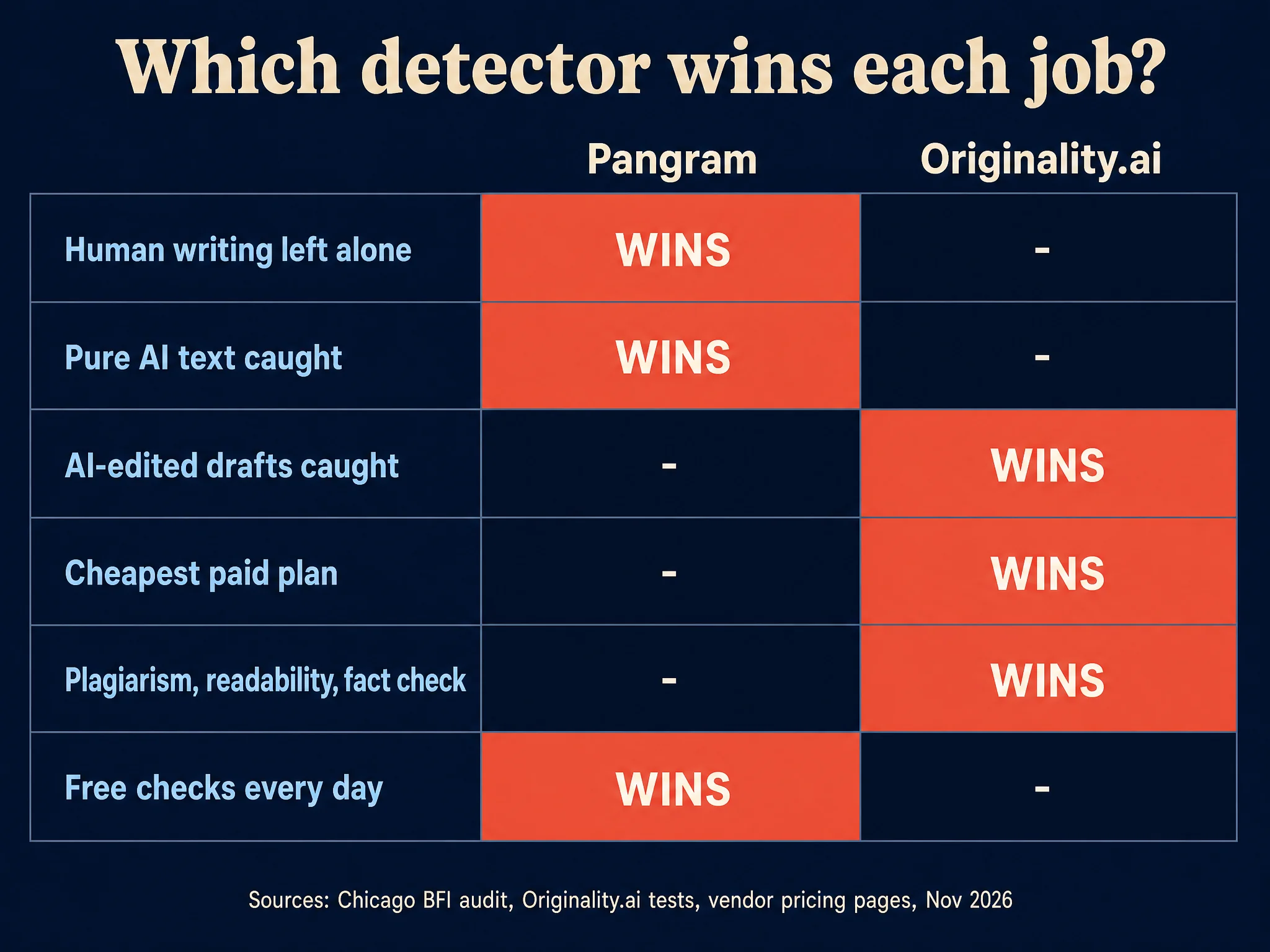
Pangram leads on false positives and on pure AI text in the independent research, and Originality.ai leads on features, entry price and, by its own measure, edited drafts. The table puts the main numbers side by side, each with its source.
| Measure | Pangram | Originality.ai | Source |
|---|---|---|---|
| False positive rate, average | 0.1% | 0.2% | Chicago BFI audit |
| AI text missed, average | 1% | 3.5% | Chicago BFI audit |
| Recall on the Chicago benchmark, re-run | 98.9% | 81.3% | GPTZero re-run, Jan 2026 |
| Edited drafts labelled human (1,000 docs) | 40.8% | 6.4% | Originality.ai test |
| False positives, 228 pre-AI abstracts | 0% | 3.07% | Originality.ai test |
| Missed AI, academic abstracts | 15.26% | 0.38% | Originality.ai test |
| Blind head-to-head wins (66 votes) | 46 | 18 | DetectArena |
| Entry plan | $20/mo, 300k words | $14.95/mo, 200k words | Pangram, Originality.ai |
| Free use | 20 credits a day | 10,000 words, once | Pangram, Originality.ai |
Who ran each test, and who won it?
Almost every test is won by whoever ran it, which is the single most useful thing to know before reading any detector comparison. Originality.ai’s two October 2026 studies find Originality.ai stronger on mixed text and abstracts. Pangram’s evaluation page highlights the studies where Pangram leads. GPTZero’s re-run of the Chicago data puts GPTZero first.
| Test | Who ran it | Sample | Who came out ahead |
|---|---|---|---|
| Artificial Writing and Automated Detection | University of Chicago researchers (independent) | Six genres, four AI models, short to long passages | Pangram, Originality.ai close second |
| Originality.ai vs Pangram | Originality.ai | Up to 31,448 AI texts; 1,000 mixed documents | Tie on pure AI; Originality.ai on mixed |
| Academic abstracts extension | Originality.ai | 2,056 texts from 642 papers | Originality.ai on recall; Pangram on false positives |
| Chicago benchmark re-run | GPTZero (a competitor to both) | The Chicago dataset | Pangram ahead of Originality.ai |
| 160-text comparison | DecEptioner, which sells a humanizer | 138 shared texts | Pangram (right in 19 of 24 disagreements) |
| DetectArena blind votes | Crowd voting site | 66 head-to-head votes | Pangram, 46 to 18 |
| Authors Guild check | Authors Guild (independent) | 10 human articles | Both near zero; Pangram 0% on all ten |
Read that way, the independent results and the competitor re-runs point the same direction: Pangram is ahead on false positives and pure AI text. The one area where Originality.ai leads is measured only by Originality.ai so far. That does not make its result wrong, but it has not been repeated by anyone without a stake in it. Reddit users notice this too; in r/academia, a thread asked why Pangram’s headline 1-in-10,000 false positive claim differs from a figure in a study it cites.
Why do they disagree on edited drafts?
They disagree on edited drafts because they draw the line between human, mixed and AI in different places. In Originality.ai’s test of 1,000 documents where AI rewrote some passages, Pangram 4 labelled 40.8% of them fully human and correctly called 49.4% mixed. Originality.ai, at its 15% AI Allowance, called 6.4% human and 72.7% mixed. On a second benchmark (OpAI-Bench, 1,000 texts) Originality.ai spotted AI help in 69% and Pangram in 22.4%.
That is a real trade-off, not a bug in either tool. A detector that is slow to flag light AI editing will also be slow to flag a human writer whose style happens to look polished. Pangram’s design leans toward leaving people alone; Originality.ai’s leans toward catching help. The same split shows up in its abstracts study: Originality.ai missed far less AI (0.38% vs 15.26%) but wrongly flagged 7 of 228 abstracts written before ChatGPT existed, while Pangram flagged none.
This matters most for students who used Grammarly or ChatGPT to tighten their own draft. One r/ApplyingToCollege poster reported 0% AI on QuillBot and 81% on Pangram after AI edits. If that is your situation, our guides on Grammarly’s detector and running a college essay through a detector explain what those scores do and do not mean.
Which one costs less per word?
Originality.ai has the cheaper sticker price, but Pangram is slightly cheaper per word on monthly plans. Pangram’s Individual plan is $20 for 300,000 words, about $6.67 per 100,000 words. Originality.ai Pro is $14.95 for 200,000 words, about $7.48 per 100,000 words, or about $6.48 if you pay yearly at $12.95 a month.
For occasional use the free tiers matter more. Pangram’s 20 free credits a day reset daily, while Originality.ai’s free plan is a one-time 10,000 words (100 credits at 100 words each). A student checking one essay a week is better served by Pangram’s free tier; a team checking articles every day will be on a paid plan with either.
When should you choose Pangram?
Choose Pangram when a wrongly flagged human is the worst outcome. That covers teachers deciding whether to raise a concern, students checking their own writing, and anyone building a case that their work is genuine. It had the lowest false positive rate in the Chicago study, and the researchers called it the only detector holding “policy-grade” levels across all four AI models.
It also handles more than 20 languages and has a Chrome extension. Its weak spot is the one above: lightly AI-edited text can come back human. For a broader look at free options for students, see our best free AI detector for students.
When should you choose Originality.ai?
Choose Originality.ai when you manage content at volume and need to know if writers leaned on AI. Its AI Allowance setting, plagiarism checker, readability tool and fact-check assistant fit an editorial workflow, and its API returned results in a median 0.99 seconds against 2.42 for Pangram in its own timing test on 280 texts.
Expect more false alarms on human writers than Pangram gives, and say so in your contributor policy. Our piece on whether publishers use AI detectors covers how editors handle that in practice, and our Winston AI review covers the other detector content teams often weigh.
Which one fits your situation?
Pick the line closest to you.
What should you do when Pangram and Originality.ai disagree?
When they disagree, look at what kind of text you have before picking a winner. If the text is fully your own, a Pangram human score is the stronger signal, because its false positive rate is the lowest measured. If AI rewrote or polished some passages, an Originality.ai AI score is probably picking up that help, and Pangram’s human score may be missing it.
Then do three things. First, read which segments each tool highlights instead of the headline percentage. Second, keep your Google Docs or Word version history, which shows the writing process in a way no score can. Third, do not run the text through a humanizer to make a score go away; we looked at whether humanizer skills beat detectors, and the answer is not one to bet a grade on. Short texts are also less reliable on every detector, as our explainer on why short essays get flagged shows.
Frequently asked questions
Is Pangram more accurate than Originality.ai?
On the independent University of Chicago audit, yes: Pangram had fewer false positives (0.1% vs 0.2%) and missed less AI text (1% vs 3.5%) averaged across genres and models. Originality.ai’s own tests find it ahead on edited, AI-assisted drafts. Which one is more accurate depends on whether your text is pure AI, pure human or mixed.
Which detector flags human writing as AI less often?
Pangram, in every test we found that measured it. The Chicago audit put its false positive rate at 0.1%, and even Originality.ai’s own study on 228 pre-AI academic abstracts recorded 0 Pangram false positives against 7 of its own (3.07%).
Which detector catches AI-edited or mixed writing better?
Originality.ai, according to Originality.ai. In its October 2026 test of 1,000 documents with AI-rewritten passages, Pangram 4 labelled 40.8% as human while Originality.ai labelled 6.4% as human. No independent study has repeated that test yet.
Is Pangram or Originality.ai cheaper?
Originality.ai has the cheaper entry plan at $14.95 a month for 200,000 words. Pangram’s Individual plan is $20 a month for 300,000 words, which works out slightly cheaper per word. Pangram also gives 20 free credits a day; Originality.ai gives a one-time 10,000 free words.
Why do Pangram and Originality.ai give different scores on the same essay?
They are trained differently and draw the line between mixed and AI text in different places. Disagreement is most common on drafts where AI rewrote or polished some passages. On fully human or fully AI text the two agree most of the time.
Which one do schools use?
Neither is a default the way Turnitin is. Pangram markets to teachers and has a Canvas integration; Originality.ai markets mainly to publishers, agencies and SEO teams. Reddit users in college and admissions communities mention Pangram far more often.
Should I trust a single AI detector score?
No. Both vendors publish results showing errors in at least some conditions, and the studies that rank them disagree. Treat a score as a reason to look closer, keep your drafts and version history, and never treat it as proof on its own.
