ZeroGPT vs GPTZero is not a coin toss: they are different companies with different models, and when ZeroGPT says 90% AI while GPTZero says 3%, the independent evidence says ZeroGPT is usually the one raising a false alarm.
Runs Detection Drama and covers AI detectors and humanizers. I ran no new detector checks for this piece. It is based on three published studies, both vendors’ own pages, an earlier Detection Drama check of ZeroGPT, and reader reports on Reddit, all read on 18 and 19 November 2026. Reddit comments are people’s claims, not verified facts. Neither company paid for this article.
Want to bypass Turnitin in 2026? Grab the free prompt pack.
Get the exact text-humanization prompts I use to drop an AI score by hand — copy, paste, submit. Free, straight to your inbox.
Send me the free prompts →Last updated: 19 November 2026
Key Takeaways
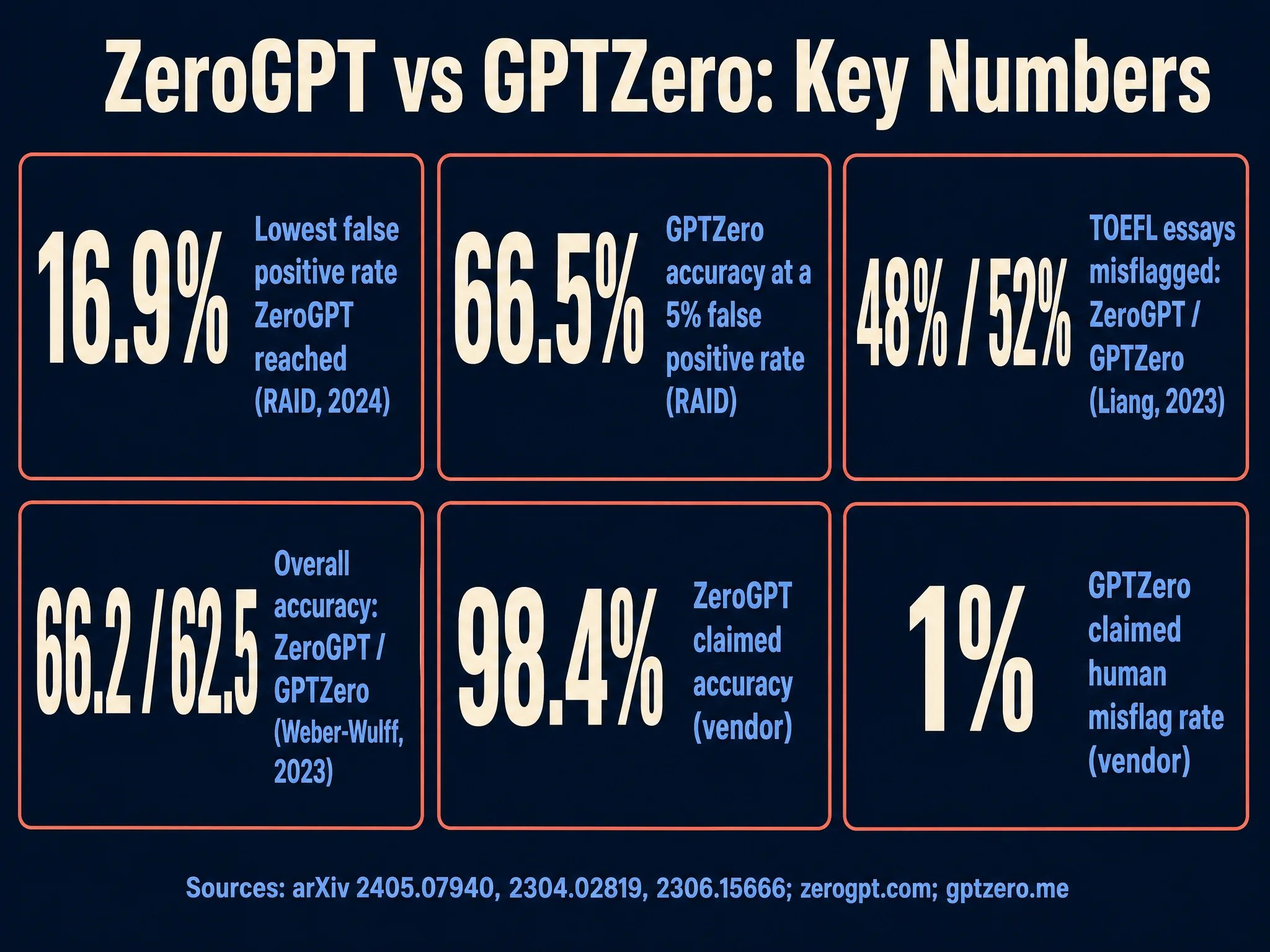
- In RAID, the largest independent detector benchmark, ZeroGPT could not get its false positive rate below 16.9%, so roughly one human text in six still came back as AI at its strictest setting (Dugan et al., 2024).
- GPTZero could be held to a 5% false positive rate and still caught 66.5% of AI text in the same benchmark (RAID).
- Older 2023 studies call them close to a tie: 66.2 vs 62.5 overall accuracy for ZeroGPT and GPTZero (Weber-Wulff et al.), and both misflagged about half of 91 non-native English essays (Liang et al.).
- Since mid-November 2026, Reddit users report ZeroGPT scores on old, unchanged work jumping from single digits to 70% to 100%. ZeroGPT’s site shows no dated changelog explaining it.
- Free use: ZeroGPT allows 15,000 characters per check with no account; GPTZero allows 10,000 words a month (ZeroGPT, GPTZero).
- Neither score is proof. If they disagree on your own writing, trust the GPTZero result more, and keep your version history either way.
This ZeroGPT vs GPTZero comparison exists because the same question keeps landing in the same forums. On 11 November 2026 an r/BypassAiDetect user posted that ZeroGPT flagged their essay at 90% AI while GPTZero said 3%. The same day, an r/humanizeAIwriting user reported about 80% on ZeroGPT against about 4% on GPTZero. Both asked the same thing: should I be worried?
Those are two people’s reports, not tests. But the pattern they describe matches what the research says about the two tools, and this page walks through that evidence. If you only want the ZeroGPT details, our full ZeroGPT review goes deeper.
What is ZeroGPT?
ZeroGPT is a free, ad-supported AI text detector at zerogpt.com that gives a single AI percentage and highlights the sentences it suspects. You can paste up to 15,000 characters per check without an account, and the site claims 98.4% detection accuracy with what it calls DeepAnalyse technology.
It has grown into a toolbox: paraphraser, summarizer, grammar checker, translator and plagiarism checker sit beside the detector. Paid plans start at $8.99 a month on a promotional price ($14.99 regular), and they mainly raise limits on those extra tools. The detector itself stays at 100,000 characters per check on Pro.
What is GPTZero?
GPTZero is a separate company, launched in January 2023, that sells AI detection mostly to schools, publishers and businesses. Its free plan covers 10,000 words a month, and paid plans run from $12.99 a month for 300,000 words to $24.99 for 500,000 words, billed annually.
GPTZero publishes more about its own testing. On its comparison page it claims to catch 95.7% of AI texts while flagging 1% of human texts, and says it shipped 15 model releases in 2025. Those are the vendor’s numbers. Our Pangram vs GPTZero comparison shows where independent tests put it against a stronger rival.
How does ZeroGPT compare to GPTZero?
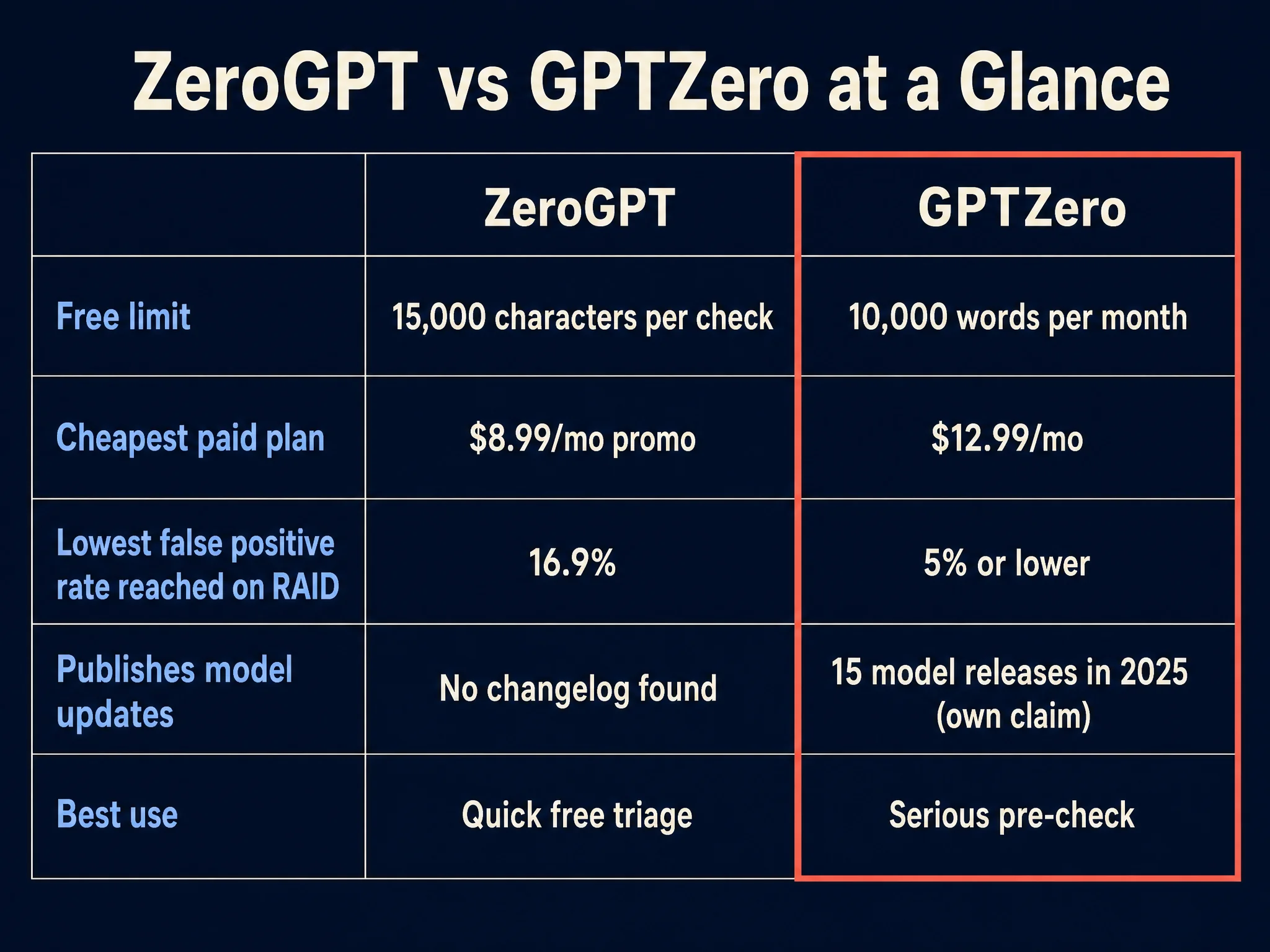
GPTZero is the better calibrated detector, and ZeroGPT is the more generous free tool. The table lists each number with its source, and marks which ones come from the vendors themselves.
| Measure | ZeroGPT | GPTZero | Source |
|---|---|---|---|
| Lowest false positive rate it could reach | 16.9% | 5% or lower | RAID, 2024 |
| AI text caught at a 5% false positive rate | Could not reach 5% | 66.5% | RAID, 2024 |
| Overall accuracy, 54 test cases | 66.2 | 62.5 | Weber-Wulff et al., 2023 |
| Non-native TOEFL essays flagged as AI | 48% | 52% | Liang et al., 2023 |
| US 8th-grade essays flagged as AI | 0% | 0% | Liang et al., 2023 |
| Claimed accuracy | 98.4% (vendor) | 95.7% caught at 1% misflag (vendor) | ZeroGPT, GPTZero |
| Free limit | 15,000 characters per check, no account | 10,000 words a month | ZeroGPT, GPTZero |
| Cheapest paid plan | $8.99 a month (promo) | $12.99 a month (annual) | Same pricing pages |
Why does ZeroGPT say 90% when GPTZero says 3%?
ZeroGPT says 90% when GPTZero says 3% because the two tools draw the line between human and AI in very different places, and ZeroGPT draws it much closer to ordinary human writing. Every detector has a threshold. Set it low and the tool catches more AI text but also flags more people; set it high and it misses more AI but accuses fewer people.
The RAID team tested this directly. They tuned each commercial detector to stricter and stricter false positive targets on human-written text, and reported that some tools “failed to achieve the lowest FPR we tested, plateauing at 16.9% (ZeroGPT)” (Dugan et al.). In plain terms, even at its most cautious setting, ZeroGPT kept calling about one human text in six AI. GPTZero could be held to 5% and still catch two thirds of AI text.
That gap is exactly what produces the 90% versus 3% screenshots. A text with some polished, predictable sentences sits in a grey zone. GPTZero leans human on it; ZeroGPT leans AI. Short texts make the grey zone wider on every tool, as our explainer on why short essays get flagged more often shows.
Why do older studies call ZeroGPT and GPTZero a tie?
Older studies call them a tie because they measured a different thing on smaller samples, before either tool’s current model existed. Weber-Wulff and colleagues ran 14 detectors over 54 test cases in 2023 and gave ZeroGPT 66.2 and GPTZero 62.5 for overall accuracy, concluding the tools were “neither accurate nor reliable” (Weber-Wulff et al.).
The Stanford study by Liang and colleagues found the same rough tie on bias. On 91 TOEFL essays written by non-native English speakers, the seven detectors misflagged 61.22% on average; ZeroGPT flagged 48% and GPTZero 52% (Liang et al.). Both flagged 0% of US 8th-grade essays. We cover that bias in our piece on AI detection and ESL writers.
So which result stands? Overall accuracy mixes two errors together, missing AI and accusing humans, and a tool can score “accurate” while making far too many accusations. RAID is newer, uses millions of texts, and separates the two errors by fixing the false positive rate first. On the question most readers care about, how often a human gets flagged, it is the clearest evidence, and it does not favour ZeroGPT. All three studies are older than the models running today, which is one more reason to treat any single score as a hint, not a verdict.
What changed in ZeroGPT in November 2026?
Nobody outside ZeroGPT knows yet, and ZeroGPT has not said. What is visible is a cluster of reports. On 13 November 2026 an r/BypassAiDetect user wrote that essays that had scored 5% to 10% “a few days ago” were now “well into the 70s-90s”, and several replies said the same about their own drafts. On 18 November an r/ChatGPT post titled “ZERO GPT IS A SCAM!!” complained that the tool now flags nearly everything the poster types as 100% AI.
A thread in a Turnitin-checking subreddit asked whether ZeroGPT had updated its DeepAnalyse model; that community is run around a paid checking service, so we treat it as context only. When we read ZeroGPT’s homepage on 19 November, it described DeepAnalyse and the 98.4% claim but gave no model version or update date.
Two cautions. These are anonymous reports, and some come from people who had run AI text through a humanizer, so a detector catching more of that would look the same. And the jump is not universal: in a Detection Drama check published on 18 November, ZeroGPT’s free version scored two pre-ChatGPT human application essays at 0% and 8.6%, both labelled human written (full write-up). If your old work suddenly scores higher, the text did not change. The tool did.
What happens when you rewrite the sentences ZeroGPT flags?
The flag tends to move rather than disappear. In that same 18 November check, ZeroGPT flagged two sentences in one paragraph of a 2020 personal statement. Replacing only those two sentences with a plainer version of the same facts dropped the score from 8.6% to 3.3%, but ZeroGPT then flagged the new sentence instead (Detection Drama).
That is one essay, not a study. Still, it shows why chasing a ZeroGPT score sentence by sentence is a poor use of an evening: the tool reacts to how predictable a sentence looks, and almost any clear sentence can look predictable. It also shows why a humanizer is the wrong fix; we looked at whether humanizer skills beat AI detectors, and the answer is not one to bet a grade on.
What should you do when ZeroGPT and GPTZero disagree?
When they disagree on writing you produced yourself, give the GPTZero result more weight, then stop testing. The independent evidence says ZeroGPT is far more likely to misflag a human, so a high ZeroGPT score next to a low GPTZero score is mostly noise. If both are high, look at what you actually did with AI before you panic, and read the highlighted passages rather than the headline number.
Either way, three habits matter more than any score. Write in Google Docs or Word so your version history exists. Keep notes and outlines. And remember that your school probably uses neither tool; our guide to the AI detector closest to Turnitin covers what instructors actually see.
What did your two scores say?
Pick the line closest to your result.
When should you choose ZeroGPT, and when GPTZero?
Choose ZeroGPT for a quick, free, no-account look at a draft when nothing rides on the number. Its 15,000-character free check is the most generous of the two, and the extra writing tools are handy if you want them.
Choose GPTZero when the result matters: checking a submission before it goes in, screening a contributor’s article, or getting a second opinion on a flag. Its false positive record in RAID is far better, and it publishes more about how its models change. If you want a stronger free pre-check than either, our list of the best free AI detectors for students includes Pangram, which beat GPTZero on false positives in independent tests.
Frequently asked questions
Are ZeroGPT and GPTZero the same company?
No. GPTZero launched in January 2023 and sells mainly to schools, publishers and businesses. ZeroGPT is a separate, ad-supported site at zerogpt.com. The near-identical names cause constant confusion, including about which tool a teacher used.
Is GPTZero more accurate than ZeroGPT?
On false positives, yes. In the RAID benchmark ZeroGPT could not get below a 16.9% false positive rate, while GPTZero was held to 5% and still caught 66.5% of AI text. Older 2023 studies with smaller samples found the two roughly level on overall accuracy.
Why is ZeroGPT so much higher than GPTZero on my essay?
ZeroGPT draws the line between human and AI closer to ordinary writing, so polished or predictable sentences tip it toward AI sooner. Since mid-November 2026, Reddit users have also reported ZeroGPT scores on unchanged work jumping sharply, and ZeroGPT has published no changelog explaining it.
Did ZeroGPT update its detector in November 2026?
Users report a sudden change around 11 to 13 November 2026, with old essays moving from single digits to 70% or more. ZeroGPT’s homepage, read on 19 November, gave no model version or update date, so the cause is unconfirmed.
Which one is free?
Both have free tiers. ZeroGPT checks up to 15,000 characters at a time with no account. GPTZero’s free plan covers 10,000 words a month. Paid plans start at $8.99 a month promotional for ZeroGPT and $12.99 a month for GPTZero.
Do teachers use ZeroGPT or GPTZero?
GPTZero sells institutional plans to schools, while ZeroGPT is mostly used as a free website. Individual teachers can paste text into either free tool, which is why ZeroGPT’s false positive record matters to students.
Should I rewrite my essay until ZeroGPT says human?
No. In a Detection Drama check, rewriting the two sentences ZeroGPT flagged lowered the score but the tool flagged the new sentence instead. Keep your drafts and version history, fix only what is genuinely generic, and do not run your work through a humanizer.
Sources
Dugan et al., RAID: A Shared Benchmark for Robust Evaluation of Machine-Generated Text Detectors (ACL 2024). Liang et al., GPT detectors are biased against non-native English writers (Patterns, 2023). Weber-Wulff et al., Testing of detection tools for AI-generated text (2023). Vendor pages: ZeroGPT, ZeroGPT pricing, GPTZero pricing, GPTZero vs ZeroGPT, all read 18 and 19 November 2026. Reader reports: Reddit threads linked above, posted 11 to 18 November 2026.
