The only tool that bypassed Pangram and Turnitin in 2026.
Most humanizers clear one detector and get caught by the other. StealthWriter is the one that gets past both — run Ghost 5.2 Pro at level 7–8, section by section, and re-check before you submit.
Try StealthWriter →Avoid Sounding Like AI: 2026 Statistics on People Deliberately Changing How They Write
The fastest-growing writing trend of 2026 is people trying to avoid sounding like AI. Not students running essays through humanizers — ordinary adults deliberately shortening sentences, leaving small mistakes in, and stripping out em-dashes so their own human writing does not get mistaken for machine output. This page aggregates every published number on that behavioral shift: how many people are doing it, what exactly they change, and what the social penalty for “sounding AI” now costs. All figures below are sourced and dated; most were published between May and July 2026.
The only tool that bypassed Pangram and Turnitin in 2026.
Most humanizers clear one detector and get caught by the other. StealthWriter is the one that gets past both — run Ghost 5.2 Pro at level 7–8, section by section, and re-check before you submit.
Try StealthWriter →Key Takeaways
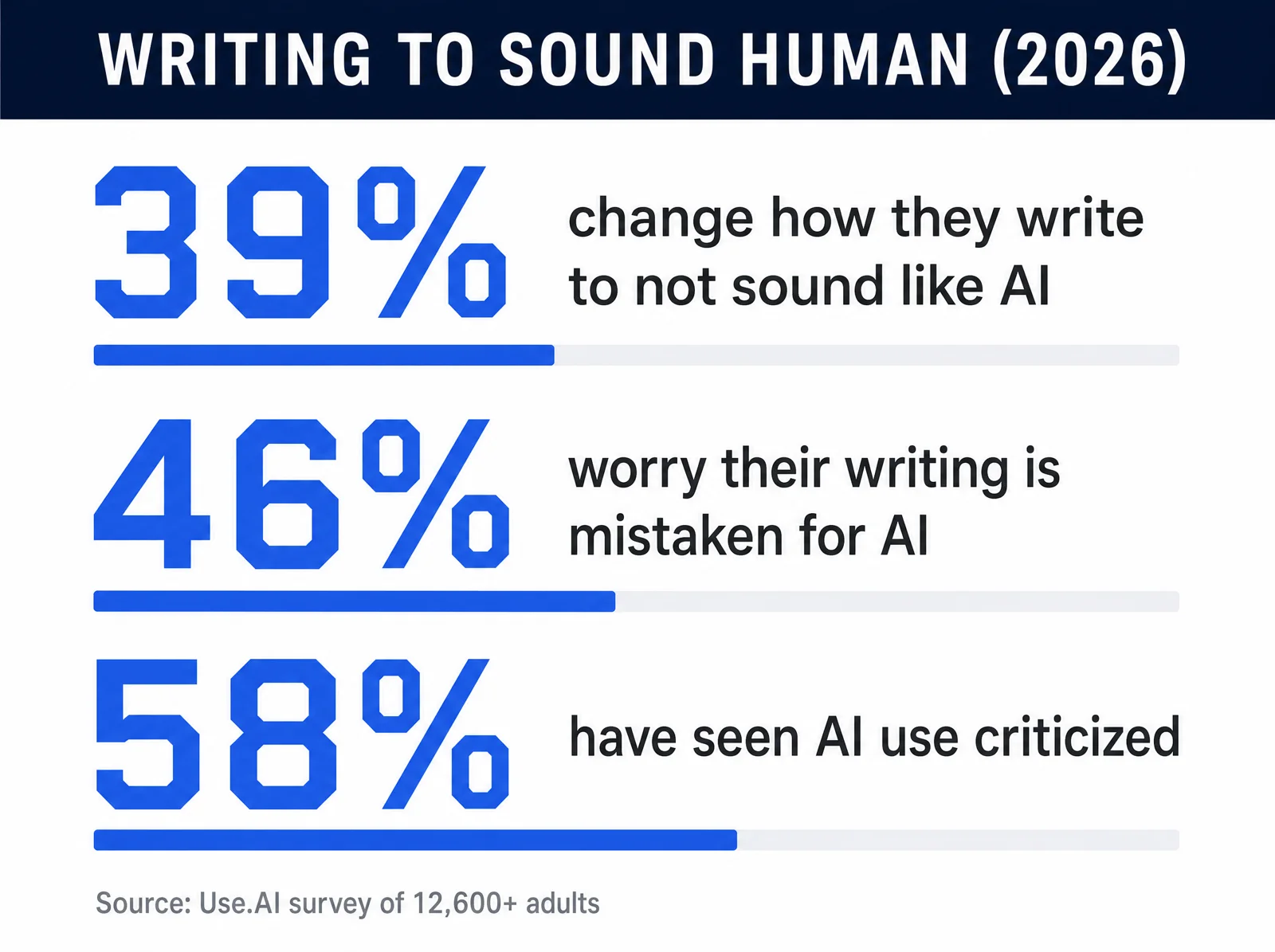
- → 39% of 12,600+ surveyed adults are changing how they write so it does not sound like AI (Use.AI, 2026)
- → 46% worry their own writing could be mistaken for AI-generated content (Use.AI, 2026)
- → 58% have seen someone criticized online or at work for using AI (Use.AI, 2026)
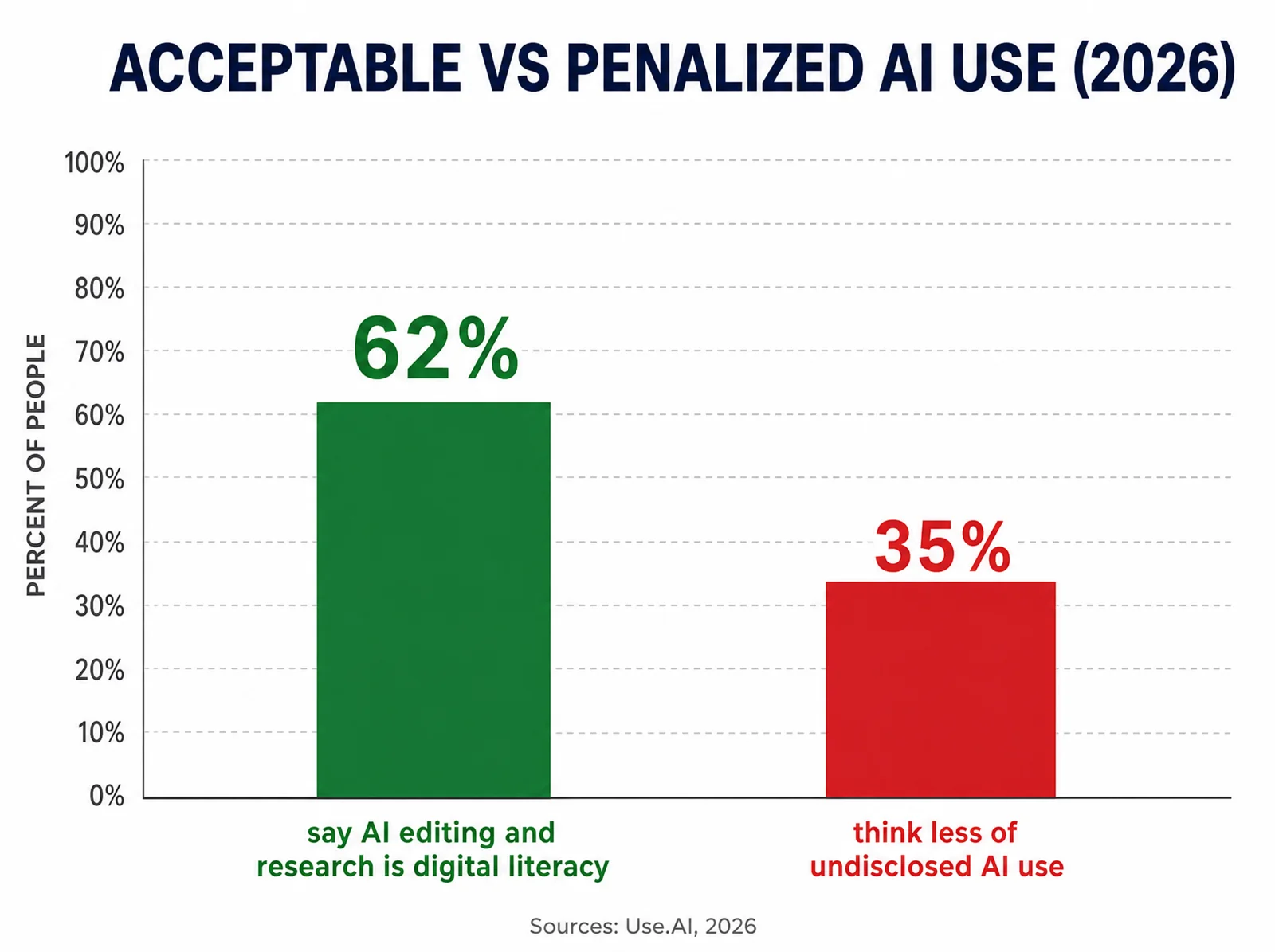
- → 35% would think less of a colleague or creator who used AI without disclosure; 34% would be less likely to support that creator (Use.AI, 2026)
- → More than 4 in 10 UK/US consumers now question whether the messages they receive are genuine (Exclaimer, 2026)
- → 62% say AI for editing, brainstorming and research is simply modern digital literacy (Use.AI, 2026)
- → A browser plugin now exists whose only job is adding typos to AI emails so they read as human (Futurism, 2026)
1 How Many People Are Changing How They Write?
39% of more than 12,600 adults surveyed across the US, UK, Europe and Latin America say they now change how they write specifically to avoid sounding like AI, and 46% worry their writing could be mistaken for machine output (Use.AI, June 2026).
| Metric | Value | Source |
|---|---|---|
| Adults changing how they write to not sound like AI | 39% | Use.AI, 2026 |
| Worry their writing could be mistaken for AI | 46% | Use.AI, 2026 |
| Have seen someone criticized for using AI | 58% | Use.AI, 2026 |
| Survey sample (US, UK, Europe, Latin America) | 12,600+ | Use.AI, 2026 |
| Source: Use.AI report, via TechRadar, June 21, 2026 | ||
The ordering of those three numbers tells the story: exposure to criticism (58%) breeds fear (46%), and fear converts into behavior change (39%). Use.AI’s own framing is blunt — “sounding like AI has now become a social stigma.” The report singles out creative workers as facing the sharpest version of the problem, because their genuinely polished work carries the same surface signals readers associate with machine output. That perception loop is the same one we documented from the detector side in how a fully human-written essay can still look AI-generated — polish itself has become evidence.
3 What People Actually Do to Sound Human
The documented tactics are all subtraction: shorter sentences, deliberate small imperfections, and removing the em-dashes that AI tools overuse (Use.AI, 2026). At the extreme end, a browser plugin now adds typos to AI-generated emails automatically.
The Use.AI report describes workers editing AI output — and their own writing — by “cutting sentences shorter, adding small imperfections and removing the long dashes that AI tools still seem obsessed with using.” What began as students’ folk wisdom about dodging Turnitin has become general professional practice. The irony is that most of these “tells” were never reliable to begin with — we broke down what actually makes writing sound AI-generated to human readers, and punctuation barely registers next to rhythm and specificity.
The literary world is running the same playbook with higher stakes. Machine Brief documents an emerging anti-AI counterculture among authors and essayists: deliberate typos as stylistic signals, em-dashes swapped for parentheses, aggressive sentence-length variance, and literary magazines adding explicit “no AI polish” notes to submission guidelines. Professional writers are voluntarily doing to their prose what the AI humanizer industry charges monthly subscriptions to do to ChatGPT output — roughing up text so it reads as human. The difference is direction: humanizers disguise machines as people; these writers are trying to stop being mistaken for machines. Both are responding to the same detector-shaped incentive we covered in what makes an essay sound “too polished”.
4 Where Readers Draw the Line on AI Use
The stigma is specific, not general: 62% say AI for editing, brainstorming and research is simply modern digital literacy (Use.AI, 2026), and 58% of UK/US adults already use AI somewhere in their communications (Exclaimer, 2026). The penalty attaches to full generation without disclosure.
Read together, the two studies describe a population using AI heavily while policing how AI-shaped the results are allowed to look. Grammar fixes and tone polish are fine; text that reads generated is not. Use.AI summarizes the resulting etiquette with unusual candor: “Use the tool, but leave no fingerprints. Be efficient, but not suspiciously efficient. Write clearly, but not too cleanly.” The report’s stated worry is not weak work looking competent — it is skilled people degrading good work to appear less AI.
5 Can Anyone Actually Tell? The Detection Reality
Mostly no. 2026 research covered by Fast Company found most people cannot tell when a personal text message was written by AI — while separate research shows automated detectors misclassify lightly AI-polished human writing in both directions.
The perception arms race runs on weak radar. When researchers tested whether people could identify AI-written personal messages, most participants could not reliably tell — yet the suspicion itself has spread into the most sensitive channels: a 2026 study formally analyzed clients asking “are you an AI?” in crisis counseling conversations. Machines are no better positioned to referee. The “Almost AI, Almost Human” research found that detectors systematically stumble on AI-polished human text (2025; no superseding benchmark as of mid-2026), which matches the disagreement we measured across commercial tools in how much AI detectors disagree with each other.
6 The Education Spillover: Students Writing Worse on Purpose
The behavior went mainstream in classrooms first. A March 2026 r/Professors thread on students deliberately writing worse to avoid AI flags drew 681 upvotes and 203 comments from faculty seeing it firsthand.
Professors did not need a survey to spot the trend — the r/Professors discussion is 203 comments of faculty describing students simplifying vocabulary and flattening style as flag insurance. We covered the student side of this in depth, including the survey data on detector stress, in our AI detection anxiety statistics; the population-level numbers on this page show the same defensive instinct escaping the classroom. The students most exposed are the ones whose natural writing already trips detectors — non-native English writers and neurodivergent students — for whom “writing worse on purpose” is less a tactic than a survival strategy. Even routine tool use now carries flag risk, as the cases in Grammarly-triggered Turnitin flags show.
7 Interactive: Does Your Writing Read as AI?
Methodology
This page aggregates published survey data, journalism and research on deliberate “de-AI-ing” of human writing. Statistics were compiled and verified on August 1, 2026. Where two sources reported the same behavior, the more recent figure is used. Two widely circulated numbers — a claimed Stanford em-dash usage study and a “45% leave typos on purpose” figure circulating on Reddit — could not be traced to a primary source and were excluded.
- Sources cited: 8 (2 large-sample surveys, 2 peer-reviewed/preprint studies, 3 journalism outlets, 1 primary community thread)
- Data range: 2025 – July 2026; core survey data from June 2026
- Last verified: August 1, 2026
- Update schedule: quarterly, or when new large-sample survey data publishes
Frequently Asked Questions
How many people change their writing to avoid sounding like AI?
39% of more than 12,600 people surveyed across the US, UK, Europe and Latin America say they change how they write specifically so it does not sound like AI, per the June 2026 Use.AI report. A further 46% worry their writing could be mistaken for AI output.
Why do people not want to sound like AI?
Because readers punish it: 58% have seen someone criticized for using AI, 35% would think less of a colleague or creator using AI without disclosure, and 34% would be less likely to support that creator (Use.AI, 2026). Sounding machine-made now has a social cost even when the writing is fully human.
What writing habits make text seem AI-generated to readers?
Perfection is the tell: flawless grammar, predictable transitions, emotionally neutral tone and heavy em-dash use (Use.AI, 2026). Many of the same habits are normal writing habits that can also trigger detector flags.
Does adding typos actually stop AI detectors?
No. Typos target human perception. Detectors score statistical patterns across whole documents, and research on AI-polished text (arXiv 2502.15666) shows they misclassify in both directions regardless of surface imperfections. A typo strategy can make writing worse without making it safer.
Is it socially acceptable to use AI for editing and research?
Largely yes — 62% call AI-assisted editing, brainstorming and research part of modern digital literacy, and 58% of UK/US adults already use AI in their communications (Use.AI and Exclaimer, 2026). The penalty concentrates on undisclosed full generation.
Sources & References
- Use.AI. “Report on AI and writing authenticity” (survey of 12,600+, US/UK/EU/LatAm), covered in TechRadar, “Study finds people are starting to fear sounding like AI.” techradar.com. Accessed August 1, 2026.
- Exclaimer. “As AI use rises, over four in 10 consumers question whether messages are genuine.” intelligenttechchannels.com. Accessed August 1, 2026.
- Machine Brief. “Writers Building Anti-AI Literary Counterculture.” machinebrief.com. Accessed August 1, 2026.
- Futurism. “New Browser Plugin Adds Typos to Your AI-Generated Emails to Make Them Look Real.” futurism.com. Accessed August 1, 2026.
- Fast Company. “Most people can’t tell when a personal text message is written by AI.” fastcompany.com. Accessed August 1, 2026.
- arXiv. “‘Are you an AI?’ Analyzing Client Suspicion of AI Use in Crisis Counseling” (2606.18261). arxiv.org. Accessed August 1, 2026.
- arXiv. “Almost AI, Almost Human: The Challenge of Detecting AI-Polished Writing” (2502.15666, 2025). arxiv.org. Accessed August 1, 2026.
- r/Professors. “Students are deliberately writing worse to avoid AI detection flags” (March 2026, 681 upvotes). reddit.com. Accessed August 1, 2026.
Last updated: August 1, 2026. Statistics verified against primary coverage on this date.

2 The Social Penalty for Sounding Like AI
Undisclosed AI use now carries a measurable reputational cost: 35% of people would think less of a colleague or creator who used AI without disclosure, and 34% would be less likely to support that creator at all (Use.AI, 2026).
Note what the Exclaimer trust signals have in common: none of them are about the writing. Readers who can no longer judge authenticity from prose quality fall back on metadata — contact details, sender domains, names. For anyone accused of machine writing, this is the same shift we track in accusation defense: process evidence beats text evidence, which is exactly why version history has become the default proof of authorship when a detector or a suspicious reader flags human work. And suspicion is not rare: detector-side numbers show the same pattern, with documented false-positive rates putting real people in that position every day.