College essay AI detector scores are worth far less than the panic they cause. If you wrote the essay, you do not need one. If AI wrote part of it, you already know the problem, and a score will not fix it.
Written by Vlad Ivanov
Runs Detection Drama, testing AI detectors and humanizers hands-on. I ran no new detector test for this piece and I am not an admissions officer. I read the college and policy pages below directly on 6 November 2026. Reddit comments are people’s claims, not verified facts.
Want to bypass Turnitin in 2026? Grab the free prompt pack.
Get the exact text-humanization prompts I use to drop an AI score by hand — copy, paste, submit. Free, straight to your inbox.
Send me the free prompts →Last updated: 6 November 2026
Key Takeaways
- Few colleges say they run detectors. Of the five I read directly, one rules it out, one uses a detector for one program only, and none publishes a score cutoff.
- The Common App does not need a detector to act. Its fraud policy already covers AI output presented as your own work.
- Pangram’s low false positive numbers come from web text, articles and academic papers. None of the tests I found used college application essays.
- If you wrote it yourself, a flag is not a reason to rewrite. Save your drafts instead.
- A humanizer is the wrong purchase. It does not change who wrote the essay, and Pangram reportedly caught 95% of humanized papers in a 2026 Brussels study.
- Pangram states a 50-word minimum and shows less certainty under 150 words, so a short supplement gives a weaker reading (Pangram).
Should you run your college essay through an AI detector?
For most applicants, no. A detector cannot tell you whether a college will question your essay, because almost no college publishes how it checks, what tool it uses or what score matters. It can only tell you how one model reads your text today.
The question is everywhere this application season. One r/ApplyingToCollege student says a self-written personal statement got 100% AI from Pangram and 100% human from GPTZero, ZeroGPT and Copyleaks. Another got about 50% on ZeroGPT after using AI for word choice and grammar. A UK applicant saw 37% on Grammarly on a statement they say is entirely their own.
There is one fair reason to check: you want to learn how much an editing tool changed your text. That is a question about your process, and your drafts answer it better. Our admissions essay statistics page covers the wider numbers. This piece is about the decision in front of you.
Which colleges actually say they run AI detectors?
Very few say anything that specific. I read the pages below on 6 November 2026, because many guides repeat each other on this. Treat this as a sample of clear statements, not a census, and check each college on your own list.
| College or system | What its own page says | What that means for you |
|---|---|---|
| UW-Madison | It does not run essays through any AI detection system and will not disqualify an applicant over suspected AI use. | The clearest no I found. It still discourages prompt-written essays. |
| Stony Brook | Creative Writing staff send a writing sample to an AI detector if they have concerns. | A targeted check for one program, not a stated scan of every applicant. |
| BYU | Applicants commit to not using generative AI tools. | A strict rule. See the note below on the software claim. |
| University of California | It does not use AI in application review. AI-generated answers with unattributed sources could lead to disqualification. | A serious penalty, with no detector named on that page. |
| Virginia Tech | One human and one AI reviewer score each essay, and a large gap triggers another human review. | This is AI scoring, not AI detection. People mix the two up. |
What the Common App rule covers
The Common App fraud policy lists misrepresenting "the substantive content or output" of an AI platform as your own work. It sets out a process built around allegations and reports, with notice and a chance to appeal. It also lets member colleges report under their own fraud detection protocols, without saying what those protocols are.
So the real risk is not only a detector. A reader may doubt an essay, a college may have its own process, and you have signed a statement about authorship. A low score protects you from none of that if the statement is untrue.
Why do answers to "do colleges check for AI" conflict?
Partly because many answers come from companies with something to sell. Pangram’s own post answers yes and says many admissions offices use AI checkers, but the only user it names there is GradPilot, a consulting platform. Consultants checking essays before submission is a different thing from a college scanning them after.
Students in the threads add their own guesses. One commenter tells applicants to stay under 20% on Pangram. I found no college that publishes that number or any other cutoff, so treat it as folklore. A second commenter says flatly that schools do not run detectors, which UW-Madison supports and Stony Brook’s writing sample process contradicts. Neither absolute holds.
What does Pangram’s low false positive rate actually cover?
Pangram is the tool many commenters in these threads trust most, and it has real evidence behind it. A University of Chicago working paper found essentially zero false positives on medium and long passages, across 1,992 passages in six genres: news, blogs, consumer reviews, novels, restaurant reviews and resumes. College essays are not on that list.
The other numbers have the same gap. Pangram’s accuracy page reports 0.0090% false positives on 781,981 English web examples. An ACL 2025 study reported 2% for the base model and 2.7% for the humanizer model on nonfiction articles. A Brussels study, as Pangram summarizes it, reported 0% on ESL-written academic papers in a set of 160 papers split across four types.
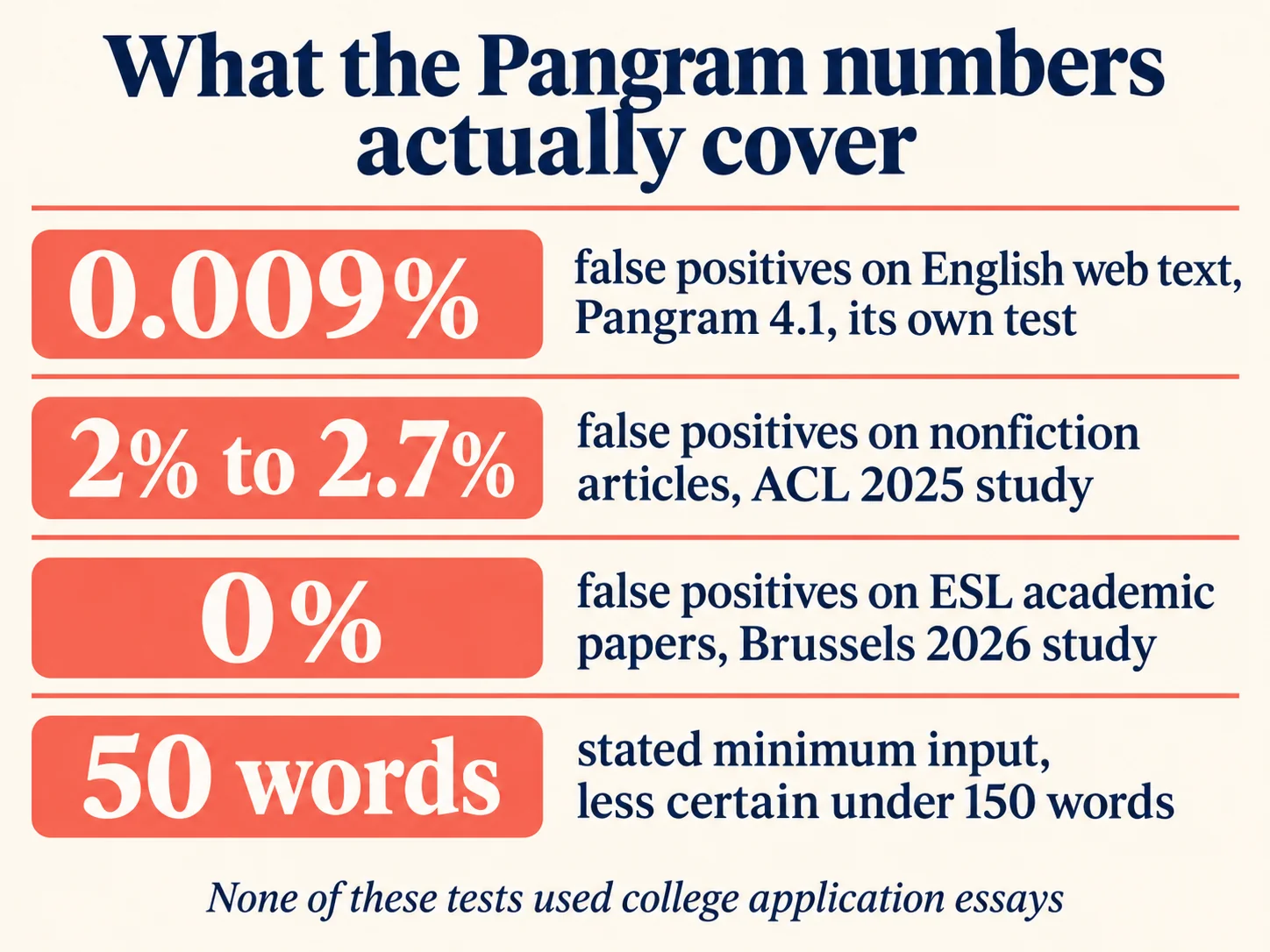
Those rates are very different in practice. As simple arithmetic, 10,000 honest essays would produce about one false flag at 1 in 10,000, or about 270 at 2.7%. Neither rate was measured on application essays, so neither is your risk. One commenter raised this directly: a polished, heavily revised essay may not behave like forum posts or product reviews. That is a fair question, and I found no published test that answers it.
For wider context, see our Pangram review, Pangram versus GPTZero and the false positive rate data.
Why did GPTZero say human while Pangram said 100% AI?
Because these are separate models with separate thresholds, and disagreement is normal. The Chicago researchers note that a detector’s error rates move with the score threshold it uses. We have tracked the same pattern in how much AI detectors disagree. A clean result from three weaker tools does not cancel a flag from a stronger one, and it does not confirm that flag either.
The useful step is one a commenter on that thread suggested: test your original version from before any edits. If the early draft reads human and the edited one does not, you have learned where the change came from. In that thread, the student said they used AI only for ideas and that a teacher then revised it. Commenters suggested both could matter, but nobody there could prove either. Our guide to detectors and tutor edits goes further on this.
Are AI detectors reliable on short supplemental essays?
They are weaker, though not in the way one Reddit comment put it. A commenter said Pangram is accurate only above about 250 words. Pangram’s page gives a 50-word minimum for its 4.1 model and says the dashboard now shows less certainty under 150 words. A review quoting Pangram’s earlier table shows misses rising as text shrinks, more than false flags.
That has a practical meaning for a 100-word "why us" answer. A human result on a short text is less solid than one on a long text, and the same goes for a tool with no published length data. We cover the pattern in why short essays get flagged.
What should you do if your essay gets flagged?
Start from how the essay was actually written, not from the number. Pick the line that is true for you.
What should I do next?
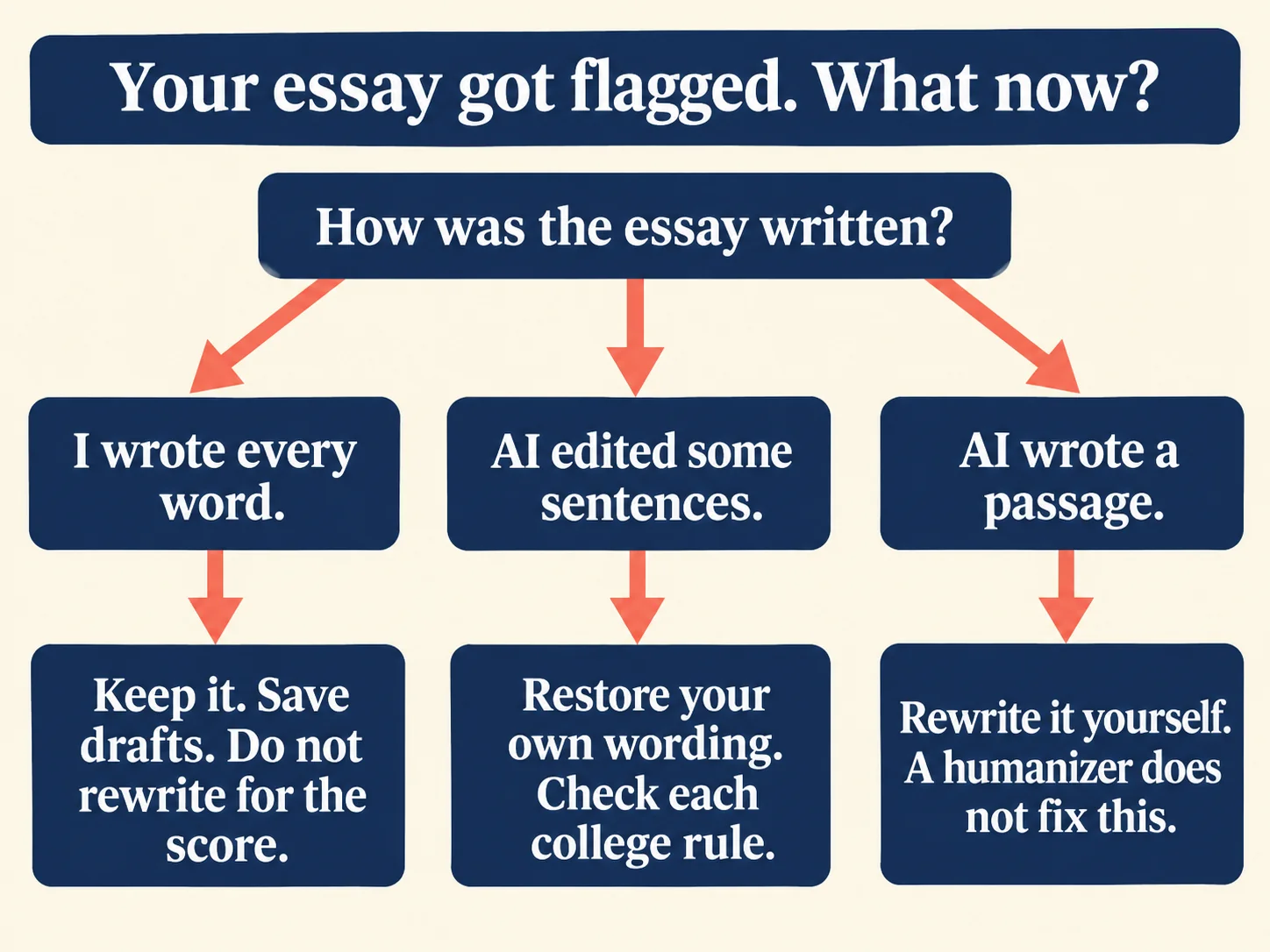
Whatever you pick, keep your evidence. Our notes on building an authorship packet and whether version history is enough apply here. Save your earliest draft now, before more edits.
Is it worth paying for a detector or humanizer before you apply?
A detector usually is not, and a humanizer is not worth buying for this. Pangram’s individual plan lists a 7-day trial and then $20 a month, which is more volume than one applicant needs and easy to forget to cancel. If you do run one check, run it once, on a final draft, and stop.
A humanizer answers the wrong question. If you wrote the essay, it would replace your wording with a machine’s, and that is the thing you were trying to avoid. If AI wrote it, a rewrite does not change the authorship statement you sign. It may not change the score either: Pangram reportedly detected 95% of humanized papers in the Brussels study, though that summary comes from Pangram.
Our own earlier guide on humanizers for personal statements covers editing tools. Read it with this in mind, and check your college’s rule first. The free versus paid comparison is more useful for other kinds of writing.
Is it safe to paste your essay into a free AI checker?
It depends on the site, and many applicants do not check. One UCAS commenter asked exactly that, and the student replied that they had just used a bunch of random websites. Your personal story is sensitive, and you should know where it goes.
Two policies I read are clear on training. Pangram’s privacy policy says submissions are not used to train its models. ZeroGPT’s policy says private content is not used for model training, but keeps it as long as reasonably necessary for operations such as security and backups. Unknown sites with no such policy deserve no trust. Our privacy guide lists what to look for.
Methodology and limits
For this article I read 13 ranking pages on whether colleges check for AI, the college pages in the table, and 8 Reddit threads from applicants, with comments, between August and November 2026. I ran no detector myself. The five colleges are examples with clear wording that I could verify, not a statistical sample. Policies change each cycle, so your application’s own text overrides anything here. This is general information, not legal or admissions advice.
Frequently Asked Questions
Do colleges run application essays through AI detectors?
Some do, most do not say. UW-Madison says it runs no detection system. Stony Brook refers Creative Writing samples to a detector when staff have concerns. Most colleges publish no statement about detector use, so nobody outside can give a percentage.
Does the Common App check essays for AI?
Its fraud policy lists presenting the substantive content or output of an AI platform as your own work as fraud. The policy describes acting on allegations and reports. It does not describe scanning every essay with a detector.
Should I rewrite my essay if a detector says it is AI?
Not if you wrote it. Rewriting for a score can flatten your voice, and two detectors can disagree on the same text. If AI wrote or reworded a passage, replace that passage in your own words because of the rule, not because of the score.
Why did Pangram say 100% AI when GPTZero said human?
Detectors use different models and thresholds, so they can disagree on one essay. One result does not show which tool is right. Compare your earliest draft with later edited versions to see where the change appeared.
Is Pangram accurate on a 650-word college essay?
It has stronger evidence than most detectors, but that specific case has not been shown. Its published tests cover web text, articles and academic papers. I found no published test on real application essays.
Is using Grammarly on a college essay allowed?
It depends on the college and on what you accepted. Spell check and comma fixes are different from accepting full sentence rewrites. Read each college’s own AI statement and keep your pre-edit version.
Should I pay for a detector before applying?
Usually no. If you wrote the essay, a score adds worry and little else. If you want one check, Pangram’s individual plan has a 7-day trial, but read the renewal terms before starting it.
Can a humanizer make my college essay safe?
No. It may change a score, but the Common App rule concerns misrepresenting AI output as your own. A humanized AI essay is still AI output, and it also tends to lose the specific voice admissions readers want.
Sources and References
- Policies: Common App fraud policy, UW-Madison essays, Stony Brook first-year applicants, BYU essays and activity, University of California, Virginia Tech
- Detector evidence: Pangram accuracy, Pangram third-party roundup, Becker Friedman Institute summary, ProofreaderPro review
- Vendor material: Pangram on admissions, Pangram pricing, Pangram privacy, ZeroGPT privacy
- Reddit (claims, unverified): r/ApplyingToCollege, Pangram AI, Do colleges check for AI?, AI Detector is frying me, essay at 89%, r/6thForm, r/UCAS
Facing an actual question from a college or school? Start with what to do in the first 24 hours.
