This GradPilot review comes down to one trade-off. GradPilot is the cheapest serious essay grader we found, at $5 a scored review, and its rubrics are public. But its AI detection layer can flag your own sentences and drag your score down, the $5 Trial gives you no way to switch it off, and paid credits expire with no refunds. If you know those three things before you pay, it is a good tool. If you don’t, it can cost you a week of panic.

Reviewed by Vlad Ivanov
Runs Detection Drama, stress-testing AI detectors and humanizers since 2024; SEO since 2020 and publishes Words At Scale to 26,000+ subscribers. For this review we read GradPilot’s product pages, technology page, rubric library, terms and AI-policy data, checked its accuracy claims against its own sources, and read every 2025 to 2026 Reddit thread about it. We did not buy a paid Full Review, so no score in this article is our own. Disclosure: Detection Drama earns a commission if you buy through our GradPilot link. That did not change the cons below. Last checked 6 November 2026.
Last updated: 6 November 2026
Opens GradPilot with our partner link. The 20% applies to your first purchase.
Introduction and First Impressions
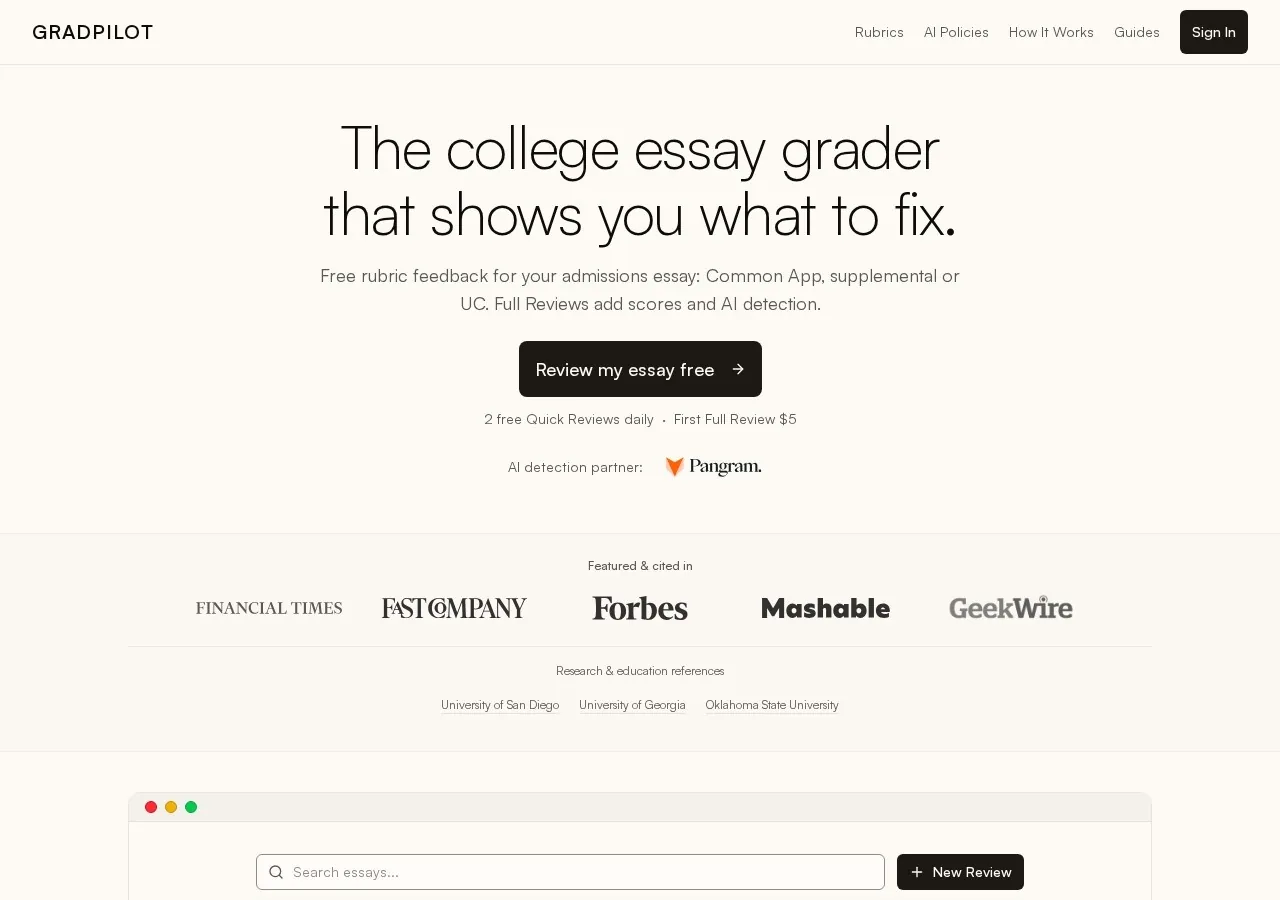
GradPilot is an online college essay grader. You paste a draft, pick the application and prompt, and it reviews the essay against a published rubric for that exact prompt. Paid Full Reviews add scores, sentence-level fixes, word-limit cuts and AI detection from Pangram Labs. It covers Common App essays, UC Personal Insight Questions, supplements, statements of purpose, PhD statements, medical school and PA essays, law, MBA and more.
The first impression is calm and honest. The homepage leads with “shows you what to fix”, not “get into Harvard”. The rubrics are public. The founder answers almost every Reddit thread about the product himself. That is rare in this space.
The first problem only shows up when you read the forums. In the last two months, two different applicants posted that GradPilot’s AI check held their score down. One of them wrote the flagged sentences themselves. That is the part of this review you won’t find on any of the pages that currently rank for “gradpilot review”, because almost all of them belong to GradPilot.
Product Overview and Specifications
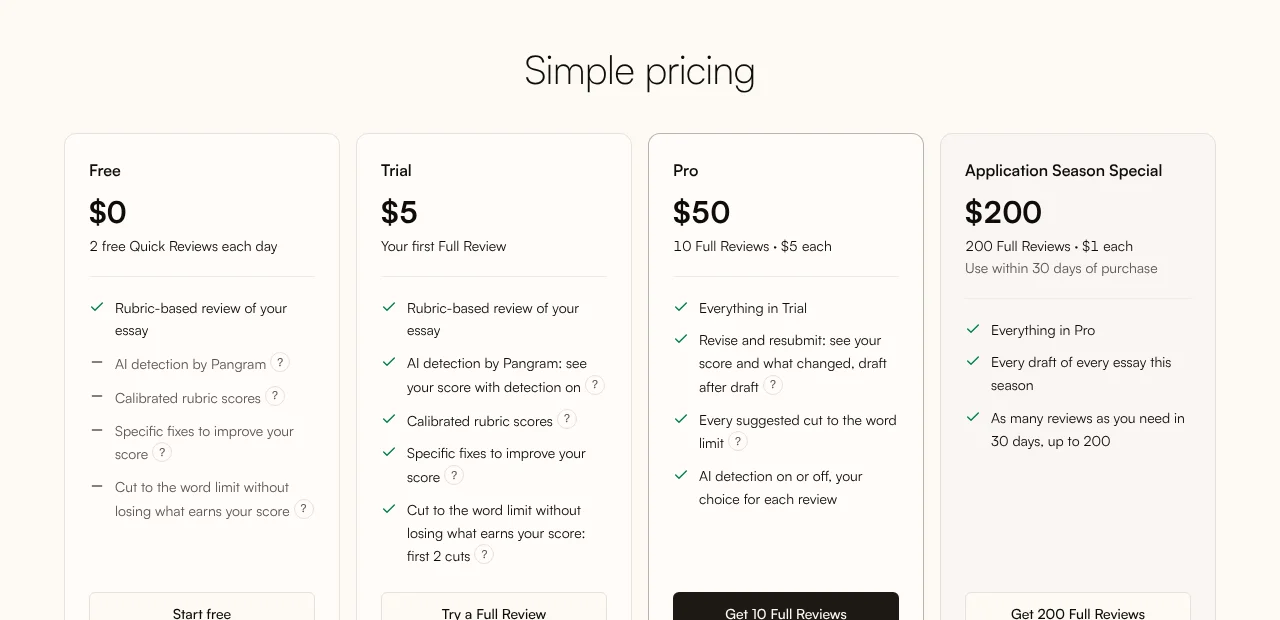
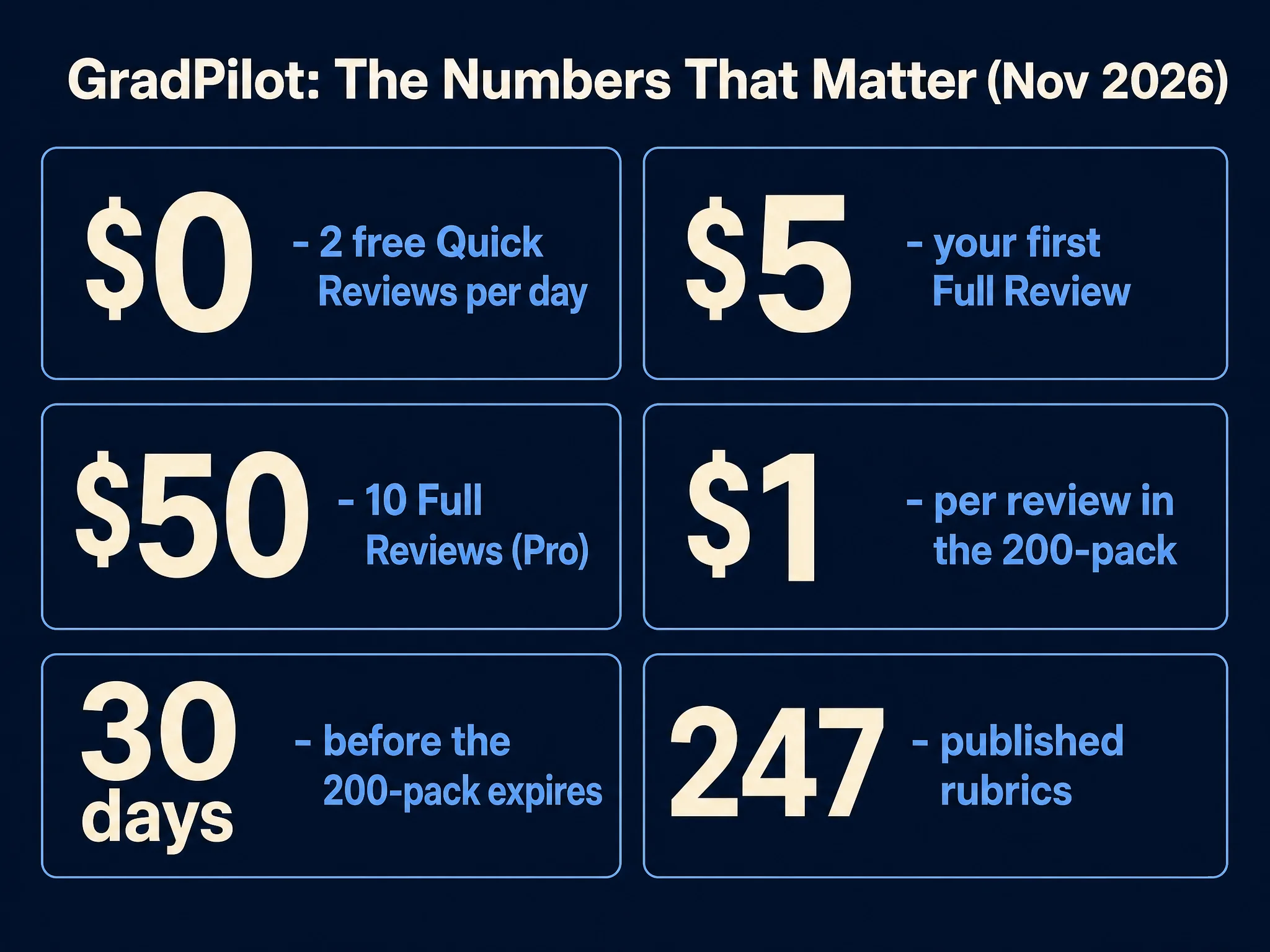
Here is what you actually get, from the live pricing table on gradpilot.com as of 6 November 2026.
| Plan | Price | What you get | AI detection |
|---|---|---|---|
| Free | $0 | 2 Quick Reviews a day. Rubric critique only: no scores, no specific fixes, no cuts | Not included |
| Trial | $5 | Your first Full Review: scores, specific fixes, first 2 word-limit cuts | Always on |
| Pro | $50 | 10 Full Reviews ($5 each), revise and resubmit, every suggested cut | On or off, per review |
| Application Season Special | $200 | 200 Full Reviews ($1 each), everything in Pro | On or off; use within 30 days |
- Turnaround: a Full Review is usually ready in about 2 to 3 minutes.
- Rubric library: 247 public rubrics, each with its source links.
- Extras: a mentor comment link that needs no account, export to ChatGPT or Claude for brainstorming, guides for 25 schools’ supplements, and an AI admissions policy tracker covering 180 U.S. and Canadian universities.
- Who it’s for: high school seniors, transfer students, and grad, medical, law, MBA and PhD applicants.
Design and Interface
The site is clean and quiet: cream background, black type, no countdown timers. The part we liked most is the rubric pages. Each one lists the scored dimensions, the score range, the word range it was designed for, the mistakes it flags and the sources it was built from. The CASPA Life Experiences rubric, for example, scores three dimensions on a 0 to 5 range for a 300 to 450 word essay, and cites four sources including the CASPA Applicant Guide.
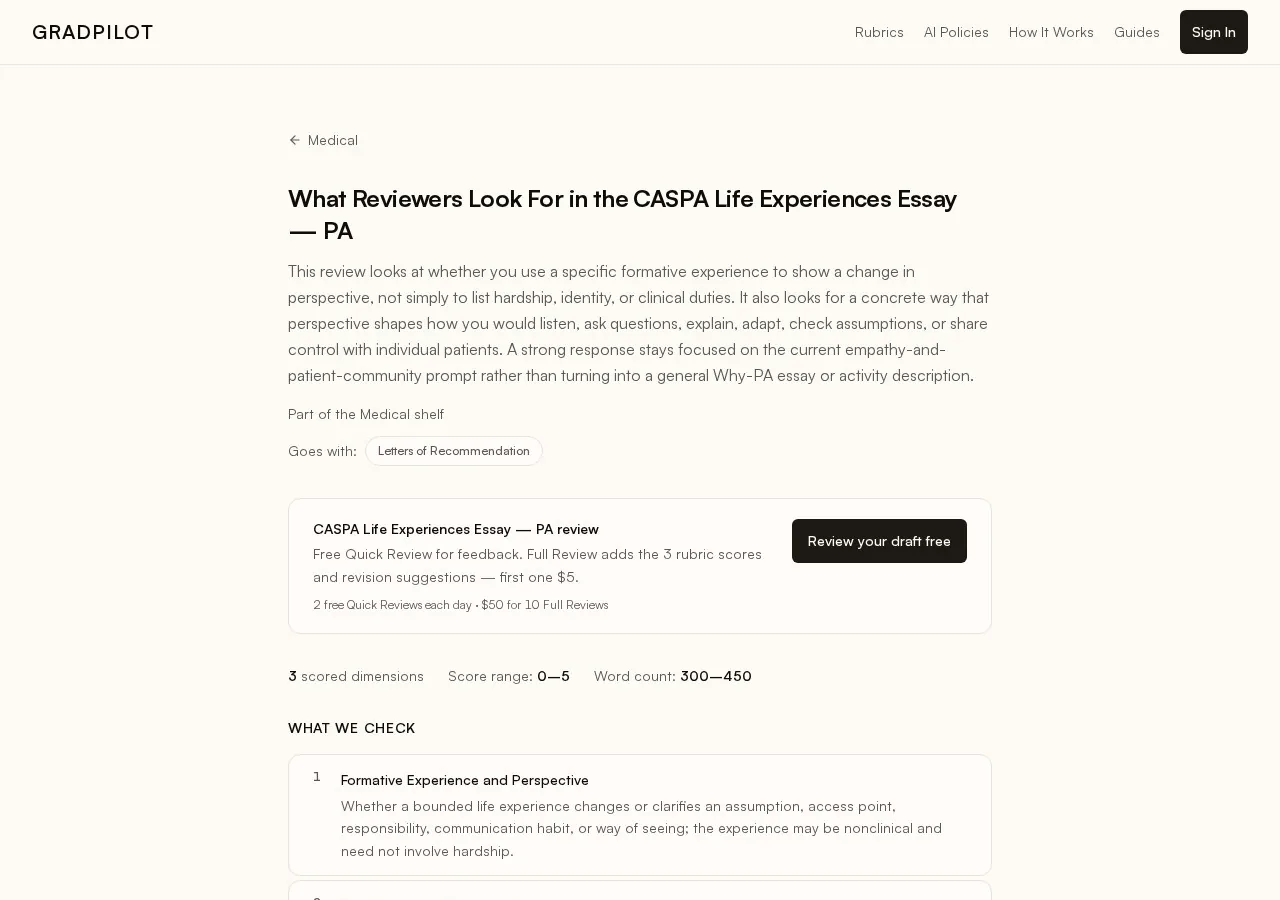
This matters more than it sounds. When you paste an essay into ChatGPT, you have no idea what standard it is using, and it changes every run. With GradPilot you can read the standard first and argue with it. We could not see the logged-in review screen without paying, so we can’t judge the editor itself.
Performance Analysis
How a Full Review scores your essay
According to GradPilot’s technology page, a Full Review runs three separate stages: an optional AI signal that flags sentences that may read as AI-written, a Foundation score for clarity, structure and voice, and a Focus score for how well the essay answers your specific prompt. Each critique quotes the sentence it is about, and if a section is already strong the review is meant to say so instead of inventing problems.
Key numbers at a glance
| Metric | Value | Source |
|---|---|---|
| Cost per scored review | $5 (Trial, Pro) or $1 (Season) | Pricing table |
| Free reviews | 2 Quick Reviews per day | Pricing table |
| Time per Full Review | About 2 to 3 minutes | GradPilot |
| Score scale | 0 to 5 per rubric area | Rubric pages |
| Public rubrics | 247 | Technology page |
| Drafts a strong essay usually needs | 6 to 8, per the founder | Reddit, Sept 2026 |
How it scores on what matters
Our ratings, based on the published product, terms and user reports, not on a paid test of our own:
The AI Detection Trap: When Your Own Sentences Get Flagged
This is the biggest thing missing from every other page about GradPilot. On 3 November 2026 a PhD applicant who had bought the 10-review Pro pack posted on r/gradpilot that Pangram kept flagging sentences they wrote themselves, and that with detection on, the review would only give them 2/5. They turned detection off to get useful scores.
A month earlier, an MSCS applicant described the same wall: GradPilot appeared to cap their Foundation and Focus scores once AI was detected. Their draft had been AI-assisted, so the flag was fair. The odd part: after they rewrote the flagged paragraph by hand, Pangram’s own site went from roughly 50% AI to 100%.
The founder’s answers in both threads are clear and worth knowing before you buy:
- Pangram’s false positive rate is low, he said, but not zero.
- Pro and Season users can switch detection off with a toggle on the submit form.
- The $5 Trial always runs AI detection. There is no toggle.
GradPilot’s technology page does not say outright whether a “Flagged” result lowers your score. It does say an “AI-polished in places” result does not. A premed applicant in July 2026 reported that using AI only to smooth clunky sentences was enough for GradPilot to flag the response. If you polish with tools like Grammarly, read whether editing help can trigger AI detectors first.
We Fact-Checked GradPilot’s Own Numbers
GradPilot leans on accuracy figures, so we checked them against the sources it cites.
- The false positive math doesn’t add up. Its Pangram partnership announcement quotes a 0.004% false positive rate for academic essays and describes it as about 1 in 10,000. But 0.004% is 1 in 25,000. One in 10,000 would be 0.01%. A small slip, but it is in the headline claim.
- The accuracy figures are Pangram’s, not GradPilot’s. The 99.8% accuracy figure comes from a Pangram blog post, and the other numbers come from university studies of Pangram. None measures GradPilot’s own scoring. The founder has also repeated “99.8% accuracy and near zero false positives” in Reddit replies.
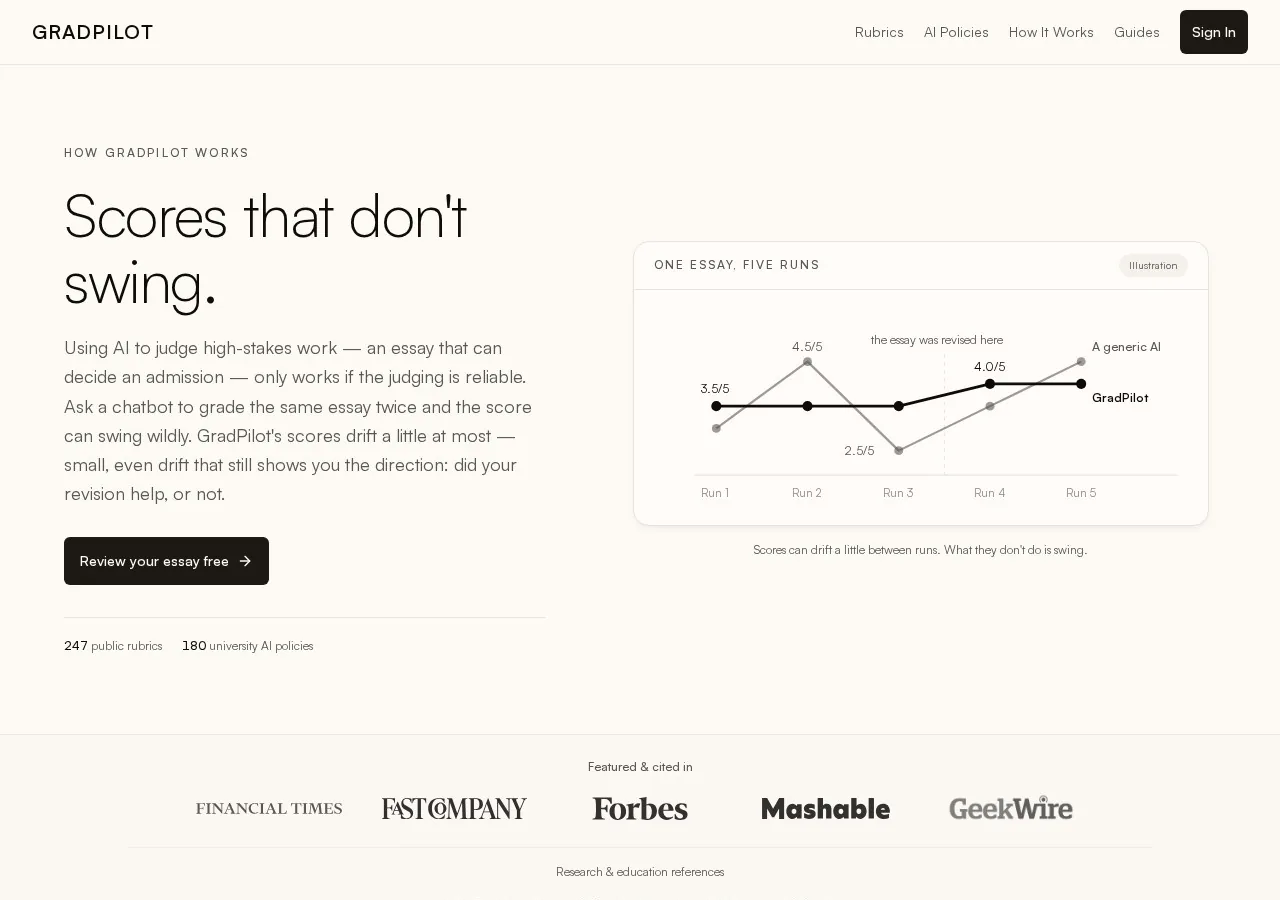
- The consistency chart is an illustration. The technology page’s “Scores that don’t swing” chart, comparing five runs of GradPilot against a generic AI, carries an “Illustration” tag. The page gives no measured drift figures.
None of this means Pangram is a weak detector. In our own Pangram review and our Pangram vs GPTZero comparison it is among the stricter and more accurate tools. It means you should read GradPilot’s numbers as marketing about its partner, and treat any single flag on your own writing with caution. Our roundup of sourced false positive rates puts these claims in context.
Is a 4/5 on GradPilot Believable?
This is the oldest question about the product, and it is still on page one of Google: a 2024 r/MSCS thread asking whether a 4/5 means anything. The honest answer, including GradPilot’s own answer, is that it measures fit to a rubric, not your chances. GradPilot says plainly that it does not predict admissions results. The founder has written that a good rubric score doesn’t mean the statement is good, and that you should still get human readers.
Users agree. In that thread one applicant said GradPilot’s notes matched what their seniors told them. Another had a 4-out-of-5 SOP that a grad student friend still told them to refocus on research interests. Use the score to see whether a revision moved you up or down, not as a green light.
User Experience
Setup: you need a free account to use the grader. Paid credits are one-time packs through Stripe, not subscriptions, so there is nothing to cancel.
Daily use: GradPilot’s suggested loop is simple. Save the original, run a review, fix one or two issues it backs with evidence, then re-review. Pro’s revise-and-resubmit view shows what changed between drafts. Word-limit cuts explain why each cut is suggested and how many words it saves, which is handy for a 650-word Common App cap.
Learning curve: close to zero. The harder part is emotional. A PA applicant said a weak review left them discouraged even though a friend had called the essays strong. Another user in the same thread found the free tier kept repeating itself after about six drafts and didn’t fit a non-traditional applicant. The founder replied that free-tier depth was expanded and that non-traditional rubrics are now available, and built free on request.
Support: email (support@gradpilot.com) plus an official subreddit where the founder answers, often within hours.
Comparative Analysis
Most applicants weigh GradPilot against three things: a general chatbot, a subscription essay platform like GradGPT, or a human editor. Prices below are list prices as of 6 November 2026.
| Feature | GradPilot | GradGPT | ChatGPT / Claude |
|---|---|---|---|
| Entry price | Free, then $5 per scored review | Free (1 review), then $36/mo or $144 per season | Free or ~$20/mo |
| Published rubric per prompt | Yes, 247, with sources | Not published | No |
| Built-in AI detection | Yes (Pangram) | No | No |
| Billing | One-time credits, expire | Monthly or season pass | Subscription |
| Refunds | Generally none | None once used | Varies |
| Admitted-student essay library | No | Yes (Max plan) | No |
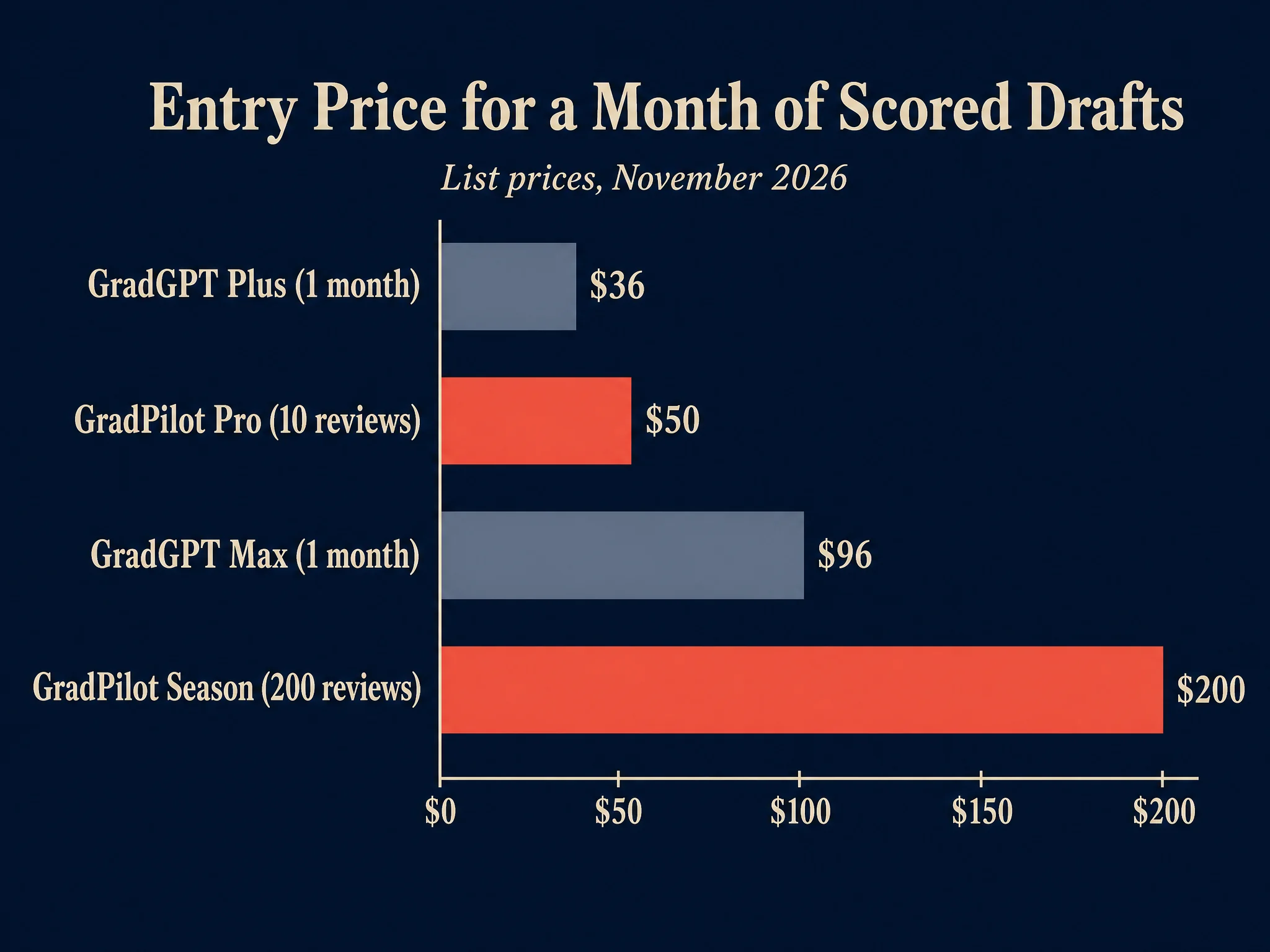
Choose GradPilot if you have a handful of essays, want to see the scoring standard, and want an AI check in the same place. Choose GradGPT if you are writing many supplements in a short window and want admitted essays to study. Use a general chatbot for brainstorming, not grading, since its standard shifts every run. If you only want a detector read, read this before you run your college essay through any AI detector.
Pros and Cons
Pros
- $5 per scored review is cheap next to human editors
- 247 public rubrics with cited sources
- Two free Quick Reviews every day
- Pangram detection built in, and never reported to schools
- No subscription to forget about
- Free mentor comment links, no account needed
- Founder answers users publicly and fast
Cons
- The $5 Trial forces AI detection on, with no toggle
- Users report false AI flags pulling human writing to 2/5
- Credits are non-refundable and expire after 1 year
- The $200 Season pack expires 30 days after payment
- Its “1 in 10,000” false positive gloss is a math error
- The consistency chart is an illustration, not data
- Free tier can feel repetitive after several drafts
Evolution and Updates in 2026
- September 2025: GradPilot rebuilt around Pangram AI detection and published its partnership.
- March 2026: it coined “flagxiety” for the fear of your own writing being flagged as AI. The term has since been picked up in admissions coverage, including Write the World’s 2026 update.
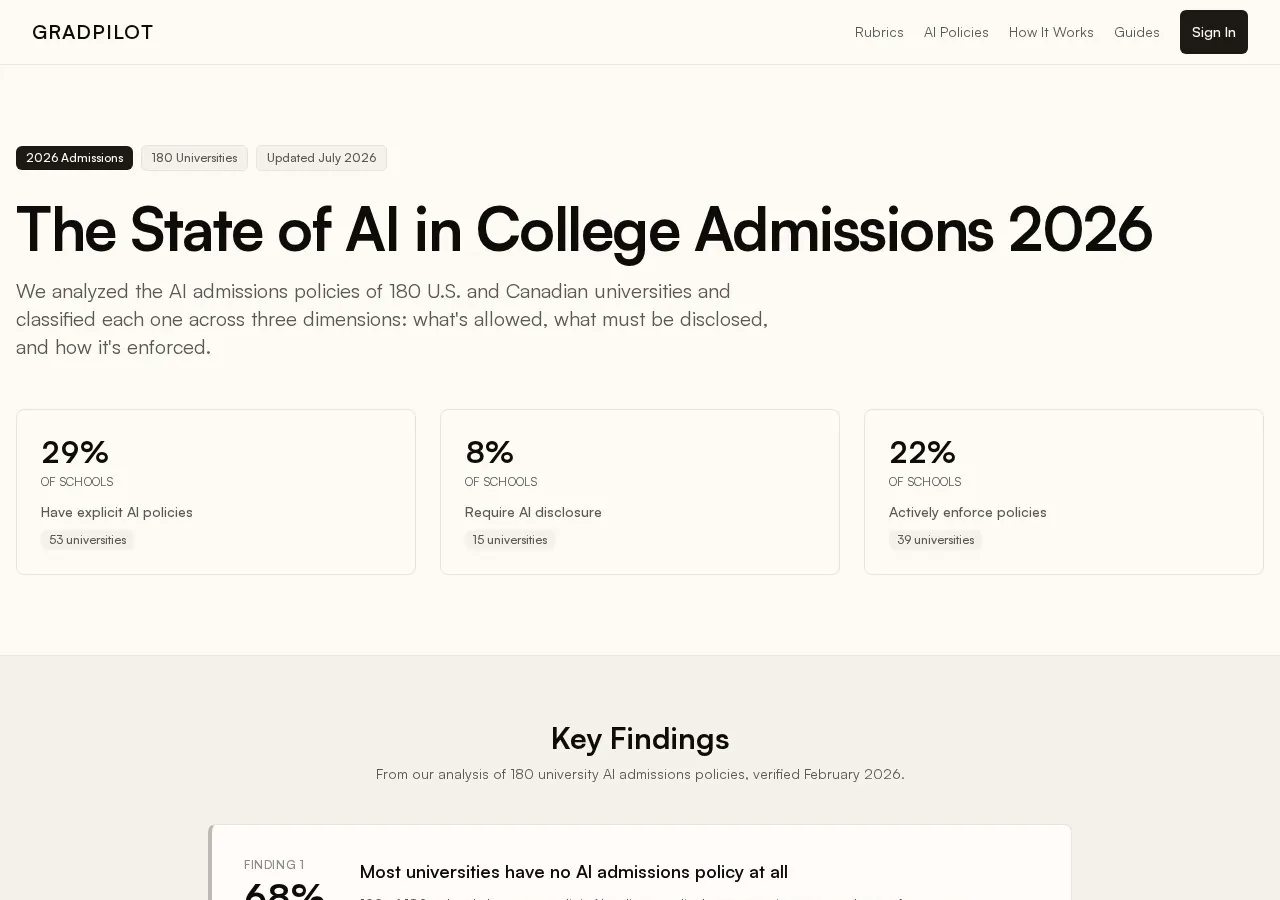
- July 2026: the AI admissions policy tracker was updated to 180 universities. Its headline numbers: 29% of schools have an explicit AI policy, 8% require AI disclosure, and 22% actively enforce. We track similar data in our AI in college admissions essays statistics.
- Autumn 2026: free-tier rubric depth expanded, rubrics for non-traditional applicants added, and an AI detection on/off toggle for Pro.
Purchase Recommendations
What a Full Application Season Actually Costs
Every page about GradPilot quotes “$5”. Nobody does the next step. The founder says successful students revise about 6 to 8 times. At Pro pricing that is $30 to $40 per essay, or one $50 pack per essay if you want spares. A senior with a Common App essay plus five supplements, at 6 scored drafts each, needs 36 reviews: four Pro packs ($200) or one Season pack ($200), but only if all 36 happen inside 30 days. Use the calculator to run your own numbers.
Best for
- Applicants who want a structured second opinion between human readers
- SOP, PhD and medical applicants whose prompt has a GradPilot rubric
- Students who used AI for brainstorming and want a private detection check before submitting
- Anyone on a tight budget who can’t pay $100+ for a human editor per essay
Skip if
- You want someone to write or heavily rewrite the essay. GradPilot won’t.
- Your writing is very formal and you are anxious about false flags, and you only plan to buy the $5 Trial
- You need a refund guarantee
- Your situation is unusual and you need a counselor who knows your whole story
Alternatives to consider
GradGPT for high-volume supplement seasons, a trusted teacher or alum for judgment calls, and a stand-alone detector if all you need is an AI read. If an essay of yours ever does get questioned, our 24-hour plan for an AI accusation and safe AI writing workflow for college drafts show how to keep proof of authorship. Applying to law school? Check the law school AI detector policies first.
Where to Buy and Best Deals
GradPilot is sold only on gradpilot.com. Through our partner link you get 20% off your first purchase, which makes the $50 Pro pack about $40 before tax.
Partner link. Detection Drama earns a commission at no extra cost to you.
Expiry and Refunds: The Fine Print Nobody Quotes
From GradPilot’s terms, checked 6 November 2026:
- Credit purchases generally can’t be refunded.
- Standard credits expire one year after purchase and can’t be extended. Bonus credits may expire sooner; check the date in Billing.
- The $200 Application Season Special expires 30 days after payment. A review submitted before the deadline may finish afterwards.
- The only refund exception named is a seasonal pack payment that can’t be fulfilled before its credits expire.
- There are no subscriptions, so there is nothing to cancel. Prices are in USD and exclude tax.
Money-saving order: use free Quick Reviews on drafts 1 to 3, then buy Pro (with the 20% discount) for scored drafts. Buy the Season pack only for a crunch month with 40+ reviews planned.
Final Verdict on GradPilot
Opens GradPilot with our partner link. The 20% applies to your first purchase.
Evidence and Proof
What real users said (2025 to 2026)
How we checked
Pulled the live Google top 10 for “gradpilot review” (US, 6 November 2026): six of the ten results were GradPilot’s own pages or subreddit, one was its detection partner, one a competitor and two were forum threads. We read GradPilot’s homepage, technology page, terms, rubric pages, Pangram partnership post and AI policy tracker, the Pangram case study, GradGPT’s pricing page, and every Reddit thread mentioning GradPilot from 2025 onward. Screenshots were captured on 6 November 2026. If you want to check your own draft first, start with how to check if your essay sounds AI-written.
GradPilot Review FAQ
Is GradPilot legit?
Yes. It is a working essay review product run by founder Nirmal Thacker, with a public rubric library, Stripe payments and a detection partnership with Pangram Labs. That does not make its scores an admissions prediction, and GradPilot says so itself.
How much does GradPilot cost?
Quick Reviews are free, two per day. A first Full Review costs $5, Pro is $50 for 10 Full Reviews, and the Application Season Special is $200 for 200 Full Reviews that must be used within 30 days. Prices are in USD and exclude tax. Our partner link gives 20% off your first purchase.
Is the free GradPilot Quick Review worth using?
For a first or second draft, yes. It gives rubric-based critique with no scores, no AI detection and no specific fixes. A PA applicant on Reddit found it repeated the same notes after about six drafts, so switch to a Full Review or a human reader once the obvious problems are fixed.
Does GradPilot report my essay to colleges?
GradPilot says it never reports essays to colleges and that AI detection results are shown to you only. Shared review links are visible to whoever has the link until you turn sharing off.
Can GradPilot flag my own writing as AI?
Yes. A PhD applicant reported in November 2026 that Pangram flagged sentences they wrote themselves, which dragged their score to 2/5. The founder replied that Pangram’s false positive rate is low but not zero, and that Pro users can turn detection off.
Can I turn off AI detection in GradPilot?
Only on Pro and the Season pack. The $5 Trial review always runs detection. The toggle sits on the submit form.
Does GradPilot offer refunds?
Generally no. Credit purchases are non-refundable, standard credits expire one year after purchase, and the $200 Season pack expires 30 days after payment. The only stated exception is a seasonal pack payment that cannot be fulfilled before its credits expire.
Is GradPilot better than ChatGPT for essay feedback?
It is more consistent, because it scores against a fixed, published rubric for your exact prompt instead of a fresh opinion each time. It also shows its sources for each rubric. It will not write the essay for you, and you can export its feedback into ChatGPT or Claude to brainstorm.
