
GPTZero review by Vlad Ivanov
Runs Detection Drama and covers AI detectors and humanizers. I ran no GPTZero scans for this review. It is based on GPTZero’s own pricing page, release notes and help center, an independent Epoch AI benchmark, older published studies, a March 2026 video review and Reddit reader reports, all read on 23 November 2026. Reddit posts are people’s claims, not verified facts. GPTZero did not pay for this page and there is no GPTZero affiliate link on it.
Want to bypass Turnitin in 2026? Grab the free prompt pack.
Get the exact text-humanization prompts I use to drop an AI score by hand — copy, paste, submit. Free, straight to your inbox.
Send me the free prompts →Last updated: 23 November 2026
GPTZero Review: Introduction and First Impressions
GPTZero review, short version: it is one of the better calibrated AI detectors you can use for free, and the independent evidence backs that up. But most people misread what it tells them. A result like “75% AI” is not the share of your text that GPTZero thinks is AI. It is the model’s confidence that the whole document is AI, and GPTZero’s own help center says so in plain words.
That one misunderstanding drives a lot of the panic on Reddit. On 25 October an engineering student posted that Pangram said 100% human while GPTZero said 35% AI on the same paper. A week later a Common App applicant wrote that GPTZero called their essay human written with AI polish. Both wanted to know if they were in trouble. This review explains what those labels mean, what GPTZero costs, what changed in Model 5.0b on 4 November 2026, and what happens to the text you paste in.
Key takeaways
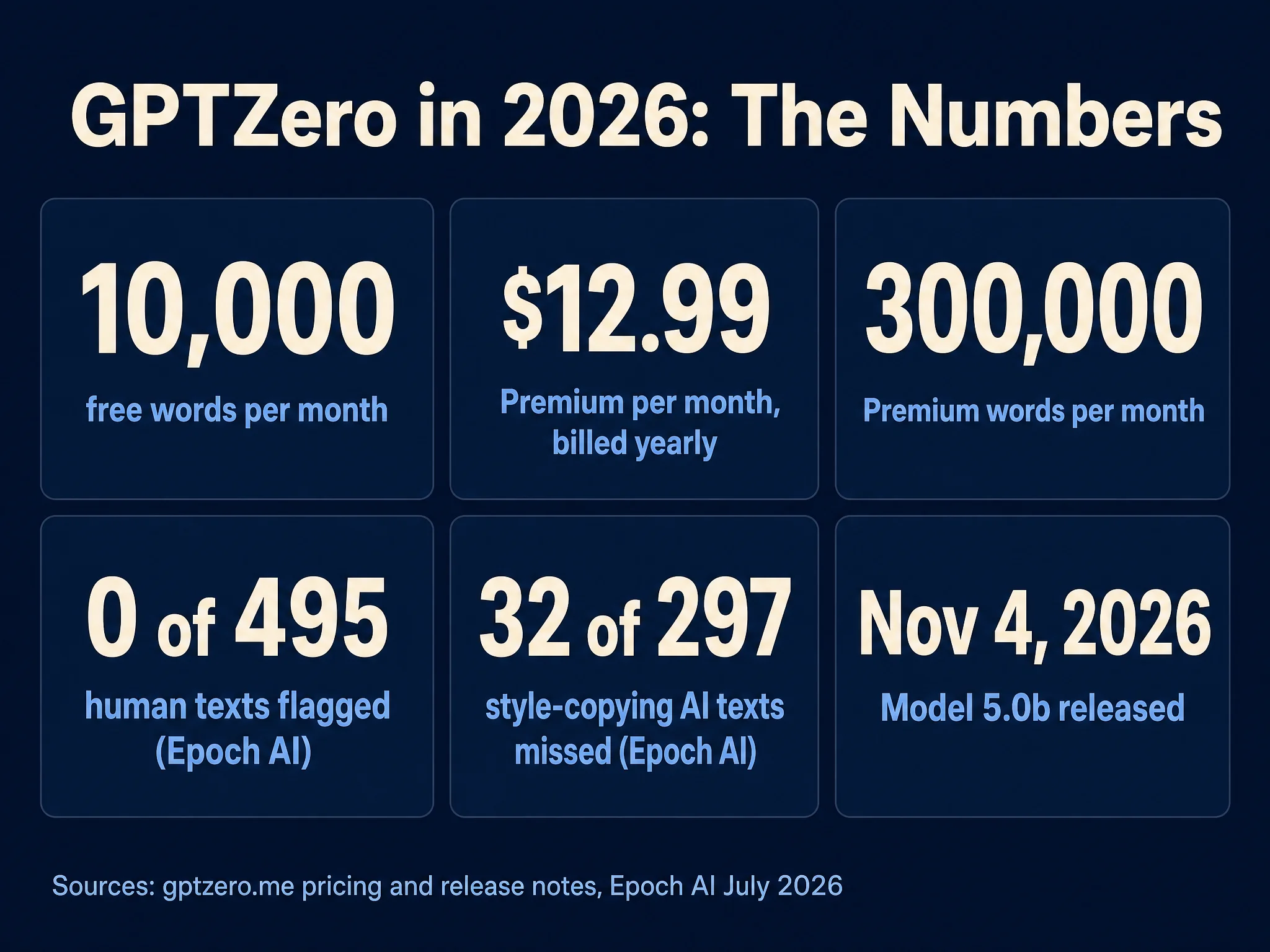
Free plan: 10,000 words a month. Premium: $12.99 a month for 300,000 words, billed yearly (GPTZero pricing).
A GPTZero percentage is confidence about the whole document, not the share of AI sentences. Scores of 40% to 70% are not a confident call.
Independent test: 0 of 495 human passages flagged, 32 of 297 author-imitating AI passages missed (Epoch AI).
Free accounts may have anonymized scans used for training. Paid, team, API and teacher accounts are not used.
Product Overview and Specifications
GPTZero is an AI text detector built by Edward Tian and Alex Cui, first as a Princeton senior thesis project. You paste text or upload a file, and it returns one of three classes for the whole document, AI, mixed or human, plus a confidence level and sentence highlights. Since June 2026 it belongs to Superhuman, the company Grammarly became, which TechCrunch reported on 23 June. We covered what the Grammarly deal means for students when it happened.
Around the detector sit a plagiarism checker, an “Advanced Scan” with AI Patterns, multilingual detection, a Chrome extension, a Google Docs Writing Report that replays how a document was typed, LMS integrations for Canvas and Google Classroom, and an API. GPTZero says it is trusted by over 10 million teachers and students in more than 100 countries and is the official AI detector partner of the American Federation of Teachers, according to its pricing page.
| Spec | Free | Premium | Professional |
|---|---|---|---|
| Price (billed yearly) | $0 | $12.99 a month | $24.99 a month |
| Words per month | 10,000 | 300,000 | 500,000, plus up to 2 million overage |
| Characters per scan | 10,000 | 50,000 | 150,000 |
| Files per batch upload | 3 | 50 | 250 |
| Advanced Scan | 1 free | Yes | Yes |
| Downloadable AI report | No | Yes | Yes |
Source: gptzero.me/pricing, read 23 November 2026. The page defaults to annual billing and says annual saves 45%, so month-to-month plans cost more.
Design and Interface
The interface is a single text box with a scan button, a file upload option and a results panel. The result line reads like “We are highly confident this text was AI generated”, with a probability bar split between AI, mixed and human. Sentences GPTZero thinks look like AI are highlighted, and since the 4o release, headers are greyed out because the model ignores them.
The newer AI Patterns view, part of Advanced Scan, names writing habits it links to chatbots, such as ideas grouped in neat threes or claims credited to unnamed experts. GPTZero says its models are designed to ignore punctuation such as em dashes, so adding or removing one should not flip a result (GPTZero 4o announcement). I could not capture logged-in screenshots for this review, so the images on this page are summaries of the published numbers, not product screenshots.
What a GPTZero Score Actually Means
This is the part almost no GPTZero review explains, and it changes how scared you should be. According to GPTZero’s support article How do I interpret a GPTZero result?:
- The percentage is confidence, not coverage. “75% AI” means the model is 75% confident the entire document was written by AI. It does not mean 75% of the sentences are AI. The same rule applies to mixed and human percentages.
- 40% to 70% is a grey zone. GPTZero says scores in that range show some features of AI writing “but not enough for a confident classification”.
- Only the top band is strong. If GPTZero is highly confident and the result is above 90% to 95% AI, it says the text was very likely AI generated.
- Never the sole basis. GPTZero says it never recommends using a detection score as the only reason for academic consequences.
So the engineering student’s 35% was a mixed-leaning signal below GPTZero’s own grey zone, and the “AI polish” label on the Common App essay describes style, not authorship. Use the tool below to read your own result against GPTZero’s published rules.
Read my GPTZero result
Performance Analysis: How Accurate Is GPTZero?
Vendor Numbers vs Independent Tests
GPTZero publishes a lot of numbers about itself. Its October 2026 4o announcement claims 1 false positive across 10,402 student essays in the PERSUADE dataset, and more than 99% recall on AI text from GPT-5.6, Gemini 3.6, Grok 4.5 and Claude 5 at a false positive rate under 0.03% (GPTZero). Those are the vendor’s own tests on its own benchmark, so treat them as claims.
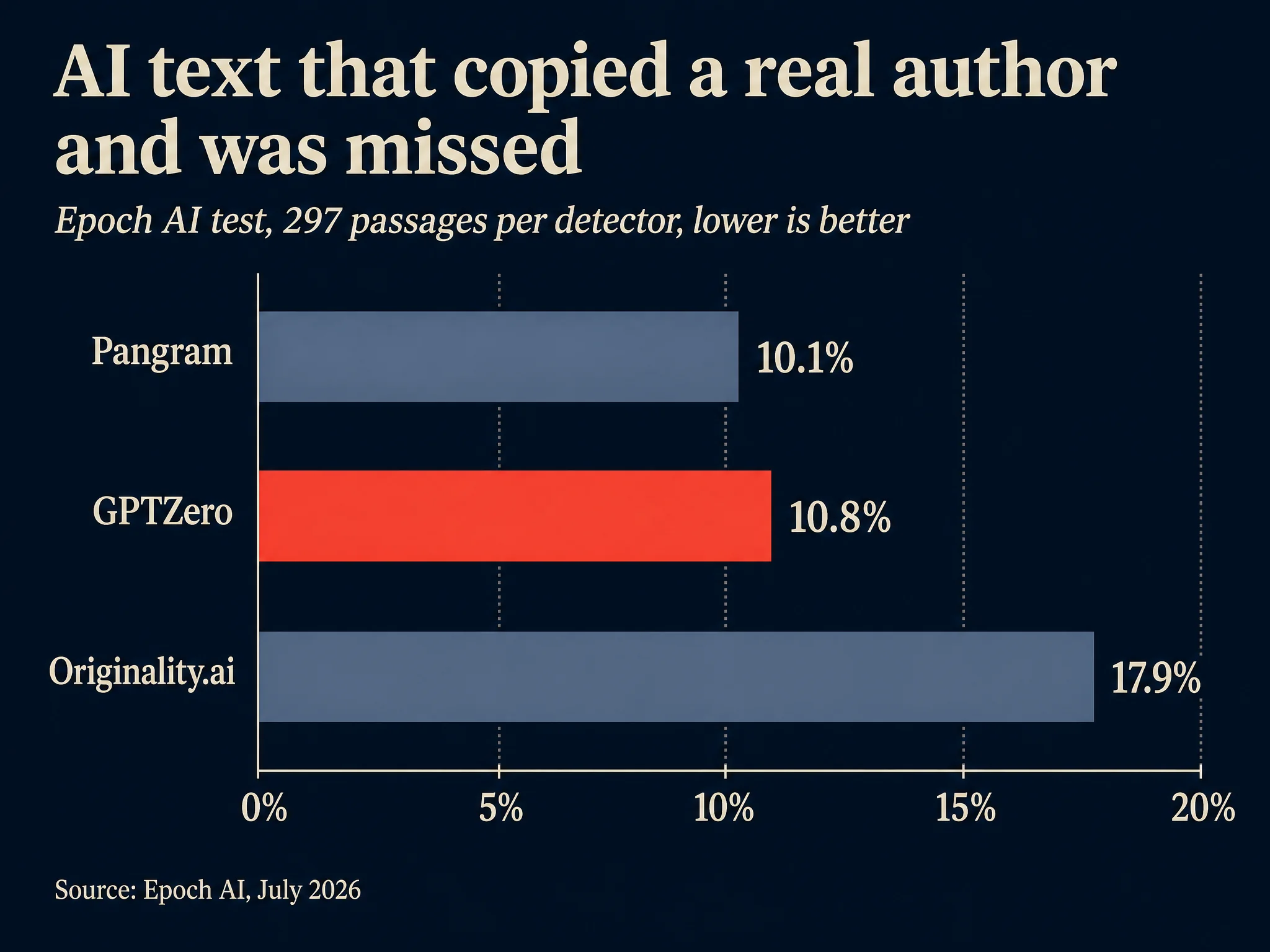
The most useful independent check in 2026 comes from Epoch AI, a research group with no product to sell. In July 2026 it ran Pangram, GPTZero and Originality.ai over 495 human passages from 99 well known authors, all written before ChatGPT, plus AI passages from Claude Opus 4.8, GPT-5.5 and Gemini 3.1 Pro.
| Epoch AI test (July 2026) | GPTZero | Pangram | Originality.ai |
|---|---|---|---|
| Human passages wrongly flagged | 0 of 495 | 0 of 495 | 19 of 495 |
| Plain-prompt AI passages missed | 2 of 297 | 0 of 297 | 1 of 297 |
| AI passages imitating an author, missed | 32 of 297 (10.8%) | 30 of 297 (10.1%) | 53 of 297 (17.9%) |
| Scientific imitation passages missed | 24% | 25% | 29% |
Two details matter. Epoch tested GPTZero’s model from 11 May 2026, which is several releases behind today’s. And it counted a “mixed” verdict as a miss; counting mixed as a catch drops GPTZero’s imitation miss rate from 10.8% to 8.8%.
What the older studies found
Older research is harsher, and it is still worth knowing because people quote it. In the RAID benchmark, GPTZero could be held to a 5% false positive rate and still caught 66.5% of AI text (Dugan et al., 2024). In a 2023 Stanford study, GPTZero flagged 52% of 91 TOEFL essays written by non-native English speakers (Liang et al., 2023). Both tested models that no longer run. We explain why the two kinds of study disagree in ZeroGPT vs GPTZero, and how GPTZero’s ESL claims have been received in our look at its multilingual model.
My scores by area
My scores, based on the studies and pages linked in this review. Not a lab test.
Where GPTZero says it struggles
GPTZero’s own limitations page is frank. Accuracy rises with more text, and document-level calls are more accurate than paragraph or sentence calls. Its training data is mostly English prose written by adults. Heavily edited text is harder to classify, and procedural or machine-like human text, such as instructions or code, can be flagged. That matches what readers report: a capstone writer on r/writinghelp said GPTZero flagged a very technical paper as AI, including writing from years ago. For code specifically, see can AI detectors detect AI-generated code.
User Experience
Setup is a free sign-up, and you can scan without paying. The daily flow is paste, scan, read the class and confidence, then look at the highlights. Teachers get batch uploads, LMS plug-ins and the Writing Report, which shows a replay of how a Google Doc was written and judges whether the typing pattern looks human.
The learning curve is not in the buttons. It is in reading the result correctly, which is why the score explainer above matters. Results also move between model versions: GPTZero shipped 12 base model releases between January and November 2026 according to its release notes, so a scan from August is not directly comparable to one from today. If your school is the one scanning, prepare the way we describe in how to build an authorship packet.
What Changed in GPTZero Model 5.0b (November 2026)
GPTZero released Model 5.0b on 4 November 2026. Its release notes list four changes: better performance on the “polished” and “AI-paraphrased” sub-classes, reduced false positive rates across several domains, better results on third-party benchmarks, and a larger detection architecture (GPTZero release notes). GPTZero has not published numbers for 5.0b yet, and no independent test of it existed when I checked.
The rest of 2026 in brief, from the same page:
| Date | Model | What GPTZero says changed |
|---|---|---|
| 4 Nov 2026 | 5.0b | Better on polished and AI-paraphrased text, fewer false positives |
| 7 Oct 2026 | 4.11b (4.1o) | Better recall on paraphrased, mixed and polished text |
| 18 Sep 2026 | 4.10b (4o) | Lower false positive rate; default for all users from 20 September |
| 12 Aug 2026 | 4.9b | Better recall on Claude 5, GPT 5.6, Gemini 3.6 and Grok 4.5 |
| 1 Aug 2026 | 4.8b | Headers excluded from the model’s input |
| 6 May 2026 | 4.5b | More granular mixed-text predictions |
The direction is clear: GPTZero is chasing edited and paraphrased AI text. That is good news if you are a teacher, and it means any humanizer result you read about from before November may not hold now. One Reddit post in a humanizer-focused subreddit claimed several humanizers were tested against 5.0b, but it was run by people with a product to promote, so I am not treating it as evidence. Our coverage of whether Undetectable AI bypasses GPTZero predates 5.0b too.
Does GPTZero Train on Your Essay?
It depends on your account, according to GPTZero’s support article Does GPTZero train on my submitted text?:
- Free users: “Possibly, anonymized only”. GPTZero may use anonymized free submissions to improve detection, and says it does not use them to build generative AI or share them with third parties.
- Paid individual, team and API users: not used for training. API text is not stored by default.
- Teachers and institutions: never used for training, on any plan.
You can delete scans from your document history, and GPTZero says deleted items are removed and excluded from later training runs. If you are a student pasting an unpublished essay into a free account, that is the trade you are making. It is a clearer policy than many humanizers publish, which we compared in should you run your college essay through an AI detector.
Comparative Analysis
The question most readers really have is not “is GPTZero good” but “is it the one my reader uses, and does it agree with the others”. Here is how it lines up on facts we could source.
| GPTZero | Pangram | Originality.ai | Turnitin | |
|---|---|---|---|---|
| Who mostly buys it | Teachers, students, schools | Publishers, Substack, writers | Content marketers, SEO teams | Schools only |
| Free use | 10,000 words a month | Trial | See our review | None for students |
| Epoch AI: humans flagged | 0 of 495 | 0 of 495 | 19 of 495 | Not tested |
| Epoch AI: imitation AI missed | 10.8% | 10.1% | 17.9% | Not tested |
On edited or “humanized” text, the independent evidence we have read leans toward Pangram, which is why we scored it higher in Pangram vs GPTZero. Against Turnitin, the bigger issue is that students cannot run Turnitin themselves; we cover that in Turnitin vs GPTZero and which detector is closest to Turnitin. If two tools give you opposite answers, our ZeroGPT vs GPTZero guide explains why GPTZero is usually the calmer one. For the other names, read our Originality.ai review and Winston AI review.
Pros and Cons
- Most generous free tier of the major detectors: 10,000 words a month.
- No human passages flagged in Epoch AI’s independent July 2026 test.
- Public, dated release notes for every model since 2023.
- Clear help pages on what a score means and where the tool is weak.
- Paid, API and teacher text is not used for training.
- Writing Report and LMS tools useful for schools.
- The percentage is easy to misread as the share of AI text.
- Missed about 1 in 9 AI passages written to copy a real author, and about a quarter of scientific ones.
- Free scans may be used, anonymized, for training.
- Frequent model updates mean scores shift over time.
- Pricing page shows annual prices first; monthly costs more.
- Now owned by Grammarly’s parent, which also sells writing help.
Purchase Recommendations
Best for:
- Students who want to see roughly what a teacher using GPTZero might see, within 10,000 free words.
- Teachers who want batch uploads, LMS plug-ins and a typing replay, not just a score.
- Editors who check under 300,000 words a month and want a sourced, calibrated detector.
Skip it if:
- You need a verdict you can use as proof. No detector gives that, GPTZero included.
- You mostly check heavily edited or scientific writing, where all detectors miss more.
- Your publisher or platform uses a different detector. Check the one your reader runs, as we explain in our Pangram review.
Not sure which plan you need? Enter your monthly volume.
Which GPTZero plan fits?
Where to Buy and Best Deals
Buy directly at gptzero.me/pricing. The cheapest route is annual billing, which GPTZero says saves 45%, but only if you will use it for most of a year. Teams of two or more can buy Professional seats without a sales call; three seats come to $899.64 a year billed annually, according to the same page. Start on the free plan first: 10,000 words is enough to see whether its results match what you need.
Final Verdict
If you are a student and GPTZero flags your own work, do not panic over a single number. Check which class and confidence it gave, scan earlier drafts, and gather your version history. Our guide to what to do when an essay is flagged as AI walks through it, and how to prepare for an authorship meeting covers the conversation itself.
Evidence and Proof
What users report. These are individual claims, quoted to show patterns, not tests:
Sources used: GPTZero pricing, release notes, GPTZero 4o announcement, how to interpret a result, training policy, limitations, Epoch AI, RAID, Liang et al., TechCrunch. For wider context see our AI detection false positive statistics.
GPTZero Review FAQ
Is GPTZero accurate in 2026?
On human writing, the best independent 2026 test found it accurate: Epoch AI saw 0 false positives on 495 human passages. It missed 2 of 297 plainly prompted AI passages and 32 of 297 passages written to copy a real author. No detector is accurate enough to be proof on its own.
What does a GPTZero percentage mean?
It is the model’s confidence in its label for the whole document. A 75% AI score means GPTZero is 75% confident the entire text is AI, not that 75% of the sentences are AI. Scores of 40% to 70% are not a confident call, according to GPTZero.
How much does GPTZero cost?
The free plan covers 10,000 words a month. Premium is $12.99 a month for 300,000 words and Professional is $24.99 a month for 500,000 words, both billed yearly. GPTZero says annual billing saves 45%, so monthly billing costs more.
What is GPTZero Model 5.0b?
It is the detection model GPTZero released on 4 November 2026. GPTZero says it improves results on polished and AI-paraphrased text, reduces false positives across several domains and uses a larger architecture. No independent test of it had been published when this review was written.
Does GPTZero save or train on my text?
Free accounts may have anonymized submissions used to improve the model. Paid individual, team and API accounts are not used for training, and text from teachers and institutions is never used. You can delete scans from your document history.
Can GPTZero detect paraphrased or humanized text?
Sometimes. GPTZero has an AI Paraphrased label and has focused recent updates on it, but its own help center says heavily edited text is still harder to classify. In Epoch AI’s test, about 11% of AI passages written to imitate an author slipped past it.
Who owns GPTZero now?
Superhuman, the company formerly known as Grammarly, announced it was acquiring GPTZero on 23 June 2026. GPTZero continues to run as its own product.
Is GPTZero better than Pangram?
They are close. Both flagged no human passages in Epoch AI’s test, and Pangram missed slightly fewer style-copying AI passages. Independent studies have leaned toward Pangram on edited text, while GPTZero has the more generous free tier and deeper school integrations.
