Can Turnitin Detect ChatGPT? What 280 Million Papers Show (2026)
The only tool that bypassed Pangram and Turnitin in 2026.
Most humanizers clear one detector and get caught by the other. StealthWriter is the one that gets past both — run Ghost 5.2 Pro at level 7–8, section by section, and re-check before you submit.
Try StealthWriter →Key Takeaways
- Turnitin turned on ChatGPT detection on 4 April 2023 for 10,700+ institutions, 2.1 million educators and 62 million students (Turnitin).
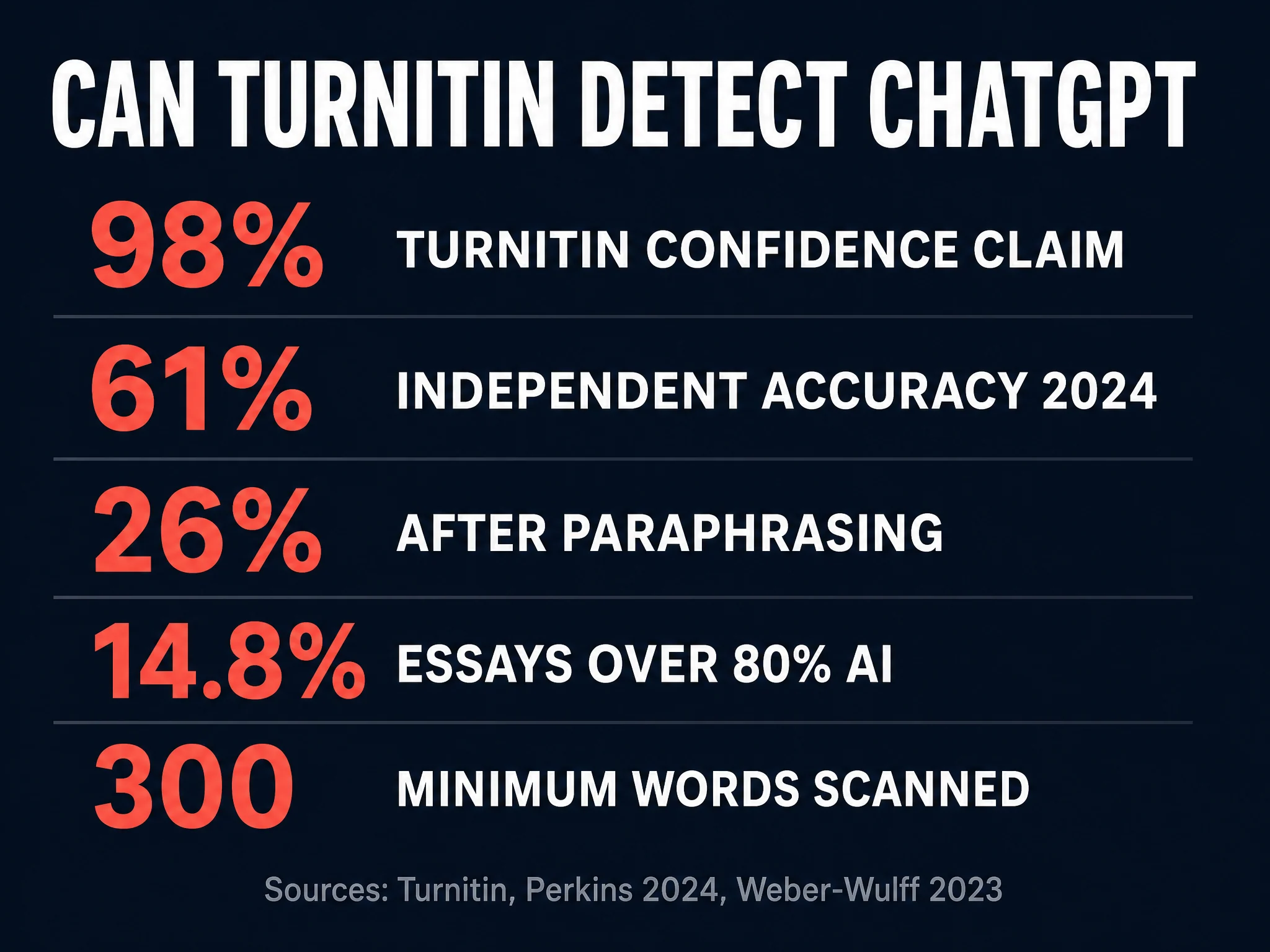
- Its launch claim was a 98% confidence threshold — not an accuracy rate. Turnitin has never published an accuracy figure, calling the metric “too easily manipulated” (Turnitin whitepaper).
- Independent peer review, Perkins et al. 2024: 61% accuracy on unmodified AI text, and the steepest fall of any detector once evasion was applied — a 42.1 point drop.
- Weber-Wulff et al. ranked Turnitin 1st of 14 tools, yet found accuracy fell to 26% across the field on machine-paraphrased text.
- A June 2026 study found Turnitin scored 100% of fully AI-generated GPT-4o papers between 0 and 20% AI — every one missed — while producing zero false positives on human work.
- Turnitin’s own false positive rates: under 1% per document and about 4% per sentence. Vanderbilt did the arithmetic on 75,000 submissions, got ~750 students, and switched the tool off.
- Heavily AI-written English submissions rose from 3.3% in 2023 to 14.8% by early 2026 — roughly one essay in seven (Turnitin).
The answer is yes, and it has been yes since April 2023. That is the easy part. The hard part is that “can it” and “will it” are separated by a gap wide enough to have ended pilots at several large universities and produced a peer-reviewed 2026 result in which Turnitin missed every single fully AI-written paper it was shown. Here are the numbers on both sides of that gap.
1 Yes — and the famous 98% is not an accuracy rate
Turnitin built its detector specifically to catch ChatGPT. The 98% figure everyone quotes is a confidence threshold for flagging, not a measure of how often the tool is right.
| Metric | Value | Source |
|---|---|---|
| Launch date | 4 April 2023 | Turnitin Press |
| Coverage at launch | 10,700+ institutions, 62M students | Turnitin Press |
| Turnitin’s confidence claim | 98% sure before flagging | K-12 Dive / Turnitin |
| Development start | 2020, pre-ChatGPT | Turnitin Press |
| Models covered (2026) | GPT-3 to GPT-5 family, Gemini, Claude, LLaMA | Turnitin Guides |
| Published accuracy figure | None — refused as a metric | Turnitin whitepaper |
| Document-level recall | 84.2% | Turnitin whitepaper |
| Sentence-level recall | 92.3% | Turnitin whitepaper |
Read the second-to-last row twice. Turnitin’s own whitepaper says it “does not use accuracy as a metric as it is too easily manipulated,” and publishes recall and false positive rates instead. So when a blog tells you Turnitin is “98% accurate”, that number has been lifted from a sentence about flagging confidence and quietly relabelled. A separate 98% figure circulates too — the share of Turnitin institutions that had the feature switched on in mid-2023 — which is an adoption statistic, not a performance one.
2 What actually gets scanned
Under 300 words, no score. Wrong file type, no score. Wrong language, no score. And you will never see the result yourself.
| Metric | Value | Source |
|---|---|---|
| Minimum length | 300 words of prose | Turnitin Guides |
| Maximum analysed | 30,000 words | Turnitin Guides |
| File types scanned | .docx, .pdf, .txt, .rtf | Turnitin Guides |
| Languages scored | English, Spanish, Japanese | Turnitin Guides |
| Paraphrase / bypasser detection | English only | Turnitin Press |
| Visible to students? | No — instructors and admins only | Turnitin Guides |
| Scores 1-19% | Suppressed, shown as *% | Turnitin Guides |
| ChatGPT-written code | Not detected | Turnitin Guides |
| Detection method | Classifier, not database matching | Turnitin whitepaper |
Two of those rows cause most of the confusion students bring to us. First, the AI score is not the similarity score — they are separate systems, and the AI check does not match your text against a stored library of chatbot answers. It is a transformer classifier making a per-sentence prediction. Second, you cannot see your own AI percentage; only your instructor can, which is why pre-submission checking is guesswork by design unless your institution has enabled a self-check assignment.
That 300-word floor is also why short assignments behave unpredictably: a 280-word discussion post returns nothing at all, while a 310-word one returns a full score computed from a very small sample of sentences. We dug into that asymmetry in why short essays get flagged more often.
3 Independent studies: best in class, and still not good enough
Turnitin has finished first in multiple peer-reviewed comparisons. The same papers conclude that no detector should be used as evidence in a misconduct case.
| Metric | Value | Source |
|---|---|---|
| Weber-Wulff 2023: scope | 14 tools, 54 documents, 6 categories | Int. J. Educational Integrity |
| Weber-Wulff 2023: Turnitin rank | 1st, zero false accusations | Int. J. Educational Integrity |
| Weber-Wulff 2023: field verdict | All tools under 80% accuracy | Int. J. Educational Integrity |
| Weber-Wulff 2023: paraphrased text | 26% accuracy | Int. J. Educational Integrity |
| Perkins 2024: scope | 805 tests, 7 detectors, GPT-4 / Claude 2 / Bard | Perkins et al. |
| Perkins 2024: Turnitin unmodified | 61%, 2nd of 7 | Perkins et al. |
| Perkins 2024: Turnitin after evasion | 42.1 point drop, fell to 5th | Perkins et al. |
| Perkins 2024: field mean | 39.5% before, 17.4% after | Perkins et al. |
| Van Vlasselaer 2026: fully AI | 100% false negatives | Int. J. Educational Integrity |
| Van Vlasselaer 2026: hybrid / humanized | 60.0% / 50.0% | Int. J. Educational Integrity |
| RAID benchmark 2024 | 6.2M generations; 40.6% mean drop under attack | Dugan et al., ACL |
The 2026 result is worth stating carefully, because it is the strongest single data point on this page. Van Vlasselaer, Van Droogenbroeck and Spruyt generated papers with GPT-4o and GPT-4o Deep Research in May 2025 and ran them through four detectors. Turnitin scored every fully AI-generated paper between 0 and 20% AI — a 100% false negative rate on that set — while Pangram hit 97.5% inclusive accuracy on the same documents. Turnitin also produced zero false positives on genuinely human papers, so the model has not become reckless. It has become blind to current-generation output.
Set that against Weber-Wulff’s 2023 finding that Turnitin was the only tool to correctly classify every unmodified AI document, and the trend line is not subtle. Detection worked reasonably well against GPT-3.5-era text and has been losing ground with each model generation since, which matches what we found tracking how far detectors now diverge from each other.
4 What actually breaks detection
Perkins et al. measured six evasion techniques individually. Every one of them cut mean detector accuracy below 40%; the worst dropped it to 12.9%.
First bar: Turnitin’s accuracy on unmodified AI text. Remaining bars: mean accuracy across all seven detectors tested after each evasion technique. Source: Perkins et al. (2024).
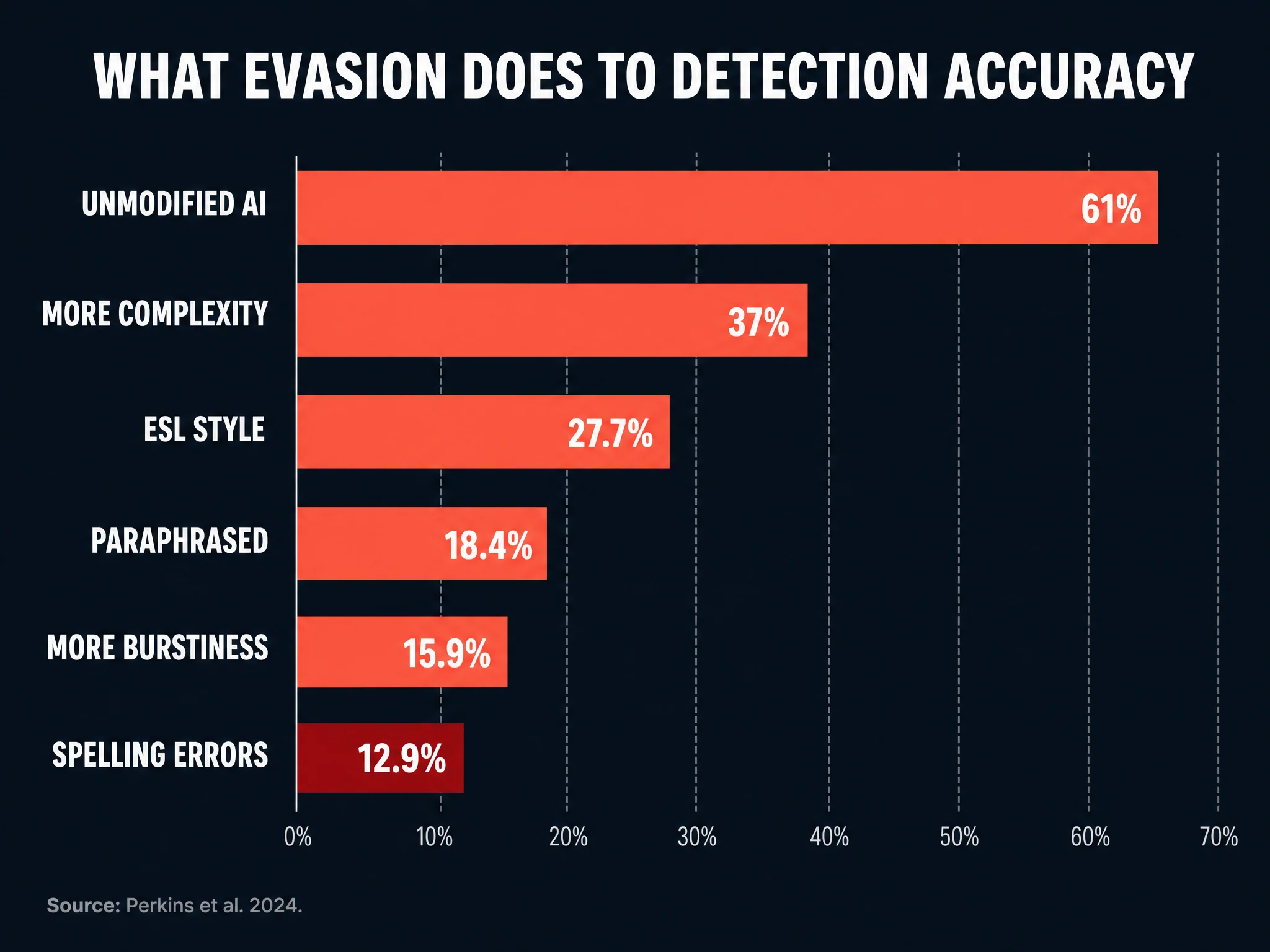
The uncomfortable row in that chart is “ESL-style writing” at 27.7%. Perkins et al. included it as an evasion technique, which means prompting an LLM to write like a non-native speaker defeats detectors more reliably than paraphrasing does. The same property that makes it an evasion route is what makes genuine non-native writing risky to submit — Liang et al. at Stanford found seven detectors flagged 97.80% of TOEFL essays as AI-written by at least one tool, against near-perfect classification of native-speaker essays. Turnitin was not among the seven tested, but the pattern is why we wrote up safer revision habits for ESL writers.
| Metric | Value | Source |
|---|---|---|
| Add spelling errors | 12.9% mean accuracy | Perkins et al. |
| Increase burstiness | 15.9% | Perkins et al. |
| Paraphrase | 18.4% | Perkins et al. |
| Decrease complexity | 21.0% | Perkins et al. |
| Write as a non-native speaker | 27.7% | Perkins et al. |
| Increase complexity | 37.0% | Perkins et al. |
| Prompt for literary language | Detection fell from 100% to 13% | Liang et al. |
| Translate out of EN/ES/JA | No AI score generated at all | Turnitin Guides |
Turnitin’s response has been to ship counter-models: AI paraphrasing detection in July 2024, and AI bypasser detection in August 2025, which it says was trained on “the signals and patterns of leading humanizers.” Both are paid add-ons requiring Turnitin Originality, both are English-only, and neither has a published accuracy figure. The one independent measurement we have — the June 2026 study — put Turnitin at 50.0% on humanized text. We tracked the rollout in Turnitin now detects AI humanizers and the model update in what the 2026 model claims to catch.
None of this is a recommendation. It is the published state of the evidence, and the practical takeaway runs the other way: the techniques that suppress a score are the same ones that damage a piece of writing, and a 50-50 detector is still a coin flip you have to live with. The durable protection is a documented drafting process, which is exactly what a defensible writing workflow is for.
5 Detection risk estimator
Pick what happened to the text and see the measured detection accuracy for that scenario, with the study it comes from.
What are the published odds?
Figures are detection accuracy as measured in peer-reviewed studies, not guarantees. Scenarios 1, 4 and 5 are field means across all detectors tested; scenarios 0, 2, 3 and 6 are Turnitin-specific results.
6 False positives, and the student who won
Turnitin publishes a sub-1% document error rate. Multiplied by institutional volume, that is hundreds of students a year — and in February 2026 one of them won in court.
| Metric | Value | Source |
|---|---|---|
| Document false positive rate | Under 1% above the 20% threshold | Turnitin Guides |
| Sentence false positive rate | ~4% | Turnitin Blog |
| Whitepaper lab figures | 0.7% document, 0.2% sentence | Turnitin whitepaper |
| False positives adjacent to real AI | 54% | Turnitin CPO |
| Vanderbilt exposure calculation | ~750 of 75,000 submissions | Vanderbilt |
| Adelphi University case outcome | Student won, 11 February 2026 | Inside Higher Ed |
| Indiana University Kelley School | Detectors banned 1 June 2026 | Tom’s Guide |
| Institutions documented as opting out | 37+ worldwide | PLEASE tracker |
The Adelphi case is the one to know. A student’s World Civilizations essay was marked fully AI-written by Turnitin while two other detectors read it as human. A judge ruled the plagiarism finding without merit and the charge was removed from his record — after his family spent six figures on legal fees. That last detail is the real lesson: being right is not the same as being cheap to prove, which is why assembling an authorship packet before you submit costs an hour and an appeal costs a semester.
Turnitin’s own data on where errors cluster helps here too: 54% of false-positive sentences sit directly beside genuine AI writing. If you used a chatbot for one section and wrote the rest yourself, the boundary sentences are the documented risk. And if your instructor is treating the score as proof, it is worth knowing what most institutional policies actually say about that — Perkins et al. concluded flatly that these tools “cannot currently be recommended for determining whether violations of academic integrity have occurred.”
Our pick — after testing 100+ humanizers
The only tool that bypassed Pangram and Turnitin in 2026.
Most humanizers are built for one detector and quietly fail the other. StealthWriter is the one that got past both. The settings matter more than the tool, so here is exactly how I run it.
Free plan to start · no credit card · paid from $20/mo. Or get the free prompt pack first →
Affiliate link — I earn a commission if you upgrade. I only point at tools I actually run.
7 280 million papers: what the scale data shows
Turnitin publishes running totals. They show AI-written submissions rising roughly 4.5x in under three years while detection accuracy in the literature moved the other way.
| Metric | Value | Source |
|---|---|---|
| July 2023: papers reviewed | 65 million | Turnitin Press |
| July 2023: 20%+ AI | 10.3% (6.7 million) | Turnitin Press |
| July 2023: 80%+ AI | 3.3% (2.1 million) | Turnitin Press |
| March 2024: papers reviewed | 200 million+ | Turnitin Press |
| March 2024: 80%+ AI | ~3% (6 million) | Turnitin Press |
| October 2024: cumulative | 280 million; 9.9 million at 80%+ | Turnitin Blog |
| Oct 2025 – Feb 2026: 80%+ AI | 14.8% of English submissions | Turnitin Press |
| Clarity: students writing own prompts | 94% | Turnitin Press |
Share of submissions scoring 80% or more AI-generated writing, Turnitin’s own published data. Bars scaled to the highest value. Sources: Turnitin press releases, 2023-2026.
So: can Turnitin detect ChatGPT? It can, it does it hundreds of millions of times a year, and it is measurably worse at it than the marketing suggests — best-in-class against raw output, close to useless against current-generation text that has been touched by a human or a laundering tool, and conservative enough that a clean score proves nothing either way. If you are on the receiving end of a flag you believe is wrong, start with our false positive defence checklist and our guide to what the scores really mean.
Methodology
Compiled 27 July 2026. Every figure is sourced either to Turnitin’s own published material — guides, whitepaper, blog posts and press releases — or to peer-reviewed research in the International Journal for Educational Integrity, the International Journal of Educational Technology in Higher Education, Patterns and the ACL Anthology. Twenty-four sources are cited below. Vendor-published competitor benchmarks were excluded from the data tables because they are not independently replicated.
Freshness distribution: nine cited sources are from 2025 or 2026, seven from 2024, and eight from 2023. The 2023 items are Turnitin’s launch-era technical disclosures and the Weber-Wulff and Liang studies, which remain the most-cited work of their kind. Limitations: Turnitin has published no cumulative paper total since October 2024, no accuracy figures for its paraphrasing or bypasser detection add-ons, and no independent study has yet tested Turnitin specifically on non-native English writing at scale — Liang et al. did not include it. Reviewed quarterly.
Frequently asked questions
Can Turnitin detect ChatGPT?
Yes. Turnitin switched on AI writing detection on 4 April 2023 explicitly to “pinpoint the use of ChatGPT and other tools,” across 10,700+ institutions and 62 million students. Its current model is trained on output from GPT-3 through the GPT-5 family, Gemini, Claude Sonnet 4.5 and LLaMA. Whether it detects your ChatGPT text is a different question — independent studies put real-world accuracy between 0% and 61% depending on how much the text was edited. [source]
How accurate is Turnitin at catching ChatGPT?
Turnitin says it only flags text when the model is “98 percent sure it is written by AI,” and its whitepaper reports 84.2% document-level recall. Independent peer review is harsher: Weber-Wulff et al. ranked it first of 14 tools but found all tools below 80% accuracy; Perkins et al. measured 61% on unmodified AI text; and a June 2026 study found Turnitin scored 100% of fully AI-generated papers between 0 and 20% AI, missing every one. [source]
Does paraphrasing or a humanizer beat Turnitin?
The published evidence says it degrades detection badly. Weber-Wulff et al. found machine paraphrasing cut accuracy to 26%. Perkins et al. measured mean detector accuracy of 18.4% after paraphrasing and 12.9% after adding spelling errors, with Turnitin taking the largest single hit of any tool: a 42.1 percentage-point drop. Turnitin has since shipped paraphrasing and bypasser detection add-ons but has published no accuracy figures for either. See our data on bypass rates after humanization. [source]
Can I see my own Turnitin AI score before submitting?
No. Turnitin states plainly that “the AI writing detection indicator and report are not visible to students.” Only instructors and administrators see it, though an instructor can download the report as a PDF and share it. Scores from 1% to 19% are suppressed and shown only as an asterisk. If your institution offers a self-check assignment, that is the only legitimate way to see a score first. [source]
Does Turnitin compare my essay against a database of ChatGPT answers?
No, and this is the most common misconception. AI writing detection is a classifier, not a matching database. Turnitin splits your submission into overlapping segments of five to ten sentences, scores each sentence from 0 to 1 with a transformer model, and aggregates. The database matching you are thinking of is the Similarity Report, which is a completely separate check. [source]
What is the minimum length before Turnitin scores my text?
300 words of prose in a long-form format. Below that, no AI score is generated at all. Turnitin also caps analysis at 30,000 words, accepts only .docx, .pdf, .txt and .rtf, and scores long-form text in just three languages: English, Spanish and Japanese. Bullet lists, tables and code do not count toward the 300 words. [source]
How common are false accusations?
Turnitin publishes a document-level false positive rate under 1% for documents scoring above 20% AI, and roughly 4% at sentence level — about one in twenty-five highlighted sentences. Vanderbilt calculated that 1% across its 75,000 annual submissions meant around 750 students wrongly flagged, and disabled the tool. In February 2026 an Adelphi University student won a federal case after Turnitin marked his essay fully AI-written while two other detectors read it as human. [source]
Which universities have turned Turnitin’s ChatGPT detection off?
Vanderbilt disabled it on 16 August 2023, followed by Michigan State, Northwestern and UT Austin. Western University dropped it in January 2024. Indiana University’s Kelley School of Business banned Turnitin AI Detection, GPTZero and Originality.AI on 1 June 2026 as “highly unreliable.” Trackers now list 37 or more institutions worldwide. Our running list covers who has switched off and why. [source]
The only tool that bypassed Pangram and Turnitin in 2026.
Most humanizers clear one detector and get caught by the other. StealthWriter is the one that gets past both — run Ghost 5.2 Pro at level 7–8, section by section, and re-check before you submit.
Try StealthWriter →Sources
- Turnitin Press. “Turnitin turns on AI writing detection capabilities for educators and institutions (4 April 2023).” https://www.turnitin.com/press/turnitin-turns-on-ai-writing-detection-capabilities-for-educators-and-institutions Accessed 27 July 2026.
- K-12 Dive. “Turnitin unveils AI writing detection tool (98% confidence claim).” https://www.k12dive.com/news/turnitin-launches-AI-writing-detection/646632/ Accessed 27 July 2026.
- Turnitin Guides. “Turnitin’s AI writing detection capabilities FAQs.” https://guides.turnitin.com/hc/en-us/articles/28477544839821-Turnitin-s-AI-writing-detection-capabilities-FAQs Accessed 27 July 2026.
- Turnitin. “AI writing detection model architecture and testing protocol (whitepaper).” https://iknow.library.uitm.edu.my/249/2/AI%20Writing%20Detection%20Model.pdf Accessed 27 July 2026.
- Turnitin Blog. “AI writing detection update from Turnitin’s Chief Product Officer (23 May 2023).” https://www.turnitin.com/blog/ai-writing-detection-update-from-turnitins-chief-product-officer Accessed 27 July 2026.
- Turnitin Blog. “Understanding the false positive rate for sentences (14 June 2023).” https://www.turnitin.com/blog/understanding-the-false-positive-rate-for-sentences-of-our-ai-writing-detection-capability Accessed 27 July 2026.
- Turnitin Press. “AI detection feature reviews more than 65 million papers (25 July 2023).” https://www.turnitin.com/press/turnitin-ai-detection-feature-reviews-more-than-65-million-papers Accessed 27 July 2026.
- Turnitin Press. “Turnitin marks one year of its AI writing detector (9 April 2024).” https://www.turnitin.com/press/turnitin-first-anniversary-ai-writing-detector Accessed 27 July 2026.
- Turnitin Blog. “Does Turnitin detect AI writing? Debunking common myths (31 October 2024).” https://www.turnitin.com/blog/does-turnitin-detect-ai-writing-debunking-common-myths-and-misconceptions Accessed 27 July 2026.
- Turnitin Press. “New AI paraphrasing detection feature (16 July 2024).” https://www.turnitin.com/press/turnitin-new-ai-paraphrasing-detection-feature Accessed 27 July 2026.
- Turnitin Press. “Turnitin expands capabilities amid rising threats posed by AI bypassers (27 August 2025).” https://www.turnitin.com/press/turnitin-expands-capabilities-amid-rising-threats-posed-by-ai-bypassers Accessed 27 July 2026.
- Turnitin Press. “Turnitin Delivers Turnitin Clarity (15 July 2025).” https://www.turnitin.com/press/turnitin-delivers-turnitin-clarity Accessed 27 July 2026.
- Turnitin Press. “Turnitin Data Shows Transparency About AI Use Benefits Students And Educators (24 February 2026).” https://www.turnitin.com/press/turnitin-data-shows-transparency-about-ai-use-benefits-students-and-educators Accessed 27 July 2026.
- Weber-Wulff et al. (2023). “Testing of detection tools for AI-generated text, International Journal for Educational Integrity.” https://link.springer.com/article/10.1007/s40979-023-00146-z Accessed 27 July 2026.
- Perkins et al. (2024). “GenAI Detection Tools, Adversarial Techniques and Implications for Inclusivity in Higher Education.” https://arxiv.org/abs/2403.19148 Accessed 27 July 2026.
- Perkins et al. (2024). “Open-access full text with per-technique accuracy table, James Cook University.” https://researchonline.jcu.edu.au/86904/1/86904.pdf Accessed 27 July 2026.
- Van Vlasselaer, Van Droogenbroeck & Spruyt (2026). “Who wrote this? Evaluating the reliability of AI detection tools in higher education, International Journal for Educational Integrity.” https://link.springer.com/article/10.1007/s40979-026-00226-w Accessed 27 July 2026.
- Liang et al. (2023). “GPT detectors are biased against non-native English writers, Patterns.” https://arxiv.org/html/2304.02819v3 Accessed 27 July 2026.
- Dugan et al. (2024). “RAID: A Shared Benchmark for Robust Evaluation of Machine-Generated Text Detectors, ACL.” https://aclanthology.org/2024.acl-long.674/ Accessed 27 July 2026.
- Vanderbilt University. “Guidance on AI Detection and Why We’re Disabling Turnitin’s AI Detector (16 August 2023).” https://www.vanderbilt.edu/brightspace/2023/08/16/guidance-on-ai-detection-and-why-were-disabling-turnitins-ai-detector/ Accessed 27 July 2026.
- Western Gazette. “Western stops using Turnitin AI written detection software (January 2024).” https://westerngazette.ca/news/administration/western-stops-using-turnitin-ai-written-detection-software/article_f34a50d8-b647-11ee-bc98-678b913cbcc0.html Accessed 27 July 2026.
- Tom’s Guide. “A major university just banned AI detectors (Indiana University Kelley School, 1 June 2026).” https://www.tomsguide.com/ai/a-major-university-just-banned-ai-detectors-heres-why Accessed 27 July 2026.
- Inside Higher Ed. “Adelphi student wins AI plagiarism lawsuit (11 February 2026).” https://www.insidehighered.com/news/quick-takes/2026/02/11/adelphi-student-wins-ai-plagiarism-lawsuit Accessed 27 July 2026.
- PLEASE. “Schools that Banned AI Detectors.” https://www.pleasedu.org/resources/schools-that-banned-ai-detectors Accessed 27 July 2026.
Last updated: 27 July 2026. Reviewed quarterly against Turnitin’s published documentation and new peer-reviewed studies.
